
Feeling overwhelmed and can’t afford therapy? These 7 free mental health support options are available RIGHT NOW in the US, UK, and Canada. No insurance needed. Start here.
If you’re struggling with stress, anxiety, or depression but can’t afford therapy – you’re not alone. Here are 7 free mental health support options available right now in the US, UK, and Canada. No insurance required.
Let’s sit with something real for a moment.
If you’re reading this, chances are you or someone you love has been struggling. Maybe sleep feels impossible. Maybe the weight of everyday life has gotten heavier. Maybe you look fine on the outside but inside, things feel… off.
And then there’s the other weight—the financial one. Therapy can cost $100-200 per session in the US. Private counselling in the UK runs £40-80 per hour. In Canada, a single session with a psychologist can set you back $200+.
When money is tight, mental health support often feels like a luxury you can’t afford.
Here’s the truth they don’t tell you: There is a whole world of free and affordable support out there. It’s just hiding in plain sight.
This guide is for real adults living in the US, UK, and Canada who need help but don’t have hundreds of dollars to spend. No judgment. No complicated jargon. Just real options that work.
Small Daily Habits That Can Dramatically Improve Your Mental Health
You don’t need a complete life overhaul to feel better. The smallest, most consistent actions — done daily — have the biggest long-term impact on your mental health.
Why Small Habits Work Better Than Big Changes
| Big Change (Hard to sustain) | Small Habit (Easy to stick with) |
|---|---|
| “I’ll exercise 1 hour every day” | “I’ll walk for 10 minutes after lunch” |
| “I’ll meditate for 30 minutes” | “I’ll take 5 deep breaths before checking my phone” |
| “I’ll fix my sleep schedule completely” | “I’ll go to bed 15 minutes earlier tonight” |
| “I’ll stop all negative thinking” | “I’ll write down one good thing that happened today” |
The science: Your brain resists big, sudden changes (too much effort). But tiny habits create compound effects — like interest on money. A 1% improvement each day = 37x better after one year.
The 5-Minute Morning Habit That Sets Your Day Right
Habit #1: Stack Your “Anchor Breath”
What to do: Before you pick up your phone, take 3 slow breaths:
- Inhale for 4 seconds
- Hold for 2 seconds
- Exhale for 6 seconds
Why it works: This activates your parasympathetic nervous system (rest-and-digest) before stress hormones spike from emails, news, or social media.
Time required: 30 seconds
When to do it: The moment you wake up, before touching your phone.
The 60-Second Gratitude Practice That Rewires Your Brain
Habit #2: One Sentence. Every Day.
What to do: Every evening, write down one specific thing that went well. Not “my family” (too vague). But “my daughter laughed at my joke” or “the sun felt warm on my walk.”
| Instead of… | Write this… |
|---|---|
| “I’m grateful for my job” | “My coworker brought me coffee today” |
| “Good health” | “I had energy to take the stairs” |
| “My friends” | “Sarah texted me just when I needed it” |
Why it works: Your brain has a negativity bias (it remembers bad events more than good ones). Writing down one positive thing daily trains your brain to scan for good – after 21 days, you’ll naturally notice more positive moments.
Time required: 60 seconds
When to do it: Right before brushing your teeth at night.
The 10-Minute Movement Habit That Lowers Anxiety
Habit #3: A Walk Without Your Phone
What to do: Walk for 10 minutes. No phone. No music. No podcasts. Just you and your surroundings.
| With Phone | Without Phone |
|---|---|
| Brain stays in “processing mode” | Brain enters “default mode network” (restoration) |
| Still stimulated | Allows mental clutter to settle |
| You don’t notice your body | You feel your feet, breath, environment |
Why it works: Walking naturally produces endorphins (mood boosters) and reduces cortisol (stress hormone). Adding phone-free time gives your overstimulated brain a real break.
Time required: 10 minutes
When to do it: Right after lunch or before dinner.
The “Brain Dump” Habit for Overthinkers
Habit #4: Write Down Whatever Is Stuck in Your Head
What to do: Take 2 minutes to write down everything circling in your mind – worries, to-dos, random thoughts. No structure. No grammar. Just dump.
| Before Brain Dump | After Brain Dump |
|---|---|
| “I need to email John, pay bills, call mom, what if I forgot something, I’m tired, why did I say that yesterday…” | Thoughts are on paper, not stuck on repeat |
| Mental loop (same thoughts circling) | Brain releases the need to remember |
Why it works: Your brain uses working memory to hold open loops. Writing them down tells your brain “I’ve captured this – you can let go.” Anxiety drops immediately.
Time required: 2 minutes
When to do it: When you feel overwhelmed or can’t fall asleep.
The Hydration Habit That Affects Your Mood More Than You Think
Habit #5: Drink Water First, Then Coffee
What to do: Before your morning coffee or tea, drink one full glass of water (250–300ml).
| Dehydrated Brain | Hydrated Brain |
|---|---|
| Irritable, foggy, low energy | Clearer thinking, stable mood |
| Can increase anxiety symptoms | Reduces fatigue-related low mood |
| Headaches (common mental drain) | Fewer physical stressors |
Why it works: Even 1–2% dehydration reduces cognitive performance, increases irritability, and mimics anxiety symptoms. Most people wake up dehydrated after 6–8 hours of sleep.
Time required: 30 seconds
When to do it: First thing in the morning, before anything else.
The “Name It to Tame It” Emotion Habit
Habit #6: Label Your Feeling in One Word
What to do: When you feel off, pause and say: “I notice I’m feeling [one word].”
| Instead of… | Say this… |
|---|---|
| Spiral of “Why am I so upset? Everything is wrong” | “I notice I’m feeling frustrated“ |
| Ignoring the feeling (pushing through) | “I notice I’m feeling tired“ |
| Getting lost in the story | “I notice I’m feeling anxious“ |
Why it works: Naming an emotion activates the prefrontal cortex (logic brain) and calms the amygdala (alarm brain). This is called “affect labeling” – proven in neuroscience to reduce emotional intensity.
Time required: 5 seconds
When to do it: Any time you feel a strong or uncomfortable emotion.
The “Finish Something Small” Habit for Low Motivation Days
Habit #7: Complete One Tiny Task
What to do: On days you feel stuck or unmotivated, do one thing that takes less than 2 minutes and finish it completely.
| Examples | Why It Helps |
|---|---|
| Make your bed | Visual accomplishment first thing |
| Wash 3 dishes | Small win breaks “stuck” feeling |
| Reply to one email | Reduces mental clutter |
| Put laundry in the hamper | Creates momentum |
Why it works: Motivation doesn’t lead to action – action leads to motivation. Completing a tiny task releases dopamine (reward chemical), making the next task easier.
Time required: 2 minutes or less
When to do it: When you feel paralyzed, overwhelmed, or low energy.
The “Digital Sunset” Habit for Better Sleep
Habit #8: Stop Screens 30 Minutes Before Bed
What to do: Put your phone in another room (or face down) 30 minutes before you want to sleep. Read a book, stretch, or just sit.
| With Screens Before Bed | Without Screens |
|---|---|
| Blue light suppresses melatonin (sleep hormone) | Melatonin rises naturally |
| Endless scrolling keeps brain alert | Brain begins wind-down mode |
| You bring phone anxiety into bed | Bed becomes a sleep-only sanctuary |
Why it works: Poor sleep is both a symptom and a cause of poor mental health. Thirty minutes of screen-free time before bed improves sleep quality more than many supplements.
Time required: 30 minutes
When to do it: Every night, starting 30 minutes before your target bedtime.
The Social “Micro-Connection” Habit
Habit #9: One Genuine Text Per Day
What to do: Send one short, genuine message to someone – not a task, not a question about work. Just: “Thinking of you”, “Saw this and thought of you”, or “Hope your day is okay.”
| Low‑Effort but High‑Impact Messages |
|---|
| “You popped into my head today – hope you’re good” |
| “No need to reply, just saying hi” |
| “That thing we laughed about last week – still makes me smile” |
Why it works: Humans are social mammals. Even a tiny connection reduces loneliness, strengthens relationships, and creates a “safety net” for harder days.
Time required: 60 seconds
When to do it: During a waiting moment (in line, between meetings).
How to Make These Habits Stick (Without Willpower)
| Strategy | What to Do |
|---|---|
| Habit stacking | Attach new habit to an existing one. Example: “After I brush my teeth, I will write my gratitude sentence.” |
| Start absurdly small | Make it so easy you can’t say no. Example: “I will take ONE deep breath before coffee.” |
| Never miss twice | If you miss a day, that’s fine. Never miss two days in a row. |
| Track simply | Check a box on a paper calendar. No apps needed. |
| Celebrate small wins | Say “good job” to yourself after completing a habit. Seriously – it works. |
One Week Challenge: Try These 3 Habits First
You don’t need to do all 9 at once. Start with these three highest‑impact habits for one week.
| Day | Habit | Time |
|---|---|---|
| Daily | Morning anchor breath (3 deep breaths before phone) | 30 sec |
| Daily | One gratitude sentence before bed | 60 sec |
| Daily | 10-minute phone‑free walk | 10 min |
After 7 days, notice:
- Do you feel less reactive in the morning?
- Are you sleeping slightly better?
- Do you notice more positive moments?
Then add one more habit the following week.
What NOT to Do (Common Mistakes)
| Mistake | Why It Backfires | Better Approach |
|---|---|---|
| Trying all 9 habits at once | Overwhelm → quitting | Start with 2–3 |
| Using apps for everything | More screen time, more distraction | Paper checkboxes or mental notes |
| Being hard on yourself when you miss | Shame kills motivation | “Never miss twice” rule |
| Expecting immediate results | Mental health changes slowly | Give habits 3–4 weeks |
| Doing habits but staying on your phone | Splits attention, reduces benefit | Do habits fully present |
Final Truth: Small Habits Compound Into Big Changes
| After | You’ll Notice |
|---|---|
| 1 week | Slightly calmer mornings, better sleep |
| 1 month | Fewer reactive moments, more stable mood |
| 3 months | Friends/family may comment “you seem different” (in a good way) |
| 6 months | The habits feel automatic – you do them without thinking |
| 1 year | Your baseline mental health has shifted upward permanently |
You don’t need a mental health crisis to start these habits. You need them most when life feels “fine but not great.” Small daily actions are the difference between surviving and thriving.
Quick Reference Card
| Habit | Time | Best Time | One‑Sentence How‑To |
|---|---|---|---|
| Anchor breath | 30 sec | Morning before phone | 3 slow breaths |
| Gratitude sentence | 60 sec | Before bed | Write one specific good thing |
| Phone‑free walk | 10 min | After lunch | Walk, no device |
| Brain dump | 2 min | When overwhelmed | Write all circling thoughts |
| Water first | 30 sec | Morning | Glass of water before coffee |
| Name the feeling | 5 sec | Any strong emotion | “I notice I feel [word]” |
| Tiny task | 2 min | Low motivation day | Complete one small thing |
| Digital sunset | 30 min | Before bed | No screens 30 min pre‑sleep |
| Micro‑text | 60 sec | Waiting moments | Send one genuine message |
Start Today
Pick one habit from this list. Just one. Do it tomorrow. Then do it the next day. After one week, add a second.
Your mental health doesn’t need a dramatic transformation. It needs small, daily, consistent kindness – starting with the next breath you take.
First, Know This: You Deserve Support (Even If You Can’t Pay)
Before we dive into the list, let’s clear something up.
You don’t need to be in crisis to ask for help. You don’t need to be suicidal. You don’t need to have a “serious enough” diagnosis.
If you’re struggling, you deserve support. Period.
The services below exist because people just like you—busy, stressed, financially stretched adults—needed them. They are free, confidential, and staffed by people who genuinely care.
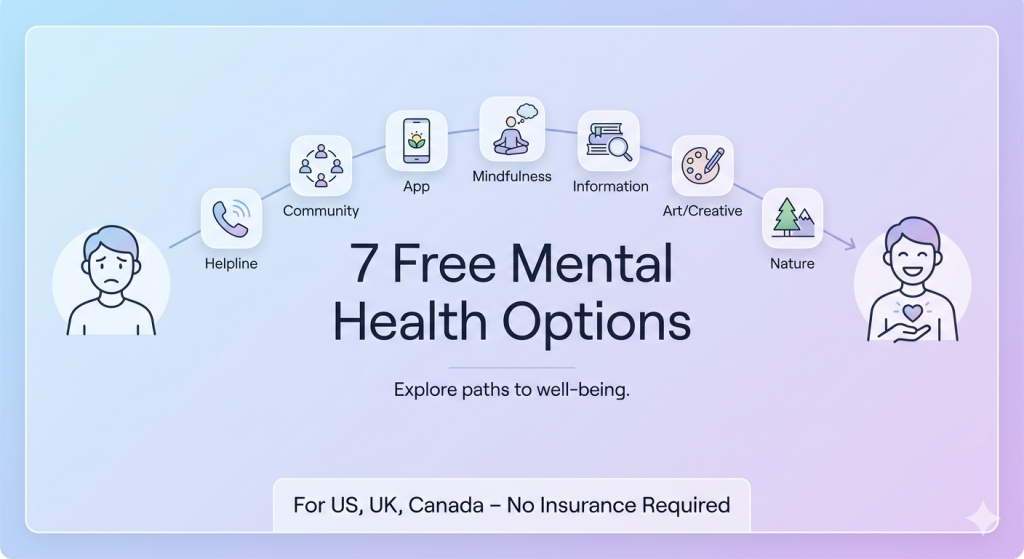
Option 1: Crisis Helplines (When You Need a Human Right Now)
Sometimes you just need to talk to someone. Right this minute.
US: 988 Suicide & Crisis Lifeline
In 2022, the United States made a massive shift. They designated 988 as the new, easy-to-remember crisis number .
Call or text 988. It’s free, confidential, and available 24/7. You’ll reach a trained counselor who knows how to listen. You don’t need to be in immediate danger to call—if you’re overwhelmed, anxious, or just need someone to hear you, they’re there .
UK: Samaritans (116 123)
The Samaritans have been listening to the UK for decades. Call 116 123 for free, 24 hours a day. Whether you’re desperate or just confused, they will listen without judging or telling you what to do.
Canada: Talk Suicide Canada (1-833-456-4566)
If you’re in Canada, 1-833-456-4566 connects you to trained responders across the country. For residents of specific regions like London or Middlesex, Reach Out at 519-433-2023 offers 24/7 bilingual support from local mental health professionals who know the services in your community .
Global: Find A Helpline
Traveling? Living abroad? Find A Helpline is a global directory covering over 130 countries . Just visit the website, select your country, and get connected to local support.
Option 2: Anonymous Online Communities (You’re Not Alone)
Sometimes talking to a professional feels too intimidating. Sometimes you just need to know other people feel the same way.
Togetherall (US, UK, Canada)
Togetherall is an anonymous online community where people support each other through tough times .
Here’s what makes it special:
- It’s professionally moderated—trained mental health professionals monitor the community to keep everyone safe
- You can join 24/7, 365 days a year
- It’s free for many people through employers, universities, or regional health programs
If you’re feeling isolated, anxious, or depressed, logging on and reading posts from people who get it can be profoundly healing .
LifeWorks Community
LifeWorks Community connects people across the US, UK, and Canada through peer support forums . You can post anonymously about relationships, anxiety, parenting, or whatever you’re carrying. Trained professionals monitor the space, but the support comes from real people like you .
Option 3: NHS-Funded Services (UK Only)
If you’re in the UK, the NHS provides mental health support that won’t cost you a penny.
well (For Adults 18+)
Qwell is an NHS-funded platform that offers free, anonymous mental health support for adults .
No waiting lists. No referrals needed. Just register online and access:
- Live text chat with trained counsellors (weekdays 12pm-10pm, weekends 6pm-10pm, even on Christmas Day)
- Peer support forums where adults share experiences
- Self-help activities, journaling tools, and articles written by professionals
It’s completely anonymous. No one—not your GP, not your family—needs to know you’re using it.
Silver Cloud (Digital CBT)
If you prefer working through things independently, SilverCloud offers free, self-guided programmes for stress, anxiety, sleep, resilience, and more .
It’s available to anyone in participating NHS regions (like Devon). You sign up, choose a programme, and work through cognitive behavioral therapy techniques at your own pace. Your data stays private—NHS staff can’t see who signed up .
Option 4: Free Apps for Your Phone
Your phone can be a source of stress (hello, doom-scrolling). But it can also be a tool for healing.
Finch (Free)
Finch takes a gentle approach to self-care. You care for a virtual pet that grows as you complete small wellness goals—breathing exercises, journaling, gratitude practices .
It sounds simple because it is. But sometimes having a cute creature depend on you is enough motivation to take care of yourself .
Headspace (Low-Cost)
Headspace isn’t completely free, but it’s affordable compared to therapy. For a low monthly subscription, you get hundreds of guided meditations, sleep sounds, and mindfulness exercises .
Many employers now offer Headspace for free—check with your HR department.
Option 5: Condition-Specific Support Organizations
Sometimes you need support from people who understand your specific struggle.
Emotions Matter (BPD Support)
Emotions Matter offers free peer support groups for adults living with borderline personality disorder (BPD) . They also provide educational videos, podcasts, and resources .
International OCD Foundation (IOCDF)
If you’re struggling with OCD, the IOCDF provides recovery resources, support groups, and a therapist directory that helps you find specialists .
National Alliance on Mental Illness (NAMI)
NAMI is one of America’s largest mental health organizations. Their website offers free support groups, helpline numbers, and educational resources . Even if you’re not in crisis, their resources can help you understand what you’re experiencing.
Option 6: Peer Support for Specific Communities
BeThere.org (Youth & Young Adults)
If you’re a young adult in Canada (or supporting one), BeThere.org offers 24/7 anonymous support . You can chat, text, or call—whatever feels safest .
Local Crisis Lines
Don’t underestimate local support. Many communities have their own helplines staffed by people who know local resources. In Ontario, Reach Out serves multiple regions with bilingual, professional support . A quick Google search for “[your city] mental health helpline” can uncover hidden gems.
Option 7: Online Educational Resources
Sometimes information is the first step toward healing.
Psych Central
Psych Central offers expert-reviewed articles, quizzes, and self-help tools . It’s like having a mental health library at your fingertips—completely free.
SAMHSA (US Government Resource)
The Substance Abuse and Mental Health Services Administration (SAMHSA) is a US government agency that provides free resources, connects people to treatment programs, and funds community services nationwide . Their helpline: 1-800-662-4357.
How to Choose What’s Right for You
With so many options, it’s easy to feel overwhelmed. Here’s a simple way to decide:
| If you need… | Try this… |
|---|---|
| Someone to talk to right now | 988 (US), 116 123 (UK), 1-833-456-4566 (Canada) |
| Ongoing support without cost | Qwell (UK), Togetherall (US/UK/Canada) |
| To work through things alone | SilverCloud (UK), Finch app |
| Connection with people who understand | Emotions Matter, IOCDF, peer forums |
| Information and education | Psych Central, NAMI, SAMHSA |
A Gentle Reminder
Here’s what I want you to take away from this:
You are not alone.
The numbers prove it. Millions of adults across the US, UK, and Canada are struggling with the same feelings you’re carrying. And millions have found help through these very services.
The hardest step is the first one—admitting you need support and reaching out. But once you do, you’ll find that the world of mental health support is wider, more accessible, and more compassionate than you ever imagined.
Take the Next Step: Support Your Whole Health
Mental health doesn’t exist in a vacuum. It’s connected to how we sleep, how we move, how we eat, and how we manage stress.
As you work on your mental well-being, don’t forget to check in with your physical health too. Small changes in nutrition and activity can have profound effects on your mood and resilience.
👉 Use Our Free Weight Loss & Fitness Calculator
This simple tool helps you understand your body’s needs without complicated math. It calculates your daily calorie needs based on your unique stats using the scientific Mifflin-St Jeor equation. It’s completely free, and it helps you align your physical health with your mental health journey.
Frequently Asked Questions Are these services really free?
Yes. Every service listed in this guide is completely free to access. Some (like Headspace) offer free versions with optional paid upgrades, but the core support options listed are no-cost.
Do I need insurance or a doctor’s referral?
No. Most of these services are self-referral. You can access them directly without involving your GP or insurance company.
What if I don’t feel “sick enough” to call a helpline?
Helplines are for everyone. You don’t need to be in crisis. If you’re struggling, overwhelmed, or just need someone to listen, you are welcome to call.
Is online support as effective as in-person therapy?
Research shows that online support—whether through text chat, forums, or self-guided programmes—can be highly effective, especially for mild to moderate anxiety and depression. For some people, the anonymity makes it easier to open up.
What if I try a service and don’t like it?
That’s okay. Not every service fits every person. Try another. The right support is out there—sometimes it just takes a few tries to find it.
Conclusion: Help Is Here
If you take nothing else from this guide, remember this:
You deserve support. Help exists. And it doesn’t have to cost a thing.
Whether you’re in a bustling city in the US, a quiet town in the UK, or somewhere in between in Canada, free mental health support is waiting for you. Crisis lines, online communities, NHS services, peer support groups—they’re all there, staffed by people who chose this work because they want to help.
Bookmark this page. Share it with a friend who might need it. And when you’re ready, take that first small step.
You’ve already done the hardest part: you started looking.
Movement & Physical Health
- Daily 15-Minute Walk: A short walk outside can reduce stress, boost endorphins, and improve focus.
- Movement “Snacks”: Engage in small, simple movements throughout the day. You can stretch or dance in your kitchen. These actions help release muscle tension.
- Hydration: Drink enough water throughout the day, as dehydration can affect focus
Morning & Mindset
- Start with Gratitude: Before checking your phone, name three things you are grateful for. This practice trains your brain to notice the good.
- Delay Screen Time: Avoid checking your phone or social media for the first 30–60 minutes. This helps prevent instantly switching your brain into “react” mode.
- Positive Self-Talk: Rephrase negative thoughts by talking to yourself as you would to a
Let’s be honest for a moment. If you’re reading this, chances are you or someone you love has been struggling. Maybe sleep feels impossible. Maybe the weight of everyday life has gotten heavier. Maybe you look fine on the outside but inside, things feel… off. And on top of all that, there’s the financial stress—therapy can cost $100–$200 per session in the US, £40–£80 in the UK, and $200+ in Canada. When money is tight, mental health support often feels like a luxury you can’t afford. But here’s the truth they don’t tell you: there is a whole world of free and affordable support out there, hiding in plain sight. This guide is for real people living in the US, UK, and Canada who need help but don’t have hundreds of dollars to spend. No judgment. No complicated jargon. Just real options that work.
Support Your Whole Health: Helpful Tools & Resources
Mental health doesn’t exist in a vacuum. It’s deeply connected to how we sleep, how we move, how we eat, and how we manage stress. The resources below are designed to support your overall well-being—because when you feel better physically, your mind often follows.
Free Calculators to Understand Your Body
👉 Use Our Free Calorie Calculator
This simple tool uses the scientific Mifflin-St Jeor equation to estimate your Basal Metabolic Rate (BMR) and Total Daily Energy Expenditure (TDEE). Knowing these numbers helps you fuel your body properly—because stable blood sugar means a more stable mood.
👉 Use Our Free Weight Loss & Fitness Calculator
This gives you a fuller picture—BMI, BMR, TDEE, daily target, and estimated timeline to your goals. It’s a gentle way to check in with your physical health while you focus on your mental well-being.
👉 Use Our Free Fitness Unit Converter
If you’re starting a movement practice to support your mental health, this tool instantly converts weight, height, distance, and pace—perfect for following workouts or recipes from different countries.
Products Some People Find Helpful (Optional)
These are not treatments for mental health conditions. They are wellness tools that some adults use to support sleep, cognitive function, and overall vitality—things that can indirectly support your mental well-being.
For Cognitive Clarity & Focus
Advanced Memory Formula
Stress and anxiety can leave you feeling foggy and forgetful. This supplement is designed to support memory, focus, and mental clarity with ingredients backed by research. Some people find that when their brain feels sharper, they cope better with daily stressors.
👉 Check out Advanced Memory Formula here
Neuro Prime
Similar to the formula above, Neuro Prime targets cognitive performance and mental energy. If you’re struggling with brain fog or difficulty concentrating, this might be worth exploring.
For Restorative Sleep
Pineal Guardian
Sleep and mental health are deeply connected. When you don’t sleep well, your mood suffers, your anxiety spikes, and your resilience drops. Pineal Guardian is formulated to support deeper, more restorative sleep—so you wake up feeling genuinely rested.
👉 Check out Pineal Guardian here
Sumatra Slim Belly Tonic
This product takes a unique approach by focusing on the connection between sleep quality and weight management. Better sleep supports better mood, and better mood supports better choices. It’s all connected.
👉 Check out Sumatra Slim Belly Tonic here
For Metabolic & Energy Support
GlucoTonic
Blood sugar swings can cause mood swings, irritability, and anxiety. GlucoTonic combines natural ingredients traditionally used to support healthy blood sugar balance and sustained energy—helping you feel more stable throughout the day.
For Joint & Mobility Support
Advanced Joint Support
Physical discomfort can wear down your mental resilience. If you’re dealing with creaky knees or achy joints, this supplement supports mobility and comfort—making it easier to stay active and engaged.
👉 Check out Advanced Joint Support here
For Nerve Comfort
Nerve Fresh
Chronic nerve discomfort (tingling, numbness, or pain) can be mentally exhausting. Nerve Fresh is designed to support nerve health and comfort, helping you feel more at ease in your body.
For Weight Management Support
Patriot Slim Short
If weight has been a source of stress or frustration, this product offers gentle support for your body’s natural fat-burning processes. It’s not a magic pill—just a little extra help for those who want it.
👉 Check out Patriot Slim Short here
For Overall Wellness
Moringa
Sometimes called the “miracle tree,” moringa is a nutrient-dense plant packed with antioxidants, vitamins, and minerals. It’s a simple, natural way to support your body’s overall health.
A Gentle Reminder
You are not alone. Millions of adults across the US, UK, and Canada are navigating the same feelings you’re carrying. The free resources listed in this article are there for you—right now, tonight, whenever you need them.
The products above are completely optional. They are not replacements for therapy, medication, or professional support. But if you’re looking for small, natural ways to support your body while you heal your mind, they might be worth exploring.
The hardest step is the first one—admitting you need support and reaching out. You’ve already done that by reading this far. That takes courage.
Be kind to yourself. You’re doing the best you can. And that’s enough.
This article contains affiliate links. If you purchase through these links, I may earn a commission at no extra cost to you. I only recommend products I genuinely believe in. This content is for informational purposes only and is not medical advice. Always consult your healthcare provider before starting any new supplement.
FAQ
1: What are free mental health resources for adults?
Free mental health resources for adults include community mental health clinics, peer support groups, and crisis helplines. Nonprofit organizations and online mental health screenings are also available. Many local clinics offer sliding-scale or no-cost services based on income. Support groups and crisis lines are often available 24/7 at no charge.
2: Can adults get therapy without insurance?
Yes, adults can get therapy without insurance. Many therapists offer sliding-scale fees based on income, and community clinics offer low-cost or free counseling. Online therapy platforms also offer financial aid or discounted plans for those who qualify.
3: How can I improve my mental health without therapy?
You can improve your mental health without therapy by building daily routines. Practice journeying regularly. Get regular physical activity to help your mind and body. Improve your sleep habits consistently. Connect with supportive people in your life. Free support groups and self-help resources can also offer guidance and emotional support.
🧘♀️ YOGA & WELLNESS PLANNER
10 pages bundle · daily rituals · mindful tracker · printable
Morning Yoga Flow
Evening Wind-Down
Daily Intention Setter
Hydration & Habit Tracker
Gratitude Log
Pose Library (10 asanas)
Weekly Wellness Schedule
Mindful Eating Check-in
Sleep & Energy Tracker
Monthly Reflection + Goals