
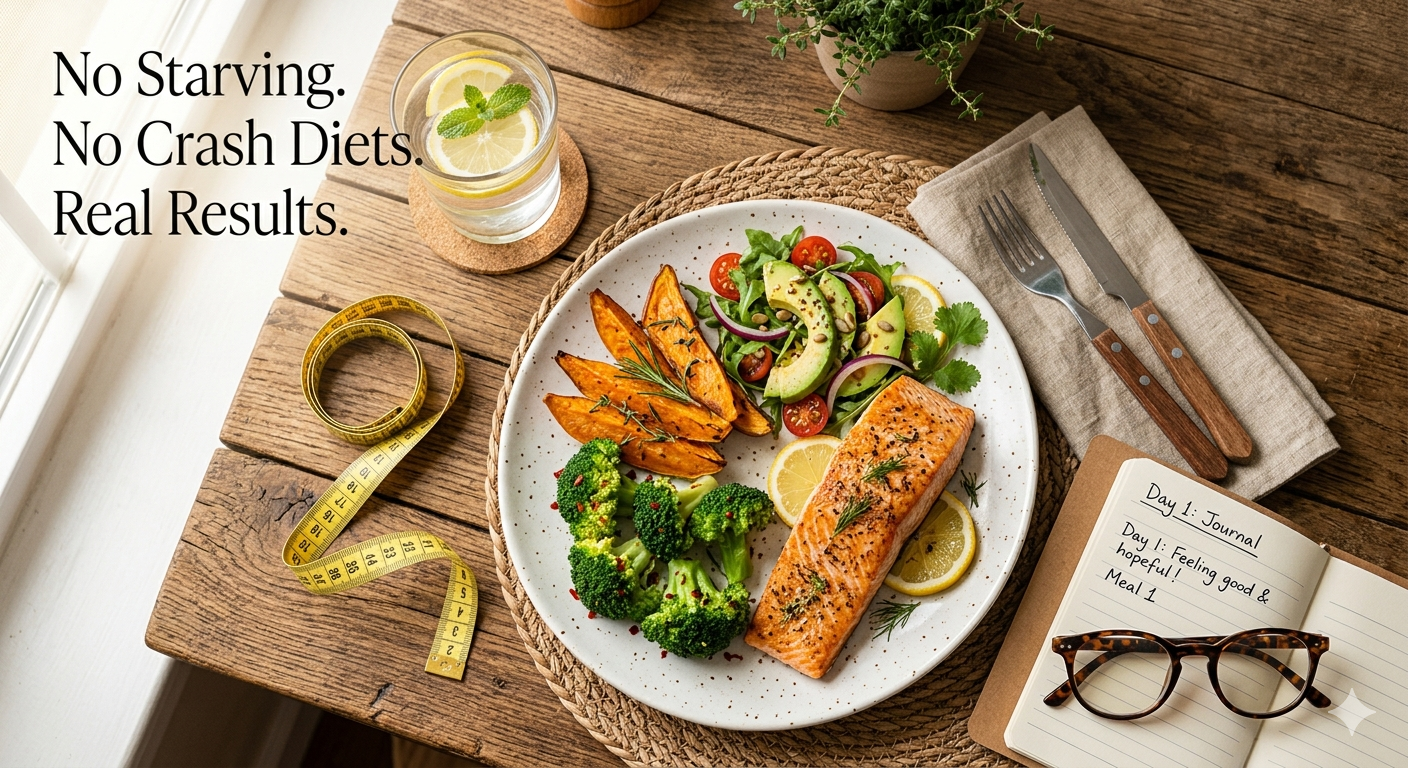
A healthy weight loss diet plan that actually works. No crash diets, no starvation. Learn what to eat, portion control, and track your progress with free tools.
Tired of diets that fail? Discover a Healthy Weight Loss Diet Plan for Real Results (No Crash Diets! designed for real, lasting results. Learn how to eat well, boost metabolism, and lose weight without starvation. Follow our Healthy Weight Loss Diet Plan for Real Results (No Crash Diets!).
We live in a world of “quick fixes.” There is always a new detox tea, a magic pill, or a challenge promising you will lose 10 pounds in 3 days.
The problem? They don’t last.
If you want real results, you need a plan that works with your body, not against it. You need a Healthy Weight Loss Diet Plan for Real Results (No Crash Diets!) that is sustainable, satisfying, and actually enjoyable.
This guide is not about starving yourself. It is about fueling your body correctly so the weight comes off naturally and stays off forever.
⚠️ Starting your fitness journey? Avoid these 5 beginner mistakes to avoid when starting a home workout – common errors that sabotage progress.
Why Most Diets Fail (And How This Plan is Different)
Before we dive into the food, let’s look at the science. Most diets fail for two reasons:
- They are too restrictive. You cut out entire food groups, feel deprived, and eventually binge.
- They cut too many calories. When you eat too little, your body goes into “starvation mode.” It holds onto fat and burns muscle instead.
A healthy weight loss diet plan for real results flips the script. It focuses on:
- Eating enough to keep your metabolism firing.
- Eating whole foods that keep you full.
- Building habits you can keep for life.
The Golden Rules of Lasting Weight Loss
To get real results, follow these three non-negotiable rules:
1. Protein at Every Meal
Protein is the king of nutrients for weight loss. It takes more energy to digest, and it keeps you feeling full for hours.
- Action: Ensure every meal has a protein source (eggs, chicken, tofu, fish, beans, Greek yogurt).
2. Fiber is Your Best Friend
Fiber bulks up your meals and slows down digestion. It stabilizes blood sugar, which stops cravings.
- Action: Eat vegetables, fruits, beans, and whole grains at every meal.
3. Drink Water First
Thirst is often mistaken for hunger. Sometimes when you think you are hungry, you are actually just dehydrated.
- Action: Drink a glass of water 20 minutes before every meal
How to Customize This Plan for “Real Results”
A diet plan is just a template. To make it work for you, you need to customize it.
Listen to Your Hunger
Don’t eat just because the clock says 12:00 PM. If you aren’t hungry at lunch, wait an hour. If you are starving at 4:00 PM, have a snack. This plan is a guide, not a prison sentence.
The 80/20 Rule
To get real results, you don’t need to be perfect 100% of the time. Aim to eat healthy foods 80% of the time, and leave 20% for flexibility. This prevents the “all-or-nothing” mindset that leads to quite
I’ve been on every diet you can imagine.
The cabbage soup diet. The baby food diet. The “eat nothing but grapefruit” diet. The low-fat, no-fat, fat-is-the-enemy diet. The keto diet where I ate so much cheese I thought I might turn into a dairy product myself.
Each one worked for about two weeks. Then I’d crack, eat everything in sight, feel guilty, and start again. It was a miserable cycle that left me heavier and more confused than when I started.
Here’s what took me thirty years to learn: diets don’t work. Not because you’re weak, but because they’re designed to fail.
They ask you to ignore hunger. To cut out entire food groups. To eat food that doesn’t taste good while the rest of the world eats normally. That’s not a plan. That’s a setup.
The plan I’m going to share with you isn’t a diet. It’s just… eating. Real food, in reasonable amounts, most of the time. It’s how my grandmother ate. It’s how people ate before the diet industry convinced us we needed rules and restrictions and “cheat days.”
And here’s the thing: it works. Slowly, steadily, without drama. The weight comes off and stays off because you’re not fighting your body—you’re finally working with it.
First, Let’s Talk About What “Diet” Actually Means
The word “diet” has been ruined. These days it means “a temporary period of suffering in exchange for weight loss.”
But the original meaning is just “the food you habitually eat.” That’s it.
So this isn’t about going on a diet. It’s about changing your diet—permanently, but gently. Shifting what you eat toward things that nourish you, without ever feeling deprived.
If you’re thinking “but I love food too much to give things up,” good. Me too. This plan isn’t about giving up. It’s about adding. Adding more vegetables, more protein, more fiber, more water. When you add enough good stuff, the not-so-good stuff naturally takes up less space.
The Four Pillars of Real Weight Loss
Every crash diet tries to sell you on one magic trick. Cut carbs. Cut fat. Eat only at certain times. Drink vinegar. Whatever.
Real weight loss isn’t magic. It’s four simple things, working together.
Protein keeps you full. When you eat enough protein, your brain gets the signal that you’re satisfied. You stop thinking about food. Cravings fade. Eggs, chicken, fish, beans, lentils, tofu, Greek yogurt—these are your new best friends.
Fiber fills you up. It bulks out your meals, slows digestion, and feeds your gut bacteria. Vegetables, fruits, whole grains, beans, nuts, seeds. The more fiber, the fuller you feel.
Water matters more than you think. Half the time you think you’re hungry, you’re actually thirsty. Your body’s signals get crossed. Drink a glass of water before every meal and anytime you feel a craving coming on.
Portions still count. Even healthy food has calories. You can gain weight eating too much quinoa and avocado. But portion control doesn’t mean measuring everything—it means paying attention. Eating slowly. Stopping when you’re satisfied, not stuffed.
That’s it. That’s the whole plan. Everything else is just details.
🍽️ Fuel your weight loss right: Get more beginner-friendly nutrition tips for home fitness to support your goals.
What a Real Day of Eating Looks Like
Let me walk you through a normal day. Not a perfect day. Not a “I followed every rule” day. Just a regular Tuesday where someone’s trying to eat well.
Morning
You wake up. You’re hungry. You make yourself a couple of eggs—scrambled, fried, whatever you have time for. You put them on a slice of whole grain toast. Maybe you have a handful of berries on the side, maybe you don’t.
You drink a glass of water with your coffee.
That’s breakfast. Protein, carbs, a little fat. You’re full. You won’t think about food again until lunch.
Midday
Lunch rolls around. You’re busy, because you’re always busy. You have leftovers from last night’s dinner—some kind of chicken and vegetable situation with a little rice. You heat it up. You eat it. You’re satisfied.
If you didn’t have leftovers, you make a quick salad with a can of tuna or some chickpeas, whatever vegetables are in the fridge, and a simple dressing of olive oil and lemon.
Afternoon
It’s 3 p.m. You’re a little tired. You want something. Instead of reaching for the biscuits, you have an apple with a handful of almonds. Or a small yogurt. Or some carrot sticks with hummus.
You drink another glass of water.
The craving passes. You get on with your day.
Evening
Dinner is whatever you’re making for the family. Maybe pasta with a tomato and vegetable sauce, with a little bit of cheese grated on top. You have a reasonable portion—about the size of your fist—and a big side salad to fill out the plate.
You eat slowly. You actually taste it. You stop when you’re full.
Later
Maybe you want something after dinner. A square of dark chocolate. A small bowl of berries. A cup of herbal tea. You have it. You enjoy it. You don’t spiral into guilt.
That’s a day. Real food, reasonable portions, no suffering.
The Foods That Actually Help You Lose Weight
Some foods make weight loss easier because they fill you up for fewer calories. Here are the all-stars.
Vegetables: All of them. Particularly the non-starchy ones—leafy greens, broccoli, cauliflower, peppers, courgette, mushrooms, tomatoes, cucumber. Eat as many as you want. They’re mostly water and fiber.
Protein: Eggs, chicken breast, turkey, fish, tofu, tempeh, lentils, chickpeas, black beans, kidney beans, Greek yogurt, cottage cheese, edamame.
Fruit: Berries are particularly good—lots of fiber, lots of flavor, not too much sugar. Apples, pears, oranges, and grapefruit are also great. Bananas and grapes are fine too, just be mindful of portions.
Complex carbs: Oats, quinoa, brown rice, whole wheat bread, sweet potatoes, regular potatoes (with the skin on), whole wheat pasta.
Healthy fats: Avocado, olive oil, nuts, seeds, nut butters.
Dairy: Milk, yogurt, cheese—in moderation. Full-fat is often more satisfying than low-fat, which can have added sugar.
Herbs and spices: Use them freely. They make food taste good without adding calories.
🌅 Start your day strong: Discover what to eat for breakfast to feel your best and stay full until lunch.
The Foods That Are Tricky
I’m not going to tell you to never eat these. That’s how binges start. But knowing which foods work against you helps you make conscious choices.
Sugary drinks: Sodas, fruit juices, sweetened coffees, energy drinks. Liquid sugar doesn’t fill you up, but it adds calories fast. Water, tea, coffee (with a little milk if you want) are better choices.
White carbs: White bread, white pasta, white rice, most breakfast cereals. They’re not evil, but they’re less filling than their whole grain cousins. Have them sometimes, but don’t make them the base of every meal.
Ultra-processed foods: Packaged snacks, biscuits, crisps, frozen meals with long ingredient lists, most “diet” products. They’re designed to be irresistible and not filling. Eat them occasionally, but don’t keep them in the house if you struggle with portion control.
Fried foods: Chips, fried chicken, anything deep-fried. Delicious, but calorie-dense and not very filling. Treats, not staples.
Added sugar: In all its forms. You don’t need to cut it out completely, but being aware of how much is hiding in things like sauces, yogurts, and bread helps.
The Portion Control Trick That Changed Everything
I used to think portion control meant weighing everything and eating off tiny plates. Then someone showed me this, and it changed everything.
Use your hands. They’re always with you, and they’re proportional to your body.
- Protein: A serving is about the size of your palm.
- Vegetables: A serving is two hands cupped together.
- Carbs: A serving is about the size of your cupped hand.
- Fats: A serving is about the size of your thumb.
At each meal, aim for one palm of protein, two handfuls of vegetables, one cupped hand of carbs, and one thumb of fat.
It’s not precise, but it doesn’t need to be. It just gives you a rough guide so you’re not guessing.
The Hunger Scale: Learning to Stop
Most of us eat on autopilot. We clear our plates because that’s what we were taught. We eat until the food is gone, not until we’re full.
The hunger scale helps you reconnect with your body.
1-2: Ravenous, dizzy, can’t think straight. You’ve waited too long to eat.
3-4: Hungry, ready to eat, stomach growling.
5: Neutral, not hungry but not full.
6-7: Satisfied, comfortable, could eat more but don’t need to.
8-9: Full, a bit uncomfortable.
10: Stuffed, miserable, need to loosen your trousers.
The goal is to eat when you’re at 3 or 4, and stop when you’re at 6 or 7. Not stuffed, just satisfied.
This takes practice. You’ll get it wrong sometimes. That’s okay. Just keep checking in.
What About Cravings?
Cravings are normal. They’re not a sign of weakness.
When a craving hits, pause. Ask yourself:
- When did I last eat a proper meal? If it’s been more than four or five hours, you might actually be hungry. Eat something real.
- Have I had enough water today? Thirst masks as hunger. Drink a glass and wait ten minutes.
- Am I stressed, bored, tired, or lonely? Sometimes we want food because we want comfort. If that’s the case, food won’t fix it. A walk, a call to a friend, a hot bath, or just sitting with the feeling might help more.
And sometimes? Sometimes you just want the thing. Have the thing. A reasonable portion, mindfully enjoyed, is not a disaster. It’s just food.
The problem isn’t having treats. The problem is feeling guilty about them and then binge-eating because you’ve already “ruined” the day.
One biscuit doesn’t ruin anything. One meal doesn’t ruin anything. What ruins progress is the guilt spiral that follows.
A Seven-Day Sample Menu
Here’s a week of meals to get you started. Mix and match, repeat your favourites, don’t stress about following it exactly.
Monday
- Breakfast: Greek yogurt with berries and a tablespoon of chopped nuts
- Lunch: Lentil soup with a slice of whole grain bread
- Dinner: Baked chicken breast with roasted vegetables and a small sweet potato
- Snack: An apple
Tuesday
- Breakfast: Scrambled eggs on whole grain toast
- Lunch: Leftover chicken and vegetables from last night
- Dinner: Salmon with quinoa and steamed broccoli
- Snack: A small handful of almonds
Wednesday
- Breakfast: Overnight oats with milk, berries, and a spoonful of peanut butter
- Lunch: Chickpea and tuna salad (mix a can of tuna with a can of chickpeas, add chopped cucumber and tomato, dress with olive oil and lemon)
- Dinner: Vegetable and tofu stir-fry with brown rice
- Snack: A pear
Thursday
- Breakfast: Smoothie with spinach, banana, protein powder, and milk
- Lunch: Leftover stir-fry
- Dinner: Turkey or bean chilli with a little rice and a dollop of yogurt
- Snack: Carrot sticks with hummus
Friday
- Breakfast: Porridge made with milk, topped with banana and seeds
- Lunch: Leftover chilli
- Dinner: Homemade pizza on a whole grain base, loaded with vegetables, with a side salad
- Snack: A small pot of yogurt
Saturday
- Breakfast: Poached eggs on avocado toast
- Lunch: Big salad with mixed greens, chicken or chickpeas, vegetables, and feta
- Dinner: Roast chicken or nut roast with roasted vegetables and one small roast potato
- Snack: A handful of grapes
Sunday
- Breakfast: Pancakes made with oats, banana, and eggs, topped with yogurt and berries
- Lunch: Leftovers from last night
- Dinner: Vegetable soup with a cheese toastie on whole grain bread
- Snack: A square of dark chocolate
The Truth About Exercise
This is a food plan, not an exercise plan. But movement helps.
Not because you’ll burn massive calories—you won’t. A 30-minute walk burns about 100-150 calories, which is basically an apple. But movement helps regulate appetite, improves mood, reduces stress, and makes you more likely to make good food choices.
Find movement you actually enjoy. Walking, swimming, cycling, dancing in your kitchen, yoga, gardening. It doesn’t have to be a workout. It just has to be something that gets you moving.
Tracking Progress Without Obsessing
How do you know if this is working?
The scale is one measure, but it’s a liar. It can’t tell the difference between fat, muscle, water, and the food in your digestive system. It fluctuates wildly day to day for reasons that have nothing to do with your actual progress.
Better measures:
- How do your clothes fit?
- How’s your energy?
- How’s your mood?
- Are you sleeping better?
- Do you feel less controlled by food?
- How do you feel in your body?
Take photos once a month. Measurements once a month. And use the scale if you must, but only once a week, first thing in the morning, and don’t panic about normal fluctuations.
A Tool to Help You Find Your Numbers
Everyone’s body is different. Your age, height, weight, and activity level all affect how much you need to eat.
If you’re curious about what your specific numbers look like—how many calories for maintenance, for weight loss, for weight gain—a calculator can help take the guesswork out.
👉 Use Our Free Calorie Calculator
This simple tool uses the scientific Mifflin-St Jeor equation to estimate your Basal Metabolic Rate (BMR) and Total Daily Energy Expenditure (TDEE). In seconds, you’ll see estimates for maintenance, weight loss, and weight gain calories.
It’s not about restriction. It’s about understanding what your body needs.
And for Converting Recipes
If you’re following recipes from different countries—a US blog with cups and ounces, a UK site with grams, a Canadian cookbook with a mix—sometimes you need a little help.
👉 Use Our Free Fitness Unit Converter
This handy tool instantly converts weight, height, distance, and pace. Bookmark it for your next cooking session—it’ll save you the mental math.
💪 Staying on track? Learn how to stay consistent with home workouts – even on your busiest days.
A Gentle Reminder
Here’s what I want you to take away from all this.
Weight loss isn’t about punishment. It’s not about eating as little as possible or cutting out everything you love. It’s about building meals that actually nourish you, that keep you full and satisfied, that make you feel good instead of deprived.
The people who maintain healthy weights for decades don’t have superhuman willpower. They’ve just built habits that work. They eat real food, in reasonable portions, most of the time. They enjoy treats without guilt. They listen to their bodies.
You can do this too.
Start with one meal. Make it protein, vegetables, a little complex carb, a little healthy fat. See how you feel. Then do it again.
Your body will thank you. And you might just find that eating for weight loss doesn’t have to feel like a punishment.
You don’t need to be perfect. You just need to be consistent.
Start by drinking more water today. Add a vegetable to your dinner tonight.
Small steps lead to big changes.
Are you ready to start your journey? Pin this plan so you have it handy all week!