
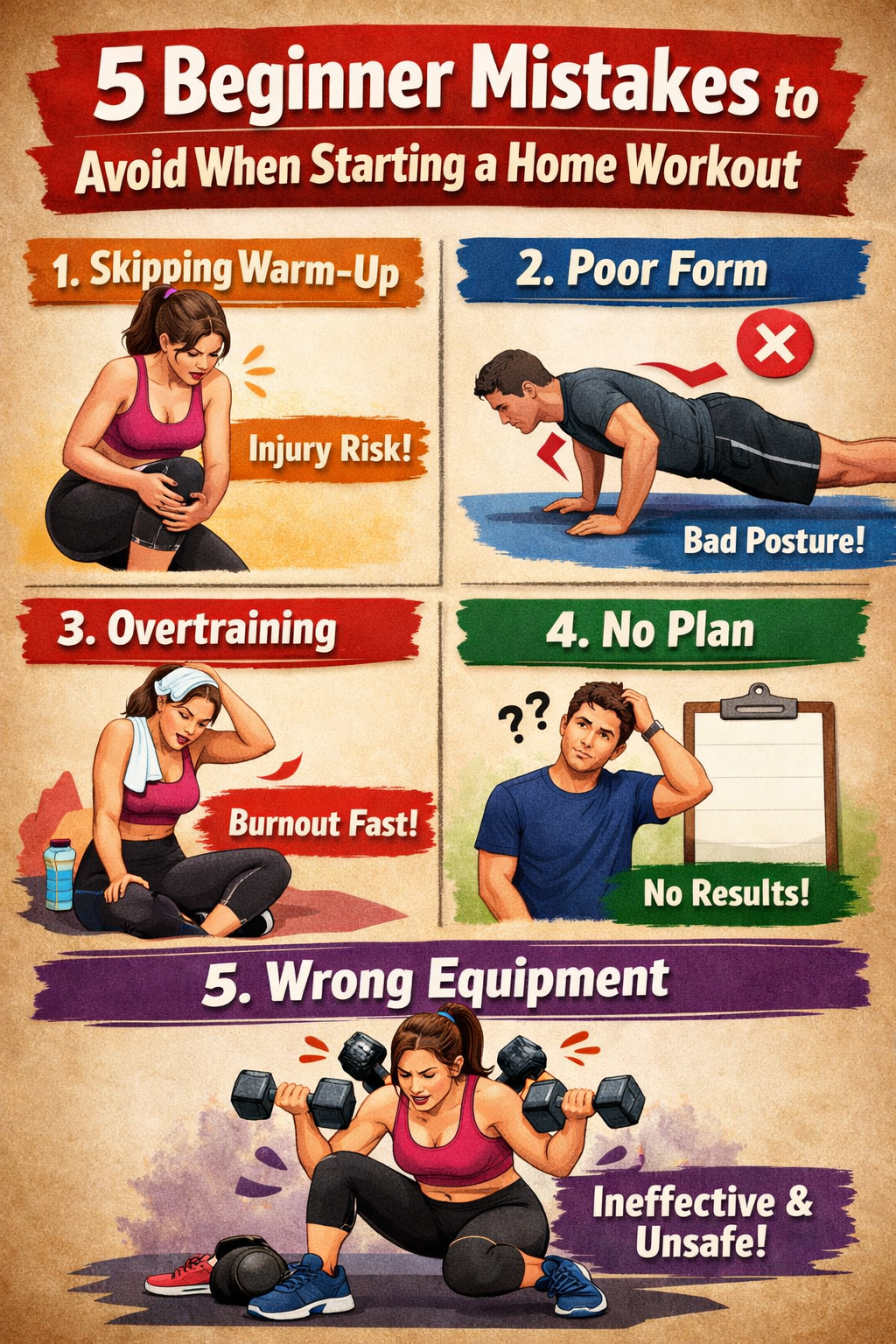
Starting a home workout but not seeing results? You might be making these common beginner mistakes. Here’s how to fix them and start making real progress today.
👉 Download and start your fitness journey to
Let me tell you about my first month of home workouts.
I was so motivated. I cleared a space in my living room, found a YouTube video with millions of views, and went for it. By day three, my knees hurt. By week two, I’d lost motivation. By week three, my workout mat was back in the closet, gathering dust.
Sound familiar?
Here’s the thing: home workouts are brilliant. They’re convenient, free, and can be incredibly effective. But when you’re starting out without a trainer or gym buddies to guide you, it’s incredibly easy to make mistakes that sabotage your progress—or worse, leave you injured .
The good news? Every single one of these mistakes is fixable. I’ve made them all, learned the hard way, and now I’m going to save you the trouble.
Before we dive in, here’s a quick tool to help you understand your body’s needs. Your workout results depend heavily on fueling properly:
👉 Use Our Free Calorie Calculator
This simple tool uses the scientific Mifflin-St Jeor equation to estimate your Basal Metabolic Rate (BMR) and Total Daily Energy Expenditure (TDEE). Knowing these numbers helps you eat enough to fuel your workouts without overdoing it.
Now, let’s fix those mistakes.
Mistake 1: Skipping Your Warm-Up (and Cool-Down)
I get it. You’re short on time. You figure it’s better to jump straight into the workout than to “waste” five minutes on warming up.
Here’s what actually happens when you skip your warm-up: your body performs worse, and you dramatically increase your injury risk . A proper warm-up dilates blood vessels, ensuring your muscles receive optimal oxygen while raising their temperature for better flexibility . Studies show warm-ups can boost athletic performance by up to 20% .
Think of your muscles like rubber bands. When they’re cold after a day of sitting, they’re stiff and prone to snapping if suddenly forced into intense exercise . A warm-up gradually elevates your heart rate, minimizing cardiovascular stress during exertion .
The Fix: 5-10 Minutes of Dynamic Movement
Before any workout, spend 5-10 minutes on dynamic stretches—movements that mimic what you’ll be doing. Good options include :
- Alternating lunges
- Arm circles
- High knees
- Hip circles
Save the static stretching (holding a stretch) for after your workout when your muscles are warm . Cooling down properly reduces soreness and helps you recover faster for your next session .
If you’re looking for extra support with recovery, some people find targeted supplements helpful. Better recovery means better results.
This product supports joint health and mobility, making those warm-ups and cool-downs even more effective.
Mistake 2: Using Terrible Form (and Not Knowing It)
Without a mirror or a trainer, how do you know if you’re doing the exercises correctly? Here’s the hard truth: you probably don’t.
Common form mistakes include :
- Squats: Letting knees cave inward, rounding your back, or letting knees travel too far past your toes
- Planks: Letting your hips sag (puts pressure on lower back) or piking them too high
- Push-ups: Flaring elbows out to the sides instead of keeping them at 45 degrees
- Lunges: Letting your front knee travel too far forward or your back knee hit the ground
Poor form doesn’t just mean you’re not working the right muscles—it’s a direct path to injury . You’re essentially building your fitness on a shaky foundation.
The Fix: Use Mirrors or Your Phone Camera
Strategically placed mirrors give instant feedback on your body position that internal awareness sometimes misses . For home setups, tempered glass mirrors provide the most accurate reflection .
Even better: use your phone. Set it on a small tripod at waist height, positioned at a 3/4 angle to capture your entire body . This perspective shows more than directly front or side views alone .
When reviewing footage, look for specific technical elements rather than general appearance—are your knees tracking over toes? Is your back staying neutral?
Taking the time to film and review one set per workout can transform your technique. Good form means better results and fewer injuries.
Mistake 3: Doing Too Much, Too Fast
You’re excited. You want results yesterday. So you do two workouts a day, follow twelve different trainers on Instagram, and push through pain because “no pain, no gain,” right?
Wrong. This is a classic beginner trap .
When you pile on heavier weights, extra sets, harder exercises, and more workout days all at once, you’re setting yourself up for burnout and injury . The internet is saturated with workout content, and many beginners become overwhelmed and start overtraining .
The Fix: Follow the Progressive Overload Principle
Your muscles grow stronger through small, consistent challenges, not massive overnight changes . This is called progressive overload, and it works anywhere with anything .
Here’s how to do it at home with no fancy equipment :
- Add more reps: Those 10 bodyweight squats feeling easy? Push for 12, then 15 next week
- Slow down the movement: Take 3-4 seconds lowering into each push-up instead of dropping fast
- Level up your moves: Start with knee push-ups, graduate to standard ones, then elevate your feet on a couch
- Get creative with household items: A backpack loaded with books makes great weights; water jugs work as dumbbells
- Cut rest time: Shorter rest periods amp up the burn without adding weight
The magic happens when you track everything. Log your reps, note your modifications, celebrate those small wins .
For an extra edge in your fitness journey, some people find that targeted support helps manage cravings and energy levels.
👉 Check out Patriot Slim Short here
It’s designed for people who want to nudge the scale in the right direction while building consistent workout habits.
Mistake 4: Never Taking Rest Days
Here’s a truth that surprises most beginners: skipping rest days won’t make you stronger faster—it’ll actually slow you down .
When you train without proper recovery, you risk developing overtraining syndrome. Warning signs include :
- Unusual tiredness even after good sleep
- Struggling through workouts that used to feel manageable
- Muscle soreness that just won’t quit
- Irritability, trouble focusing, or losing motivation
What happens inside your body when you don’t rest? Your hormones—including testosterone, cortisol, and thyroid hormones—can get thrown completely out of balance . This messes with everything from your metabolism to your sleep quality and immune system .
The real kicker? While taking a day off might feel like losing progress, severe overtraining can sideline you for weeks or months .
The Fix: Schedule 48 Hours Between Similar Workouts
Take 24 to 48 hours between workouts of a similar nature to rest and recover . This doesn’t mean sitting on the couch for two days—gentle walking, stretching, and mobility work are great active recovery options.
Recovery is when your body actually builds muscle. The workout just breaks things down; rest builds them back stronger.
Sleep quality dramatically impacts your recovery. If you struggle with sleep, optimizing your evening routine can make a huge difference.
👉 Check out Sumatra Slim Belly Tonic here
This product takes a unique approach by focusing on the connection between sleep quality and weight management—perfect for supporting those rest days.
Mistake 5: Having No Plan or Routine
Walking into your living room and thinking “I’ll just do some exercises” is a recipe for inconsistency . Without a structured plan, you’ll skip workouts, lose motivation, and wonder why you’re not seeing results .
Many beginners don’t stick to their workouts because being home all the time challenges time management skills. We put off workouts or just lack motivation .
The Fix: Create a Simple Weekly Schedule
Here’s your game plan :
- Get a journal and calendar – Write down your goals in a journal to hold yourself accountable
- Create a weekly schedule – Block out specific times for workouts (e.g., Monday, Wednesday, Friday at 9 AM)
- Aim for 3-4 workouts per week – This is sustainable and effective
- Build in compound movements – Exercises that work multiple muscle groups give you more bang for your buck
Sticking to a well-structured plan is key to achieving your goals . When you have a routine written down, you’re far less likely to skip it.
To track your progress and stay motivated, use this tool to see the bigger picture of your health journey:
👉 Use Our Free Weight Loss & Fitness Calculator
This gives you a fuller picture—BMI, BMR, TDEE, daily target, and estimated timeline to your goal. Seeing your progress in numbers can keep you motivated when motivation flags.
Bonus: What About Nutrition?
Workouts are only half the equation. What you put in your body determines whether you’ll see results from all that hard work.
If you’re looking for support with blood sugar balance and metabolic health—which directly impacts how your body uses fuel during workouts—some people find targeted supplements helpful.
It combines natural ingredients traditionally used to support healthy blood sugar balance and sustained energy.
And if you’re following workout plans or recipes from different countries, this handy tool saves mental math:
👉 Use Our Free Fitness Unit Converter
It instantly converts weight, height, distance, and pace.
Your Action Plan for Success
Let’s summarize what success looks like:
| Mistake | The Fix | Your 30-Day Goal |
|---|---|---|
| Skipping warm-up | 5-10 minutes dynamic stretching | Do it before EVERY workout |
| Bad form | Film yourself with phone | Review one set per workout |
| Doing too much | Progressive overload | Increase ONE variable per session |
| No rest days | 48 hours between similar workouts | Schedule rest days in calendar |
| No plan | Write workouts in journal | Complete 12 workouts in 30 days |
A Gentle Reminder
Starting a home workout routine is one of the best things you can do for yourself. But like anything worthwhile, it takes a little knowledge to do it right.
The mistakes on this list? I’ve made every single one. The sore knees, the lost motivation, the months of wasted effort—I’ve been there. But when you fix these five things, everything changes.
You’ll start seeing results. You’ll actually enjoy your workouts. And you’ll stick with it long enough to build the strength and health you’re looking for.
Start with one fix this week. Just one. When that feels natural, add another.
Your body will thank you. And a year from now, you’ll look back and realize that avoiding these five mistakes was the best thing you ever did for your fitness.
This article contains affiliate links. If you purchase through these links, I may earn a commission at no extra cost to you. I only recommend products I genuinely believe in.
“Tools to Keep You on Track”
💪 Your Home Workout Success Kit
Building a consistent workout habit is easier when you have the right tools. These printable planners and trackers are designed to keep you motivated, organized, and focused on your goals.
🏋️♂️ Fitness Planner Bundle
Get organized, stay consistent, and track your progress with this complete fitness planner.
This digital bundle includes:
- Workout schedule templates
- Exercise tracker with reps, sets, and weights
- Progress photo tracker
- Goal-setting worksheets
- Monthly and weekly review pages
Perfect for anyone serious about building a sustainable home workout habit.
👉 [Download the Fitness Planner Here]
🧘♀️ 100 Days of Meditation Challenge – Printable Tracker
*Pair your physical fitness with mental clarity. This 100-day tracker helps you build a daily mindfulness habit—one day at a time.*
Features:
- 100-day grid to color in each completed session
- Daily reflection prompts
- Mood and energy tracking
- Monthly check-ins
Whether you’re new to meditation or deepening your practice, this tracker turns intention into action.
👉 [Start Your 100-Day Meditation Challenge]
📚 Daily Study Planner Kit (Daily, Weekly, Habit & Goal Tracker PDF)
For students, lifelong learners, or anyone building new skills alongside their fitness goals.
This comprehensive kit includes:
- Daily schedule and priority planner
- Weekly overview and reflection
- Habit tracker (perfect for tracking workouts!)
- Goal-setting worksheets
- Progress reviews
👨💼 Male Daily Planner – Digital Download
Designed specifically for men who want to organize their fitness, work, and life in one place.
Features:
- Daily priority list
- Workout and nutrition tracking
- Habit tracker
- Weekly goal setting
- Productivity focus section
FAQ :
1. How long does it take to see results from a home workout routine?
Most beginners notice improved energy, better sleep, and feeling stronger within 2-4 weeks. Visible changes in muscle tone typically appear in 8-12 weeks of consistent effort. The key is consistency, not intensity—showing up 3-4 times a week is more important than one perfect workout.
2. What if I don’t have any equipment?
No problem! Bodyweight exercises are incredibly effective, especially for beginners. Your body doesn’t know if you’re lifting a dumbbell or your own weight—it only knows resistance. Use household items like water jugs or a backpack filled with books when you’re ready to add weight.
3. How do I stay motivated when I don’t feel like working out?
Motivation is unreliable. Instead, rely on routine. Attach your workout to something you already do—like stretching while your coffee brews or exercising right after you brush your teeth. Also, track your progress. Seeing your improvement in a journal or planner is powerful motivation when willpower fades.