
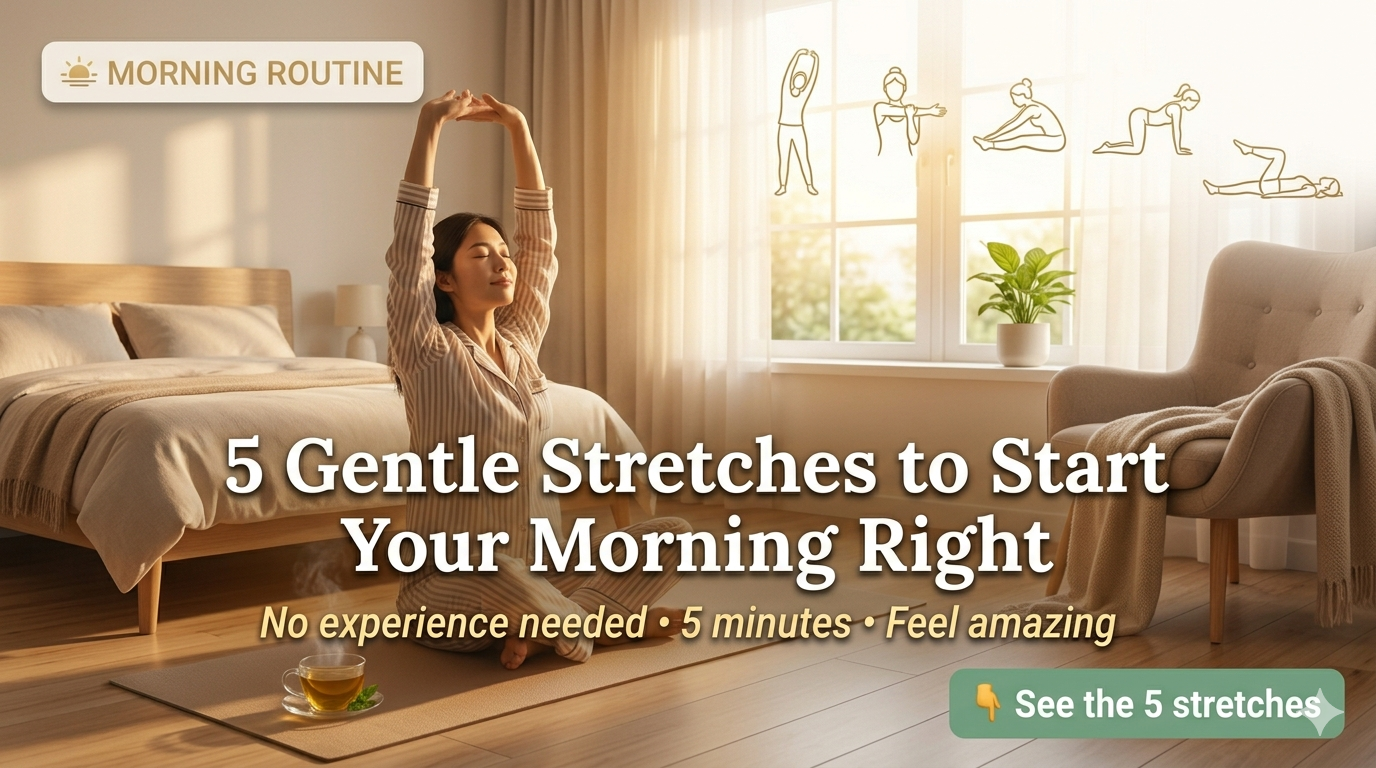
Start your day with this gentle 5-minute morning stretch routine for beginners. No flexibility needed. Improve mobility, reduce stiffness, and feel better fast.
Mornings feel better when you move a little. Here’s a simple, five-minute stretch routine for beginners—no flexibility required.
Let me tell you about my mornings.
For years, they looked the same. Alarm blaring. Snooze button. Alarm blaring again. Roll out of bed, stumble to the kitchen, and immediately start doing things—making coffee, packing lunches, checking emails, feeding the cat. My body was the last thing on my mind.
And honestly? I felt it. By mid-morning, my shoulders were tight. My back ached a little. I was already carrying tension I hadn’t even noticed accumulating.
Then a friend—the kind who does yoga and glows while the rest of us just survive—suggested something simple. “Just stretch,” she said. “Five minutes. Before you do anything else.”
I laughed. Five minutes? I barely had five seconds.
But I tried it. And something shifted.
Not dramatically. Not overnight. But slowly, morning by morning, I started noticing that my body felt… awake. Not in a jolt-of-coffee way, but in a gentle, “good morning, nice to see you” kind of way.
If you’ve never stretched in your life, if you’re sure you’re “not flexible enough,” if mornings already feel like too much—this routine is for you.
No experience needed. No equipment needed. No flexibility required. Just you, a few minutes, and a willingness to be kind to your body first thing.
I have structured this into a warm-up routine, the 10 stretches, and a cool-down, with specific instructions to ensure you do them safely.
10 Simple Morning Stretches for Beginners
Why stretch in the morning?
After 6-8 hours of sleep, your muscles are stiff and your joints are tight. Morning stretching increases blood flow, wakes up your nervous system, improves flexibility, and helps release tension (especially in the neck and back) before you start your day.
The Golden Rule for Beginners: Never bounce. Hold each stretch statically and breathe deeply. If you feel sharp pain, stop immediately. You should only feel a mild, comfortable pull.
The Warm-Up (Do this first for 1 minute)
Before you stretch cold muscles, get your blood moving.
- Stand up and march in place for 30 seconds.
- Gently roll your shoulders forward five times and backward five times.
The 10 Stretches
1. Neck Tilt (Side-to-Side)
- Target: Neck and upper trapezius.
- How to: Sit or stand tall with a straight spine. Gently tilt your head toward your right shoulder, bringing your right ear toward the shoulder. Hold for 15 seconds. Return to center and repeat on the left side.
- Tip: Keep your shoulders relaxed and down—do not hunch them up to meet your ear.
2. Chin Tuck
- Target: The front of the neck and upper back.
- How to: While looking straight ahead, gently pull your chin straight backward (as if you are making a double chin). Keep your head level—do not tilt it up or down. Hold for 5 seconds and release. Repeat 5 times.
- Tip: This is excellent for counteracting “tech neck” from phone/computer use.
3. Shoulder Shrug and Roll
- Target: Shoulders and upper back.
- How to: Inhale and shrug your shoulders up toward your ears as high as possible. Exhale and forcefully drop them down. Immediately roll your shoulders backward in a big circle five times, then forward five times.
4. Standing Cat-Cow
- Target: Entire spine and back.
- How to: Stand with feet hip-width apart and knees slightly bent. Place your hands on your thighs. As you inhale, arch your back, drop your belly forward, and look up (Cow). As you exhale, round your spine toward the ceiling, tuck your chin to your chest, and pull your belly in (Cat). Repeat 5 times slowly.
5. Overhead Side Stretch
- Target: Obliques (sides) and lat muscles.
- How to: Stand tall and interlace your fingers above your head with palms facing the ceiling. Keeping your hips square and facing forward, gently lean your upper body to the right. Hold for 15 seconds. Return to center and lean to the left.
- Tip: Imagine you are trying to reach over a tall fence to grab something.
6. Torso Twist
- Target: Mid-back and core.
- How to: Stand with feet hip-width apart. Extend your arms straight out to the sides at shoulder height. Slowly twist your torso to the right, allowing your left arm to swing forward and your right arm to swing back. Look over your right shoulder. Hold for 10 seconds. Return to center and twist to the left.
7. Forward Fold (Hang)
- Target: Hamstrings, calves, and lower back.
- How to: Stand with feet hip-width apart and knees slightly bent (this is crucial). Hinge at your hips and fold forward, letting your arms dangle toward the floor. Let your head hang heavy. Gently sway side to side. Hold for 30 seconds.
- Tip: Do not lock your knees. Bend them as much as you need to. If you cannot reach the floor, grab your elbows or opposite biceps.
8. Low Lunge (Hip Flexor Stretch)
- Target: Hip flexors and quads.
- How to: Step your right foot forward into a lunge position. Lower your left knee to the floor (place a towel under it for comfort). Keep your right knee directly over your right ankle. Gently press your hips forward until you feel a stretch in the front of your left hip. Hold for 20 seconds. Switch legs.
9. Standing Quad Stretch
- Target: Front of the thigh.
- How to: Stand tall and hold onto a wall or chair for balance. Bend your right knee and bring your heel toward your buttock. Grab your right ankle with your right hand. Keep your knees together and gently pull your heel closer to your glutes. Hold for 20 seconds. Switch legs.
- Tip: If you cannot reach your ankle, loop a towel around your foot and pull the ends
Pro-Tip for Beginners: Do not worry about doing all 10 perfectly on Day 1. Start with 5 stretches and add one new one each day. Consistency is more important than perfection!
Before We Start: A Word About Kindness
Let’s get something out of the way right now.
You don’t need to touch your toes. You don’t need to look like the people in the videos. You don’t need to feel anything “deep.”
Stretching isn’t a competition. It’s not something you can fail. It’s just a conversation with your body—a way of saying, “I see you. I’m here. Let’s wake up together.”
So as you go through these stretches, listen to what your body tells you. If something hurts—not aches, but genuinely hurts—ease up. If something feels good, stay there a little longer. If you only do two of the five stretches today, that’s still a win.
This is for you. Not for anyone else.
Getting Ready
Find a comfortable spot. The floor is great if that works for you, but a bed is fine too. Early morning, your body is colder and stiffer, so a soft surface can actually be more welcoming.
Wear whatever you slept in. No need to change. No need to be presentable.
Take one deep breath first. Just one. In through your nose, out through your mouth. Let your shoulders drop. Let your face soften.
Ready? Let’s move.
Stretch One: The Knees-to-Chest Hug
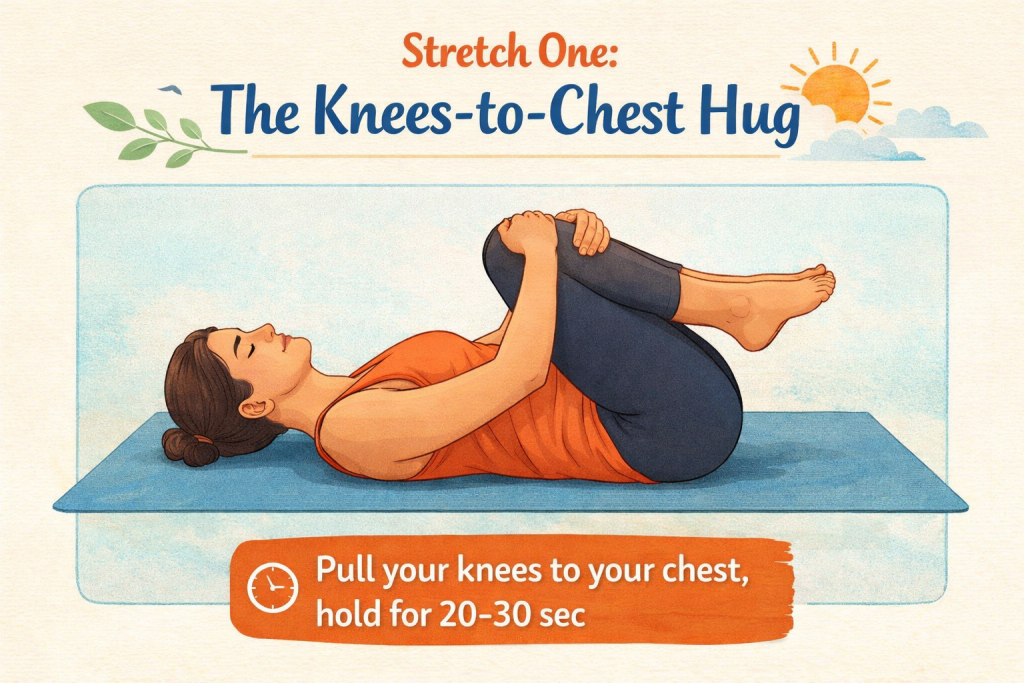
Lie on your back. If you’re on a bed, that’s fine. If you’re on the floor, maybe grab a pillow for under your head if that’s more comfortable.
Bend both knees and slowly draw them toward your chest. Wrap your arms around them, like you’re giving your legs a hug.
Just rest here.
Feel your lower back lengthen against the floor. Feel your hips open gently. You might feel a light stretch across your back and glutes, or you might just feel held. Both are perfect.
Rock side to side a little if that feels nice. Just a tiny sway, like you’re comforting yourself.
Stay here for five or six slow breaths. Let your body remember what it feels like to be soft.
This stretch is especially wonderful if you sleep on your side or stomach. It counteracts the curling-up position many of us adopt at night. It tells your spine: “You can lengthen now. The night is over.”
I like to close my eyes here. Just for a few seconds. It feels like a small meditation before the day really begins.
Stretch Two: The Lying Spinal Twist
From your knees-to-chest position, let your knees fall gently to the right side. Keep both shoulders on the floor as best you can—one might lift, and that’s okay. Turn your head to look toward the left.
You’re now in a gentle twist.
This one is magic for your back. It releases tension you didn’t even know you were holding. It gently wrings out your spine like a soft towel.
Breathe here for a few breaths. Feel the stretch across your lower back, maybe into your chest if your shoulders are open.
Then use your hands to guide your knees back to center, and let them fall to the left side. Turn your head to the right.
Another few breaths here. Soft. Easy. No forcing.
What I love about this stretch is how it feels on my sides. The oblique muscles—the ones that help you twist and turn—get a gentle awakening. It’s like they’re saying, “Oh right, we’re part of this body too.”
If your shoulders don’t stay flat, truly, it’s okay. Your body is unique. It has its own shapes and limits. Honor them.
Stretch Three: The Pelvic Tilts (Cat-Cow, But Lying Down)
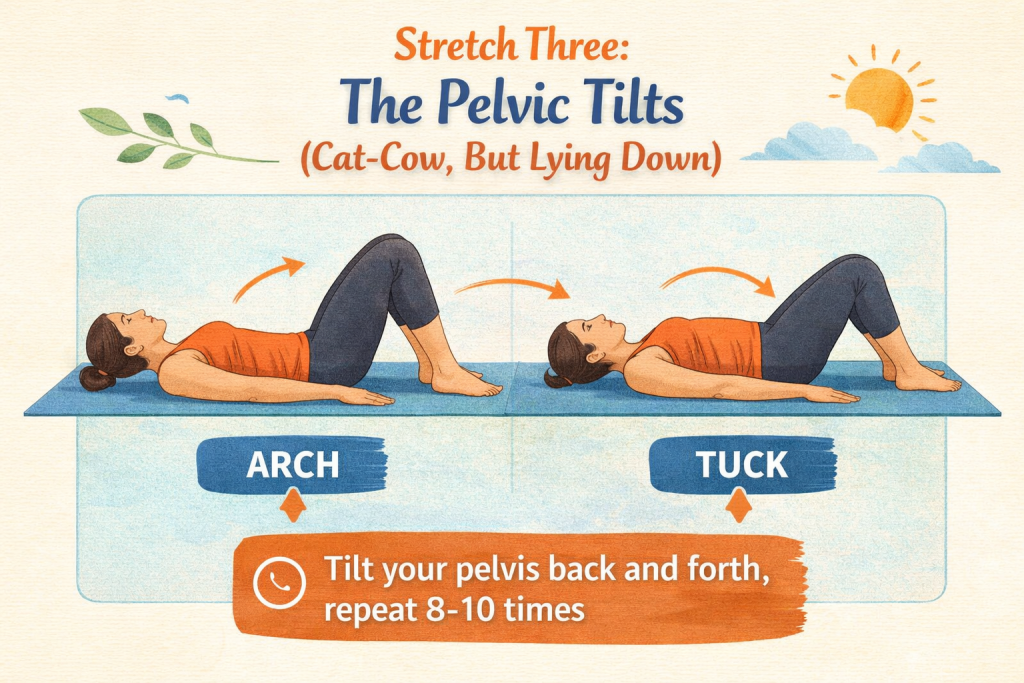
Stay on your back for this one. Keep your knees bent, feet flat on the floor (or bed).
As you inhale, gently arch your lower back, letting your belly rise. Let your hips tilt forward slightly.
As you exhale, press your lower back into the floor, tilting your hips back. You’ll feel your abdominals engage gently.
Move slowly between these two positions, following your breath. Inhale, arch. Exhale, press down.
This is a tiny movement, but it wakes up your spine. It mobilizes your lower back and reminds your body how to move. Do this five or six times, nice and slow.
This stretch is incredibly subtle. You might wonder if you’re doing it right. The answer is: if you’re moving and breathing, you’re doing it right.
The space between the floor and your lower back changes with each breath. That’s all. That’s enough.
I sometimes imagine my spine as a string of pearls, each vertebra gently separating and coming back together with each breath. It sounds a little silly, but it helps me slow down and actually feel what’s happening.
Stretch Four: The Seated Forward Fold
Slowly come up to sitting. Extend your legs out in front of you. If this is uncomfortable for your lower back, keep a soft bend in your knees.
Inhale, lengthen your spine. Sit up tall, even if just for a moment.
Exhale, and gently hinge forward from your hips. Go only as far as feels comfortable. Maybe that’s just a few inches. Maybe your hands rest on your knees. Maybe they reach your shins. Maybe they reach your feet.
There is no right answer.
Let your head hang heavy. Let your neck relax. Feel the stretch along your hamstrings—the backs of your legs—and your lower back.
Breathe here for five slow breaths. With each exhale, see if your body wants to soften a tiny bit more. Not pushing. Just softening.
To come out, inhale and slowly roll up, stacking your spine one vertebra at a time.
This stretch is humbling in the best way. It asks you to surrender. To let go of the idea that you need to be somewhere else, more flexible, better. Right here, right now, exactly as far forward as you are, is perfect.
I often think about my hamstrings during this stretch. They spend all day sitting—compressed, shortened, forgotten. This is a chance to say thank you. To give them a little space.
Stretch Five: The Standing Forward Fold
Stand up slowly. Give your body a moment to adjust.
From standing, bend your knees slightly and gently fold forward, letting your upper body hang heavy. Let your arms dangle toward the floor. Let your head hang loose.
You might feel a stretch in your hamstrings, your lower back, even your shoulders. You might just feel the blood rushing to your head a little.
Bend your knees as much as you need to. This isn’t about straight legs. It’s about letting go.
Stay here for a few breaths. Gently sway side to side if that feels good. Shake your head yes and no, just a little, to release any remaining neck tension.
To come out, bend your knees deeply and slowly roll up, bringing your head up last. Let your arms float up at the very end if you want, or just come up however feels natural.
This stretch is the grand finale. It uses gravity to do the work for you. You just hang. Like laundry on a line. Like a child’s drawing of a person. Like nothing at all.
I love the moment of coming up slowly. It’s like rising from a bow. A return to standing, but somehow different. Lighter.
After You Finish: Just Stand There
When you’re done, just stand for a moment.
Notice how your body feels. Maybe your back feels longer. Maybe your shoulders feel lower. Maybe you just feel a little more… present.
That’s the point. Not transformation. Just presence. Just a few minutes of paying attention to the body that carries you through every single day.
If you want, put a hand on your chest and one on your belly. Take one more deep breath. Thank your body for showing up.
Then go make your coffee. The day can wait another minute.
🧘 Deepen your mind-body practice: Pair your morning stretches with the 3-in-1 Yoga & Wellness Bundle for yoga flows, meditation logs, and daily self-care tracking.
Why This Matters More Than You Think
Here’s something I’ve learned.
How we start our mornings sets a tone. Not in a big, dramatic way, but in a quiet, cumulative way. When you take five minutes to stretch before you do anything else, you’re telling yourself: “I matter. My body matters. I’m worth this small pause.”
That message sinks in. Over days and weeks and months, it changes something.
You might find you’re less reactive to stress. You might find you carry less tension in your shoulders. You might just find that mornings feel a little softer, a little more yours.
And all it takes is five minutes and a willingness to try.
There’s research to back this up, too, though you don’t need science to feel the difference. Gentle morning stretching improves circulation, reduces stiffness, and can even lower cortisol levels—that stress hormone that makes everything feel harder. But honestly? The best reason to do it is simply because it feels good.
🔥 Build your morning stretch streak: Stay consistent with Streakify AI Premium Habit Tracker – track your daily stretch routine and never miss a morning.
Making It a Habit
If you want this to stick, don’t rely on motivation. Motivation is fickle. It shows up some days and hides on others.
Instead, attach it to something you already do.
- Stretch right after you turn off your alarm, before you even get out of bed.
- Stretch while your coffee brews.
- Stretch before you open your phone.
Make it so easy you can’t say no. If five minutes feels too long, do two minutes. If two minutes feels too long, do one stretch. Just one.
The goal isn’t perfection. The goal is showing up, again and again, in whatever small way you can.
I have a friend who does just the first stretch—knees to chest—every morning while she waits for her kettle to boil. That’s it. One stretch. And she swears it’s changed her mornings.
Start where you are. Use what you have. Do what you can.
What If You Miss a Day?
You’ll miss days. We all do.
Some mornings you’ll wake up late and rushed. Some mornings you’ll just not feel like it. Some mornings you’ll forget entirely.
That’s not failure. That’s being human.
The only thing that matters is what you do the next day. Do you give up entirely, or do you try again?
Try again. Always try again.
I’ve missed weeks. Months, even. And every time I come back, my body remembers. It doesn’t punish me for leaving. It welcomes me home.
📋 Fix the root causes of low energy: Download the Metabolism Reset Checklist to identify and fix issues that may affect your mobility and energy.
Listen to Your Body
As you make this a habit, you might notice things changing.
Maybe a stretch that felt tight last week feels easier this week. Maybe you notice you’re sleeping better. Maybe you catch yourself standing taller during the day.
Pay attention to these small shifts. They’re your body talking to you.
And if something ever hurts—not aches, but sharp, painful hurts—stop. Ease off. Your body knows its limits better than any article or expert ever could.
There’s a difference between discomfort and pain. Discomfort is the gentle pull of a muscle waking up. Pain is your body saying “no, thank you.” Listen to the difference.
📊 Track your overall fitness journey: Use the Smart Fitness Tracker for Men to log your stretches, workouts, sleep, and calories – all in one digital planner.
A Simple Way to Track Your Progress
If you’re the kind of person who likes numbers and clarity, sometimes it helps to see the bigger picture.
How does your morning stretching fit into your overall health? What about your nutrition, your energy levels, your goals?
👉 Use Our Free Calorie Calculator
This simple tool uses the scientific Mifflin-St Jeor equation to calculate your Basal Metabolic Rate (BMR) and Total Daily Energy Expenditure (TDEE). In seconds, you’ll see estimates for maintenance, weight loss, or weight gain calories.
It’s not about restriction. It’s about understanding. About knowing what your body needs to feel energized and supported.
And If You’re Tracking Workouts…
Maybe you’re also lifting weights or following exercise guides from different countries. Maybe you’ve seen a workout plan in pounds but your gym uses kilograms, or a running plan in miles when you think in kilometers.
👉 Use Our Free Fitness Unit Converter
This handy tool instantly converts weight, height, distance, and pace. Bookmark it for your next workout—it’ll save you the mental math.
A Final Thought
Your body wakes up every single day.
It breathes. It beats. It carries you through whatever the day brings. It does all of this without you even thinking about it.
Taking five minutes to stretch in the morning is just a way of saying thank you. A way of acknowledging the vessel that holds you.
You don’t need to be flexible. You don’t need to be good at it. You just need to show up, breathe, and move a little.
Tomorrow morning, try it. Just once. See how it feels.
Your body will thank you. And you might just find that those five minutes become the ones you look forward to most.
If you’re starting to move more and want to understand what your body needs to feel supported, sometimes it helps to have clarity.
👉 Use Our Free Weight Loss & Fitness Calculator
This simple tool takes your unique stats—age, height, weight, how much you move—and gives you a realistic picture of your daily needs. No judgment. No complicated charts. Just helpful information, completely free, designed for real people in the US, UK, and Canada.
Think of it as another way of checking in with yourself.
Tip:
Stretching should never cause pain. Move slowly and listen to your body.
FAQS:
- Can I do these stretches every day?
Absolutely. Unlike intense strength training, gentle stretching is safe and beneficial to do daily. In fact, consistency is key—a little movement every day is far more effective than an hour once a week. Just remember to listen to your body and never push into pain.
2. Do I need to stretch in the morning, or can I do this later?
You can do this routine anytime! Morning is ideal because it counteracts the stiffness from sleeping and sets a positive tone for the day. But if evenings work better for you, these same stretches can help release tension built up from the day and prepare you for better sleep.
3. What if I’m not flexible at all?
You’re exactly who this routine is for! Flexibility is not a requirement—it’s a result of consistent practice. Start where you are. If you can only move an inch, that inch is perfect. Over days and weeks, your range of motion will naturally increase. The only “wrong” way to stretch is to push through pain .