
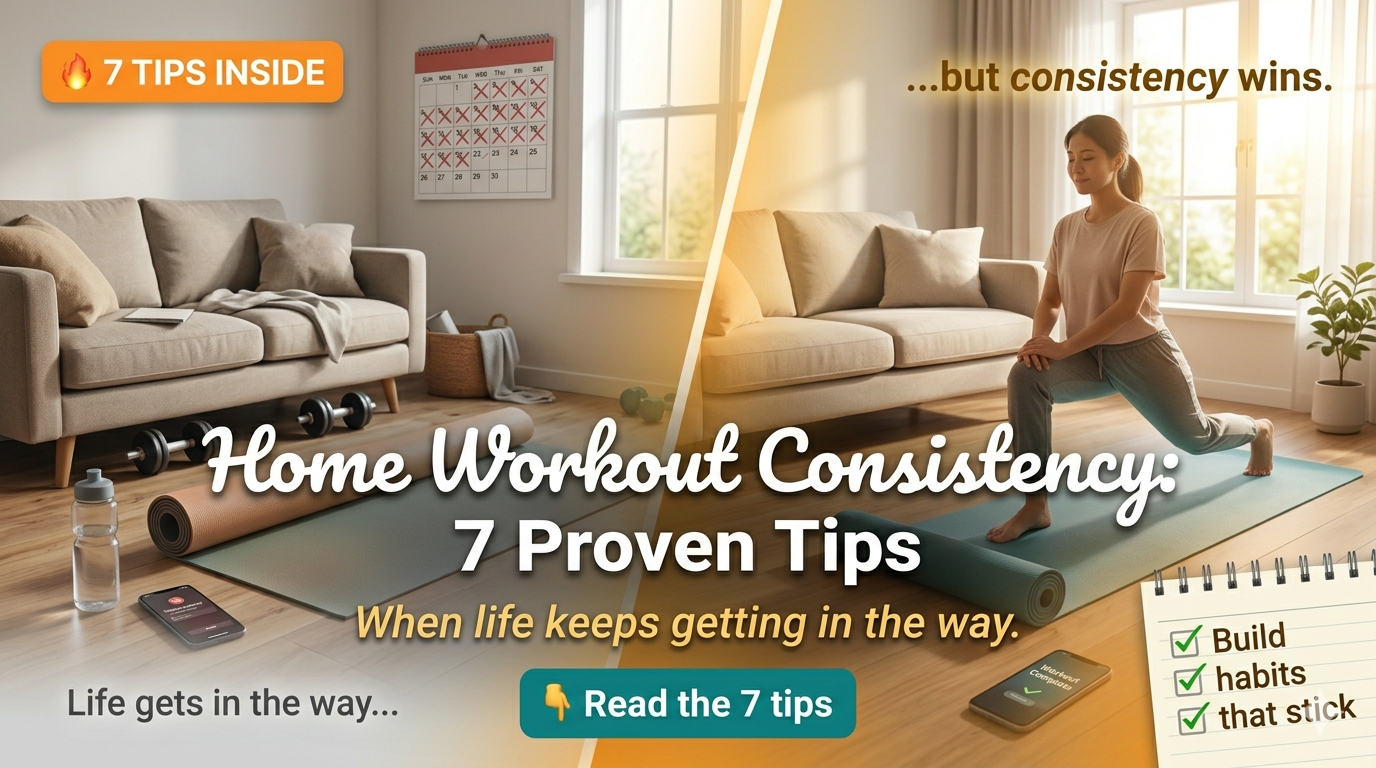
Struggling with home workout consistency? Discover 7 proven, guilt-free strategies to build lasting fitness habits.
If you’re struggling with home workout consistency, you’re not alone. |
It lives in the corner of my bedroom, right next to the wardrobe. It’s been there for about eight months now. Sometimes I unroll it and actually use it. Other times, I walk past it for weeks, giving it a little side-eye as I head to bed, promising myself that tomorrow will be different.
Tomorrow usually isn’t different.
If you have a mat like mine—or a set of dumbbells gathering dust, or a yoga app you haven’t opened in months—I need you to know something: you’re not lazy. You’re not failing. You’re just busy. And tired. And human.
The problem isn’t you. The problem is that most fitness advice is written by people who seem to have 25 hours in their day. They talk about “making time” like it’s a choice. As if you’re just choosing to sit on the couch instead of working out.
But you’re not choosing the couch. You’re choosing to finish that work email. You’re choosing to make dinner for your kids. You’re choosing to finally sit down for five minutes after a day that never stopped. Those aren’t failures. Those are called being a responsible adult.
So let’s talk about how to actually stay consistent with home workouts. Not in some fantasy world where you have infinite energy and time. But in the real world. Your world.
First, Let’s Ditch the All-or-Nothing Thinking
Here’s the biggest trap we all fall into.
We have this picture in our heads of what a “real workout” looks like. It’s an hour long. We’re sweaty and red-faced. We’ve done all the things. If we don’t hit that mark, we feel like we might as well have done nothing.
So when life gets busy and we can’t do the full hour, we do nothing. Because doing nothing feels less disappointing than doing something “incomplete.”
I’ve done this a hundred times. Maybe you have too.
Here’s what I’m learning: something is always better than nothing.
Five minutes is better than zero. A single stretch is better than no movement at all. Walking around the block while listening to a podcast counts. It all counts.
The people who stay consistent aren’t the ones who never miss a workout. They’re the ones who do something—anything—on the days when they can’t do everything.
The Five-Minute Rule That Changes Everything
I stole this from a therapist, actually. It’s for procrastination, but it works perfectly for workouts.
Tell yourself you only have to do five minutes.
That’s it. Five minutes of movement. You can do anything for five minutes. Even on your worst day, you can suffer through five minutes.
Here’s what happens: most of the time, once you start, you keep going. You do your five minutes, and you think, “Well, I’m already here, might as well do ten.” Or fifteen. Or twenty.
But on the days when you genuinely have nothing left? You do your five minutes and stop. And you know what? You still won. You moved your body. You kept the streak alive. You proved to yourself that you could show up.
The five-minute rule works because it lowers the barrier to entry. The hardest part of any workout isn’t the workout itself. It’s the decision to start. Once you’re moving, your body takes over.
Attach Your Workout to Something You Already Do
This is called “habit stacking,” but let’s not use fancy words. It’s just attaching a new habit to an old one.
Look at your day. What do you already do without thinking?
- Make coffee in the morning
- Wait for the kettle to boil
- Brush your teeth at night
- Watch the evening news
- Put the kids to bed
- Let the dog out
These are your anchors. Attach a tiny workout to one of them.
While the kettle boils, do ten squats. While you wait for your coffee to brew, do a 30-second wall lean. After you brush your teeth at night, lie on the floor and do five minutes of stretching.
The workout becomes part of the routine. You don’t have to remember to do it separately. It’s just what happens after the kettle clicks off.
Lower the Bar Until It’s Embarrassingly Low
I mean this sincerely.
If you’re struggling to work out consistently, your expectations are probably too high. Lower them. Lower them until the goal feels almost silly.
Maybe your goal is just to put on workout clothes. That’s it. You don’t even have to exercise. Just put the clothes on.
Here’s the trick: once you’re in the clothes, you’ll probably do something. But if you don’t? You still succeeded at your goal. You still showed up.
Or maybe your goal is to unroll your mat and lie on it for two minutes. That’s the whole workout. Just lying there, breathing.
This sounds ridiculous, I know. But it works. Because the shame spiral of “I didn’t work out” keeps us from working out. When the goal is so easy you can’t fail, you stop avoiding it.
Make It So Easy You Can’t Say No
Think about what stops you from working out at home.
Is it getting changed? Leave your workout clothes right next to your bed. Put them on first thing in the morning, before you even know what’s happening.
Is it finding a workout video? Bookmark three short ones right now. Ten minutes max. When it’s time to move, you don’t scroll—you just click.
Is it clearing space? Leave your mat out. Always. Let it live in the middle of the floor if you have to. Yes, it’s annoying to step around. That’s the point. It’s a constant reminder.
Is it not knowing what to do? Have a list of five exercises on your phone. Squats, lunges, wall push-ups, glute bridges, marching in place. That’s a full workout. No video needed.
Remove every single obstacle between you and movement. Make it harder not to do it than to do it.
Stop Waiting for Motivation
Here’s a hard truth: motivation is a liar.
Motivation shows up when you’re already feeling good. It’s easy to work out when you’re well-rested and stress-free. But those aren’t the days when you need help. You need help on the days when you’re exhausted, overwhelmed, and absolutely zero percent motivated.
Those days, you need discipline. But discipline sounds scary, so let’s call it something else: a decision you made in advance.
You decided last week that on Thursday, no matter how you felt, you would do five minutes of movement. It’s not a choice anymore. It’s just what happens. Like brushing your teeth. You don’t wake up and decide whether to brush your teeth based on motivation. You just do it.
Make the decision now, while you’re reading this. “I will do something—anything—every day. Even if it’s tiny. Even if it’s ridiculous. I will move my body.”
Write it down. Tell someone. Make it real.
What to Do When You Miss a Day (Because You Will)
You will miss a day. Maybe a week. Maybe a month.
Life happens. Kids get sick. Work gets insane. You get the flu. You go on holiday and decide to take a break. These are not failures. These are called being alive.
The difference between people who stay consistent and people who quit is not that the consistent people never miss. It’s that they start again.
They miss a week, and instead of thinking, “Well, I ruined it, might as well give up forever,” they think, “Okay, that happened. Now I start again today.”
Starting again is the only skill that matters.
Realistic Workouts for Real Days
Let me give you some actual options for those days when you’re busy, tired, and unmotivated.
The “I Literally Have Five Minutes” Workout
- 60 seconds: March in place, really lifting your knees
- 60 seconds: Wall push-ups (hands on wall, lean in and out)
- 60 seconds: Chair squats (sit and stand from a chair)
- 60 seconds: Rest
- 60 seconds: Repeat anything you liked
That’s it. You’re done. You moved.
The “I’m Exhausted But Need to Move” Workout
Lie on your back. Any soft surface.
- 10 glute bridges (lift hips, squeeze, lower)
- 10 knee hugs (pull one knee to chest, then the other)
- 10 spinal twists (knees side to side, arms out)
- 30 seconds of happy baby pose (knees wide, grab feet, rock gently)
This takes maybe three minutes. It barely feels like exercise. But your body will thank you.
The “I’m Stressed and Need to Reset” Workout
- 5 minutes walking outside, no phone
- 5 minutes of stretching anything that feels tight
- 5 minutes of deep breathing (in for four, out for six)
This isn’t a workout in the traditional sense. But it’s movement. And it’s self-care. And it counts.
The Truth About Results
Here’s something nobody tells you.
When you work out consistently—even just a little—things shift. Not overnight, but over time.
You notice you’re not as winded climbing stairs. You sleep a little better. You have more patience with your kids. You feel less achy at the end of the day. You catch a glimpse of yourself in the mirror and think, “Huh, not bad.”
These aren’t dramatic transformations. They’re small, quiet shifts. But they add up. They remind you that your body is on your side.
And that’s really the point. Not six-pack abs or a number on the scale. Just feeling at home in your own skin. Just having enough energy to live the life you want to live.
Fueling Your Body for Consistency
Movement is one piece. The other piece is what you put in your body.
When you’re exhausted and running on empty, the last thing you want to do is move. So part of consistency is making sure you have actual energy to work with.
That means eating enough. Eating regularly. Eating food that doesn’t crash your blood sugar an hour later.
Sometimes it helps to have clarity on what your body actually needs.
👉 Use Our Free Weight Loss & Fitness Calculator
This simple tool takes your unique stats—your age, height, weight, how much you move—and gives you a realistic picture of your daily needs. No judgment. No complicated charts. Just helpful information, completely free, designed for real people in the US, UK, and Canada.
Think of it as a friendly check-in. A way to see if your eating is supporting your movement (or working against it).
A Gentle Reminder for the Hard Days
On the days when you don’t work out, when you sit on the couch and scroll your phone instead, when you feel guilty and disappointed in yourself:
Be kind.
Talk to yourself the way you’d talk to a friend who was struggling. Would you tell them they’re lazy? Would you make them feel worse? Of course not. You’d say, “It’s okay. Tomorrow’s another day. You’re doing your best.”
Say that to yourself instead.
Your best changes day to day. Some days your best is a full workout. Some days your best is a five-minute stretch. Some days your best is just getting through.
All of it counts. All of it is enough.
The Bottom Line
Consistency at home isn’t about willpower. It’s not about motivation. It’s not about being the kind of person who never misses a workout.
It’s about making it so easy you can’t say no. It’s about lowering the bar until you can step over it every single day. It’s about starting again, every time you stop.
Your mat will be there. Your body will be there. And on the days when you show up—even for five minutes, even for something tiny—you’re proving something important.
You’re proving that you matter. That your health matters. That you’re worth showing up for.
And that’s the only consistency that really counts.
Reminder:
Being busy is not an excuse—planning is the solution.
Struggling to stay consistent?
Our Beginner-to-Advanced Home Fitness Planner helps you stay organized, motivated, and on track—even on busy days.
Start building your fitness habit today
Before You Start: Know Your Numbers
If you’re considering Advanced Memory Formula, it’s smart to understand your overall health first. Brain health doesn’t exist in a vacuum—it’s connected to your metabolism, your nutrition, your stress levels.
Use Our Free Calorie Calculator
This simple tool uses the scientific Mifflin-St Jeor equation to estimate your Basal Metabolic Rate (BMR) and Total Daily Energy Expenditure (TDEE). Knowing your baseline helps you make better decisions about nutrition and supplements.
Use Our Free Weight Loss & Fitness Calculator
This gives you a fuller picture—BMI, BMR, TDEE, daily target, and estimated timeline to your goals.
Use Our Free Fitness Unit Converter
If you’re following international recipes or workout plans, this tool instantly converts weight, height, distance, and pace.
FAQ
1. What if I only have 5 minutes? Is that even worth it?
Absolutely. The “five-minute rule” is scientifically backed—doing something small keeps the habit alive and often leads to longer sessions. Five minutes of movement is infinitely better than zero, and it signals to your brain that you’re someone who shows up. Consistency beats duration every time.
2. How do I stop feeling guilty when I miss a workout?
Guilt is the enemy of consistency. Instead of spiraling, practice self-compassion. Acknowledge that you missed a day, remind yourself that one missed day doesn’t erase progress, and commit to starting again tomorrow. The only real failure is not restarting.
3. What’s the single best tip for someone with zero motivation?
Lower the bar until it’s embarrassingly low. Your goal isn’t a workout—it’s to put on your workout clothes, or to unroll your mat, or to do one single squat. When the goal is impossible to fail, you stop avoiding it. Momentum will often carry you from there.
🧘♀️ YOGA & WELLNESS PLANNER
10 pages bundle · daily rituals · mindful tracker · printable
Morning Yoga Flow
Evening Wind-Down
Daily Intention Setter
Hydration & Habit Tracker
Gratitude Log
Pose Library (10 asanas)
Weekly Wellness Schedule
Mindful Eating Check-in
Sleep & Energy Tracker
Monthly Reflection + Goals