

Ready to burn calories at home? Try this 60-minute full-body fat-burning workout with simple exercises designed to support weight loss—no gym required..
Search “fat burning workout” and you’ll find thousands of 60-minute routines promising to melt pounds away, no gym required. The honest question most people actually want answered is simpler: does a session like this actually work, or is it just another video that leaves you sweaty and sore with nothing to show for it a month later?
The real answer is yes, with important caveats. A well-structured 60-minute full body workout, performed consistently at home with no equipment beyond your own body weight, can absolutely be an effective part of a weight loss plan. The exercise science behind it is solid: full body circuits that combine strength and cardio elements burn a meaningful number of calories during the session, continue burning extra calories for hours afterward through a well-documented effect called excess post-exercise oxygen consumption, and build the muscle that keeps your metabolism higher over the long run. But the workout alone is not the whole story, and this guide is honest about that too.
This article answers the exact question in the title directly, then gives you the complete 60-minute, no-equipment, full-body fat-burning workout, broken into warm-up, four circuits, and cool-down, with full exercise instructions, a 4-week beginner-to-intermediate progression, modifications for every fitness level, and the nutrition and lifestyle context that determines whether a workout like this actually translates into fat loss or just leaves you tired.
Important note: This article is for general education and is not medical advice. If you are new to exercise, pregnant, have a heart condition, joint problems, or any other health concern, please check with a doctor before starting a new workout program. Stop any exercise that causes sharp pain, dizziness, or chest discomfort.
Table of Contents
- Can a 60-Minute Home Workout Really Burn Fat? The Honest Answer
- How Fat Loss Actually Works (and Where Exercise Fits In)
- Why Full Body Workouts Are Especially Effective for Fat Loss
- What You Need Before You Start
- The Complete 60-Minute Full Body Fat Burn Workout
- Detailed Exercise Instructions and Form Cues
- How Many Calories Does This Workout Actually Burn?
- The 4-Week Progression Plan
- Modifications by Fitness Level
- Is 60 Minutes Too Long? Shorter Alternatives That Still Work
- The Role of Diet: Why This Workout Alone Won’t Guarantee Weight Loss
- How Often Should You Do This Workout?
- Recovery, Soreness, and Avoiding Burnout
- Common Mistakes That Sabotage Home Fat-Burning Workouts
- How to Track Real Progress (Beyond the Scale)
- Common Myths About Fat-Burning Workouts, Debunked
- This Workout for Specific Situations and Populations
- Comparing This Workout Format to Other Popular Approaches
- Optional Equipment Upgrade Path
- Pre-Workout Checklist
- Glossary: Key Terms Used in This Guide
- A Sample Weekly Schedule
- Daily Habits That Support This Workout’s Results
- Frequently Asked Questions About the 60-Minute Full Body Fat Burn Workout
- A Deeper Look at the Science: EPOC, Muscle, and Hormones
- Troubleshooting Common Scenarios
- Three Illustrative Scenarios and How to Adapt
- Printable Quick-Reference Workout Card
- Nutrition Timing Around This Workout
- Common Injuries and How to Prevent Them
- Beyond 8 Weeks: Building a Long-Term Practice
- A Few More Frequently Asked Questions
- Why Each Circuit Is Ordered the Way It Is
- Signs This Workout Is Working
- A Full Printable 4-Week Calendar
- Making This Routine Work Around a Busy, Home-Based Work Life
- Key Takeaways
- Final Thoughts: Building a Sustainable Path to Real Results
Can a 60-Minute Home Workout Really Burn Fat? The Honest Answer
Let’s address the title question head-on before going any further.
Tomorrow Never Comes. Today Does.
Fitness, money, or peace of mind — everything in one digital dashboard. Invest in yourself. Right now.
🛒 Buy Now – Start My Transformation
⚡ Instant Digital Download • Only
$17
One decision today. A completely different you tomorrow.
💳 Secure Checkout
⚡ Instant Access
✅ 100% Satisfaction
Yes, It Can Genuinely Help, Here’s Why
A 60-minute full body workout combining resistance exercises (squats, lunges, push-ups) with cardio-style intervals (jumping jacks, mountain climbers, high knees) does several things simultaneously that research consistently links to fat loss:
- It burns calories during the session itself, often 400 to 600 or more, depending on body weight, intensity, and fitness level, which contributes directly to the calorie deficit needed for fat loss.
- It triggers excess post-exercise oxygen consumption (EPOC), sometimes called the “afterburn effect,” where your body continues burning calories at an elevated rate for hours after the workout ends as it works to restore itself to its resting state, particularly after higher-intensity circuit-style training like the one in this guide.
- It builds and maintains muscle mass, which is metabolically active tissue; more muscle means a higher resting metabolic rate over time, even when you are not exercising.
- It improves insulin sensitivity and cardiovascular fitness, both of which support a healthier metabolic environment for fat loss over the medium and long term.
But Here’s the Honest Caveat
No single workout, no matter how well-designed, guarantees weight loss on its own. Weight loss ultimately depends on sustaining a calorie deficit over time, burning somewhat more calories than you consume, and exercise is only one side of that equation. A person who does this exact 60-minute workout four times a week but also significantly increases their food intake, whether consciously or through the common “I worked out, I deserve this” mindset, may not lose weight at all, despite doing everything right in the gym (or living room). This guide will not pretend otherwise; the “Role of Diet” section later in this article addresses this directly and honestly.
What Makes This Particular Workout Format Effective
The 60-minute workout in this guide is built as a full body circuit, alternating between compound strength movements (which work multiple large muscle groups at once) and cardio bursts, performed with minimal rest between exercises. This format, often associated with high-intensity interval training principles when performed at appropriate intensity, is specifically well-supported in exercise research for maximizing calorie burn per minute of exercise time and for producing a larger EPOC effect compared with steady-state cardio alone (such as a 60-minute walk at a single consistent pace).
Does It Matter That It’s at Home With No Equipment?
Not nearly as much as many people assume. Research comparing bodyweight resistance training to equipment-based training generally finds that, when exercises are selected and progressed appropriately (as this guide’s routine is designed to do), bodyweight training can produce comparable strength and metabolic benefits, particularly for beginner to intermediate exercisers. The main advantage of equipment (like heavy barbells) becomes more relevant for advanced strength athletes seeking to continue progressing beyond what bodyweight resistance alone can provide, which is a more advanced consideration than most people starting a home fat-burning routine need to worry about initially.
The Bottom Line
A 60-minute full body fat-burning workout at home, done consistently and combined with reasonable attention to nutrition, is a legitimately effective tool for weight loss, grounded in solid exercise science rather than hype. It is not a magic solution that works regardless of everything else you do, but as one well-designed piece of a broader approach, it absolutely can and does help people lose fat and keep it off.
EOF wc -w /mnt/user-data/outputs/60-minute-full-body-fat-burn-workout-at-home.md—
How Fat Loss Actually Works (and Where Exercise Fits In)
Before diving into the workout itself, it helps to understand the actual mechanism of fat loss, since this context explains why this particular workout format was chosen and what role it realistically plays.
The Calorie Deficit Principle
Fat loss, at its core, requires your body to use more energy than you consume over a sustained period, commonly referred to as a calorie deficit. When you are in a consistent deficit, your body draws on stored energy, including body fat, to make up the difference. This principle holds true regardless of which specific diet or exercise approach you use to create that deficit; the deficit itself is what drives fat loss, and exercise is one of several tools (alongside dietary changes) for creating and sustaining it.
Three Components of Daily Calorie Burn
Your total daily energy expenditure comes from three main sources:
🔥 Limited Time Sale – Was $30, Now Only $20
Are You Ready to Transform Yourself in 90 Days?
This isn’t just a planner — it’s your personal
90-Day Mind & Body Reset journey.
“Stop starting over every Monday. This time — build something that lasts.”
🚀 Buy Now – Start My 90-Day Reset
⚡ Instant Digital Download • Only
$20
$30
One decision today. A completely different you in 90 days.
💳 Secure Checkout
⚡ Instant Access
✅ 100% Satisfaction
- Basal metabolic rate (BMR): The energy your body uses for basic functions like breathing, circulation, and cell repair, even at complete rest. This accounts for the largest share of most people’s daily calorie burn, often 60 to 75 percent.
- The thermic effect of food: The energy used to digest and process the food you eat, accounting for roughly 10 percent of calories consumed.
- Activity-related energy expenditure: This includes both structured exercise (like the 60-minute workout in this guide) and non-exercise activity, such as walking, fidgeting, and daily movement, sometimes called NEAT (non-exercise activity thermogenesis).
Where a 60-Minute Workout Fits Into This Picture
A single 60-minute workout directly contributes to the “activity-related energy expenditure” portion of the equation, both during the session and, as discussed in the previous section, for some hours afterward through EPOC. Over time, consistent strength training also modestly increases BMR by building and maintaining muscle mass, since muscle tissue burns more calories at rest than fat tissue, though this effect is more gradual and builds over months of consistent training rather than appearing after a single session.
Why Exercise Alone Often Isn’t Enough
A commonly cited finding in exercise and weight loss research is that exercise alone, without corresponding attention to diet, often produces more modest weight loss results than many people expect, partly because of a phenomenon sometimes called “compensatory eating,” where people unconsciously eat somewhat more after exercising, and partly because even a vigorous 60-minute workout burns fewer calories than many people assume, often representing a relatively modest percentage of total daily energy needs. This is not a reason to skip exercise, exercise offers substantial benefits beyond calorie burning alone, including the muscle-building, metabolic, and cardiovascular benefits discussed throughout this guide, but it is an important, honest piece of context that shapes how this guide frames the workout: as a genuinely valuable tool, not a standalone solution.
Fat Loss Is Not the Same as Weight Loss
It’s worth distinguishing between the two. The number on the scale reflects total body weight, including water, muscle, bone, and organs, not just fat. A workout program like this one, combined with adequate protein intake, can help you lose fat while maintaining or even building muscle, which means the scale may move more slowly than someone pursuing weight loss through extreme calorie restriction alone, even though the actual improvement in body composition (the ratio of fat to muscle) may be more favorable. This is discussed further in the tracking section later in this guide.
Spot Reduction Doesn’t Work, But Full Body Training Still Matters
It is not possible to selectively burn fat from one specific body area through targeted exercise, a concept known as “spot reduction,” which has been consistently unsupported by research. This is actually part of why a full body workout, rather than one focused on a single area like “abs only,” is a more effective strategy: it maximizes overall calorie burn and muscle engagement across your entire body, supporting fat loss throughout your body generally, including, over time, the areas you may be most focused on, rather than attempting (unsuccessfully) to target fat loss in one specific spot.
Why Full Body Workouts Are Especially Effective for Fat Loss
Understanding why this guide uses a full body format, rather than, for example, a workout that isolates just the arms or just the legs, helps explain the exercise selection in the main routine.
More Muscle Groups Engaged Means More Calories Burned
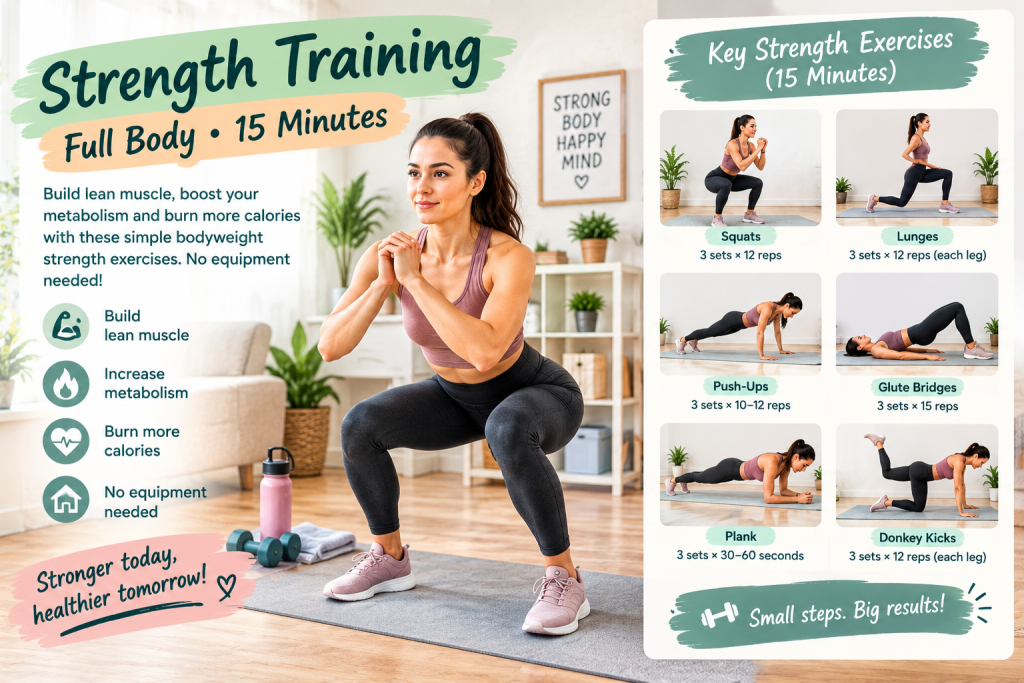
Full body workouts, particularly those built around compound movements (exercises that work multiple muscle groups and joints simultaneously, like squats and push-ups), engage significantly more total muscle mass per exercise than isolation movements (exercises that target a single muscle, like a bicep curl). More muscle mass engaged means a higher calorie expenditure both during the exercise and in the recovery period afterward.
Greater EPOC Effect
Research on excess post-exercise oxygen consumption generally finds that higher-intensity, full-body, compound-movement-based training produces a larger and longer-lasting EPOC effect compared with lower-intensity or more isolated exercise, meaning your body continues burning calories at an elevated rate for a longer period after a full body workout like the one in this guide, compared with, for example, an equivalent duration of gentler, isolated exercise.
Time Efficiency
For a 60-minute home workout to be genuinely sustainable, it needs to deliver meaningful results without requiring additional separate sessions for different muscle groups. A full body approach allows every major muscle group, legs, glutes, chest, back, shoulders, arms, and core, to be trained within the single session, making this format particularly well-suited to a realistic home routine that most people can actually fit into their week consistently.
Functional, Real-World Strength
Compound, full body movements like squats, lunges, and push-ups closely mirror the movement patterns used in daily life, standing up, climbing stairs, pushing and carrying objects, which means the strength built through this type of training tends to translate more directly into improved daily function compared with more isolated exercise.
Balanced Development
Training the whole body in each session, rather than focusing heavily on certain areas while neglecting others, supports more balanced overall strength and muscle development, which research links to better movement quality, reduced injury risk, and improved long-term exercise sustainability, since muscular imbalances can sometimes contribute to discomfort or increased injury risk over time.
A Note on “Fat Burning Zones” and Why This Guide Doesn’t Rely on Them
You may have heard of a specific “fat burning heart rate zone,” typically described as a lower-intensity exercise zone where a higher percentage of calories burned come from fat stores compared with carbohydrate stores. While this physiological phenomenon is real, at lower intensities, a higher percentage of calories burned do come from fat, the total number of calories burned, and therefore the total amount of fat burned, is generally higher during and after higher-intensity exercise, like the circuit-based workout in this guide, despite a lower percentage of those calories coming from fat during the session itself. In practical terms, this means chasing a specific “fat burning zone” heart rate is generally less important for actual fat loss than simply performing an effective, appropriately challenging workout consistently, which is the approach this guide takes.
What You Need Before You Start
One of the biggest advantages of this workout is how little it requires to get started.
Equipment
None is strictly required. Every exercise in this routine uses only your own body weight. If you want to add intensity as you progress, a few optional items can help, but none are necessary to begin:
- A yoga mat or towel, for comfort during floor-based exercises.
- A sturdy chair, used for a few modification options.
- Optional, for later progression: a pair of light dumbbells or resistance bands, and a jump rope, none required for the base routine described in this guide.
Space
You need enough floor space to lie down with your arms and legs extended, roughly a 6 by 6 foot (about 2 by 2 meter) area, clear of furniture and tripping hazards. A living room, bedroom, or even a cleared garage or patio space works well.
Clothing and Footwear
Comfortable athletic clothing that allows a full range of motion, and supportive athletic shoes, are generally recommended for this workout, since it includes jumping and lateral movements where shoe support and traction matter for both performance and injury prevention. Some people prefer bare feet or minimalist shoes for certain floor-based and balance exercises; this is a matter of personal preference and comfort.
Time
The full routine, including warm-up and cool-down, takes about 60 minutes, as the title suggests. If you are new to exercise, it is completely reasonable to start with a shorter version (discussed in detail in the “Is 60 Minutes Too Long?” section later in this guide) and build up to the full 60-minute session over time.
A Note on Fitness Level
This workout, as written, is designed for a beginner-to-intermediate fitness level, with modifications provided throughout for those who are brand new to exercise and progressions for those who find the base version too easy. Read through the “Modifications by Fitness Level” section before your first session to identify where you should realistically start.
Music or a Timer
Many people find that music with a consistent, motivating tempo helps maintain pace and energy throughout a 60-minute session. A simple interval timer app (widely available for free) is also useful for managing the work and rest periods described in the workout structure, removing the need to constantly check a clock mid-exercise.
Water
Keep water nearby and accessible throughout the session, taking small sips during rest periods as needed, particularly important for a longer, more demanding session like this one.
The Complete 60-Minute Full Body Fat Burn Workout
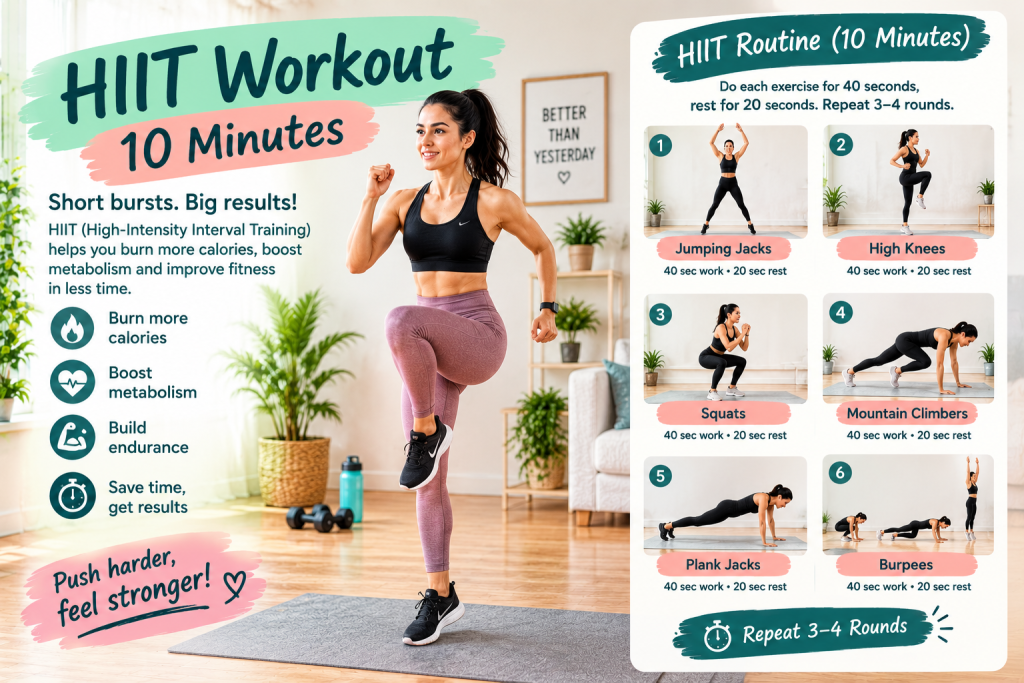
This workout is structured in four parts: a warm-up, four full-body circuits (each targeting a slightly different emphasis while still working the whole body), and a cool-down. Each circuit uses a format of 40 seconds of work followed by 20 seconds of rest per exercise, repeated for 3 rounds, with a longer rest between circuits, though this timing can be adjusted based on your fitness level as described in the modifications section.
Warm-Up (8 Minutes)
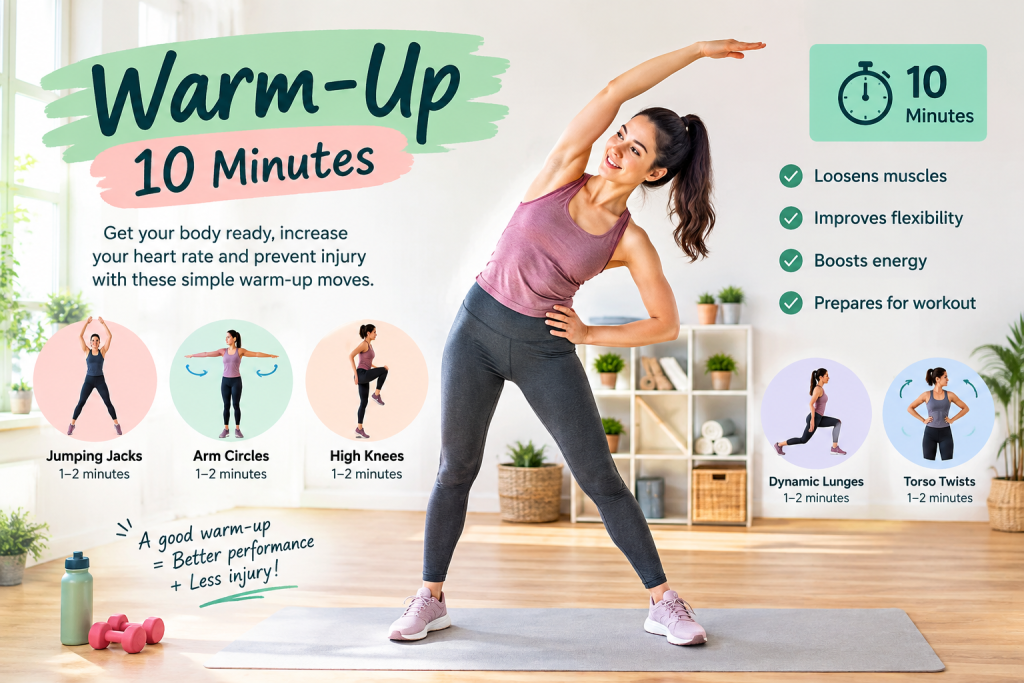
A proper warm-up raises your heart rate and body temperature gradually and prepares your joints and muscles for the more demanding work ahead, reducing injury risk and improving performance in the circuits that follow.
Perform each of the following for 45 seconds, moving directly from one to the next with minimal rest:
- Standing marches: March in place, lifting knees to a comfortable height, pumping your arms.
- Arm circles: Extend your arms out to the sides and make controlled circles, small at first, gradually increasing in size, for 20 seconds, then reverse direction for 20 seconds.
- Bodyweight squats (slow tempo): Perform slow, controlled squats, focusing on full range of motion rather than speed.
- Hip circles: Standing with hands on hips, make large, controlled circles with your hips, 20 seconds in each direction.
- Walking lunges: Step forward into a lunge, alternating legs, moving forward across your available space.
- Torso twists: Standing with feet shoulder-width apart, gently rotate your torso side to side, allowing your arms to swing naturally with the movement.
- High knees (moderate pace): Jog in place, bringing your knees up toward your chest at a moderate, building pace.
- Inchworms: Standing, hinge forward and walk your hands out to a plank position, pause briefly, then walk your hands back and stand up, repeating for the full 45 seconds.
Circuit 1: Lower Body and Cardio Foundation (12 Minutes)
Exercises (40 seconds work, 20 seconds rest, 3 rounds):
- Bodyweight squats: Feet shoulder-width apart, lower into a squat by bending your knees and pushing your hips back, keeping your chest up, then drive back up to standing.
- Reverse lunges: Step one leg back into a lunge, lowering until both knees form roughly 90-degree angles, then push back to standing and alternate legs.
- Jumping jacks: Standard jumping jacks, jumping feet out while raising arms overhead, then back to start.
- Glute bridges: Lying on your back, knees bent and feet flat, lift your hips toward the ceiling by squeezing your glutes, then lower with control.
Rest 1 to 2 minutes between rounds of the circuit.
Circuit 2: Upper Body and Core (12 Minutes)
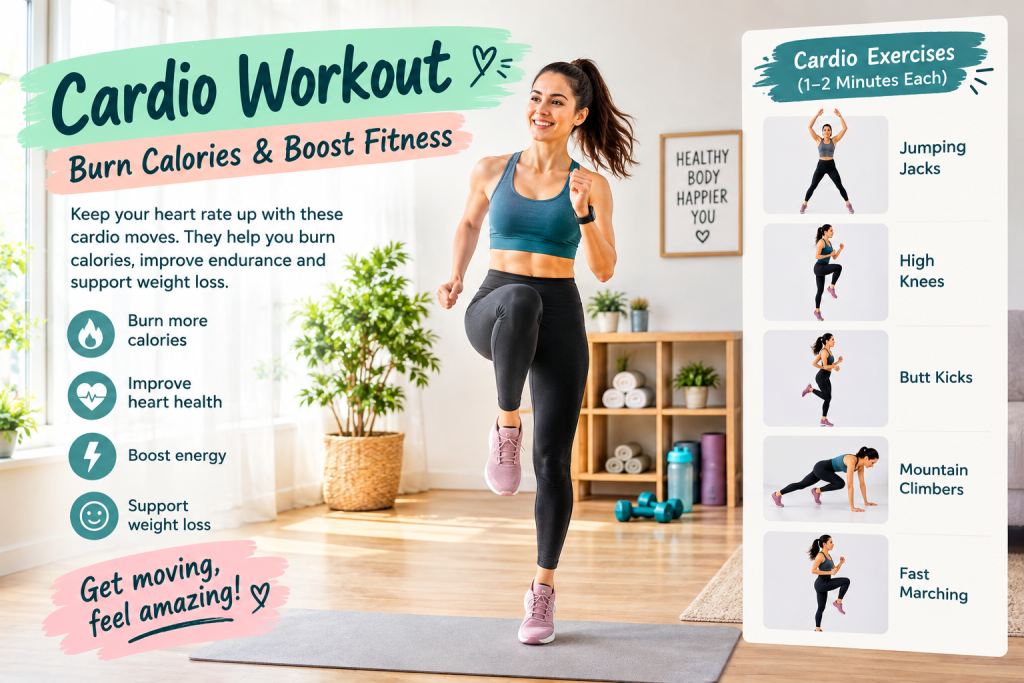
Exercises (40 seconds work, 20 seconds rest, 3 rounds):
- Push-ups (standard or modified on knees): Hands slightly wider than shoulder-width, lower your chest toward the floor with control, then press back up.
- Plank shoulder taps: In a plank position, alternate tapping each hand to the opposite shoulder while keeping your hips as stable as possible.
- Mountain climbers: In a plank position, alternate driving each knee toward your chest at a brisk, controlled pace.
- Superman holds: Lying face down, lift your arms, chest, and legs slightly off the floor simultaneously, hold briefly, then lower with control.
Rest 1 to 2 minutes between rounds of the circuit.
Circuit 3: Full Body Power and Cardio Burst (12 Minutes)
Exercises (40 seconds work, 20 seconds rest, 3 rounds):
- Burpees (standard or modified, see modifications section): From standing, drop into a squat, kick your feet back to a plank, perform a push-up (optional), jump your feet back toward your hands, then explode upward into a jump.
- Lateral lunges: Step to one side into a lunge, keeping the opposite leg straight, then push back to center and alternate sides.
- High knees: Jog in place at a brisk pace, driving your knees up toward your chest.
- Plank hold: Hold a standard or modified (knee-supported) plank position, keeping your body in a straight line from head to heels.
Rest 1 to 2 minutes between rounds of the circuit.
Circuit 4: Finisher, Full Body Combination Moves (12 Minutes)
Exercises (40 seconds work, 20 seconds rest, 3 rounds):
- Squat to overhead reach: Perform a bodyweight squat, and as you stand, reach both arms overhead, combining lower body strength with a full-body extension.
- Bear crawls: From a tabletop position with knees hovering just above the floor, crawl forward and backward across your available space, maintaining a flat back.
- Skater jumps: Jump laterally from one foot to the other in a skating motion, landing softly and maintaining balance before jumping to the other side.
- Standing bicycle crunches (or floor bicycle crunches): Standing, bring opposite elbow to opposite knee in a twisting motion; or, for the floor version, lying on your back, alternate bringing opposite elbow to opposite knee in a pedaling motion.
Rest 1 to 2 minutes after completing the final round.
Cool-Down (8 Minutes)
Gradually lowering your heart rate and stretching the muscles you just worked helps with recovery and reduces post-workout stiffness.
- Standing forward fold: Hinge forward from the hips, letting your upper body hang, for 20 to 30 seconds.
- Quad stretch: Standing, hold one ankle behind you, bringing your heel toward your glutes, 20 to 30 seconds per side.
- Seated hamstring stretch: Sitting with one leg extended, gently hinge forward over the extended leg, 20 to 30 seconds per side.
- Child’s pose: Kneeling, sit back toward your heels and extend your arms forward on the floor, holding for 30 to 45 seconds.
- Chest and shoulder stretch: Clasp your hands behind your back and gently lift, opening the chest, for 20 to 30 seconds.
- Deep breathing: Finish with 1 to 2 minutes of slow, deep breathing, allowing your heart rate to settle before moving on with your day.
Full Workout Summary Table
| Section | Duration | Focus |
|---|---|---|
| Warm-up | 8 minutes | General mobility, gradual heart rate increase |
| Circuit 1 | 12 minutes | Lower body and cardio foundation |
| Circuit 2 | 12 minutes | Upper body and core |
| Circuit 3 | 12 minutes | Full body power and cardio burst |
| Circuit 4 | 12 minutes | Full body finisher combinations |
| Cool-down | 8 minutes | Stretching, heart rate recovery |
| Total | ~60 minutes | Complete full body session |
Detailed Exercise Instructions and Form Cues
Proper form matters enormously for both effectiveness and injury prevention, especially in a longer, higher-volume session like this one. Here are detailed instructions for the key exercises in the main circuits.
Bodyweight Squats
- Stand with feet shoulder-width apart, toes slightly turned out.
- Keeping your chest up and core engaged, bend your knees and push your hips back as if sitting into a chair.
- Lower until your thighs are roughly parallel to the floor, or as low as comfortable with good control.
- Keep your knees tracking in line with your toes, avoiding them caving inward.
- Drive through your heels and mid-foot to return to standing.
Common mistake: Letting the knees cave inward, or letting the heels lift off the floor. Focus on pushing the floor away through your whole foot.
Reverse Lunges
- Stand tall, feet hip-width apart.
- Step one foot back, lowering until both knees form roughly 90-degree angles, front knee stacked over the ankle.
- Push through the front foot to return to standing, then alternate legs.
Common mistake: Letting the front knee travel too far past the toes, or losing balance by taking too large or too small a step back; a moderate step length usually feels most stable.
Push-Ups (Standard and Modified)
- Standard: Start in a plank position, hands slightly wider than shoulder-width. Lower your chest toward the floor by bending your elbows, keeping your body in a straight line, then press back up.
- Modified (on knees): Perform the same movement with your knees on the floor instead of your toes, reducing the amount of body weight lifted while maintaining the same upper body movement pattern.
Common mistake: Letting the hips sag or pike upward, breaking the straight line from head to heels (or head to knees in the modified version). Engage your core throughout to maintain this alignment.
Plank Hold and Plank Shoulder Taps
- Start in a forearm or straight-arm plank position, body in a straight line from head to heels, core engaged.
- For shoulder taps, from a straight-arm plank, alternate lifting one hand to tap the opposite shoulder, keeping your hips as still and stable as possible, resisting the urge to rock side to side.
Common mistake: Letting the hips sag toward the floor or pike up toward the ceiling; imagine someone could balance a glass of water on your lower back throughout the hold.
Mountain Climbers
- Start in a straight-arm plank position.
- Drive one knee toward your chest, then quickly switch, alternating legs in a running-like motion while keeping your hips low and stable.
Common mistake: Letting the hips rise too high, turning the movement into more of a hip-focused exercise than the intended core and cardio combination; keep hips level with shoulders throughout.
Burpees (Standard and Modified)
- Standard: From standing, squat down and place your hands on the floor. Kick your feet back into a plank position. Perform a push-up (optional). Jump your feet back toward your hands. Explode upward into a vertical jump, reaching arms overhead.
- Modified: Remove the jump at the end (simply stand up instead), remove the push-up, or step your feet back into the plank one at a time instead of jumping them back, reducing impact and intensity while maintaining the overall movement pattern.
Common mistake: Rushing through with poor form, particularly a rounded back during the hip hinge portions; prioritize controlled, correct form over speed, especially when first learning the movement.
Glute Bridges
- Lie on your back, knees bent, feet flat on the floor hip-width apart, arms at your sides.
- Squeeze your glutes and lift your hips toward the ceiling until your body forms a straight line from shoulders to knees.
- Hold briefly at the top, then lower with control.
Common mistake: Overarching the lower back at the top of the movement instead of achieving the lift primarily through glute engagement; focus on squeezing the glutes rather than simply pushing the hips as high as possible.
Skater Jumps
- Starting on one foot, jump laterally to the other foot, letting the trailing leg sweep behind you for balance, landing softly with a slight bend in the knee.
- Immediately jump back in the other direction, continuing the side-to-side pattern.
Common mistake: Landing stiffly with a straight knee, which increases impact; focus on a soft, controlled landing each time, bending the knee to absorb the impact.
Bear Crawls
- Start in a tabletop position, hands under shoulders, knees under hips, knees hovering just above the floor.
- Crawl forward by moving opposite hand and foot together (right hand with left foot, then left hand with right foot), keeping your back flat and hips low.
- Crawl backward in the same pattern to return to your starting point.
Common mistake: Letting the hips rise too high, turning it into more of a downward-dog-style movement; keep the hips roughly level with the shoulders throughout.
How Many Calories Does This Workout Actually Burn?
This is one of the most common questions about any fat-burning workout, and it deserves an honest, nuanced answer rather than a single, oversimplified number.
Why There’s No Single Correct Answer
Calorie burn during exercise depends on multiple individual factors: body weight (heavier individuals generally burn more calories performing the same exercise, since more energy is required to move more mass), fitness level (someone less conditioned often has a higher heart rate and calorie burn for the same relative effort), exercise intensity and form, and how much rest is actually taken between intervals. Any calorie estimate is therefore a reasonable approximation, not a precise figure.
General Estimates for This Type of Workout
For a 60-minute circuit-style, full body bodyweight workout performed at a moderate-to-vigorous intensity (consistent with the structure described in this guide), commonly cited estimates range from approximately:
- 300 to 400 calories for a lighter individual (around 130 to 150 lbs / 60 to 70 kg) at a moderate intensity
- 400 to 550 calories for an average-sized individual (around 150 to 185 lbs / 70 to 85 kg) at a moderate-to-vigorous intensity
- 500 to 700+ calories for a larger individual (over 185 lbs / 85 kg) or anyone working at a particularly high intensity throughout
These figures represent calories burned during the session itself and do not include the additional calories burned afterward through the EPOC effect discussed earlier, which research suggests can add a meaningful additional amount, sometimes cited in various studies as roughly an extra 6 to 15 percent of the workout’s calorie burn over the following hours, though this varies based on workout intensity and individual factors.
Why Fitness Trackers and Apps Often Overestimate
Many fitness trackers and apps tend to overestimate calorie burn for strength and circuit-style training specifically, since the algorithms used are often better calibrated for steady-state cardio activities like running, where heart rate correlates more directly and predictably with calorie burn. For resistance-focused circuit training like this workout, heart rate alone doesn’t fully capture the metabolic cost of the resistance component, which is part of why tracker estimates for this type of workout should be treated as a rough guide rather than a precise figure.
Why the Exact Number Matters Less Than You Might Think
While it’s natural to want a specific calorie figure, the exact number burned in any single session matters less for overall fat loss than consistent weekly training volume combined with overall dietary habits. Four sessions of this workout per week, even using a conservative calorie estimate, contribute meaningfully to a weekly calorie deficit when combined with reasonable nutrition, which is a far more useful way to think about this workout’s contribution to fat loss than fixating on the precise number burned in any one session.
A Rough Weekly Picture
For context, if this workout is performed 3 to 4 times per week at a moderate-to-vigorous intensity, the direct calorie expenditure from the workouts alone (not including EPOC or any additional daily activity) might reasonably total somewhere in the range of 1,200 to 2,400 calories per week for an average-sized individual, which represents a meaningful, though not solely sufficient on its own for most people, contribution toward the weekly calorie deficit generally needed for consistent fat loss, underscoring why the nutrition component discussed later in this guide matters so much alongside the workout itself.
The 4-Week Progression Plan
Rather than jumping straight into the full 60-minute workout at maximum intensity, this structured progression allows your body to adapt gradually, which supports both better results and lower injury risk.
Week 1: Building the Foundation
- Perform the workout 2 to 3 times this week, with at least one rest or light-activity day between sessions.
- Use the beginner modifications described in the next section for any exercise that feels too challenging (particularly push-ups and burpees).
- Consider shortening the work intervals to 30 seconds with 30 seconds of rest if 40/20 feels too demanding initially, completing 2 rounds per circuit instead of 3.
- Focus primarily on learning correct form for each exercise rather than pushing maximum intensity.
Week 2: Increasing Consistency
- Perform the workout 3 times this week.
- Move toward the standard 40 seconds work, 20 seconds rest format if you started with a gentler ratio in week 1.
- Complete the full 3 rounds per circuit if you were doing 2 rounds in week 1.
- Begin paying closer attention to maintaining good form even as fatigue builds in the later circuits.
Week 3: Adding Intensity
- Perform the workout 3 to 4 times this week.
- If the standard version feels manageable, begin incorporating the progression options noted for specific exercises (full push-ups instead of modified, standard burpees instead of modified, deeper squats and lunges).
- Reduce rest periods between circuits slightly (from 2 minutes toward 1 to 1.5 minutes) if you are recovering well and maintaining good form.
Week 4: Full Intensity and Assessment
- Perform the workout 3 to 4 times this week at full intensity, using the standard version of each exercise and the full 40/20 interval structure with minimal rest between circuits.
- At the end of this week, reassess using the tracking guidance later in this guide: how do you feel compared with week 1? Has your capacity to complete the workout with good form improved?
- From this point forward, continue the workout 3 to 4 times per week as an ongoing routine, using the further progression ideas in the modifications section (such as adding light dumbbells or increasing circuit rounds) to continue challenging yourself over the following weeks and months.
A Note on Progression Pace
This 4-week timeline is a general guideline, not a rigid requirement. If week 1’s modified, shortened version still feels too demanding, it is completely reasonable to spend 2 weeks at that level before progressing, rather than forcing yourself onto a fixed timeline that doesn’t match your actual recovery and adaptation. Consistency over time matters far more than how quickly you move through this specific progression structure.
Modifications by Fitness Level
This workout can be adjusted significantly to match your current fitness level, which matters more for long-term success than attempting the exact version described above regardless of readiness.
For Complete Beginners
- Reduce work intervals to 20 to 30 seconds with equal or greater rest (such as 30 seconds work, 30 seconds rest).
- Complete only 2 rounds per circuit instead of 3, and consider doing just 2 circuits per session (roughly 30 minutes total) rather than all 4, building up to the full session over several weeks.
- Use modified versions of every exercise that offers one: knee push-ups, modified burpees without the jump, and a shortened plank hold (even 10 to 15 seconds is a valid starting point).
- Extend rest between circuits to 2 to 3 minutes as needed.
- It is completely reasonable for a true beginner’s “60-minute session” to initially take closer to 75 to 90 minutes including extra rest, or to be split across a shorter active portion with the remainder made up of a longer warm-up and cool-down; prioritize completing the movements with reasonable form over rigidly matching the time structure described for the standard version.
For Intermediate Exercisers (Some Regular Activity, New to This Specific Format)
- Follow the workout largely as written, using modified versions only for the specific exercises that feel most challenging (commonly burpees and standard push-ups initially).
- Use the standard 40 seconds work, 20 seconds rest structure, with 3 rounds per circuit and 1 to 2 minutes rest between circuits.
For Advanced Exercisers Looking for More Challenge
- Reduce rest periods between circuits to 45 to 60 seconds.
- Add a 4th round to each circuit.
- Incorporate light dumbbells (holding them during squats, lunges, and the squat-to-overhead-reach exercise) or a weighted vest if available, though neither is required.
- Increase the work interval to 45 or 50 seconds while keeping rest at 20 seconds, increasing the overall work-to-rest ratio.
- Add explosive variations where applicable, such as jump squats instead of standard squats, or plyometric (jumping) lunges instead of standard reverse lunges, for those with adequate base strength and no joint concerns that would make higher-impact movements inadvisable.
For Those With Joint Concerns (Knees, Back, Shoulders)
- Replace high-impact exercises (jumping jacks, burpees, skater jumps, jump squats) with their lower-impact alternatives: standing marches or step-outs instead of jumping jacks, the modified burpee without a jump, a step-touch side lunge instead of a skater jump.
- For shoulder or wrist concerns affecting push-ups and plank-based exercises, consider performing push-ups against a wall or a sturdy elevated surface (like a countertop) instead of on the floor, which reduces the load through the wrists and shoulders while maintaining the same general movement pattern.
- If you have specific knee concerns, consider reviewing a dedicated knee-focused exercise guide alongside this one, and reduce squat and lunge depth to a comfortable, pain-free range rather than forcing a full range of motion.
For Those Recovering From a Break in Exercise
- Treat yourself as a beginner for the first 1 to 2 weeks regardless of your previous fitness level, using the beginner modifications above, then progress more quickly than a true beginner might, since your body likely retains some of its previous conditioning and will generally re-adapt faster than building fitness from a true starting point.
Is 60 Minutes Too Long? Shorter Alternatives That Still Work
Sixty minutes is a significant time commitment, and it’s worth honestly addressing whether this length is actually necessary, or whether shorter options can deliver similar results.
What Research Says About Workout Duration and Fat Loss
Research comparing different workout durations and formats generally suggests that total weekly training volume and intensity matter more for fat loss outcomes than the specific length of any single session. A well-structured 30-minute high-intensity session can, in some cases, produce comparable or even superior results to a 60-minute moderate-intensity session, particularly when it comes to the EPOC effect discussed earlier, which tends to be more pronounced with higher-intensity, shorter-duration formats.
Why This Guide Still Offers the Full 60-Minute Version
The 60-minute format in this guide is built at a moderate-to-vigorous intensity (rather than an all-out, maximum-intensity format), which allows for more total training volume, more total muscle groups and movement patterns addressed, and a session structure that many people, particularly beginners, find more approachable and sustainable than a very short but extremely intense alternative. It also directly answers the specific question in this article’s title, which many readers are searching for by that exact duration.
A 30-Minute Alternative Version
If 60 minutes genuinely doesn’t fit your schedule on a given day, or ever, this shortened version maintains the core structure while cutting total time roughly in half:
- Warm-up: 5 minutes (abbreviated version of the full warm-up, choosing 5 to 6 of the 8 movements)
- Circuit 1 and Circuit 3 from the full routine (skipping Circuits 2 and 4, or rotating which two circuits you choose each session for variety), 2 rounds each instead of 3: approximately 16 minutes
- Cool-down: 5 minutes (abbreviated version)
This totals approximately 26 to 30 minutes and still delivers a genuine full body stimulus, since each circuit already combines lower body, upper body, core, and cardio elements.
A 20-Minute “Express” Version
For the busiest days, this minimal version still provides meaningful benefit:
- Warm-up: 3 minutes
- One circuit of your choosing from the full routine, 3 rounds: approximately 12 minutes
- Cool-down: 3 minutes
This totals roughly 18 to 20 minutes, which research on “exercise snacking” (shorter bouts of exercise) suggests can still provide meaningful cardiovascular and metabolic benefits, particularly when performed consistently, even if it does not match the total volume of the full 60-minute session.
The Honest Trade-Off
Shorter sessions generally mean less total training volume per session, which may mean somewhat less total calorie burn and a more modest EPOC effect compared with the full 60-minute version, though this gap narrows considerably when sessions are performed at higher intensity. The practical, honest recommendation: the full 60-minute version delivers the most complete session when you have the time, but a consistent 20 to 30 minute version performed several times a week will produce meaningfully better results than an “ideal” 60-minute session that you only manage to complete once every two weeks due to time constraints. Choose the version you can actually sustain consistently.
The Role of Diet: Why This Workout Alone Won’t Guarantee Weight Loss
This section addresses, directly and honestly, the caveat raised at the start of this guide: exercise is powerful, but it is not the whole picture for weight loss.
The Math That Often Surprises People
A 400 to 600 calorie workout, while genuinely meaningful, can be offset entirely by relatively small, easy-to-miss additions to daily food intake: a couple of extra snacks, a larger-than-usual dinner portion, or a sugary drink consumed as a post-workout “reward.” This isn’t a reason to feel discouraged, it’s simply useful, honest context for understanding why some people exercise consistently without seeing the scale move, and why addressing both sides of the equation (activity and nutrition) together tends to produce more reliable results than focusing on exercise alone.
The “Compensatory Eating” Effect
As mentioned earlier in this guide, research has identified a common pattern where people unconsciously increase their food intake somewhat after exercising, sometimes enough to offset a meaningful portion of the calories burned during the workout itself. This isn’t a personal failing, it’s a well-documented behavioral pattern, but being aware of it can help you make more conscious choices around meals and snacks on workout days, rather than assuming exercise automatically creates a calorie deficit without any attention to food intake.
A Reasonable, Sustainable Approach to Combining This Workout With Nutrition
Rather than pairing this workout with an extremely restrictive diet (which research consistently shows is difficult to sustain and often backfires), a moderate, consistent approach tends to produce better long-term results:
- Prioritize protein at each meal, which supports muscle recovery from this workout and tends to increase fullness, helping manage overall calorie intake without requiring strict counting for everyone.
- Build meals around whole foods: vegetables, fruits, whole grains, lean proteins, and healthy fats, which tend to be more filling per calorie than highly processed alternatives.
- Be mindful, not restrictive, around “workout reward” eating, recognizing the compensatory eating pattern discussed above without necessarily eliminating treats entirely, which can backfire into feelings of deprivation and reduced long-term adherence.
- Stay adequately hydrated, since thirst is sometimes mistaken for hunger, and this workout’s duration and intensity mean genuine hydration needs are real and worth attending to separately from food intake.
If you want a complete, structured approach to the nutrition side of weight loss to pair with this workout, a dedicated meal plan resource (such as a structured weekly meal plan with a defined calorie and protein framework) can provide more specific, actionable guidance than general principles alone.
Exercise’s Benefits Beyond the Scale
Even accounting for this honest caveat about diet’s importance, it’s worth emphasizing that this workout provides substantial benefits regardless of what the scale shows: improved cardiovascular fitness, increased strength and muscle mass, better insulin sensitivity, improved mood (discussed further in later sections), and the general health benefits associated with regular physical activity, independent of any weight change. Framing this workout purely as a weight loss tool somewhat understates its full value.
How Often Should You Do This Workout?
Frequency matters as much as the workout content itself for both results and sustainability.
The General Recommendation
For most people pursuing fat loss, performing this full workout 3 to 4 times per week, with at least one rest or light-activity day between sessions, strikes a reasonable balance between sufficient training volume for results and adequate recovery to sustain the routine long-term without burnout or excessive fatigue. This aligns with broadly accepted exercise guidelines, which commonly recommend a combination of moderate-to-vigorous aerobic activity and muscle-strengthening activity on most days of the week for general health and weight management.
Why More Isn’t Always Better
It might seem logical that performing this workout every single day would accelerate fat loss, but this approach often backfires for several reasons: inadequate recovery time can impair the muscle-building and strength adaptations this workout is designed to produce, accumulated fatigue increases injury risk, and the mental and physical burnout from daily high-intensity sessions is a common reason people abandon exercise routines altogether after an initial burst of enthusiasm.
What to Do on Rest Days
Rest days don’t necessarily mean complete inactivity. Many people find that light activity on rest days, such as a casual walk, gentle stretching, or a leisurely recreational activity, supports recovery (sometimes called “active recovery”) better than complete sedentary rest, while still allowing the specific muscles worked in this workout adequate time to repair and adapt.
Signs You May Need More Rest
If you notice persistent, excessive fatigue that doesn’t improve with normal rest, declining performance in the workout itself (needing more modifications than usual, or struggling with exercises that previously felt manageable), increased irritability, poor sleep, or a nagging ache or pain that doesn’t resolve with a day or two of rest, these are signals to add an extra rest day or two and reassess your overall training volume, rather than pushing through, which can lead to overtraining or injury.
Building Up Frequency Gradually
If you are new to this level of exercise frequency, it’s reasonable to start with 2 to 3 sessions per week and build toward 4 over the course of several weeks, following a similar gradual progression philosophy to the 4-week plan described earlier in this guide, rather than committing to the highest recommended frequency immediately.
Combining This Workout With Other Activity
If you also enjoy other forms of exercise, walking, cycling, recreational sports, those activities can complement this workout well on your non-workout days, contributing to your overall weekly activity level and supporting fat loss goals, without needing to perform this specific 60-minute routine every single day to see meaningful results.
Recovery, Soreness, and Avoiding Burnout
A 60-minute full body workout, particularly one that’s new to your body, will likely produce noticeable muscle soreness, especially in the first few weeks. Understanding what’s normal and how to manage it supports both comfort and long-term consistency.
Understanding Delayed Onset Muscle Soreness (DOMS)
The muscle soreness that typically peaks 24 to 48 hours after a new or more intense workout, known as delayed onset muscle soreness, is a normal response to the muscular stress of unfamiliar or increased exercise and is not, on its own, a sign of damage or a reason for concern. It generally resolves within 2 to 4 days and tends to become less pronounced over time as your body adapts to consistent training, which is part of why the gradual 4-week progression plan described earlier in this guide is structured the way it is.
Managing Soreness
- Light movement, such as walking or gentle stretching, is generally more helpful for easing soreness than complete inactivity, since it promotes blood flow to the affected muscles.
- Adequate hydration and protein intake support the muscle repair process that soreness reflects.
- A warm bath, gentle self-massage, or foam rolling can provide comfort for some people, though evidence for these specific interventions significantly speeding up recovery is mixed; they’re generally considered reasonable, low-risk comfort measures rather than essential recovery tools.
- Adequate sleep plays a significant role in muscle recovery and adaptation, discussed further below.
The Difference Between Normal Soreness and a Potential Injury
Normal DOMS typically feels like a dull, generalized ache or tightness in the muscles worked, worsens somewhat with movement initially but eases as you warm up, and gradually improves over a few days. Signs that may indicate something beyond normal soreness, worth paying attention to and potentially seeking medical evaluation for, include sharp or localized pain (particularly in a joint rather than a muscle belly), swelling, pain that worsens rather than improves over several days, or pain significant enough to notably limit normal daily movement well beyond typical post-workout soreness.
The Importance of Sleep for Recovery
Adequate sleep is one of the most significant, and often overlooked, factors in exercise recovery, since much of the physiological repair and adaptation process that makes you stronger and fitter from training occurs during sleep. Consistently inadequate sleep can impair recovery, increase perceived exertion during workouts, and has been linked in research to increased injury risk and reduced exercise performance over time, making sleep a legitimate, important part of a complete approach to a program like this one, not a separate, unrelated topic.
Recognizing and Preventing Burnout
Beyond physical recovery, mental burnout, a sense of dread or significant reluctance around a workout routine that was previously motivating, is a real risk, particularly with a demanding, longer-duration workout performed frequently. Strategies to reduce this risk include varying your routine occasionally (rotating which circuits you emphasize, trying the shorter alternative versions discussed earlier on some days), setting realistic expectations about results and timelines (discussed further in the tracking section), and giving yourself permission to take an extra rest day when genuinely needed, rather than treating the frequency recommendations in this guide as rigid, non-negotiable rules.
Common Mistakes That Sabotage Home Fat-Burning Workouts
Avoiding these common pitfalls will help you get genuinely better, more sustainable results from this routine.
Mistake 1: Skipping the Warm-Up
Jumping straight into high-intensity circuits without adequately raising your heart rate and warming your muscles first increases injury risk and often means your body isn’t performing optimally in the early portions of the workout. Fix: Always complete the full 8-minute warm-up, even on days when you’re tempted to skip straight to the “real” workout.
Mistake 2: Sacrificing Form for Speed or Repetitions
Particularly as fatigue builds in later circuits, it’s tempting to rush through movements or let form deteriorate to complete more repetitions within the work interval. This increases injury risk and reduces the effectiveness of the exercise. Fix: Prioritize quality movement over quantity; it’s better to complete fewer, well-executed repetitions than to rush through poor-form repetitions.
Mistake 3: Doing Too Much, Too Soon
Attempting the full, advanced version of this 60-minute workout in week one, particularly for someone new to this level of exercise, often leads to excessive soreness, discouragement, or injury. Fix: Follow the 4-week progression plan and the beginner modifications outlined earlier in this guide, resisting the urge to push to the most advanced version immediately.
Mistake 4: Inconsistency
Performing this intense workout once, then not again for two weeks due to soreness, busy schedules, or lost motivation, fails to produce the consistent weekly training volume that drives meaningful fat loss and fitness improvements over time. Fix: Use the shorter alternative versions discussed earlier on busy or low-energy days rather than skipping entirely, and refer to general habit-building strategies (such as scheduling workouts at a consistent time, like an appointment you wouldn’t skip) to support long-term consistency.
Mistake 5: Ignoring Nutrition Entirely
As discussed in detail in the “Role of Diet” section, treating this workout as a standalone solution while ignoring overall eating patterns, or using it to justify significantly increased food intake, is one of the most common reasons people don’t see expected results despite consistent exercise. Fix: Apply at least the basic, sustainable nutrition principles outlined earlier in this guide alongside your workout routine.
Mistake 6: Comparing Your Progress to Unrealistic Standards
Comparing your results to heavily edited fitness content, extreme transformation stories, or simply expecting results faster than is realistically achievable can lead to discouragement and abandoning an otherwise effective routine prematurely. Fix: Set realistic expectations based on the general timelines discussed in the tracking section below, and focus on your own consistent progress rather than external comparisons.
Mistake 7: Not Adjusting the Workout to Your Body’s Feedback
Continuing to push through genuine pain (as opposed to normal muscle fatigue or soreness), or failing to modify specific exercises that consistently feel wrong for your body, misses an opportunity to personalize the routine in a way that supports both safety and long-term adherence. Fix: Use the modification guidance throughout this guide, and don’t hesitate to substitute a lower-impact or modified version of any exercise that doesn’t feel right for your body, even if the “standard” version is described as the default.
Mistake 8: Neglecting Recovery
Performing this demanding workout daily without adequate rest days, insufficient sleep, or inadequate attention to hydration and nutrition undermines the very adaptations (strength gains, improved fitness, fat loss) the workout is designed to produce. Fix: Follow the frequency guidance discussed earlier (3 to 4 sessions per week for most people) and prioritize the recovery factors discussed in the previous section.
Mistake 9: Fixating Solely on the Scale
Focusing exclusively on scale weight, particularly in the first few weeks, can be discouraging and somewhat misleading, since, as discussed earlier, this workout builds muscle while also supporting fat loss, which can mean slower or less dramatic scale movement than expected even as meaningful, positive changes are occurring. Fix: Use the broader tracking approach described in the next section, incorporating measures beyond the scale alone.
Mistake 10: Expecting a Single Workout Format to Work Forever Without Adjustment
Performing the exact same workout indefinitely, without ever increasing intensity, volume, or variation, can lead to a performance and results plateau over time, as your body adapts to a consistent stimulus. Fix: Use the progression ideas discussed in the “Modifications by Fitness Level” section (reduced rest periods, added rounds, light added resistance) to continue challenging your body as your fitness improves over the weeks and months following your initial 4-week progression period.
How to Track Real Progress (Beyond the Scale)
Tracking progress accurately and comprehensively helps you stay motivated and understand what’s actually happening with your body, which, as discussed throughout this guide, is often more nuanced than the scale alone can capture.
Why the Scale Alone Can Be Misleading
As discussed in the “How Fat Loss Actually Works” section, body weight reflects fat, muscle, water, and other factors combined, not fat alone. Since this workout is specifically designed to build and maintain muscle while supporting fat loss, scale weight may change more slowly, or less dramatically, than a person pursuing weight loss through diet alone, even though body composition (the more meaningful underlying change) may be improving favorably.
What to Track Instead, or Alongside the Scale
Body measurements: Taking measurements of your waist, hips, chest, and thighs every 2 to 4 weeks often reveals changes in body composition that the scale doesn’t capture, particularly as muscle increases and fat decreases simultaneously.
How clothes fit: A simple, practical indicator that many people find more meaningful and motivating day-to-day than frequent scale checks.
Progress photos: Taken under consistent conditions (similar lighting, clothing, and poses) every few weeks, these can reveal gradual changes that are difficult to notice day-to-day when looking at yourself in the mirror constantly.
Workout performance: Tracking how many rounds you complete, how much rest you need, which modifications you’re using versus standard versions, and how the workout feels overall (effort level, recovery time) provides concrete evidence of fitness improvements that often precede visible body composition changes.
Energy levels and mood: Many people notice improved energy, better sleep, and improved mood within the first few weeks of consistent exercise, well before significant visible body composition changes occur; these are genuine, valuable indicators of progress in their own right.
Resting heart rate: Over weeks of consistent training, many people notice a gradual decrease in resting heart rate, reflecting improved cardiovascular fitness, which can be tracked with a simple pulse check or a fitness tracker if you have one.
A Simple Weekly Tracking Template
| Week | Workouts completed | Weight (optional) | Waist measurement | Workout difficulty (easy/moderate/hard) | Energy/mood notes |
|---|---|---|---|---|---|
| 1 | |||||
| 2 | |||||
| 3 | |||||
| 4 |
Realistic Timelines for Different Types of Progress
- Workout performance improvements (needing less modification, completing more rounds with good form): often noticeable within 2 to 3 weeks of consistent training.
- Energy, mood, and sleep improvements: many people notice these within the first 1 to 2 weeks.
- Visible body composition changes: typically become more apparent after 4 to 8 weeks of consistent training combined with reasonable nutrition, though this varies considerably between individuals.
- Significant scale weight changes: highly individual, and dependent heavily on the nutrition side of the equation discussed earlier; some people see meaningful scale movement within a few weeks, while others, particularly those building significant muscle alongside fat loss, may see more modest scale changes despite real underlying progress.
When to Reassess Your Approach
If, after 6 to 8 weeks of consistent effort (including both the workout and reasonable attention to nutrition), you’re not noticing improvement across most of the measures described above, this is a reasonable point to honestly reassess: Is your nutrition genuinely supporting a calorie deficit, or has compensatory eating crept in? Are you actually completing the workout consistently at an appropriately challenging intensity, or has it become too easy without you progressing it? This honest reassessment, rather than simply continuing unchanged or abandoning the approach entirely, tends to be the most productive path forward.
Common Myths About Fat-Burning Workouts, Debunked
Myth 1: “You Need Weights or Gym Equipment to Really Burn Fat”
Reality: As discussed throughout this guide, bodyweight circuit training, when performed at adequate intensity and volume, can produce substantial calorie burn, cardiovascular benefit, and muscle-building stimulus, particularly for beginner to intermediate exercisers. Equipment becomes more important for continued strength progression at more advanced levels, but it is not a requirement for an effective fat-burning workout, as this entire routine demonstrates.
Myth 2: “You Can Target Fat Loss in Specific Areas With the Right Exercises”
Reality: As discussed in the “Why Full Body Workouts Are Especially Effective” section, spot reduction, losing fat from one specific targeted area through exercises focused on that area, is not supported by research. Where your body loses fat from first is determined primarily by genetics and hormonal factors, not by which specific exercises you perform, which is part of why this guide emphasizes full body training rather than area-specific workouts.
Myth 3: “More Sweat Means a Better, More Effective Workout”
Reality: Sweat is primarily your body’s cooling mechanism and is influenced heavily by factors like ambient temperature, humidity, and individual variation in sweat response, not a direct, reliable indicator of calorie burn or workout effectiveness. Some people sweat heavily during a moderate workout while others sweat minimally during a genuinely vigorous session; using sweat as your primary indicator of a “good workout” can be misleading.
Myth 4: “If You’re Not Sore the Next Day, the Workout Didn’t Work”
Reality: As your body adapts to consistent training, as it is specifically designed to do through the progression outlined in this guide, you will generally experience less soreness over time for the same workout, which is a sign of positive adaptation, not a sign that the workout has stopped being effective. Continued fitness improvements (and the fat loss and health benefits that come with them) do not require ongoing significant soreness after every session.
Myth 5: “You Have to Work Out on an Empty Stomach to Burn More Fat”
Reality: While some research has explored whether fasted exercise shifts the proportion of fat versus carbohydrate used as fuel during the workout itself, similar to the “fat burning zone” discussion earlier in this guide, the broader evidence does not show a clear, meaningful advantage for overall fat loss from fasted exercise compared with exercising after eating, and for a demanding 60-minute session like this one, many people perform better and feel more comfortable with at least a small amount of food beforehand. This is ultimately a matter of personal preference and how your individual body responds, rather than a rule with strong evidence behind it.
Myth 6: “Cardio Burns Fat, Strength Training Builds Muscle, and You Should Pick One”
Reality: This workout’s combined circuit format, blending strength-focused compound movements with cardio-style intervals, reflects a well-supported approach in exercise research: combining both elements in a single session (or program) tends to produce better overall body composition outcomes than either strength training or cardio alone, since each contributes differently to the calorie burn, EPOC effect, and muscle-building stimulus discussed throughout this guide.
Myth 7: “A Longer Workout Is Always Better Than a Shorter One”
Reality: As discussed in the “Is 60 Minutes Too Long?” section, research generally points to weekly training volume and consistency mattering more than any single session’s length, and a shorter, higher-intensity session can in some respects be comparably or even more effective than a longer, more moderate one. Longer isn’t inherently better; the right duration is the one that allows you to train with good form at an appropriate intensity, consistently, over time.
Myth 8: “You Should Feel Exhausted and Depleted After Every Workout”
Reality: While this workout is designed to be genuinely challenging, particularly at full intensity, consistently feeling completely depleted or exhausted after every session is more often a sign of excessive intensity relative to your current fitness and recovery capacity than a sign of an effective workout. A well-calibrated session should leave you feeling appropriately fatigued but generally positive and energized, not wiped out for the rest of the day, which, as discussed in the recovery section, supports better long-term consistency and results.
Myth 9: “Home Workouts Can’t Really Compare to Gym Workouts”
Reality: As discussed throughout this guide, particularly in the opening section addressing the article’s central question, well-designed bodyweight home workouts can produce comparable results to equipment-based gym workouts, particularly for general fitness and fat loss goals, for beginner to intermediate exercisers. The specific advantages of a gym (heavier resistance options, more equipment variety, social and class-based motivation for some people) matter more for certain specific goals (significant strength or muscle-building goals beyond what bodyweight training can provide) than for general fat-loss-focused fitness.
Myth 10: “If the Workout Doesn’t Feel Hard Enough, You’re Not Doing It Right”
Reality: Especially during the early weeks of the progression plan described in this guide, or when using beginner modifications, the workout is intentionally designed to feel manageable rather than maximally difficult, since gradual progression (rather than maximum initial intensity) produces better long-term adherence and results, as discussed throughout this guide. A workout that feels appropriately challenging for your current level, rather than one that leaves you completely unable to continue, is the correct approach, particularly when starting out.
This Workout for Specific Situations and Populations
For Busy Parents and Those With Fragmented Schedules
The full workout can be split across the day if a single uninterrupted 60-minute block genuinely isn’t available: for example, the warm-up and Circuits 1 and 2 in the morning, Circuits 3 and 4 plus cool-down later in the day. While performing the full session in one continuous block is generally preferable for maximizing the EPOC effect and overall session intensity, a split session still provides meaningful benefit and is far better than skipping exercise entirely due to an all-or-nothing mindset about the 60-minute format. The shorter 20- and 30-minute alternative versions discussed earlier are also particularly well-suited to fragmented schedules.
For Postpartum Individuals (With Medical Clearance)
If you have recently given birth, it’s essential to obtain clearance from your healthcare provider before beginning this or any new exercise program, since postpartum recovery timelines and considerations vary significantly between individuals and types of delivery. Once cleared, starting with the beginner modifications described earlier, and paying particular attention to core-engaging exercises (such as planks and mountain climbers), which may need further modification depending on individual core and pelvic floor recovery, is a reasonable, cautious approach; working with a postpartum-specific fitness professional or physical therapist for individualized guidance is often valuable during this specific period.
For Those Over 50
The general structure and exercises in this guide remain appropriate and beneficial for most healthy older adults, with particular attention to the beginner modifications, a thorough warm-up, and the lower-impact alternatives discussed in the “Modifications by Fitness Level” section, particularly if you have any joint concerns or have been relatively inactive. Resistance and full-body training of this type is specifically well-supported in research for older adults, since it helps counteract age-related muscle loss (sarcopenia) and supports bone density, balance, and functional independence, making it a particularly valuable practice for this population when appropriately modified.
For Those Working Out in a Small Apartment or Shared Living Space
Several exercises in this routine involve jumping or other higher-impact movements (jumping jacks, burpees, skater jumps) that may not be practical in a small apartment, particularly if neighbors below you are a consideration. The low-impact modifications discussed in the “Modifications by Fitness Level” section (standing marches instead of jumping jacks, modified burpees without the jump, step-touch lunges instead of skater jumps) allow you to complete the full workout with significantly reduced noise and impact, without substantially compromising the overall effectiveness of the session.
For Those New to Exercise Entirely (Not Just New to This Workout)
If you have little to no recent exercise history, it’s worth reading through the beginner modifications section carefully and considering starting with an even gentler foundation for the first 1 to 2 weeks before attempting even the modified version of this full workout: brief daily walks, basic bodyweight movements at a very light intensity, and general movement to build a baseline level of comfort with exercise before taking on a structured 60-minute circuit format, even in its most modified version. There is no harm, and significant benefit, in building this foundation first rather than starting with a program that feels overwhelming from day one.
For Athletes or Those With a Strong Existing Fitness Base
If you are already quite fit, this workout may serve better as a conditioning or active recovery session within a broader training program, rather than as your primary training stimulus, using the advanced modifications discussed earlier (reduced rest, added rounds, added resistance) to ensure it remains appropriately challenging. This workout can also serve as a useful full-body conditioning piece on days separate from more sport-specific or strength-focused training.
Comparing This Workout Format to Other Popular Approaches
Understanding how this full body circuit format compares to other commonly discussed workout styles can help you decide how it fits into your broader approach to fitness and fat loss.
This Workout vs. Traditional Steady-State Cardio (Running, Cycling at a Consistent Pace)
Steady-state cardio, such as a 60-minute run or bike ride at a consistent, moderate pace, is a well-supported and effective form of exercise for cardiovascular health and calorie expenditure. Compared with this guide’s circuit-style format, steady-state cardio generally produces a smaller EPOC effect and doesn’t provide the same strength and muscle-building stimulus, since it doesn’t include resistance-focused compound movements. Both approaches are valid; many people benefit from incorporating both into their overall weekly routine, using this workout on some days and steady-state cardio (like walking or jogging) on others.
This Workout vs. Traditional Weightlifting Splits
A traditional weightlifting approach, often organized around training different muscle groups on different days (such as “leg day” or “upper body day”) using progressively heavier external resistance, is generally the most effective approach for maximizing long-term strength and muscle size gains, particularly for more advanced exercisers. This guide’s full body, bodyweight circuit format is generally more time-efficient, more accessible for beginners, and produces a stronger relative cardiovascular and calorie-burning effect per session, but offers less potential for continued, substantial strength gains over the long term compared with progressive weightlifting, since bodyweight resistance has a natural ceiling that external weights don’t.
This Workout vs. Dedicated HIIT Programs
This workout incorporates principles associated with high-intensity interval training (structured work-to-rest intervals, a mix of cardio and strength elements) but is generally performed at a moderate-to-vigorous intensity rather than the true maximal, all-out intensity that defines more extreme HIIT programs. This makes it more approachable and sustainable for a broader range of fitness levels while still capturing many of the metabolic benefits associated with interval-style training, representing a reasonable middle ground between gentler, more moderate exercise and true maximal-intensity interval training.
This Workout vs. Yoga or Pilates-Based Approaches
Yoga and Pilates offer significant benefits for flexibility, core strength, mind-body awareness, and stress reduction, but generally provide a lower cardiovascular and calorie-burning stimulus compared with this guide’s more vigorous circuit format, making them less directly comparable as primary fat-loss tools, though they can serve as valuable complementary practices, particularly on rest days or alongside this workout for improved flexibility and recovery.
Choosing What’s Right for You
Rather than viewing these approaches as competing options where only one can be “correct,” most comprehensive, sustainable fitness approaches incorporate elements of several: this guide’s full body circuit format a few times a week for efficient, combined strength and cardio benefit, supplemented by activities like walking, yoga, or other forms of movement you genuinely enjoy, which, as discussed throughout this guide, supports the consistency that ultimately matters most for long-term fat loss and fitness results.
Optional Equipment Upgrade Path
While this entire workout requires no equipment, as your fitness improves, a few inexpensive additions can help you continue progressing beyond what bodyweight resistance alone provides.
A Pair of Light to Medium Dumbbells
Adding dumbbells (starting around 5 to 15 lbs / 2 to 7 kg, depending on your strength level) to exercises like squats, lunges, and the squat-to-overhead-reach movement increases resistance once the bodyweight versions feel consistently manageable, providing continued progressive overload, a key principle for ongoing strength gains discussed in exercise science.
A Resistance Band Set
A set of loop or tube resistance bands is inexpensive, portable, and versatile, allowing you to add resistance to a wide range of movements, including some not covered in the base routine (such as banded lateral walks for additional glute and hip work), making it a useful, low-cost addition for continued variety and progression.
A Jump Rope
For those who enjoy higher-impact cardio and have adequate joint health to support it, a jump rope can replace or supplement exercises like jumping jacks and high knees in the warm-up or circuits, providing an effective, time-efficient cardiovascular stimulus that many people find engaging and motivating as a change of pace.
A Weighted Vest
For more advanced exercisers looking to increase the intensity of bodyweight movements (squats, lunges, push-ups, burpees) without the specific resistance profile of dumbbells, a weighted vest adds overall body resistance, increasing the demand of every movement in the routine simultaneously.
None of This Is Necessary to See Real Results
It bears repeating: every exercise in this guide’s core 60-minute routine, and the entire 4-week progression plan, is built around bodyweight resistance alone. These equipment additions are genuinely optional tools for continued progression once bodyweight versions become very comfortable, not prerequisites for an effective fat-burning workout.
Pre-Workout Checklist
Run through this quick checklist before each session to set yourself up for a safe, effective workout.
- [ ] I have cleared adequate floor space (roughly 6 by 6 feet / 2 by 2 meters) free of tripping hazards.
- [ ] I am wearing comfortable, supportive athletic clothing and footwear appropriate for jumping and lateral movement.
- [ ] I have water nearby and accessible.
- [ ] I have eaten something light if I tend to feel low-energy exercising on an empty stomach, or I am comfortable with my body’s preference for fasted exercise.
- [ ] I know which version of the workout I am doing today (full 60-minute, 30-minute alternative, or 20-minute express version) based on my available time and energy.
- [ ] I know which modifications I will use for any exercises that don’t currently suit my fitness level or any joint concerns.
- [ ] I have a timer or interval app ready if I am using one to manage the work and rest periods.
- [ ] I do not have any new, unexplained, or concerning symptoms (chest pain, significant dizziness, an acute injury) that would warrant checking with a doctor before exercising today.
- [ ] I have a general plan for how I will track today’s session (completion, difficulty level, any relevant notes).
Glossary: Key Terms Used in This Guide
Excess post-exercise oxygen consumption (EPOC): The phenomenon where your body continues to burn calories at an elevated rate for a period after exercise ends, as it works to restore itself to its resting physiological state; often informally called the “afterburn effect.”
Calorie deficit: Consuming fewer calories than your body uses over a sustained period, which is the fundamental requirement for fat loss.
Compound movement: An exercise that works multiple muscle groups and joints simultaneously, such as a squat or push-up, as opposed to an isolation exercise that targets a single muscle.
Circuit training: A workout format involving a series of different exercises performed in sequence with minimal rest between them, often repeated for multiple rounds, which this guide’s workout is built around.
High-intensity interval training (HIIT): A training format alternating between periods of intense effort and periods of lower-intensity recovery or rest; this guide’s workout incorporates interval-style structure at a moderate-to-vigorous, rather than maximal, intensity.
Delayed onset muscle soreness (DOMS): Muscle soreness that typically develops 24 to 48 hours after unfamiliar or more intense exercise, reflecting a normal muscular adaptation response rather than injury.
Basal metabolic rate (BMR): The number of calories your body uses for basic physiological functions at complete rest, representing the largest component of most people’s total daily calorie expenditure.
Non-exercise activity thermogenesis (NEAT): Calories burned through daily activities outside of structured exercise, such as walking, standing, and fidgeting.
Spot reduction: The unsupported idea that exercising a specific body area will preferentially burn fat from that specific area; research does not support this concept.
Active recovery: Light, low-intensity activity (such as walking or gentle stretching) performed on rest days, believed to support recovery better than complete inactivity for many people.
Progressive overload: The principle of gradually increasing the demands placed on your body over time (through added resistance, volume, or reduced rest) to continue producing fitness adaptations and avoid plateaus.
Thermic effect of food: The energy your body uses to digest, absorb, and process the food you eat, accounting for a modest portion of total daily calorie expenditure.
A Sample Weekly Schedule
To help you see how this workout fits into a realistic week, here is one reasonable example schedule. Adjust based on your own availability, energy levels, and the frequency guidance discussed earlier in this guide.
| Day | Activity |
|---|---|
| Monday | Full 60-minute workout |
| Tuesday | Rest or light activity (walk, gentle stretching) |
| Wednesday | Full 60-minute workout |
| Thursday | Rest or light activity |
| Friday | Full 60-minute workout |
| Saturday | 30-minute alternative version, or a different enjoyable activity (hike, recreational sport) |
| Sunday | Rest |
An Alternative Schedule for Busier Weeks
| Day | Activity |
|---|---|
| Monday | 30-minute alternative version |
| Tuesday | Rest |
| Wednesday | Full 60-minute workout |
| Thursday | Rest |
| Friday | 20-minute express version |
| Saturday | Full 60-minute workout |
| Sunday | Rest |
A Schedule for Those Combining This With Other Exercise
| Day | Activity |
|---|---|
| Monday | Full 60-minute workout |
| Tuesday | Walk or light cardio |
| Wednesday | Full 60-minute workout |
| Thursday | Rest |
| Friday | Full 60-minute workout |
| Saturday | Preferred separate activity (sport, hike, bike ride) |
| Sunday | Rest |
Any of these patterns, or a personalized variation, can work well; the key underlying principles, as discussed throughout this guide, are consistent weekly frequency (generally 3 to 4 sessions of this workout, in whichever duration variant fits your week), adequate rest and recovery between sessions, and a pattern you can realistically sustain over months, not just the first motivated week or two.
Daily Habits That Support This Workout’s Results
Beyond the workout sessions themselves, these daily habits reinforce and support the results this program is designed to produce.
- Prioritize 7 to 9 hours of sleep most nights, supporting the recovery and adaptation process discussed in the recovery section earlier in this guide.
- Stay consistently hydrated throughout the day, not just during and immediately around workouts.
- Include a source of protein at most meals, supporting muscle recovery and general satiety, as discussed in the diet section.
- Take short movement breaks during long periods of sitting, contributing to your overall daily activity level (NEAT) beyond the structured workout sessions.
- Plan your workout time in advance rather than deciding spontaneously each day, which research on habit formation generally shows improves consistency.
- Lay out workout clothes the night before a planned session, removing a small but real barrier to getting started.
- Keep a simple log of completed workouts, even just a checkmark on a calendar, to support the motivational “don’t break the chain” effect discussed in exercise habit research.
- Pay attention to how you feel, not just the numbers, noting energy, mood, and sleep quality alongside any weight or measurement tracking.
- Build in at least one full rest day per week, even during highly motivated periods, to support long-term sustainability over short-term intensity.
- Revisit your “why” periodically, the specific personal reasons you started this routine, which can help sustain motivation through weeks when visible progress feels slow.
- Celebrate non-scale wins, such as completing a workout with fewer modifications than the week before, which reinforces the value of consistent effort independent of scale weight.
- Avoid all-or-nothing thinking around missed workouts; a missed or shortened session is a normal part of a sustainable long-term routine, not evidence that the whole effort has failed.
Frequently Asked Questions About the 60-Minute Full Body Fat Burn Workout
How many calories will I burn doing this workout every day?
This workout is not generally recommended as a daily practice, as discussed in the “How Often” section; 3 to 4 times per week, with rest or light-activity days between sessions, is the recommended frequency for most people. For an estimate of calorie burn per session, refer to the detailed breakdown in the “How Many Calories Does This Workout Actually Burn?” section earlier in this guide.
Can I really lose weight doing this at home with no equipment?
Yes. As discussed in detail in the opening section of this guide, bodyweight-based full body circuit training, performed consistently and combined with reasonable attention to nutrition, is a legitimately effective approach supported by exercise science, not dependent on gym equipment to be genuinely effective.
How long until I see results?
Refer to the “Realistic Timelines” portion of the tracking section earlier in this guide: workout performance improvements often appear within 2 to 3 weeks, energy and mood improvements often within 1 to 2 weeks, and visible body composition changes typically within 4 to 8 weeks of consistent effort combined with reasonable nutrition, though individual timelines vary.
Do I need to do the whole 60 minutes, or can I split it up?
Both approaches are reasonable, as discussed in the “Is 60 Minutes Too Long?” section. A single continuous 60-minute session generally maximizes the EPOC effect and overall session intensity, but splitting the workout across the day, or using one of the shorter alternative versions, still provides meaningful benefit and is preferable to skipping exercise entirely due to time constraints.
Is this workout safe for beginners?
Yes, with the modifications and gradual 4-week progression plan described throughout this guide. True beginners should start with reduced intervals, fewer rounds, and modified exercise versions, building toward the full standard version over several weeks rather than attempting it at full intensity immediately.
What if I can’t do a full push-up or burpee?
Use the modified versions described in the “Detailed Exercise Instructions” section: knee push-ups instead of standard push-ups, and burpees without the jump or push-up component. These modifications maintain the same general movement pattern and muscle engagement while reducing the demand to a more appropriate starting level, and you can progress toward the standard versions as your strength improves.
Will this workout make me bulky?
For most people, particularly women, this workout’s volume and intensity are highly unlikely to produce significant muscle bulk, since substantial muscle size gains (hypertrophy) generally require significantly higher training volumes, often combined with a calorie surplus, rather than the moderate volume and likely calorie deficit most people pursuing fat loss will be in while following this program. The strength and muscle tone gains from this type of training are generally described as “lean” or “toned” rather than bulky by most people who complete programs like this.
Can I do this workout if I have a knee injury or chronic knee pain?
Review the “Modifications by Fitness Level” section, particularly the guidance for those with joint concerns, which recommends replacing high-impact movements with lower-impact alternatives and reducing squat and lunge depth as needed. If you have a specific, diagnosed knee condition, consulting a healthcare provider or physical therapist before starting, and potentially reviewing a dedicated knee-focused exercise resource alongside this one, is a reasonable additional step.
Should I eat before or after this workout?
This is largely a matter of personal preference, as discussed in the myths section regarding fasted exercise. Many people find a light snack beneficial before a demanding 60-minute session, particularly if performed in the morning after an overnight fast, while others prefer to exercise fasted and eat afterward. Experiment with what feels best for your energy levels and digestive comfort.
How long should I rest between workout days?
For most people, at least one rest or light-activity day between full-intensity sessions of this workout is recommended, as discussed in the “How Often” section, meaning a schedule of 3 to 4 sessions per week with rest days interspersed, rather than consecutive daily sessions, generally produces the best balance of results and sustainability.
Can this workout help me lose belly fat specifically?
As discussed in the “Why Full Body Workouts Are Especially Effective” section, targeted or “spot reduction” fat loss from a specific area, including the belly, is not supported by research. This workout supports overall body fat reduction through its combined calorie-burning, EPOC, and muscle-building effects, which, combined with reasonable nutrition, can reduce fat throughout the body, including, over time, the abdominal area, though where fat is lost from first is determined by individual genetics and physiology rather than exercise selection.
What’s the difference between this workout and a typical HIIT workout?
As discussed in the “Comparing This Workout Format to Other Popular Approaches” section, this workout incorporates interval-style structure similar to HIIT principles but is generally performed at a moderate-to-vigorous rather than maximal, all-out intensity, making it more approachable and sustainable for a broader range of fitness levels while still capturing many of the associated metabolic benefits.
Can I do this workout every day if I really want faster results?
This is generally not recommended, as discussed in the “How Often” and “Recovery” sections. Daily high-intensity sessions without adequate rest increase injury and burnout risk and can actually impair the adaptations (strength, fitness, fat loss) the workout is designed to produce, since adequate recovery time is a necessary part of the training adaptation process, not an obstacle to it.
What if I plateau and stop seeing results?
Refer to the “When to Reassess Your Approach” portion of the tracking section and the progression ideas in the “Modifications by Fitness Level” section. Common causes of a plateau include the workout no longer providing sufficient challenge (addressed through added rounds, reduced rest, or added resistance), or nutrition no longer supporting a calorie deficit (addressed through honest reassessment of eating patterns, including potential compensatory eating).
Is it normal to feel really tired after this workout, or does that mean something is wrong?
Feeling appropriately fatigued immediately after a demanding 60-minute session is normal and expected. However, as discussed in the myths section, consistently feeling completely depleted or exhausted for the rest of the day after every session may indicate the intensity or volume is excessive relative to your current fitness and recovery capacity, in which case scaling back using the beginner modifications, even temporarily, is a reasonable adjustment.
Can I combine this with a specific diet plan, like a vegan diet, for better results?
Yes. This workout’s nutrition principles (adequate protein, whole-food-focused meals, mindful calorie intake) are compatible with virtually any dietary pattern, including vegan and vegetarian approaches, as long as protein needs are met through appropriate food choices. A structured, calorie-conscious meal plan can provide more specific nutritional guidance to pair with this workout’s exercise component for a complete weight loss approach.
How do I know if I’m doing the exercises with correct form?
Review the “Detailed Exercise Instructions and Form Cues” section for each exercise, paying particular attention to the “common mistake” notes provided. Performing exercises in front of a mirror, or recording yourself on your phone and comparing your form to the instructions, can help identify form issues that are difficult to notice in the moment, particularly as fatigue builds during the later circuits.
Will this workout improve my cardiovascular fitness, or just help with fat loss?
Both. The combined cardio-and-strength circuit format is specifically designed to provide genuine cardiovascular benefit (elevated heart rate throughout the session, the interval-style structure associated with cardiovascular fitness improvements in research) alongside the strength and fat-loss-supporting benefits discussed throughout this guide, making it a genuinely well-rounded fitness tool rather than one that narrowly addresses only fat loss.
Can two people do this workout together, even at different fitness levels?
Yes, this is a common and often motivating approach. Each person can use their own appropriate modifications (one person doing standard push-ups while the other does modified knee push-ups, for example) while following the same overall structure and timing, allowing people at different fitness levels to work out together and provide mutual accountability and motivation.
What should I do if a specific exercise causes pain, not just normal fatigue?
Stop performing that specific exercise and substitute a modified or alternative version from the options provided throughout this guide, or skip that particular exercise for the session if no suitable modification addresses the issue. As discussed in the recovery section, sharp or localized pain, particularly in a joint, differs meaningfully from normal muscular fatigue or soreness and warrants attention rather than pushing through.
Is this workout appropriate during pregnancy?
As discussed in the “Specific Situations and Populations” section, obtaining clearance and individualized guidance from your healthcare provider is essential before beginning or continuing this or any exercise program during pregnancy, since appropriate modifications and considerations vary significantly based on your specific pregnancy, trimester, and health status.
Can I lose weight with this workout without changing my diet at all?
As discussed extensively in the “Role of Diet” section, it’s possible for some people, particularly those starting from a relatively higher body weight or lower baseline activity level, to see some weight loss from adding this workout alone, especially if it doesn’t trigger significant compensatory eating. However, for most people, particularly as initial “easy” progress slows, combining this workout with at least reasonable attention to nutrition produces meaningfully better and more consistent results than exercise alone.
How much water should I drink during this workout?
General hydration guidance suggests drinking water before, during (small sips during rest periods as needed), and after exercise, with total needs varying based on individual sweat rate, workout intensity, and environmental conditions. There’s no single universal number that applies to everyone; listening to your thirst and ensuring your urine is a pale yellow color throughout the day are reasonable general hydration indicators for most people without specific medical conditions affecting fluid needs.
Will this workout help with stress and mental health, or is it just for weight loss?
Exercise in general, including the format used in this guide, is well-supported in research for benefits beyond physical fat loss, including improved mood, reduced anxiety symptoms, better sleep quality, and improved stress resilience, through mechanisms including the release of endorphins and other neurochemical changes associated with physical activity. These benefits are a genuine, valuable part of what this workout offers, independent of its fat-loss and fitness benefits.
A Deeper Look at the Science: EPOC, Muscle, and Hormones
For readers who want to understand the underlying physiology a bit more thoroughly, here is a closer look at some of the mechanisms referenced throughout this guide.
How EPOC Actually Works
After a demanding workout like this one, your body needs to restore several systems to their resting state: replenishing oxygen stores in the blood and muscles, clearing metabolic byproducts like lactate, repairing muscle tissue, and returning body temperature, heart rate, and breathing rate to baseline. All of these restoration processes require energy, which is why calorie burn remains elevated above resting levels for a period after exercise ends. Research generally shows that higher-intensity exercise, and exercise involving a larger amount of total muscle mass (such as this guide’s full body format), produces a larger and longer-lasting EPOC effect compared with lower-intensity or more isolated exercise, with some studies showing elevated calorie burn persisting for several hours, and in some cases up to 24 hours, after particularly intense sessions, though the magnitude of this effect varies considerably based on exercise intensity, duration, and individual factors.
Muscle Protein Synthesis and Recovery
The resistance-focused movements in this workout (squats, lunges, push-ups, and others) create small amounts of mechanical stress on muscle fibers, which triggers a biological repair and adaptation process called muscle protein synthesis in the hours and days following exercise. This process is what ultimately leads to increased muscle strength and, over time, modest increases in muscle mass, which, as discussed earlier, supports a higher resting metabolic rate. Adequate dietary protein intake, as discussed in the “Role of Diet” section, provides the necessary building blocks for this repair process to occur effectively.
Insulin Sensitivity and Exercise
Both the resistance and cardio components of this workout have been shown in research to improve insulin sensitivity, meaning your body’s cells become more responsive to insulin and more effective at taking up glucose from the bloodstream for energy or storage. Improved insulin sensitivity is generally considered favorable for metabolic health and can support more stable energy levels and, for some individuals, a metabolic environment more conducive to fat loss, though this is one of several contributing factors rather than a standalone determinant of weight change.
A Brief Note on Exercise Hormones
Exercise influences several hormones relevant to fat loss and recovery, including a temporary increase in catecholamines (like adrenaline) during exercise, which support fat mobilization, and growth hormone, which plays a role in tissue repair and is released in response to higher-intensity exercise in particular. Cortisol, often described simplistically as purely negative, actually rises naturally and appropriately during and after intense exercise as part of a normal, healthy physiological stress response that supports energy mobilization and, with adequate recovery, returns to baseline; chronic, unmanaged stress combined with inadequate recovery, rather than exercise-induced cortisol itself, is the pattern more commonly associated with less favorable outcomes in research. This is part of why the recovery guidance earlier in this guide, adequate rest days, sleep, and avoiding excessive, unmanaged training volume, matters for the hormonal and overall physiological picture, not just for muscular recovery alone.
Why Understanding the Science Can Support Better Adherence
Understanding the “why” behind a workout’s design, why it’s structured as a full body circuit, why rest periods and recovery matter, why diet plays such a significant role, tends to support better long-term adherence than simply following instructions without context, since it allows you to make informed adjustments to your own routine based on genuine understanding rather than rigid rule-following, and to trust the process during weeks when visible results feel slower than hoped.
Troubleshooting Common Scenarios
“I Keep Running Out of Time to Complete the Full 60 Minutes”
Use the 30-minute or 20-minute alternative versions described earlier in this guide on time-constrained days, rather than skipping the workout entirely or feeling that an incomplete session “doesn’t count.” Consistency with a shorter version produces better results than inconsistency chasing an ideal but unrealistic full-length session.
“I’m Sore for Days and It’s Discouraging Me From Continuing”
This is common in the first 1 to 2 weeks, as discussed in the recovery section, and generally improves significantly as your body adapts. Consider extending your rest days slightly during this initial adaptation period, using the beginner modifications more extensively, and reviewing the soreness management tips (light movement, hydration, adequate protein, sleep) discussed earlier.
“I’m Not Losing Weight Despite Doing the Workout Consistently”
Revisit the “Role of Diet” section honestly: is your nutrition genuinely supporting a calorie deficit, or might compensatory eating be offsetting the workout’s calorie burn? Also consider the broader tracking approach discussed earlier, since favorable body composition changes (muscle gain alongside fat loss) can sometimes mean slower scale movement despite real progress; measurements, how clothes fit, and workout performance improvements may be showing progress that the scale alone isn’t capturing.
“I Get Bored Doing the Same Workout Repeatedly”
Use the variation options discussed throughout this guide: rotate which circuits you emphasize on different days, try the advanced progression options (reduced rest, added rounds) to keep the standard version challenging, incorporate the optional equipment additions for variety, or alternate this workout with other enjoyable activities on your scheduled training days while maintaining overall weekly frequency.
“I Can’t Complete All the Repetitions Within the Time Interval”
This is completely normal, particularly when starting out or in the later circuits as fatigue accumulates. Focus on maintaining good form for as many quality repetitions as you can complete within the interval, resting briefly within the interval if needed, rather than rushing through with poor form simply to complete a specific repetition count; the time-based interval structure (rather than a fixed repetition target) is specifically designed to accommodate this natural variation in capacity.
“I Feel Dizzy or Lightheaded During the Workout”
Stop and rest, ensure you are adequately hydrated and have eaten something if you tend to need pre-exercise fuel, and allow your heart rate to settle before continuing or deciding to end the session early. If dizziness is frequent, severe, or accompanied by other concerning symptoms (chest pain, significant shortness of breath beyond normal exercise breathlessness), stop exercising and consult a healthcare provider, since this could indicate the workout is currently too intense for your fitness level or could reflect an underlying issue worth medical evaluation.
“My Motivation Has Dropped After the First Few Weeks”
This is an extremely common pattern, often related to the initial novelty and motivation wearing off before the habit has become fully established. Revisit the habit-building strategies discussed throughout this guide: scheduling workouts at a consistent time, tracking progress to make gradual improvements visible, varying the routine to maintain engagement, and reconnecting with your original reasons for starting, which can help sustain consistency through this common motivational dip.
Three Illustrative Scenarios and How to Adapt
These general, illustrative examples show how the same core workout can be adapted to different circumstances. They are meant to demonstrate the adaptation process, not to represent specific individual case studies or guaranteed outcomes.
Scenario: Someone Starting From a Sedentary Lifestyle
A common starting point involves minimal recent exercise history and some apprehension about a 60-minute, higher-intensity format. A reasonable approach would begin with the complete beginner modifications described earlier, 20 to 30 second work intervals with equal or greater rest, 2 rounds per circuit, and only 2 circuits per session initially (roughly 25 to 30 minutes total), performed 2 to 3 times in the first week. Over the following 4 to 6 weeks, following a progression similar to the 4-week plan but extended to allow more gradual adaptation, this person would build toward the full standard version, with particular attention to the recovery guidance given the greater adaptation demands placed on a previously sedentary body.
Scenario: Someone With a Moderate Existing Fitness Base Trying This Specific Format for the First Time
A person who already walks or does some recreational activity regularly but hasn’t tried structured circuit training before would likely find the standard version of this workout, with modified versions used only for the most challenging specific exercises (commonly burpees and standard push-ups initially), to be an appropriate and appropriately challenging starting point, generally able to progress through the 4-week plan roughly as written, reaching full intensity within the suggested timeframe.
Scenario: Someone Who Has Plateaued After Several Months of Consistent Training
A pattern of initial good progress followed by a stall in both workout performance improvement and visible results, despite continued consistent training, often reflects either insufficient ongoing progression (the workout has become too easy relative to current fitness without corresponding adjustments) or a nutritional plateau (calorie intake has crept upward over time, intentionally or not, reducing or eliminating the calorie deficit). A reasonable approach would involve implementing the advanced progression options discussed earlier (reduced rest periods, added rounds, light added resistance) alongside an honest nutritional review, potentially including more careful food tracking for a period to identify where intake may have shifted from earlier in the process.
Printable Quick-Reference Workout Card
For those who want a simple, at-a-glance reference to keep near their workout space, here is what to include, condensed from this guide.
- The full exercise list for the warm-up and all four circuits, with the 40 seconds work, 20 seconds rest, 3 rounds structure noted.
- The modification notes for your current fitness level (beginner, standard, or advanced), referencing the specific adjustments from the “Modifications by Fitness Level” section.
- A simple weekly schedule based on your chosen frequency (3 to 4 sessions per week) and preferred pattern from the sample schedules provided.
- A basic tracking log, using the weekly template provided earlier, to note completed sessions, perceived difficulty, and any relevant measurements.
- A brief safety reminder: stop for sharp pain, dizziness, or chest discomfort, and the general guideline that normal muscle fatigue differs from concerning pain.
(Editor’s note for FitHealthyMind.com: this reference card concept, similar to the printable approaches suggested in your other guides, works well as a simple one-page downloadable graphic or PDF companion to this article, and could serve as an email list lead magnet if you’d like to build one around this content.)
Nutrition Timing Around This Workout
While total daily nutrition matters more than precise timing for most people’s fat loss goals, as discussed in the “Role of Diet” section, some timing considerations can improve your experience of this specific, demanding 60-minute session.
Before the Workout
For a session this long and relatively intense, many people find a small amount of easily digestible food 30 minutes to 2 hours beforehand, such as a banana, a small serving of oatmeal, or toast with a thin layer of nut butter, helps maintain energy throughout the full 60 minutes, particularly for the more demanding later circuits. Eating a large, heavy meal immediately before this workout is generally not recommended, since it can cause digestive discomfort during the more dynamic movements (burpees, mountain climbers, jumping jacks in particular).
During the Workout
For most people, this workout’s duration doesn’t require consuming food during the session itself; water, taken in small sips during the built-in rest periods, is generally sufficient for most people. Those doing significantly extended or more advanced versions (with added rounds or reduced rest, pushing total session time well beyond 60 minutes) might consider a small amount of a quick-digesting carbohydrate source if they notice significant energy dips in the later portions of an extended session.
After the Workout
Consuming a combination of protein and carbohydrates within a couple of hours after finishing, a meal or snack like a smoothie with protein powder and fruit, eggs or tofu with whole grain toast, or a similar combination, supports the muscle repair process (muscle protein synthesis) discussed in the science section earlier and helps replenish energy stores used during the session. The commonly discussed “anabolic window” (a narrow post-workout timeframe believed to be critical for this process) is understood in more recent research to be somewhat broader and more flexible than earlier research suggested, meaning a reasonably timed meal within a few hours of finishing, rather than an urgent need to eat within minutes, is generally sufficient for most people’s goals.
A Sample Day Pairing This Workout With Balanced Nutrition
- Morning (before or shortly after waking): Light pre-workout snack if needed, such as half a banana.
- Workout: The full 60-minute session as described in this guide.
- Post-workout meal (within 1 to 2 hours): A protein-and-carbohydrate-balanced meal, such as a tofu scramble with whole grain toast and fruit, or a smoothie with protein powder, berries, and oats.
- Remaining meals throughout the day: Built around the general principles discussed in the “Role of Diet” section, whole foods, adequate protein at each meal, and mindful portions, following a structured meal plan if you want more specific guidance.
Common Injuries and How to Prevent Them
While this workout is designed to be appropriately challenging rather than excessively risky, understanding the most common injury patterns associated with this type of training, and how the guidance throughout this guide addresses them, supports a safer long-term practice.
Wrist and Shoulder Strain (From Push-Ups and Plank-Based Exercises)
Repeated loading through the wrists in an extended position, combined with inadequate shoulder stability, can sometimes lead to wrist discomfort or shoulder strain, particularly for those newer to this type of weight-bearing upper body exercise. Prevention: use the modified, knee-supported versions of push-ups and plank exercises when needed, ensure your hands are positioned appropriately (generally slightly wider than shoulder-width, fingers spread for stability), and consider the wall or elevated-surface push-up modification discussed in the “Modifications by Fitness Level” section if wrist discomfort persists.
Knee Strain (From Squats, Lunges, and Jumping Movements)
Poor form during squats and lunges (particularly knees caving inward or tracking significantly past the toes), combined with inadequate warm-up or excessive volume too soon, can contribute to knee discomfort. Prevention: follow the detailed form cues provided for squats and lunges earlier in this guide, complete the full warm-up before every session, and use the lower-impact modifications discussed for those with existing joint concerns.
Lower Back Strain
Rounding the lower back during exercises like burpees (particularly the hip-hinge portions) or allowing the hips to sag during plank-based exercises can place excessive strain on the lower back over time. Prevention: focus on maintaining a neutral, flat back position throughout plank-based exercises and the hip-hinge portions of burpees, and engage your core consciously throughout the workout rather than only during specifically core-focused exercises.
Ankle Sprains (From Lateral and Jumping Movements)
Exercises involving lateral movement or jumping (skater jumps, lateral lunges, jumping jacks) carry some inherent risk of ankle instability, particularly on uneven surfaces or with inadequate footwear. Prevention: perform this workout on a flat, even surface, wear supportive athletic shoes with adequate traction, and use the lower-impact modifications (such as step-touch lateral movements instead of jumping variations) if you have any history of ankle instability or related injury.
General Overuse Injuries From Inadequate Recovery
As discussed extensively in the “Recovery” section, performing this demanding workout too frequently without adequate rest increases the risk of cumulative overuse injuries affecting various joints and muscles. Prevention: follow the recommended frequency of 3 to 4 sessions per week with adequate rest days, and pay attention to the warning signs of inadequate recovery discussed earlier (persistent fatigue, declining performance, nagging pain).
When an Injury Does Occur
If you experience an injury despite following the prevention guidance above, stop the activity that caused or aggravates the injury, apply general initial care as appropriate (rest, ice for acute swelling, gentle movement within pain-free range once appropriate), and consult a healthcare provider for any injury involving significant pain, swelling, restricted movement, or symptoms that don’t improve within a few days of basic initial care, since a professional evaluation can identify the specific issue and appropriate treatment and recovery timeline far better than general guidance alone.
Beyond 8 Weeks: Building a Long-Term Practice
This guide has focused heavily on the first weeks of starting this workout, but fat loss and fitness are long-term pursuits. Here is how to think about sustaining and evolving this routine well beyond the initial progression period.
Continuing to Progress Without Burning Out
Once you’ve completed the 4-week progression plan and reached the full standard or advanced version of this workout, continued progress generally comes from small, incremental adjustments rather than constantly escalating intensity: occasionally adding a round to a circuit, slightly reducing rest periods, introducing light added resistance, or simply maintaining your current level consistently for a period before pushing further, all of which were discussed in the “Modifications by Fitness Level” section. Not every week needs to involve pushing harder than the last; periods of maintenance at a consistent, sustainable level are a normal and healthy part of a long-term fitness practice.
Reassessing Your Goals Over Time
As you progress, your goals may shift, from initial fat loss, to general fitness maintenance, to perhaps building more specific strength or taking on new activities this improved fitness level makes possible. Periodically reassessing what you want from your exercise routine, rather than assuming the same approach and goals from week one should apply indefinitely, supports a more engaged, sustainable long-term relationship with exercise.
Preventing Staleness
Even a well-designed routine can start to feel stale after months of consistent practice. Consider periodically trying a genuinely different activity for a few weeks (a new sport, a different style of class, an outdoor activity you enjoy) before returning to this routine with renewed interest, or permanently incorporating more variety into your regular weekly schedule once you have a solid fitness foundation, using this workout as one component of a more varied overall approach rather than the sole activity indefinitely.
Weight Maintenance After Reaching Your Goal
If and when you reach a weight or fitness goal you’re satisfied with, the same consistent exercise habits and reasonable nutritional principles that produced that progress are generally what’s needed to maintain it, rather than a fundamentally different approach. Many people find that reducing workout frequency slightly (perhaps from 4 sessions per week during active fat loss to 3 sessions per week for maintenance) while keeping the overall habit intact is a sustainable long-term pattern, though this varies based on individual goals and preferences.
The Compounding Value of Consistency
Perhaps the most important long-term principle underlying this entire guide: the cumulative effect of consistent, moderate effort over months and years vastly outweighs the effect of any single intense period of effort followed by abandonment. A person who completes this workout 3 times a week for a year, even with some weeks missed or modified due to life circumstances, will see dramatically better results than someone who does it perfectly and intensely for three weeks before stopping entirely. This guide’s entire structure, the gradual progression, the honest acknowledgment of diet’s role, the modifications for every circumstance, is built around supporting that kind of realistic, sustainable, long-term consistency rather than an unsustainable short-term intensity.
A Few More Frequently Asked Questions
Can I listen to music or watch something while doing this workout?
Yes, and many people find this genuinely helpful for maintaining motivation and pace throughout a 60-minute session, as mentioned in the “What You Need Before You Start” section. Just ensure you can still hear an interval timer if you’re using one, or position a screen where you can glance at remaining time without disrupting your form or balance during exercises.
Do I need to warm up even for the shorter 20- or 30-minute versions?
Yes, though the warm-up itself can be shortened proportionally (as described in those alternative versions), skipping it entirely still increases injury risk and reduces performance in the circuits that follow, regardless of overall session length.
What’s a good age to start this type of workout?
This workout, with appropriate modifications, is generally suitable for most healthy adults across a wide age range, as discussed in the “Specific Situations and Populations” section covering those over 50. For teenagers, general bodyweight circuit training is often appropriate with proper supervision and form instruction, though specific guidance may vary; for younger children, different, more playful and developmentally appropriate forms of physical activity are generally more suitable than a structured adult circuit training format like this one.
Can I do this workout outdoors instead of at home?
Absolutely. Every exercise in this routine can be performed outdoors on grass, a track, or any reasonably flat, clear surface, and some people find outdoor exercise additionally motivating and enjoyable, with research suggesting potential added mood benefits from exercising in natural outdoor settings compared with indoor exercise for some individuals.
How soon after eating a full meal should I wait before doing this workout?
General guidance suggests waiting roughly 2 to 3 hours after a large, full meal before a demanding workout like this one, to allow adequate digestion and avoid gastrointestinal discomfort during the more dynamic movements, while a smaller snack 30 minutes to an hour beforehand is generally well-tolerated by most people, as discussed in the nutrition timing section.
Is it better to do this workout in the morning or evening?
As discussed in a related guide on morning exercise, both timing options have research-supported advantages: morning exercise tends to show higher adherence rates for many people, while evening exercise may align with peak physical performance due to natural body temperature rhythms. For this specific workout, the timing that allows you to consistently complete it 3 to 4 times per week, with adequate energy and without excessive time pressure, is generally the better choice for your individual circumstances.
Can this workout replace my cardio and strength training on separate days?
For many people pursuing general fitness and fat loss goals, yes, this combined format can serve as a complete training approach, as discussed in the “Comparing This Workout Format to Other Popular Approaches” section. Those with more specific, advanced strength or athletic performance goals may eventually want to supplement with more targeted, progressive resistance training beyond what this bodyweight circuit format provides.
What if I have a heart condition or other cardiovascular concern?
It’s essential to obtain explicit clearance from your healthcare provider before beginning this or any moderate-to-vigorous intensity exercise program if you have a known heart condition or other significant cardiovascular concern, since appropriate exercise intensity and any necessary modifications or monitoring should be individually determined based on your specific medical situation.
Can kids or teenagers do this exact workout with me?
With appropriate supervision and attention to proper form, many of the bodyweight movements in this guide are appropriate for teenagers; however, exercise recommendations and appropriate intensity can differ for younger populations, and consulting general pediatric exercise guidelines or a healthcare provider for age-appropriate recommendations is reasonable if you plan to have a teenager join you regularly, particularly regarding appropriate volume and intensity for their stage of physical development.
How do I stay motivated when I don’t see changes right away?
Revisit the tracking guidance in this guide, which emphasizes looking beyond the scale alone to measurements, workout performance, energy, and mood, since these often show positive change before more dramatic visible results appear, and refer to the habit-building and long-term consistency principles discussed throughout, which emphasize that meaningful results genuinely take weeks to months of consistent effort to become clearly visible, a realistic timeline rather than a discouraging one once properly understood.
Why Each Circuit Is Ordered the Way It Is
The specific sequencing within this workout, both the overall warm-up-to-cool-down structure and the order of circuits and exercises within them, follows a deliberate logic worth understanding.
Circuit 1 Comes First: Lower Body and Cardio Foundation
Placing the lower-body-and-cardio-focused circuit first takes advantage of the large muscle groups in the legs and glutes, which, as discussed in the “Why Full Body Workouts Are Especially Effective” section, produce a strong calorie-burning and heart-rate-elevating effect early in the session, building on the gradual warm-up progression and establishing strong cardiovascular engagement before moving into more technically demanding upper body and core work.
Circuit 2 Follows: Upper Body and Core
With the cardiovascular system already elevated and the body thoroughly warmed from Circuit 1, Circuit 2 shifts focus to upper body pressing and core stability movements (push-ups, plank variations, mountain climbers), which generally benefit from a body that is warmed up but not yet maximally fatigued, supporting better form on these more technically demanding movements.
Circuit 3 Builds to Peak Intensity: Full Body Power
Positioned roughly at the session’s midpoint, once both lower and upper body have been engaged and the cardiovascular system is well-warmed, Circuit 3 introduces the workout’s most demanding movements (burpees in particular), taking advantage of the body’s peak readiness partway through the session, after adequate warm-up but before the accumulated fatigue of a full 60-minute session sets in too heavily.
Circuit 4 Finishes With Combination Movements
The final circuit combines elements from throughout the workout (squat-to-overhead-reach combining lower and upper body, bear crawls and skater jumps requiring full-body coordination) and includes exercises generally considered somewhat more forgiving in terms of absolute intensity demand compared with Circuit 3’s burpees, acknowledging the accumulated fatigue present by this point in the session while still maintaining meaningful training stimulus through to the end.
Why This Matters for Your Own Modifications
Understanding this underlying logic can help you make smarter adjustments if you need to modify the workout’s structure for your own circumstances, such as prioritizing which circuits to include in a shortened version (as discussed in the alternative duration versions, where Circuits 1 and 3 were specifically chosen for the 30-minute version due to their strong combined lower-body, cardio, and full-body power emphasis), or recognizing that if you need to stop a session early due to time or energy constraints, you will still have captured significant lower body and cardiovascular benefit from completing at least Circuit 1.
Signs This Workout Is Working
Beyond the scale and the specific tracking metrics discussed earlier, these broader indicators suggest your consistent effort with this routine is producing real results.
- The warm-up and early circuits feel noticeably easier than they did in your first few sessions, even at the same intensity level.
- You need fewer modifications than when you started, progressing naturally from modified to standard versions of exercises like push-ups and burpees.
- Your recovery between sessions improves, with less prolonged soreness and a greater sense of readiness for your next scheduled workout.
- Everyday activities feel more manageable, such as carrying groceries, climbing stairs, or playing with children or pets, reflecting the functional strength benefits discussed throughout this guide.
- Your resting heart rate trends downward over several weeks, reflecting improved cardiovascular fitness.
- Your clothes fit differently, even if the scale hasn’t moved dramatically, reflecting the body composition changes (muscle gain alongside fat loss) discussed in the tracking section.
- Your sleep quality and daily energy levels improve, a commonly reported benefit of consistent exercise that often appears before more visible physical changes.
- You find yourself looking forward to, or at least not dreading, your scheduled workout days, reflecting the habit formation and psychological benefits of consistent exercise discussed throughout this guide.
Not every one of these needs to be present for your routine to be genuinely working; even a few of these trending positively over several weeks represents meaningful, real progress worth continuing to build on.
A Full Printable 4-Week Calendar
For those who want a complete, ready-to-follow calendar combining the progression plan and weekly scheduling discussed throughout this guide, here is a full 28-day layout using the moderate “sample weekly schedule” pattern described earlier.
| Week | Mon | Tue | Wed | Thu | Fri | Sat | Sun |
|---|---|---|---|---|---|---|---|
| 1 | Beginner workout (shortened) | Rest/walk | Beginner workout (shortened) | Rest/walk | Beginner workout (shortened) | Rest | Rest |
| 2 | Standard intervals, 2 circuits | Rest/walk | Standard intervals, 2 circuits | Rest/walk | Standard intervals, 2 circuits | Light activity | Rest |
| 3 | Full workout, standard version | Rest/walk | Full workout, standard version | Rest/walk | Full workout, standard version | 30-min version | Rest |
| 4 | Full workout, full intensity | Rest/walk | Full workout, full intensity | Rest/walk | Full workout, full intensity | 30-min or full version | Rest |
Beyond week 4, continue with a pattern similar to week 4, adjusting frequency, intensity, and duration (using the shorter alternatives on busier weeks) based on the ongoing guidance throughout this article, particularly the “Beyond 8 Weeks” and “How Often Should You Do This Workout” sections.
Adjusting This Calendar to Your Life
This calendar represents one reasonable template, not a rigid requirement. If your week naturally has different rest-day patterns (such as weekends being busier than weekdays for you), feel free to rearrange which specific days are workout days versus rest days, while maintaining the same overall weekly frequency and progression logic described throughout this guide.
Making This Routine Work Around a Busy, Home-Based Work Life
For those building a business, managing content work, or otherwise working from home with a flexible but often unpredictable schedule, a few additional practical considerations can help this routine fit more naturally into your day.
Treating Your Workout Like a Scheduled Appointment
When your schedule is self-directed rather than externally imposed, it’s especially easy for a planned workout to get pushed aside by an urgent task or an unexpected deadline. Blocking your chosen workout time on your calendar, the same way you would block time for a client call or content deadline, and treating it with the same level of commitment, helps protect this time from being silently deprioritized day after day.
Using the Workout as a Clear Break Between Work Modes
For those who work from home, the boundary between “work time” and “personal time” can become blurry. Using this 60-minute workout (or one of the shorter alternative versions) as a clear, physical transition point, between a morning work block and an afternoon one, for example, or as a firm end-of-workday marker, can serve a dual purpose: supporting the fitness goals discussed throughout this guide while also reinforcing healthier boundaries around a home-based work routine.
Batch-Scheduling Your Workout Week
Many people find it helpful to review their work calendar at the start of each week and proactively identify which specific days and times are realistic for the full 60-minute version versus a shorter alternative, rather than deciding each morning in the moment, which is more vulnerable to being overridden by whatever feels most urgent that day. This aligns with the general habit-formation principle of advance planning discussed earlier in this guide, applied specifically to the realities of a flexible, self-managed schedule.
Key Takeaways
- Yes, a 60-minute full body workout at home can genuinely help with fat loss, supported by solid exercise science: direct calorie burn, the EPOC “afterburn” effect, and muscle-building that supports long-term metabolic rate.
- This workout alone does not guarantee weight loss; nutrition plays an equally important role, and the “Role of Diet” section of this guide addresses this honestly rather than overselling exercise as a standalone solution.
- The full body circuit format, combining compound strength movements with cardio-style intervals, is specifically well-supported for maximizing calorie burn and metabolic benefit per minute of exercise time.
- No equipment is required; bodyweight resistance training, appropriately selected and progressed as this guide demonstrates, produces genuine strength and fat-loss benefits comparable to equipment-based approaches for most people’s goals.
- Gradual progression matters; the 4-week plan and extensive modification options throughout this guide are designed to help you build toward the full workout safely and sustainably, rather than risking injury or burnout by starting at maximum intensity.
- Consistency over time matters more than any single session; 3 to 4 sessions per week, sustained over months, will produce far better results than sporadic, inconsistent attempts at a “perfect” routine.
- Track progress broadly, not just through the scale, since this workout’s muscle-building effects mean body composition changes (measurements, how clothes fit, workout performance) often tell a more complete story than weight alone.
- This guide is educational and general in nature, not a substitute for individualized medical or fitness professional guidance, particularly if you have existing health conditions or specific concerns.
Final Thoughts: Building a Sustainable Path to Real Results
So, can a 60-minute full body fat burn workout really help you lose weight at home? The honest, evidence-based answer is yes, genuinely yes, when it’s built the way this guide’s routine is: combining compound strength movements and cardio-style intervals into an efficient full body circuit, requiring no equipment, scalable to any fitness level, and grounded in well-supported exercise science around calorie burn, the afterburn effect, and the metabolic benefits of building and maintaining muscle.
But this guide has also been honest about what exercise alone cannot do. No workout, no matter how well-designed, overrides the fundamental role that nutrition plays in sustained fat loss. The people who get the best results from a program like this one are not necessarily the ones who push the hardest in any single session, but the ones who show up consistently, three or four times a week, for months, while also paying reasonable, sustainable attention to what they’re eating, rather than treating exercise as a license to eat however they want, or treating a single intense workout as something that can offset weeks of inattention to diet.
This guide has given you everything needed to start today: the complete 60-minute routine with full exercise instructions and form cues, a 4-week progression plan to build toward it safely, modifications for every fitness level and circumstance, shorter alternatives for busy days, and honest guidance on diet, frequency, recovery, and tracking real progress. None of it requires a gym membership, expensive equipment, or hours of free time you don’t have.
Start where you genuinely are, not where you think you should be. If that means the beginner modifications and the 20-minute express version for the first few weeks, that is a completely legitimate, smart starting point, not a lesser version of “real” exercise. Build consistency first, intensity second. Pay attention to how you feel, not just the number on the scale. And give the process genuine time, the 4 to 8 week timelines discussed throughout this guide for real, visible change are realistic and achievable, but they require sustained effort, not a single motivated week followed by abandonment.
Clear a small patch of floor, commit to your first session this week, and begin building the kind of consistent, sustainable routine that actually produces lasting results, at home, on your own schedule, with nothing more than your own body weight and a genuine commitment to showing up.
Medical Disclaimer
The information in this article is provided for general educational purposes only and is not intended as medical or fitness advice, and it does not create a doctor-patient or trainer-client relationship. Always consult a qualified healthcare provider before starting this or any new exercise program, particularly if you have a pre-existing medical condition, are pregnant, have a history of injury, or have been inactive for an extended period. Stop exercising immediately and seek medical attention if you experience chest pain, severe shortness of breath, dizziness, or any other concerning symptoms during exercise. Calorie burn, weight loss timelines, and other figures mentioned in this article are general estimates based on commonly cited research and will vary based on individual factors; no specific outcome is guaranteed from following this program.