
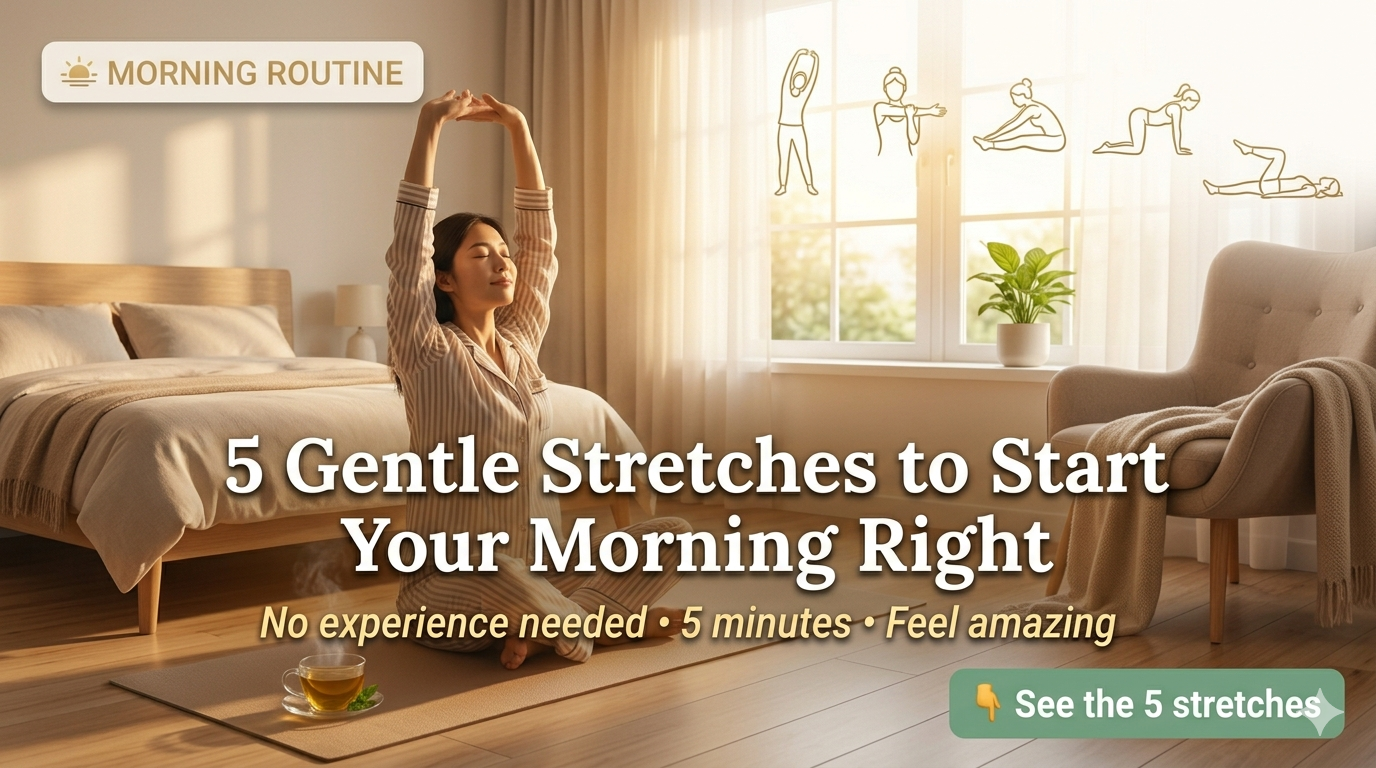
Try this simple morning stretch routine for beginners. 10 easy stretches to boost energy, ease stiffness, and improve flexibility in just 10 minutes.
By FitHealthyMind.com Editorial Team | Reading time: about 15 minutes
If you wake up feeling stiff, sluggish, or groggy, a simple morning stretch routine for beginners may be one of the easiest habits you can add to your day. You do not need a gym, a yoga mat (though it helps), or any experience. You only need about 10 minutes and a little floor space.
In this guide, you will learn exactly how to stretch in the morning, why it may help you feel more energized and flexible, and how to do 10 easy stretches step by step. You will also get a printable-style 10-minute sequence, common mistakes to avoid, a 7-day starter plan, and answers to the questions beginners ask most.
Quick answer: A good beginner morning stretch routine includes gentle movements for your neck, shoulders, back, hips, and legs. Hold each stretch for 20 to 30 seconds, breathe slowly, and never push into pain. Done daily, it takes about 10 minutes.
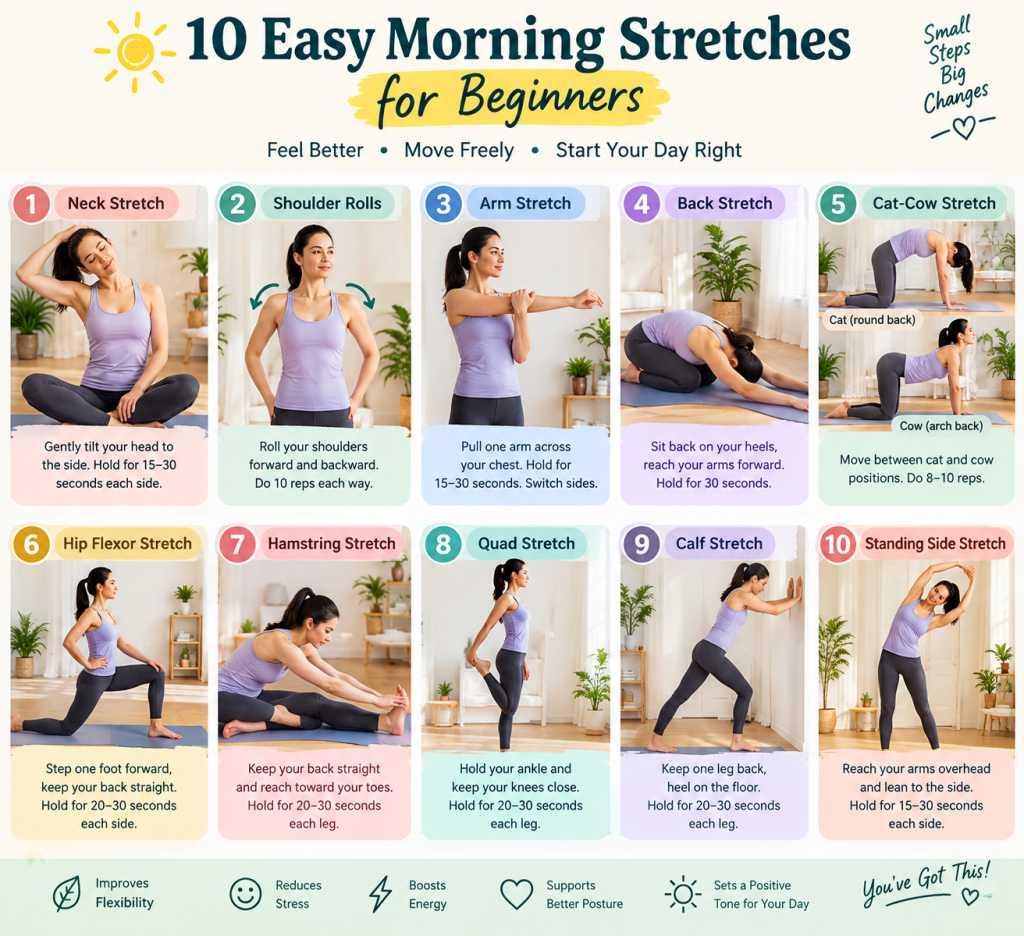
Table of Contents
- Why Stretching in the Morning Is Worth It
- Benefits of a Morning Stretch Routine
- Before You Start: Safety and Setup
- The 10 Easy Morning Stretches for Beginners
- Your 10-Minute Morning Stretch Routine (Full Sequence)
- 7-Day Beginner Stretching Plan
- How Long Should You Hold Each Stretch?
- Common Morning Stretching Mistakes
- Tips to Make the Habit Stick
- Easy Modifications for Different Needs
- Stretching vs. Warming Up: What Is the Difference?
- Frequently Asked Questions
- Final Thoughts
Why Stretching in the Morning Is Worth It
Overnight, your body stays in one or two positions for hours. Muscles and connective tissue can feel tight when you first get up, and your joints may feel stiff for the first few minutes of movement. Many people also wake up with a quiet, heavy feeling and reach for caffeine right away.
A short stretching session gives your body a gentle signal that the day has started. It increases movement through your joints, encourages deeper breathing, and gives you a few calm minutes before screens, emails, and responsibilities take over.
The best part for beginners: stretching is low impact, low cost, and easy to scale. If you have two minutes, you can do three stretches. If you have ten minutes, you can do the whole routine below.
Benefits of a Morning Stretch Routine
Research on stretching shows that regular practice can improve flexibility and range of motion, and many people report that it also helps them feel more relaxed and alert. Individual results vary, but here are the benefits most commonly associated with a consistent morning stretch habit.
Improved Flexibility and Range of Motion
Regular stretching over several weeks is linked with better flexibility. That can make everyday tasks, like bending to tie your shoes, reaching a high shelf, or looking over your shoulder while driving, feel easier.
Less Morning Stiffness
Moving your joints through gentle ranges of motion can help ease that stiff, creaky feeling many people notice after waking. If your stiffness is severe, lasts a long time, or comes with swelling, speak with a healthcare professional.
A Natural Energy Lift
Stretching combined with deep breathing wakes up your body without any stimulants. Many beginners say they feel more awake after five to ten minutes of easy movement, even before coffee.
Better Posture Awareness
Sitting at a desk or looking at a phone can round the shoulders and tighten the chest and hips. Stretching these areas each morning helps you notice how you hold your body and encourages a more upright, comfortable posture.
A Calmer Start to the Day
Slow stretching paired with steady breathing can help you feel calmer and more focused. Even a few minutes of mindful movement can create a mental pause before a busy day.
A Gateway Habit
Stretching is one of the easiest ways to build a healthy morning routine. Once you are doing it daily, it becomes simple to add a walk, a glass of water, or a short workout.
Before You Start: Safety and Setup
Stretching is generally safe, but a few simple rules keep it comfortable and effective.
Talk to a Professional If Needed
If you have an injury, recent surgery, a chronic condition, are pregnant, or have ongoing pain, check with your doctor or a physical therapist before starting a new stretching routine. This guide is educational and is not a substitute for personal medical advice.
The Golden Rule: Stretch, Do Not Strain
You should feel a gentle pull or mild tension. You should never feel sharp, stabbing, burning, or pinching pain. If you do, ease off or stop.
What You Need
- A comfortable, clear space about the size of a yoga mat
- A yoga mat, carpet, or folded blanket (optional)
- Comfortable clothes that let you move
- A towel or belt (optional, for the hamstring stretch)
- A timer or a calm playlist (optional)
Quick Wake-Up Tip
If you feel very stiff, take one minute before you begin to walk around, roll your shoulders, and take five slow breaths. This makes the first stretches feel easier.
The 10 Easy Morning Stretches for Beginners
Follow the stretches in order. They move from the top of your body to the bottom, and from standing to the floor and back up, so the whole sequence feels smooth.
Track Your Daily Habits With Streakify AI
Stop guessing what works. Track your daily routines, build powerful streaks and stay consistent with a clean, modern habit tracker made for fitness, wellness and self-improvement.
- ✔ Editable HTML planner
- ✔ Printable and mobile friendly
- ✔ Instant digital download
- ✔ No subscription required
One-time purchase • Instant access
Want to see real progress? Track your daily habits and build streaks with Streakify AI, our premium habit tracker.
Download the Free Printable Habit Tracker
Start building healthy habits today. Print it, hang it up and tick off each day. No sign-up needed.
Want streaks, tracking and more? Try Streakify AI Premium.
1. Overhead Reach (Full-Body Wake-Up Stretch)
Targets: Shoulders, sides of the torso, spine, arms
How to do it:
- Stand with your feet about hip-width apart.
- Inhale and slowly raise both arms overhead, interlacing your fingers if comfortable.
- Turn your palms toward the ceiling and gently press up as if you are growing taller.
- Keep your ribs relaxed and your shoulders away from your ears.
- Hold for 20 to 30 seconds, breathing slowly.
Why it helps: This is the classic “just woke up” stretch. It lengthens the whole front and sides of your body and encourages deeper breaths.
Beginner tip: If your shoulders feel tight, keep your arms slightly wider than shoulder-width or bend your elbows a little.
2. Side Neck Stretch
Targets: Sides of the neck, upper trapezius
How to do it:
- Sit or stand tall with your shoulders relaxed.
- Slowly tilt your right ear toward your right shoulder.
- Let the weight of your head create the stretch. Do not pull on it.
- For a deeper stretch, gently reach your left hand toward the floor.
- Hold for 20 seconds, then switch sides.
Why it helps: Many of us carry tension in the neck from sleeping position, phone use, or desk work. This stretch releases it gently.
Beginner tip: Keep your movement slow. Never roll your neck backward aggressively or force the stretch.
3. Chest and Shoulder Opener
Targets: Chest, front of the shoulders, upper back
How to do it:
- Stand tall and clasp your hands behind your back. If that is hard, hold a towel between your hands.
- Gently straighten your arms and lift them slightly away from your body.
- Open your chest and draw your shoulder blades toward each other.
- Keep your chin level and avoid arching your lower back.
- Hold for 20 to 30 seconds.
Why it helps: This stretch counteracts the forward-rounded posture from sitting and screen time.
Beginner tip: A doorway stretch is a good alternative. Place your forearm on the door frame and gently step forward until you feel a stretch across your chest.
4. Standing Side Bend
Targets: Obliques, lats, sides of the waist
How to do it:
- Stand with your feet hip-width apart and raise your arms overhead.
- Hold your right wrist with your left hand.
- Inhale to lengthen, then exhale and lean gently to the left.
- Keep both hips level and avoid twisting forward or backward.
- Hold for 20 seconds, return to center, and repeat on the other side.
Why it helps: It opens the sides of the body, which rarely get stretched in daily life, and makes breathing feel deeper.
Beginner tip: Imagine you are standing between two panes of glass so your body stays on one flat plane.
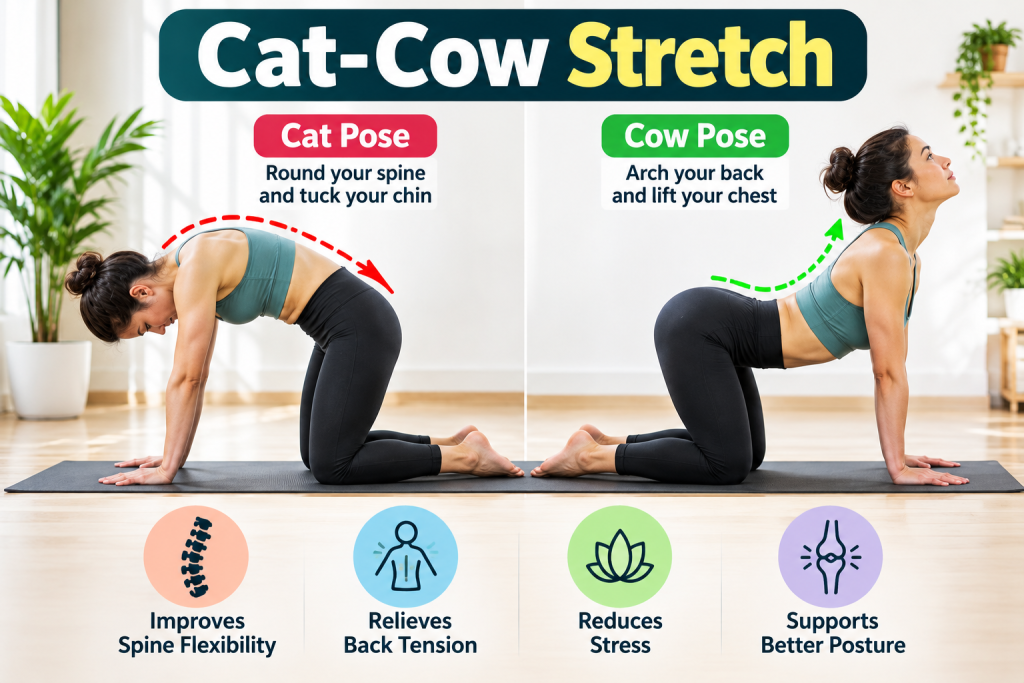
5. Cat-Cow Stretch
Targets: Spine, neck, abdomen, lower back
How to do it:
- Start on your hands and knees with your wrists under your shoulders and knees under your hips.
- Cow: Inhale, let your belly drop, and lift your chest and tailbone slightly.
- Cat: Exhale, round your spine toward the ceiling, and tuck your chin toward your chest.
- Move slowly between the two positions with your breath.
- Repeat 8 to 10 times.
Why it helps: This is one of the most popular beginner stretches for waking up the spine. The movement is gentle and rhythmic, which makes it great first thing in the morning.
Beginner tip: If your wrists feel sensitive, make fists and rest on your knuckles or use a folded towel under your hands. Pad your knees if needed.
6. Child’s Pose
Targets: Lower back, hips, thighs, shoulders
How to do it:
- From hands and knees, bring your big toes together and widen your knees slightly.
- Sit your hips back toward your heels.
- Walk your hands forward and rest your forehead on the mat.
- Relax your shoulders and breathe deeply into your back.
- Hold for 30 to 45 seconds.
Why it helps: Child’s pose is restful and calming. It gently stretches the lower back and hips and gives you a moment to slow down.
Beginner tip: Place a pillow or folded blanket between your hips and heels, or under your forehead, if you feel any strain.
7. Low Lunge (Hip Flexor Stretch)
Targets: Hip flexors, quadriceps, groin
How to do it:
- From hands and knees, step your right foot forward between your hands.
- Lower your left knee to the mat (add padding if needed).
- Slide your left knee back slightly until you feel a stretch at the front of your left hip.
- Place your hands on your right thigh and keep your chest tall.
- Hold for 20 to 30 seconds, then switch sides.
Why it helps: Long periods of sitting can shorten the hip flexors. Opening them each morning helps you stand and walk more comfortably.
Beginner tip: Gently tuck your tailbone under and squeeze the glute of the back leg to feel the stretch more at the hip rather than the lower back.
8. Seated Spinal Twist
Targets: Spine, back muscles, hips, glutes
How to do it:
- Sit on the floor with your legs extended.
- Bend your right knee and place your right foot outside your left thigh.
- Place your right hand behind you for support.
- Hook your left elbow outside your right knee or hold your knee gently.
- Inhale to sit tall, exhale and turn slightly more. Look over your right shoulder.
- Hold for 20 to 30 seconds, then switch sides.
Why it helps: Gentle twisting brings mobility to the spine and can feel wonderful after sleeping.
Beginner tip: If sitting on the floor is uncomfortable, do a twist in a chair. Sit tall, turn your torso, and hold the chair back.
9. Lying Hamstring Stretch
Targets: Hamstrings, calves, lower back
How to do it:
- Lie on your back with both knees bent.
- Lift your right leg and loop a towel or belt around the ball of your foot.
- Slowly straighten your leg toward the ceiling as far as is comfortable.
- Keep your head and shoulders relaxed on the floor.
- Hold for 20 to 30 seconds, then switch legs.
Why it helps: Tight hamstrings are very common, especially for people who sit a lot. Doing this lying down protects your lower back and makes the stretch easier to control.
Beginner tip: It is fine if your leg stays bent. Flexibility improves gradually with consistent practice.
10. Standing Forward Fold (Soft Knees)
Targets: Hamstrings, calves, lower back, neck
How to do it:
- Stand with your feet hip-width apart.
- Bend your knees generously and hinge forward from your hips.
- Let your upper body hang heavy. Hold opposite elbows or rest your hands on your shins or thighs.
- Relax your head and neck.
- Hold for 20 to 30 seconds. To come up, bend your knees, engage your core, and roll up slowly.
Why it helps: This is a calming finish that gives a gentle stretch along the back of the body and lets blood flow toward your head, which many people find refreshing.
Beginner tip: Always keep a soft bend in the knees to protect your lower back. Rise slowly to avoid lightheadedness.
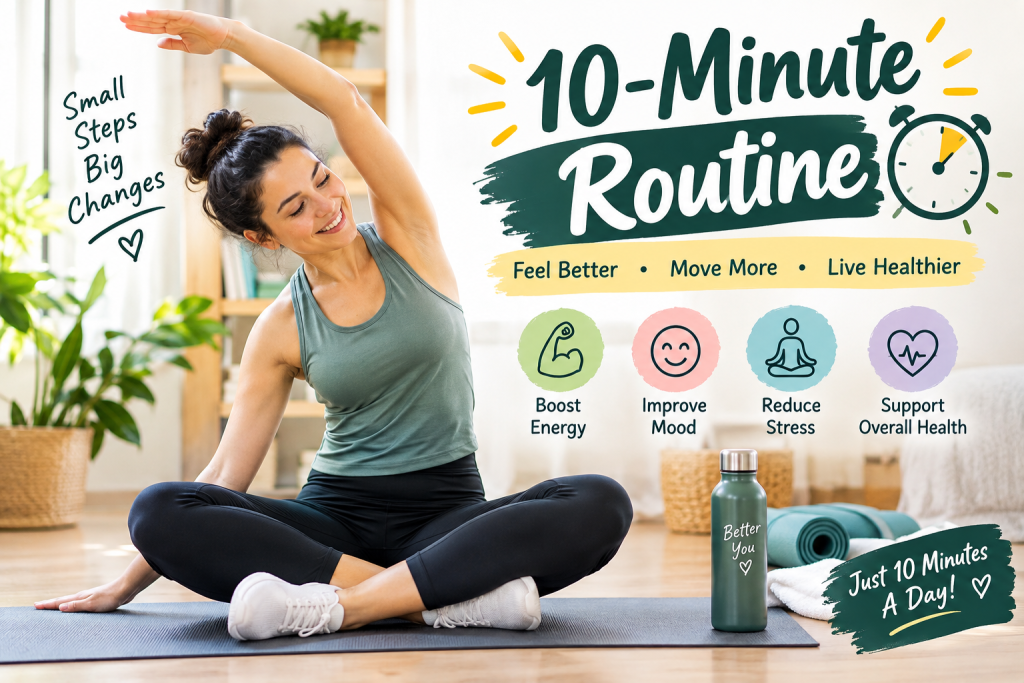
Your 10-Minute Morning Stretch Routine (Full Sequence)
Use this quick reference when you are ready to put everything together.
| Order | Stretch | Time | Body Area |
|---|---|---|---|
| 1 | Overhead Reach | 30 sec | Full body |
| 2 | Side Neck Stretch | 20 sec each side | Neck |
| 3 | Chest and Shoulder Opener | 30 sec | Chest, shoulders |
| 4 | Standing Side Bend | 20 sec each side | Sides of torso |
| 5 | Cat-Cow | 8 to 10 slow rounds | Spine |
| 6 | Child’s Pose | 45 sec | Back, hips |
| 7 | Low Lunge | 30 sec each side | Hip flexors |
| 8 | Seated Spinal Twist | 30 sec each side | Spine, hips |
| 9 | Lying Hamstring Stretch | 30 sec each leg | Hamstrings |
| 10 | Standing Forward Fold | 30 sec | Back of body |
Total time: roughly 9 to 11 minutes, depending on your breathing pace and transitions.
Short on time? Do the 3-minute version: Overhead Reach, Cat-Cow, and Standing Forward Fold. Doing a little every day is better than doing a lot once in a while.
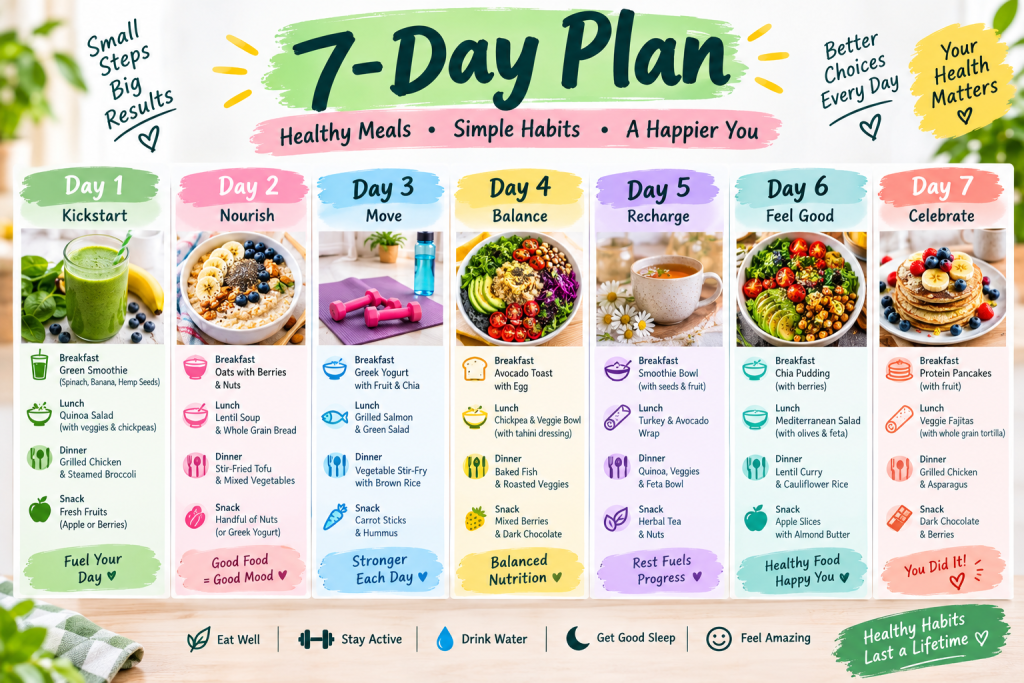
7-Day Beginner Stretching Plan
If you like structure, follow this simple one-week plan. Start gently and build comfort.
- Day 1: Do stretches 1 to 5 only. Hold each for 20 seconds.
- Day 2: Do stretches 6 to 10 only. Focus on slow breathing.
- Day 3: Do the full routine with 20-second holds.
- Day 4: Rest or take a gentle 10-minute walk. Do the Overhead Reach and Cat-Cow only.
- Day 5: Do the full routine with 25-second holds.
- Day 6: Do the full routine with 30-second holds.
- Day 7: Do your favorite five stretches and note how your body feels compared with Day 1.
Track your progress: Write down how stiff you feel (1 to 10) and your energy level (1 to 10) before and after. After a week, many people notice the numbers shift in a positive direction.
How Long Should You Hold Each Stretch?
For general flexibility, many fitness guidelines suggest holding static stretches for roughly 15 to 30 seconds, and repeating each stretch two to four times when you have time. For a quick morning routine, one round of 20 to 30 seconds is a great starting point.
A few general principles:
- Breathe. Inhale through your nose, exhale slowly. Exhaling often helps you relax deeper into a stretch.
- Be gentle in the morning. Your body is cooler and stiffer, so aim for about a 5 or 6 out of 10 in intensity.
- Do not bounce. Smooth, steady holds are safer than bouncing movements.
- Stretch both sides. Try to spend equal time on each side.
- Be consistent. Daily practice for a few weeks matters more than one long session.
Common Morning Stretching Mistakes
Avoid these common beginner errors to get more benefit and stay comfortable.
Pushing Too Hard
More pain does not mean more gain. Stretching should feel like a gentle pull, not a strain.
Holding Your Breath
Holding your breath tightens the body. Keep your breathing slow and steady.
Rushing Through the Routine
Speeding through eliminates the calming benefit. Slow down, even if you only do five stretches.
Skipping the Transitions
Move between positions carefully, especially from lying to standing, to avoid dizziness.
Locking Your Joints
Keep a soft bend in your knees and elbows during standing stretches.
Comparing Yourself to Others
Flexibility varies widely from person to person. Compare yourself only to your own progress.
Ignoring Pain Signals
Sharp, shooting, or numbing sensations are a signal to stop and, if they continue, speak with a healthcare professional.
Tips to Make the Habit Stick
The best routine is the one you actually do. Try these simple habit-building ideas.
- Stack it onto an existing habit. Stretch right after you brush your teeth or before your first cup of tea or coffee.
- Lay out your mat the night before. Seeing it first thing removes friction.
- Start small. Commit to just three stretches for the first few days. Momentum builds quickly.
- Use a calming playlist or timer. Music or a 10-minute timer helps you stay on track.
- Hydrate first. A glass of water after waking is a great companion habit.
- Track your streak. A simple calendar with an X for each day can be surprisingly motivating.
- Be kind to yourself. If you miss a day, just resume the next morning.
Easy Modifications for Different Needs
If You Have Limited Mobility or Cannot Get on the Floor
Many of these stretches can be done standing or seated. Replace Cat-Cow with a seated version (arch and round your back while sitting in a chair), replace the lunge with a standing quad stretch while holding a counter, and do the twist in a chair.
If You Have a Desk Job
This routine counteracts long hours of sitting. Consider repeating stretches 1, 2, 3, and 10 at your desk once or twice during the day.
If You Are Very Stiff
Limit holds to 10 to 15 seconds at first, use props like towels, pillows, or blocks, and increase gradually over a couple of weeks.
If You Are Older or Returning After a Break
Move slowly, use a sturdy chair or wall for balance, and check with your doctor if you are unsure which movements are appropriate.
Stretching vs. Warming Up: What Is the Difference?
Stretching and warming up are related but not identical. A warm-up raises your body temperature and heart rate through light movement such as marching in place or arm circles. Static stretching, which is what this routine uses, involves holding a position to lengthen muscles.
If you plan to exercise intensely after stretching, add a short warm-up first, such as one to two minutes of marching or easy walking, followed by dynamic movements. For a general morning wake-up and flexibility routine, gentle static stretching after a minute of easy movement works well for most beginners.
Frequently Asked Questions
What is the best morning stretch routine for beginners?
The best routine is one that is gentle, easy to remember, and covers the major areas of the body: neck, shoulders, spine, hips, and legs. The 10-stretch sequence in this guide takes about 10 minutes and is designed for people with no previous experience.
How long should a beginner stretch in the morning?
Five to ten minutes is plenty. If you are short on time, even three minutes of stretching is better than none.
Is it good to stretch right after waking up?
For most healthy people, yes, as long as you stretch gently. Your muscles may feel stiff in the morning, so start slowly, take a few deep breaths, and avoid forcing any position. Consider a minute of light walking first.
Can morning stretching boost energy?
Many people report feeling more alert after stretching because it combines gentle movement with deep breathing. It is not a replacement for good sleep, nutrition, or medical care, but it is a simple, natural way to wake up the body.
Should I stretch before or after coffee?
Either works. Some people like to stretch first to wake up naturally and then enjoy coffee as part of a calm routine. Choose whatever you will do consistently.
How often should I stretch to see results?
Daily practice is ideal. Many people notice that they feel looser within a week or two, while measurable flexibility improvements often take several weeks of regular stretching.
Does stretching help with back pain?
Gentle stretching and movement can help some people with muscle tightness and stiffness. However, back pain has many causes. If you have persistent, severe, or worsening pain, or pain that travels down a leg, see a healthcare professional.
Can I do these stretches in bed?
Some of them, yes. In bed you can do a gentle overhead reach, knee-to-chest stretches, and a lying spinal twist. For the best effect, move to a firm surface and stand up for the rest of the routine.
Will stretching help me lose weight?
Stretching burns very few calories on its own, so it is not a weight loss method. However, it supports mobility and a consistent healthy routine, which can make it easier to stay active in other ways.
For a more complete approach to weight management, combine gentle stretching with healthy nutrition and regular exercise.
How is stretching different from yoga?
Yoga often includes stretching, but it also combines breathing, balance, strength, and mindfulness in structured sequences. This routine uses a few yoga-inspired poses in a simple, beginner-friendly stretching format.
Is it normal to feel sore after stretching?
Mild tightness can happen when you are new to stretching, but you should not feel intense pain or soreness. If you do, reduce the intensity and the time of your holds.
How long should a beginner morning stretch routine last?
A beginner morning stretch routine can take 5–10 minutes. Start with gentle movements and focus on major areas such as the neck, shoulders, back, hips, and legs. As you become more comfortable, you can gradually increase the time or add more stretches.
Is it okay to stretch every morning as a beginner?
Yes, gentle stretching can be part of a daily morning routine for many beginners. Keep the movements slow and comfortable, avoid bouncing, and never force a stretch into pain. Consistency is more important than stretching for a long time.
Final Thoughts
A simple morning stretch routine for beginners does not need to be complicated, long, or intense. Ten easy stretches, a few slow breaths, and about ten minutes are enough to help you move more comfortably, feel more awake, and start your day with intention.
Start with the 3-minute version if you need to. Follow the 7-day plan. Listen to your body, stay patient, and focus on consistency rather than perfection. Over time, you may find that this small habit makes a big difference in how you feel every morning.
Ready for more? Explore our other guides on FitHealthyMind.com for simple workouts, healthy habits, and wellness tips that fit into a busy life.
Disclaimer: This article is for general educational purposes only and does not replace advice from a qualified healthcare professional. Consult your doctor or physical therapist before beginning any new exercise program, especially if you have an injury, medical condition, or are pregnant.