
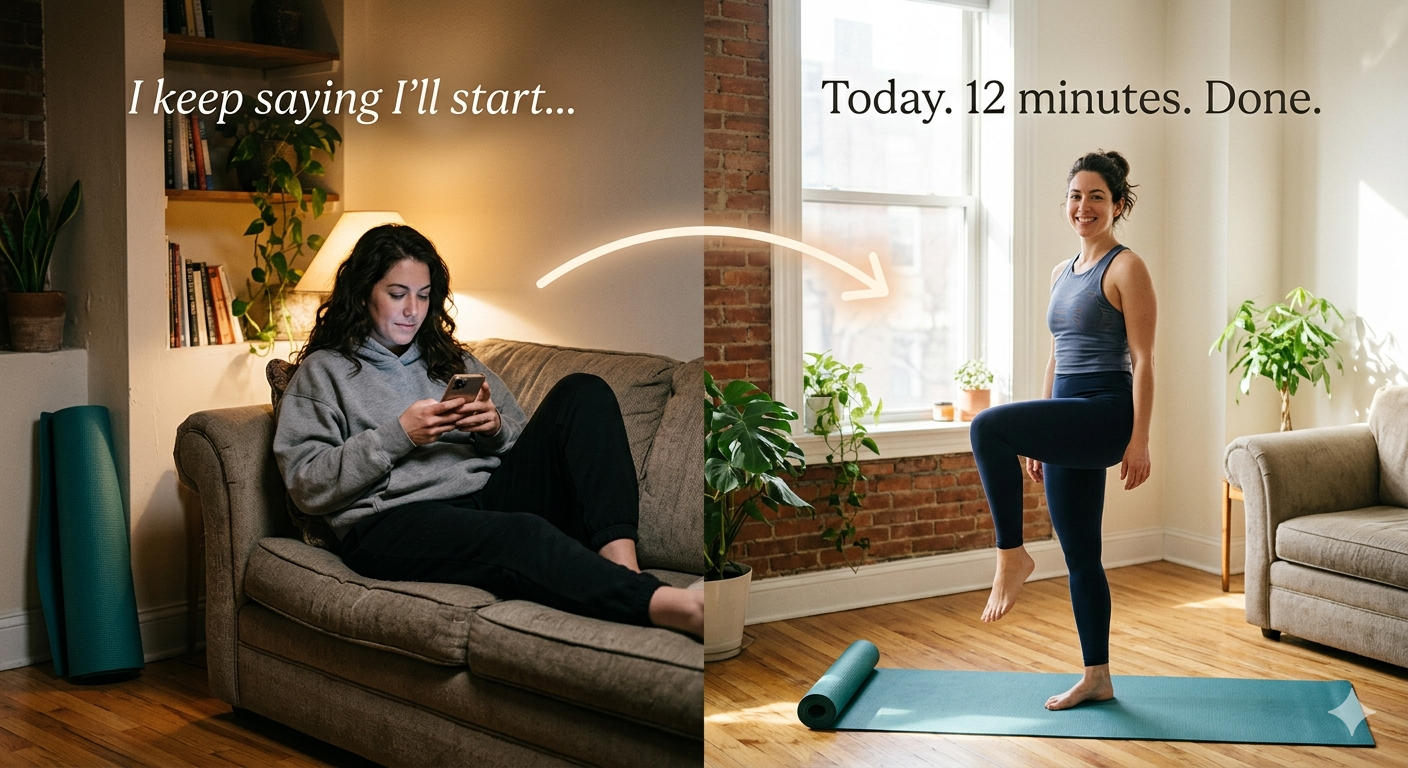
Thinking about starting a beginner fitness routine at home? Here are 5 powerful reasons to begin today, plus a simple no-equipment plan to follow.
By FitHealthyMind.com Editorial Team | Reading time: about 14 minutes
If you have been telling yourself “I will start exercising next Monday,” this guide is for you. A beginner fitness routine at home removes the biggest barriers that stop people from getting started: gym fees, travel time, crowded machines, and the fear of being judged.
In this article, you will learn the 5 best reasons to start a beginner fitness routine at home today, how to begin safely, a simple no-equipment workout you can follow right away, a 4-week starter plan, and answers to the most common questions beginners ask.
Quick answer: You should start a home fitness routine today because it saves time and money, removes excuses, lets you build consistency at your own pace, supports your physical and mental health, and needs almost no equipment. Even 15 to 20 minutes, three or four days a week, is a great place to begin.
Table of Contents
- Reason 1: It Saves You Time and Money
- Reason 2: It Removes the Excuses That Keep You Stuck
- Reason 3: You Can Learn at Your Own Pace, Without Pressure
- Reason 4: It Supports Your Body and Your Mind
- Reason 5: You Barely Need Any Equipment
- How to Start Safely as a Complete Beginner
- Your Simple Beginner Home Workout (No Equipment)
- 4-Week Beginner Home Fitness Plan
- Common Beginner Mistakes to Avoid
- How to Stay Consistent
- Frequently Asked Questions
- Final Thoughts
Reason 1: It Saves You Time and Money
The first and most practical reason to start a beginner fitness routine at home is simple: it costs far less and takes far less time.
No Membership Fees
Gym memberships, classes, and personal training sessions add up quickly over a year. A home routine can start for free. Your own bodyweight, a clear patch of floor, and a free or low-cost video or written plan are enough to begin.
No Commute
Travelling to a gym often adds 20 to 60 minutes to every workout once you count getting ready, driving or walking, parking, and waiting for equipment. At home, your workout starts the moment you decide to begin. That means a 20-minute session really takes 20 minutes.
Easy to Fit Into a Busy Day
Because there is no travel, you can exercise before work, during a break, after the kids are in bed, or while dinner is in the oven. Short sessions count. Many people find that three 10-minute bursts are easier to maintain than one long workout.
A Small Investment With Big Returns
Even if you later buy a few items such as a yoga mat, resistance bands, or a pair of dumbbells, the one-time cost is usually small compared with ongoing membership fees.
Takeaway: If time and budget have been your obstacles, a home routine takes both off the table.
Reason 2: It Removes the Excuses That Keep You Stuck
Most beginners do not fail because they lack motivation. They fail because there is too much friction between the intention and the action. Working out at home reduces that friction dramatically.
Weather Does Not Matter
Rain, heat, cold, or dark evenings will not cancel your plan. Your living room is always open.
No “I Have Nothing to Wear” Problem
You do not need stylish gym clothes. Comfortable clothing and a pair of supportive shoes (or bare feet on a non-slip surface for certain exercises) are enough.
Privacy and Comfort
Many first-time exercisers feel anxious about being watched or compared with others. At home, you can make mistakes, rest when you need to, and move at your own speed without feeling self-conscious.
Flexible Scheduling
Gyms and classes run on fixed timetables. Your home routine runs on yours. If your schedule changes, your workout simply moves with it.
Habit Stacking Becomes Easy
You can attach your workout to something you already do every day. For example: after you brush your teeth, you do 10 minutes of exercise. Over time, the cue triggers the habit automatically.
Takeaway: When starting is easy, consistency becomes much more likely, and consistency is what produces results.
Reason 3: You Can Learn at Your Own Pace, Without Pressure
Beginners often worry that they will not know what to do or will look out of place. A home environment solves this by giving you time and space to learn properly.
Master the Basics First
Fundamental movements such as squats, push-ups, lunges, and planks are the foundation of most fitness programs. At home, you can practice them slowly, check your form in a mirror or on video, and repeat as often as you like before moving on.
Adjust Intensity Easily
If an exercise feels too hard, make it easier. If it feels too easy, make it harder. For example:
- Push-ups: Start against a wall, then a countertop, then your knees, then the floor.
- Squats: Start by sitting down onto and standing up from a chair, then progress to full bodyweight squats.
- Planks: Begin with a short hold on your knees, then extend the time or lift your knees.
Rest Without Guilt
You can take extra breaks, drink water, or stop completely if something feels wrong. Listening to your body is a skill, and home workouts give you the freedom to practice it.
Track Your Own Progress
You are not competing with anyone else. Keep a simple notebook or phone note with how many repetitions you did, how long you exercised, and how you felt. Seeing your own numbers improve is highly motivating.
Takeaway: Confidence grows when you feel safe to learn. Home is the safest place to build that confidence.
Reason 4: It Supports Your Body and Your Mind
Regular physical activity is one of the best-supported habits for long-term health. You do not have to be in a gym to receive these benefits.
Heart and General Health
Health organizations such as the World Health Organization recommend that adults aim for at least 150 minutes of moderate-intensity physical activity per week, along with muscle-strengthening activities on two or more days. A home routine can help you work toward those guidelines gradually.
Strength, Mobility, and Posture
Bodyweight exercises build the muscles that support everyday life: carrying groceries, climbing stairs, lifting children, and getting up from a chair. Mobility and stretching exercises can help you feel less stiff, especially if you sit for long periods.
Energy Levels
Many beginners report feeling more energetic within a few weeks of regular movement. While results vary from person to person, consistent activity combined with good sleep and nutrition often supports better daily energy.
Mood and Stress
Physical activity is widely associated with improved mood and reduced feelings of stress. A short workout can also act as a mental reset in the middle of a demanding day.
Sleep
Many people find that regular exercise helps them fall asleep more easily and sleep more deeply. For best results, avoid very intense workouts right before bed if they leave you feeling too energized.
Weight Management
Exercise can support a healthy weight when combined with balanced eating and enough sleep. It works best as part of an overall lifestyle rather than as a quick fix.
Takeaway: A beginner routine at home can improve how you feel physically and mentally, and the benefits build over time.
Reason 5: You Barely Need Any Equipment
One of the biggest myths about fitness is that you need expensive machines to get results. In reality, a surprising amount of progress can be made with your own bodyweight.
What You Can Do With Zero Equipment
- Squats and sit-to-stands
- Lunges and step-backs
- Wall, incline, or knee push-ups
- Glute bridges
- Planks and dead bugs
- Marching, jumping jacks, and brisk stair climbing
- Stretching and mobility work
Optional Low-Cost Equipment
If you want to add variety later, these items are affordable and space-friendly:
- Yoga mat: Cushions your knees, back, and wrists.
- Resistance bands: Add resistance for legs, glutes, back, and shoulders.
- A pair of dumbbells or water bottles: Useful for progressing strength exercises.
- A sturdy chair: Great for step-ups, tricep dips, and assisted squats.
- A timer or fitness app: Keeps your intervals organized.
Small Space Is Enough
If you can lie down with your arms stretched out, you can do most beginner workouts. You do not need a dedicated room.
Takeaway: Lack of equipment is not a barrier. You can start today with what you already have.
How to Start Safely as a Complete Beginner
Beginning safely helps you avoid injury and build lasting momentum.
Check In With a Healthcare Professional if Needed
If you have a medical condition, are pregnant, have joint or heart concerns, are recovering from an injury, or have been inactive for a long time, speak with your doctor before beginning a new exercise program. This article is for general education and is not personal medical advice.
Set a Realistic Goal
Choose a goal you can measure and achieve in four weeks, for example: “Exercise for 20 minutes, three days a week” or “Complete 10 full squats in a row.”
Create Your Space
Clear a spot, move sharp objects away, and make sure the floor is not slippery. Keep water and a towel nearby.
Always Warm Up and Cool Down
Spend 3 to 5 minutes warming up with easy marching, arm circles, and hip circles. Finish with 3 to 5 minutes of gentle stretching.
Use the “Talk Test”
During moderate exercise, you should be able to talk but not sing. If you cannot speak a short sentence, slow down.
Know When to Stop
Stop and seek advice if you feel chest pain, severe dizziness, sharp pain, or unusual shortness of breath.
Your Simple Beginner Home Workout (No Equipment)
This 20-minute routine is designed for beginners. Do each exercise for 30 seconds, rest for 30 seconds, and complete two rounds.
Warm-Up (3 to 5 Minutes)
- March in place for 1 minute
- Arm circles for 30 seconds
- Hip circles for 30 seconds
- Gentle torso twists for 30 seconds
- Bodyweight squats (slow) for 1 minute
The Main Circuit
1. Sit-to-Stand or Bodyweight Squat
- Stand with feet shoulder-width apart.
- Push your hips back and bend your knees as if sitting in a chair.
- Keep your chest lifted and your knees in line with your toes.
- Press through your heels to stand.
Easier: Use a chair and lightly tap it each time. Harder: Pause at the bottom for 2 seconds.
2. Incline or Knee Push-Up
- Place your hands on a counter, sturdy table, or the floor.
- Keep your body in a straight line from head to knees or heels.
- Lower your chest toward your hands, then press back up.
Easier: Use a higher surface. Harder: Use a lower surface or the floor.
3. Glute Bridge
- Lie on your back with knees bent and feet flat.
- Press through your heels and lift your hips.
- Squeeze your glutes at the top, then lower slowly.
4. Reverse Lunge
- Stand tall with feet hip-width apart.
- Step one foot back and lower both knees.
- Push through the front heel to return to standing.
- Alternate legs.
Easier: Hold a wall or chair for balance.
5. Dead Bug
- Lie on your back with arms reaching toward the ceiling and knees bent over your hips.
- Slowly lower your right arm and left leg toward the floor.
- Return and switch sides, keeping your lower back gently pressed down.
6. Forearm or Knee Plank
- Rest on your forearms and toes, or forearms and knees.
- Keep a straight line from head to hips to knees or heels.
- Breathe steadily and hold.
7. Standing Marches or Jumping Jacks (Low-Impact Option)
- March in place, lifting knees comfortably.
- Swing your arms naturally.
- To make it harder, step wide side to side with arms overhead.
Cool-Down (3 to 5 Minutes)
- Standing quad stretch: 20 seconds per leg
- Hamstring stretch: 20 seconds per leg
- Chest opener: 20 seconds
- Child’s pose: 30 seconds
- Deep breathing: 5 slow breaths
4-Week Beginner Home Fitness Plan
Use this simple structure to build the habit and gradually increase difficulty.
Track Your Daily Habits With Streakify AI
Stop guessing what works. Track your daily routines, build powerful streaks and stay consistent with a clean, modern habit tracker made for fitness, wellness and self-improvement.
- ✔ Editable HTML planner
- ✔ Printable and mobile friendly
- ✔ Instant digital download
- ✔ No subscription required
One-time purchase • Instant access
Want to see real progress? Track your daily habits and build streaks with Streakify AI, our premium habit tracker.
Download the Free Printable Habit Tracker
Start building healthy habits today. Print it, hang it up and tick off each day. No sign-up needed.
Want streaks, tracking and more? Try Streakify AI Premium.
Week 1: Build the Habit
- Frequency: 3 days (for example, Monday, Wednesday, Friday)
- Workout: Main circuit, 1 round
- Extra: A 10-minute walk on two other days
- Goal: Learn the movements and finish every session
Week 2: Add a Little More
- Frequency: 3 days
- Workout: Main circuit, 2 rounds
- Extra: A 15-minute walk on two other days
- Goal: Improve your form and breathing
Week 3: Increase Challenge
- Frequency: 4 days
- Workout: Main circuit, 2 rounds, 40 seconds work and 20 seconds rest
- Extra: Gentle stretching on rest days
- Goal: Build stamina
Week 4: Test Your Progress
- Frequency: 4 days
- Workout: Main circuit, 3 rounds if comfortable, or 2 rounds with harder variations
- Extra: A 20-minute walk once
- Goal: Retest your starting numbers, for example how many squats or push-ups you can do with good form
Tip: Take a quick note or photo at the start of Week 1 and again after Week 4. The difference can be very motivating.
Common Beginner Mistakes to Avoid
Doing Too Much Too Soon
Enthusiasm is great, but jumping into daily intense workouts often leads to soreness, burnout, or injury. Start small and build.
Skipping the Warm-Up
A short warm-up prepares your muscles and joints and makes workouts feel better.
Sacrificing Form for Speed or Reps
Good technique matters more than the number of repetitions. Slow, controlled movements are safer and more effective.
Comparing Yourself With Others
Social media shows highlights, not beginnings. Measure yourself against who you were last week.
Ignoring Rest and Recovery
Muscles adapt during rest. Aim for at least one or two rest or light-activity days each week and prioritize sleep.
Relying Only on Motivation
Motivation fluctuates. Build routines, reminders, and easy starting rituals so you can exercise even on low-energy days.
Expecting Instant Results
Visible changes take time. Early wins usually look like better energy, sleep, mood, and strength before anything changes in the mirror.
How to Stay Consistent
- Schedule it. Put your workout in your calendar like any other appointment.
- Make it easy. Keep your mat visible and your workout clothes ready.
- Start with the two-minute rule. Tell yourself you will do just two minutes. Most days you will keep going.
- Pair it with something enjoyable. Listen to music, a podcast, or a favorite show while you exercise.
- Track your streak. Mark a calendar each time you complete a workout.
- Find accountability. Share your goal with a friend or family member, or join an online community.
- Reward milestones. Celebrate after completing a full week or month with something non-food related, like a new playlist or comfortable workout gear.
- Plan for obstacles. Decide in advance what you will do if you are tired, busy, or traveling, such as a shortened 10-minute workout.
- Be flexible. If you miss a day, just return to your plan the next day without guilt.
Frequently Asked Questions
Is a beginner fitness routine at home effective?
Yes. For beginners, bodyweight exercises and walking provide enough challenge to improve strength, stamina, and mobility. Effectiveness mostly depends on consistency, proper form, gradual progression, and supporting habits like sleep and nutrition.
How many days a week should a beginner work out at home?
Three days a week is an excellent starting point. As your fitness improves, you can increase to four or five days, including lighter activity days and rest days.
How long should a beginner home workout be?
Twenty to thirty minutes is plenty, including warm-up and cool-down. Even 10 to 15 minutes is valuable when you are just starting.
Do I need equipment to work out at home?
No. You can begin with only your bodyweight. Over time, resistance bands, dumbbells, and a yoga mat can add variety, but they are optional.
What is the best time of day to exercise at home?
The best time is the time you can do consistently. Some people prefer mornings for energy and routine, while others prefer evenings to release stress. Choose what fits your life.
Can I lose weight with home workouts?
Home workouts can support weight loss as part of a healthy lifestyle that includes balanced eating, adequate sleep, and regular activity. No single workout guarantees results, and progress varies by person.
Can I build muscle at home?
Beginners can build strength and muscle with bodyweight exercises and resistance bands by gradually increasing difficulty, volume, and control. Over time, adding weights can help continue progress.
How soon will I see results?
Many people notice improvements in energy, mood, and stamina within a few weeks. Strength gains often become noticeable in four to eight weeks. Visible body changes take longer and vary widely.
Is it normal to feel sore after starting?
Mild muscle soreness, especially 24 to 48 hours after new exercises, is common. Sharp, sudden, or joint pain is not normal. Reduce intensity, rest, and seek professional advice if pain continues.
Should I stretch before or after exercising?
Use light dynamic movements, such as marching and arm circles, to warm up before exercise. Save longer static stretches for after your workout when your muscles are warm.
What if I am overweight or very out of shape?
Start with low-impact options such as walking, chair-based exercises, and gentle mobility work. Increase gradually, and consider checking with a healthcare professional first. Everyone starts somewhere.
How do I stay motivated to exercise at home?
Set small goals, schedule your sessions, track progress, exercise at the same time each day, and make it enjoyable. Remember that action often creates motivation, not the other way around.
Final Thoughts
Starting a beginner fitness routine at home is one of the simplest, most affordable ways to invest in your health. It saves time and money, removes common excuses, lets you learn at your own pace, supports both body and mind, and requires almost no equipment.
You do not need a perfect plan, expensive gear, or a big block of free time. You only need to start. Choose three days this week, set a timer for 20 minutes, and complete the routine above. Then do it again.
Small, repeated actions create lasting change. Why not make today day one?
Want more simple, beginner-friendly guidance? Explore more guides on FitHealthyMind.com for workouts, stretching routines, and healthy habits you can start at home.
Disclaimer: This article is for general educational purposes only and does not replace advice from a qualified healthcare professional. Consult your doctor before starting any new exercise program, especially if you have a medical condition, injury, or are pregnant.
1 thought on “5 Reasons to Start a Beginner Fitness Routine at Home Today”