
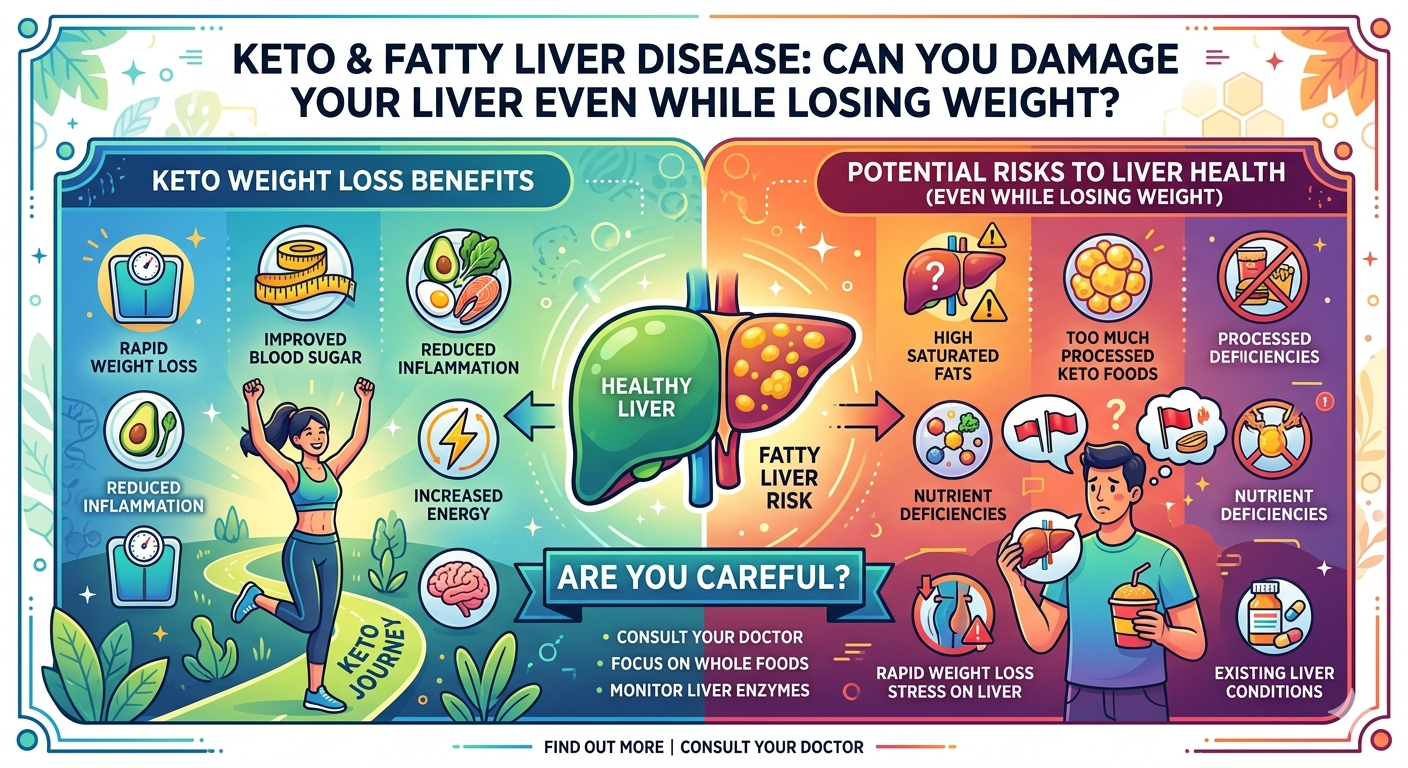
Can keto damage your liver even as you lose weight? New 2025-2026 research reveals a paradox. Here’s what you need to know before staying on keto long-term.
Let me tell you about the moment I first questioned whether keto was truly “healthy.”
I had lost 30 pounds. My blood sugar was perfect. My energy was stable. I felt like a keto success story.
Then I went for my annual physical. My doctor mentioned something about “elevated liver enzymes.” She wasn’t panicking, but she was concerned. “Your liver is working harder than it should,” she said.
I was confused. How could I be losing weight and damaging my liver at the same time?
Turns out, this is a real paradox that scientists are only now beginning to understand.
What Is Fatty Liver Disease and Why Is It So Common?
Fatty liver disease (hepatic steatosis) happens when excess fat builds up in liver cells. It’s divided into:
- NAFLD (Non-Alcoholic Fatty Liver Disease) – not caused by alcohol
- AFLD (Alcoholic Fatty Liver Disease) – caused by heavy drinking
Why so common?
Obesity, insulin resistance, high sugar intake, and sedentary lifestyles have made NAFLD affect ~25–30% of adults worldwide — often without symptoms until it progresses.
How the Keto Diet Affects Your Liver
The keto diet drastically reduces carbs and increases fat, forcing the liver to produce ketones for energy.
- Short-term: Many people see reduced liver fat and improved enzymes.
- Long-term or poorly planned keto: May increase liver workload, especially with low-quality fats or rapid fat loss.
Your liver becomes the central manager of fat metabolism on keto — for better or worse.
Can Keto Help Reverse Fatty Liver Disease?
Yes — potentially.
Several studies show a well-formulated keto diet can:
- Reduce liver fat
- Lower insulin levels
- Decrease inflammation
However, “reversal” is most likely in early-stage NAFLD. Severe cases require medical supervision. Keto is a tool, not a guaranteed cure.
Signs Your Liver May Be Struggling on Keto
Watch for these symptoms:
- Yellowish skin/eyes (jaundice)
- Unexplained fatigue
- Nausea or loss of appetite
- Brain fog that doesn’t improve
- Swollen legs/ankles (edema)
- Dark urine or pale stools
If you notice these — stop self-managing and see a doctor.
Rapid Weight Loss and Liver Stress: What You Need to Know
Losing weight too fast (more than 3–5 lbs per week) can actually worsen fatty liver.
Why? Rapid fat breakdown floods the liver with free fatty acids, causing oxidative stress and inflammation.
Safe keto weight loss: 1–2 lbs per week is ideal for liver health.
Healthy Fats vs. Harmful Fats on a Keto Diet
| Healthy Fats | Harmful Fats |
|---|---|
| Avocado, olive oil, nuts, seeds, fatty fish, coconut oil (in moderation) | Processed seed oils (canola, soybean), margarine, hydrogenated oils, cheap fried keto snacks |
For liver health: prioritize anti-inflammatory fats (omega‑3s, monounsaturated fats). Avoid processed “keto junk food.”
Common Keto Mistakes That May Worsen Fatty Liver
- Eating too much processed meat and cheese
- Ignoring vegetables (low fiber = poor liver detox)
- Using dirty keto (artificial ingredients, trans fats)
- Chronic high protein intake (excess converts to glucose)
- No carb refeed for months (can stress liver enzymes)
Best Foods for Supporting Liver Health on Keto
Add these liver-loving keto foods:
- Leafy greens (spinach, kale, arugula)
- Avocados (glutathione boosters)
- Garlic & onions (sulfur for liver detox)
- Salmon & sardines (omega‑3s reduce liver fat)
- Lemon juice & apple cider vinegar (gentle liver support)
- Black coffee (linked to lower liver fibrosis risk)
Is Keto Safe for People With NAFLD or Fatty Liver Disease?
Generally yes — with precautions.
Research shows low-carb, high-fat diets often reduce liver fat more than low-fat diets.
But safety depends on:
- Stage of liver disease
- Quality of keto diet
- Medical supervision
📌 If you have advanced liver disease (cirrhosis) , keto may be dangerous. Always consult a hepatologist first.
Warning Symptoms You Should Never Ignore
On keto, don’t brush off:
- Right upper abdominal pain
- Persistent yellowing of skin/eyes
- Severe fatigue that rest doesn’t fix
- Unexplained weight loss (while eating well)
- Vomiting or confusion
These could signal liver distress or ketoacidosis (rare in non-diabetics but possible).
How to Do Keto Without Damaging Your Liver
1. Eat whole food keto — no processed keto bars or oils.
2. Don’t crash diet — slow, steady fat loss.
3. Cycle carbs lightly (e.g., 20–30g net carbs from veggies).
4. Stay hydrated — water helps liver process fats.
5. Monitor enzymes — get blood work every 3–6 months.
6. Limit alcohol — zero is best for fatty liver.
When to Talk to a Doctor About Liver Health
Schedule a checkup if:
- You have NAFLD risk factors (obesity, diabetes, high triglycerides)
- You’ve been on keto 6+ months without liver testing
- You feel unusual fatigue or abdominal discomfort
- You want to start keto with known liver issues
Ask for: ALT, AST, GGT (liver enzymes) and an ultrasound if needed.
Final Thoughts: Can Keto Heal or Harm Your Liver?
Bottom line:
- Keto can heal early-stage fatty liver by reducing fat, inflammation, and insulin resistance.
- Keto can harm your liver if done with poor food choices, extreme speed, or without monitoring.
Keto isn’t good or bad for the liver — it depends entirely on how you do it.
If you have fatty liver, keto is promising but not risk-free. Prioritize whole foods, healthy fats, and regular medical checks.
First, the Good News: Keto Can Reverse Fatty Liver
Let’s start with the positive. If you already have Metabolic Dysfunction-Associated Steatotic Liver Disease (MASLD) – the new name for fatty liver – keto can actually help.
A comprehensive 2025 review found that short- to medium-term ketogenic diets can:
- Lower plasma triglycerides
- Improve hepatic steatosis (fat in the liver)
- Reduce inflammation and fibrosis
The mechanism makes sense. When insulin is high, your liver gets signals to store fat. When insulin is low – as it is in ketosis – your liver shifts to burning fat instead of storing it.
Weight loss itself, which keto promotes, is the most important strategy for fatty liver. A loss of just 7-10% improves hepatic steatosis.
The Concerning News: Keto Can Cause Fatty Liver
But here’s where it gets complicated.
A major 2025 study from the University of Utah found something alarming. When researchers put healthy mice on a ketogenic diet for nine months, the mice developed fatty liver disease – particularly the males.
“One thing that’s very clear,” explained the senior author, “is that if you have a really high-fat diet, the lipids have to go somewhere, and they usually end up in the blood and the liver.”
Wait, what? Keto is supposed to help fatty liver, not cause it.
The difference comes down to where you start. If you already have fatty liver, keto’s weight loss effects may reverse it. But if you start with a healthy liver and stay on a high-fat diet long-term, the constant lipid overload can stress the organ.
What This Means for You
| If You Have… | Keto May… | But You Should… |
|---|---|---|
| Existing fatty liver | Help reverse it with weight loss | Monitor liver enzymes every 3-6 months |
| No liver issues (healthy) | Potentially cause fatty liver over time | Limit keto to 6-12 months, then transition |
| Family history of liver disease | Be risky long-term | Consult your doctor before starting |
How to Protect Your Liver on Keto
- Don’t stay on keto for years. Use it as a tool, not a lifelong diet.
- Prioritize fat quality. Choose avocados, olive oil, nuts, seeds, and fatty fish. Avoid processed meats and unhealthy fats.
- Don’t skimp on vegetables. Low-carb vegetables provide fiber and antioxidants that support liver health.
- Get your liver enzymes checked. Before starting keto, and every 6 months while on it.
- Consider a cyclical approach. Taking breaks from keto may be healthier than continuous ketosis.
Frequently Asked Questions
1. Can I damage my liver even while losing weight on keto?
Yes. The 2025 study showed that mice lost overall body weight but still developed fatty liver. Weight loss alone does not guarantee liver health.
2. How do I know if keto is hurting my liver?
Get blood work. Ask your doctor to check ALT, AST, and GGT (liver enzymes). If they rise significantly, it’s a sign to reconsider.
3. Is the damage reversible?
Yes. When the mice were taken off keto and switched to a regular diet, their blood sugar regulation returned to normal within 4 weeks. The metabolic damage appears to be reversible.
4. Should I avoid keto if I have a family history of liver disease?
Consult your doctor first. You may be better off with a Mediterranean diet approach, which is proven to support liver health.
Tools to Help You Navigate
If you’re tracking your nutrition and want to understand your body’s needs better, sometimes a little data helps.
👉 Use Our Free Calorie Calculator
This simple tool uses the scientific Mifflin-St Jeor equation to estimate your Basal Metabolic Rate (BMR) and Total Daily Energy Expenditure (TDEE). It can help you understand approximately how many calories you need—useful whether you’re on keto or any other approach.
👉 Use Our Free Weight Loss & Fitness Calculator
This gives you a fuller picture—BMI, BMR, TDEE, daily target, and estimated timeline to your goal. A helpful way to check in with where you are.
👉 Use Our Free Fitness Unit Converter
A Tool to Support Your Mental Clarity
When you’re working on your health—whether it’s weight loss, stress management, or just feeling better day to day—your mental state matters just as much as what you eat or how you move.
Some people find that brainwave entrainment audio helps them reach states of deep relaxation, focus, or creativity more easily. Programs like [The Genius Wave] use specific sound frequencies to gently guide your brain into optimal states—whether you need to concentrate on work, unwind after a stressful day, or fall asleep more easily.
👉 [Check out The Genius Wave here]
It’s an audio-based program you can use with headphones or speakers, designed to support mental clarity and stress reduction. Many users report feeling calmer, more focused, and sleeping better with regular use.
As with any wellness tool, results vary from person to person. But if you’re looking for a natural way to support your mental state, it might be worth exploring.
“This article contains affiliate links. If you purchase through these links, I may earn a commission at no extra cost to you. I only recommend products I genuinely believe in.”