
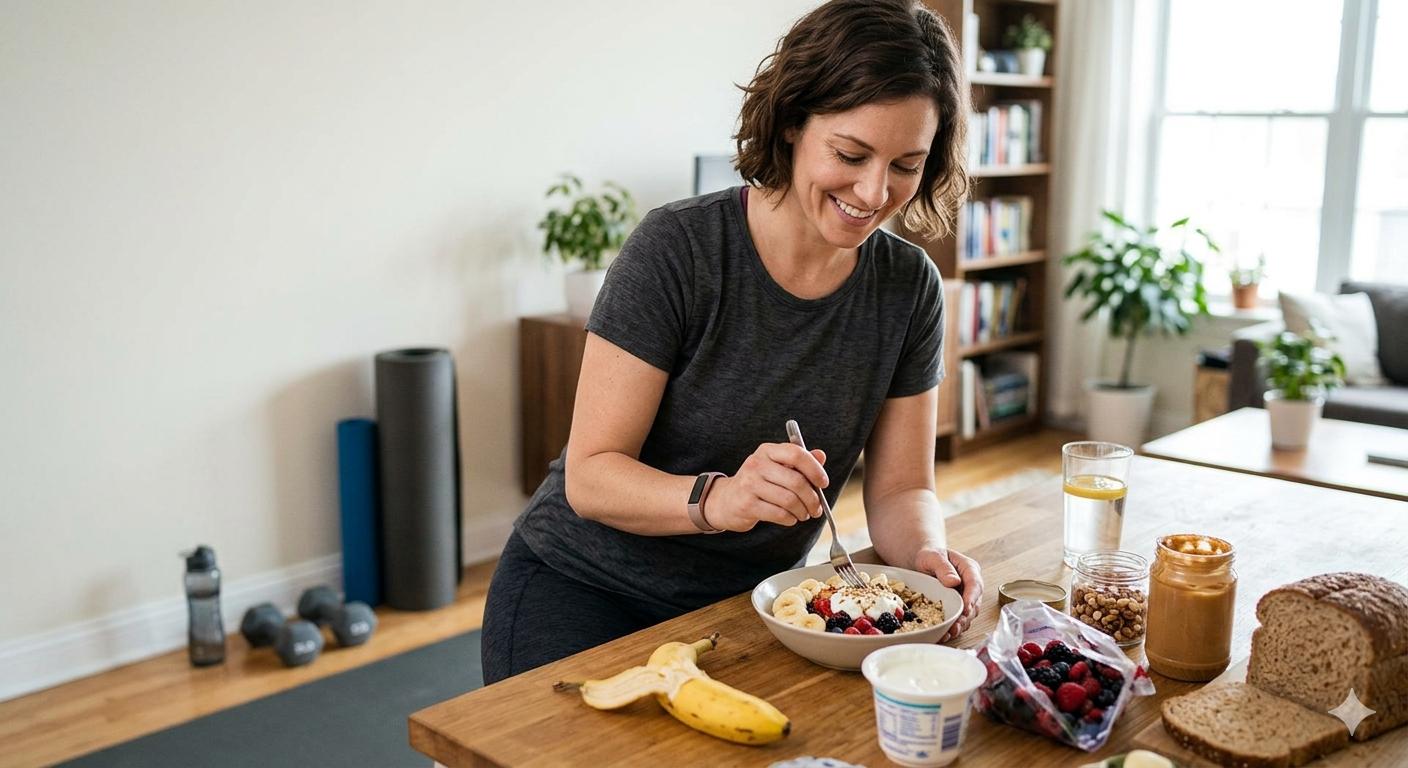
Starting to move at home? Wondering what to eat? Here’s beginner-friendly nutrition advice that actually makes sense—no complicated rules, just real food for real people
So you’ve started moving at home.
Maybe you’re doing those five-minute workouts I mentioned. Maybe you’ve unrolled your mat a few times this week. Maybe you’re even starting to enjoy it, just a little.
And now there’s this other question hovering in the back of your mind: what should I actually be eating?
It’s a fair question. The fitness world loves to make nutrition complicated. There are macros and micros and timing and supplements and rules about when to eat and what to eat and what not to eat with what else you ate. It’s exhausting just thinking about it.
But here’s the truth they don’t tell you: good nutrition for regular people is simple.
It doesn’t require counting every calorie. It doesn’t require cutting out entire food groups. It doesn’t require expensive powders or potions. It just requires paying attention—kindly, gently—to what your body is telling you.
This guide is for beginners. For people who want to support their home workouts with good food but have no idea where to start. For people in the US, UK, and Canada who are tired of diet culture and just want to feel a little better.
Let’s figure this out together.
First, Let’s Talk About Why You’re Eating
Before we get into the what, let’s talk about the why.
Most diet advice is built on a simple, damaging premise: you’re eating to get smaller. Food is the enemy. The goal is to eat as little as possible while still functioning.
But if you’re working out—even a little—your body needs fuel. It needs energy to move, to recover, to build the strength you’re asking from it.
So I want you to try shifting your mindset, just for a moment. Instead of thinking about what you “shouldn’t” eat, think about what your body needs to feel good during your workouts and throughout your day.
Food isn’t the enemy. Food is information. Food is energy. Food is how you tell your body, “I’m on your side.”
The One Thing That Matters More Than Anything Else
If you take nothing else from this article, take this: protein is your friend.
Protein does so many things, but here’s what matters for someone working out at home:
- It repairs your muscles after you move
- It keeps you full and satisfied
- It stabilizes your blood sugar so you don’t crash
- It supports your metabolism
And most people—especially women, especially as we age—don’t get nearly enough.
The good news? You don’t need to become a protein powder person if you don’t want to. You just need to think about adding a little more to each meal.
A couple of eggs at breakfast. A handful of nuts. A chicken breast at dinner. A can of tuna. A scoop of Greek yogurt. A cup of lentils. These are not complicated, expensive, or hard to find.
Just try to include some protein at every meal. That’s it. That’s the starting point.
What a Good Day of Eating Might Look Like
Let me paint you a picture of a realistic day. Not a perfect day. Not a “I followed every rule” day. Just a regular day where someone’s trying to eat in a way that supports their movement.
Morning
You wake up. You’re hungry. You make yourself a couple of eggs—scrambled, fried, whatever you have time for. You put them on a piece of toast. Maybe you have some fruit on the side, maybe you don’t.
That’s breakfast. Protein, carbs for energy, some fat from the eggs. Done.
Midday
Lunch rolls around. You’re busy, because you’re always busy. You throw together a sandwich—tuna, or chicken, or cheese, or whatever protein you have. Maybe some salad leaves if they’re in the fridge. An apple on the side.
That’s lunch. It took three minutes. You’re fed.
Afternoon
It’s 3 p.m. You’re fading. You want something. Instead of reaching for the biscuits (or maybe you do, and that’s fine), you have a yogurt. Or a handful of almonds. Or a piece of fruit with some peanut butter.
Protein and a little fat. It holds you until dinner.
Evening
Dinner is whatever you’re making for the family. Pasta with meat sauce. Chicken and vegetables. Fish with rice. Curry with lentils. You put a reasonable amount on your plate. You eat it. You enjoy it.
Later
Maybe you want something after dinner. Maybe some chocolate, maybe some crisps. You have some. You don’t spiral into guilt about it. It was a treat. Tomorrow’s another day.
Notice what this day doesn’t have: rules. Deprivation. Complicated calculations. It just has food, spread out, with a little attention to protein.
The Hydration Piece Everyone Forgets
Here’s something wild: sometimes when you think you’re hungry, you’re actually thirsty.
Your body’s signals get mixed. The part of your brain that registers thirst is close to the part that registers hunger, and messages get crossed.
So before you reach for a snack, especially if it’s not mealtime, drink a glass of water. Wait ten minutes. See how you feel.
Hydration also matters for your workouts. If you’re dehydrated, your energy drops, your muscles cramp more easily, and everything feels harder.
You don’t need a fancy water bottle with time markings. You don’t need to chug gallons. Just drink when you’re thirsty. Keep water nearby. Sip throughout the day.
What to Eat Around Your Workouts
This is where people get really anxious. “Should I eat before? After? What if I eat too close and feel sick?”
Breathe. It’s simpler than you think.
If you’re working out first thing in the morning, you don’t need to eat first. A glass of water is enough. Your body has plenty of energy stored from yesterday. Save breakfast for after.
If you’re working out later in the day, try to have a normal meal a couple of hours before. That gives your body time to digest.
If you’re hungry right before a workout and it’s been a while since you ate, have something small. A banana. A piece of toast. A few bites of yogurt. Just enough to take the edge off.
After your workout, eating something with protein is helpful. Your muscles just worked. They’re ready for repair. A glass of milk, a protein bar, your next regular meal—all good options.
That’s it. No complicated timing. No magic windows. Just eat when you’re hungry, and try to include protein after you move.
The Truth About Carbs (They’re Not the Enemy)
Somewhere along the way, carbohydrates got a terrible reputation. They became the villain in the diet industry’s story.
Here’s the truth: carbs are your body’s preferred source of energy. They’re what fuel your movement. Without them, your workouts feel harder, your energy crashes, and you crave sugar constantly.
The goal isn’t to eliminate carbs. The goal is to choose carbs that come with friends—fiber, protein, nutrients.
That means:
- Whole grains instead of white bread sometimes
- Potatoes with the skin on
- Fruit instead of fruit juice
- Oats instead of sugary cereal
But also? Sometimes you’ll have the white bread. Sometimes you’ll have the sugary cereal. Sometimes you’ll have the pasta made from refined flour because that’s what’s in the house and dinner needs to happen.
That’s fine. Really. The overall pattern matters more than any single meal.
What About Snacks?
Snacking has been demonized too, as if eating between meals is a moral failing.
But if you’re moving more, your body might genuinely need more fuel. Snacks are just small meals. They’re not good or bad.
Good snacks for someone who’s working out at home:
- An apple with peanut butter
- Greek yogurt with a spoonful of jam
- A handful of nuts and a piece of fruit
- Cheese and crackers
- Hummus with vegetables or bread
- A boiled egg
- A glass of milk
These have protein or fiber or both. They keep you going until your next meal.
The Simple Plate Method
If you want a visual guide that doesn’t require measuring or weighing, try this.
Look at your plate. Imagine dividing it into sections:
- Half the plate: vegetables or fruit
- One quarter: protein (meat, fish, eggs, beans, tofu)
- One quarter: carbohydrates (rice, potatoes, pasta, bread)
Add a little fat somewhere—oil in cooking, butter on vegetables, avocado on the side.
That’s it. That’s a balanced meal. It works for breakfast (eggs, toast, fruit), lunch (sandwich with filling and salad on the side), and dinner (chicken, rice, broccoli).
What About Weight Loss?
This is the elephant in the room, isn’t it?
Most people starting to work out are hoping it will help with weight. And it can. Movement burns energy. Movement builds muscle, and muscle burns more energy at rest.
But here’s the honest truth: you can’t outrun your fork.
If weight loss is your goal, nutrition matters more than exercise. Not because exercise isn’t important—it is, for so many reasons. But creating a calorie deficit through food is much easier than creating it through movement.
That doesn’t mean starving yourself. It doesn’t mean cutting out everything you love. It means paying attention to portions. It means eating mostly foods that nourish you, and having treats in moderation. It means being patient, because real change takes time.
If you want a clearer picture of what your body needs, our free calculator can help.
👉 Use Our Free Weight Loss & Fitness Calculator
It takes your unique stats—age, height, weight, activity level—and gives you a realistic estimate of your daily calorie needs. No judgment. No complicated charts. Just helpful information for real people in the US, UK, and Canada.
The One Rule to Break All Rules
Here’s the thing about nutrition advice: it’s all general. It’s all averages. It’s all based on studies of large groups of people, none of whom are exactly you.
So the most important rule is this: pay attention to how you feel.
When you eat a certain way, how does your body respond?
- Do you have energy or feel sluggish?
- Are you hungry an hour later or satisfied for hours?
- Do you sleep well or toss and turn?
- Do your workouts feel good or impossible?
Your body is talking to you constantly. Most of us just aren’t listening because we’re too busy following someone else’s rules.
Try something for a week. Eat a little more protein. Drink water when you’re thirsty. Have vegetables with most meals. See how you feel.
Then adjust. Add more of what works. Let go of what doesn’t.
You’re the expert on you.
The Guilt Trap
Let’s talk about guilt for a moment, because it’s the thing that actually ruins people’s relationships with food.
You eat something “bad.” Maybe you had three biscuits instead of one. Maybe you ate the whole bag of crisps while watching telly. Maybe you ordered takeaway for the third time this week.
And then the voice starts. “You’re so weak. You have no willpower. You’ve ruined everything. You might as well give up.”
That voice is lying.
One meal doesn’t ruin anything. One day doesn’t ruin anything. What ruins progress is the guilt spiral—the “I already messed up so I might as well eat whatever I want for the rest of the week.”
What if instead, you said: “That was delicious. I enjoyed it. Now I’m going to eat normally at my next meal.”
That’s it. No punishment. No extra workout to earn it back. Just… moving on.
Food is not a moral issue. Biscuits are not “bad.” You are not “good” for eating salad or “bad” for eating cake. You’re just a person, eating food, trying to feel okay in a complicated world.
Small Shifts, Not Overhauls
If you’re brand new to thinking about nutrition, do not try to change everything at once.
Pick one thing. Just one.
Maybe this week, you focus on adding protein to breakfast. Next week, you work on drinking more water. The week after, you try to have vegetables with dinner.
Small shifts compound over time. Drastic overhauls last about two weeks, then you’re back to old habits with a side of guilt.
Be patient with yourself. You didn’t get here overnight. You won’t fix it overnight. And that’s okay.
A Gentle Reminder
Your body is not a problem to be solved.
It’s not broken. It’s not failing. It’s just living in a world that makes taking care of it really, really hard.
You’re doing what you can. You’re moving a little. You’re thinking about what you eat. You’re reading articles like this one, trying to learn.
That’s enough. That’s always been enough.
The goal isn’t perfection. The goal is progress—slow, kind, sustainable progress. The goal is feeling a little better than you did last month. The goal is showing up for yourself, again and again, even when it’s hard.
You’ve got this. One meal at a time. One day at a time. One small, kind choice at a time.
FAQ :
1. Do I need to count calories or macros to see results from my home workouts?
No, absolutely not. While understanding your general needs can be helpful (which is why we offer free calculators), obsessively counting every calorie often leads to the guilt and burnout this article warns against. Focus on the quality of your food—prioritizing protein, vegetables, and whole foods—and let your hunger and energy levels be your guide.
2. What’s the single most important nutrition tip for a beginner working out at home?
Add protein to one meal. Just one. If you do nothing else, start by ensuring you have a solid source of protein at breakfast—eggs, Greek yogurt, or a protein smoothie. This one shift stabilizes your blood sugar, reduces cravings, and gives your muscles the building blocks they need to recover and grow stronger from your workouts.
3. Is it bad to work out on an empty stomach?
Not at all, especially for gentle home workouts. If you’re exercising first thing in the morning, a glass of water is perfectly fine. Your body has stored energy to burn. However, if you feel dizzy, weak, or perform a more intense session, having a small snack like a banana beforehand can help. The most important thing is to listen to your body and eat a protein-rich meal after you’re done to aid recovery.
2 thoughts on “What to Eat When You’re Working Out at Home: Simple Nutrition for Real People”