
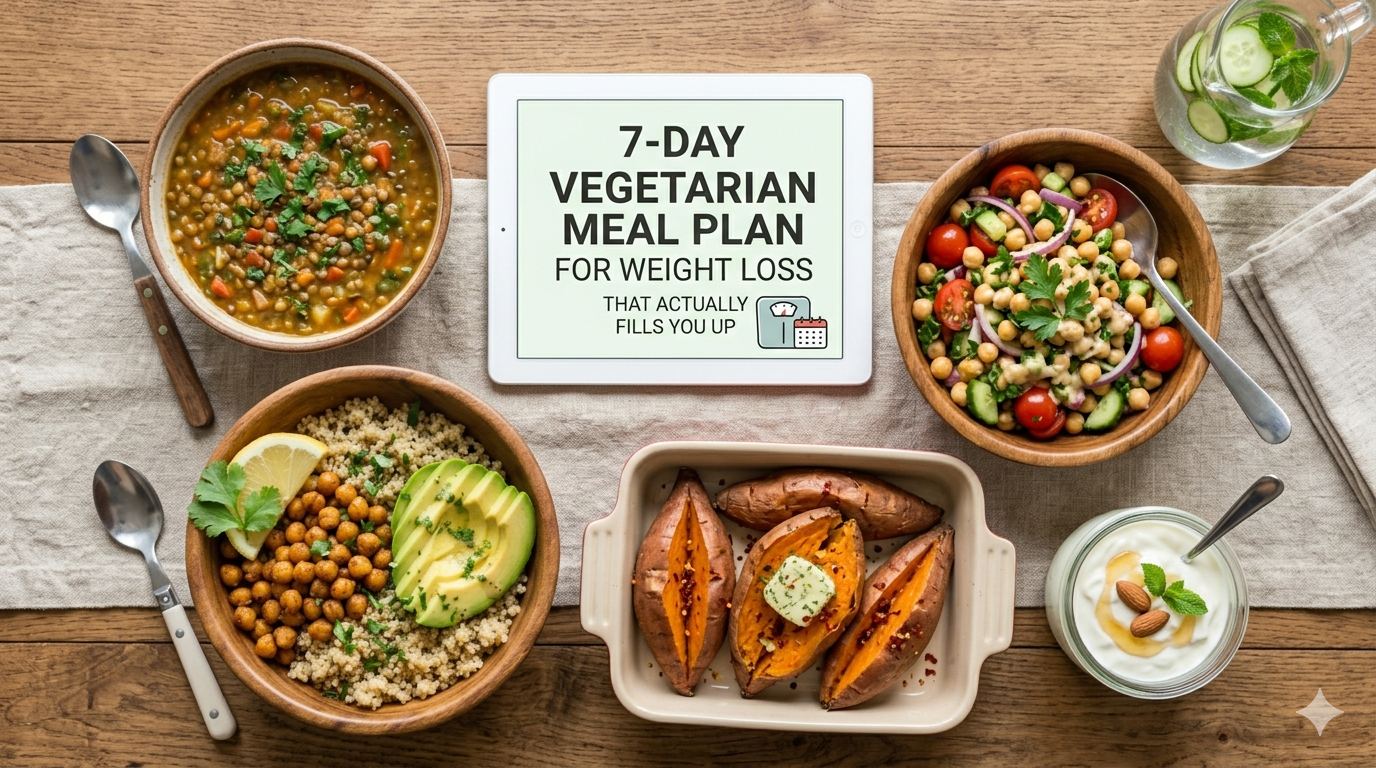
Thinking of going vegetarian to lose weight? Here’s a real-world, seven-day meal plan with delicious, filling meals
Detox & Fresh Start
Breakfast: Green detox smoothie (spinach, cucumber, apple, lemon)
Lunch: Mixed vegetable salad with olive oil & lemon
Snack: Handful of nuts or green tea
Dinner: Steamed vegetables with lentil soup
Fiber Boost Day
Breakfast: Banana oats smoothie (banana, oats, almond milk)
Lunch: Chickpea salad with tomatoes & cucumber
Snack: Fruit bowl
Dinner: Vegetable stir-fry with tofu
Fat Burning Focus
Breakfast: Spinach pineapple smoothie
Lunch: Bean salad with lemon dressing
Snack: Green tea + nuts
Let me tell you about my friend Sarah.
She’s been vegetarian for years, but when she decided she wanted to lose a few pounds, she hit a wall. She kept reaching for pasta and cheese because they were easy. She’d skip meals, get starving, and then eat whatever was in sight. The weight wasn’t budging, and she was frustrated.
“I thought vegetarian was supposed to be healthy,” she said to me one day. “So why do I feel so rubbish?”
Here’s what I told her: vegetarian isn’t automatically healthy. Chips are vegetarian. Biscuits are vegetarian. A massive bowl of white pasta with a little cheese is vegetarian. None of those things are going to help you lose weight.
The secret isn’t just cutting out meat. It’s building meals around the things that actually nourish you—vegetables, protein, fiber, healthy fats. The kind of food that fills you up, not just fills your plate.
If you’re thinking about going vegetarian for weight loss, or if you’re already vegetarian and struggling, this plan is for you.
Seven days of real meals. No fancy ingredients. No starvation. Just good food that happens to be meat-free.
How This 7-Day Vegetarian Meal Plan Works
Let me explain the thinking behind these meals.
Every day includes:
- Protein at every meal. Beans, lentils, eggs, dairy, tofu, quinoa—these keep you full and stop cravings.
- Lots of vegetables. For volume, fiber, and vitamins. You’ll be full without eating loads of calories.
- Complex carbs. Brown rice, whole grains, sweet potatoes—for steady energy, not spikes and crashes.
- Healthy fats. Avocado, nuts, seeds, olive oil—for satisfaction and nutrient absorption.
Portions aren’t strictly measured, but here’s a rough guide: your protein should be about the size of your palm, your carbs about the size of your cupped hand, and your vegetables as much as you want. Add a thumb-sized amount of healthy fat.
And drink water. So much of what we think is hunger is actually thirst.
Ready? Let’s cook.
Day One: Monday
Breakfast: Greek Yogurt with Berries and Nuts
Start simple. A bowl of full-fat Greek yogurt—don’t be tempted by low-fat, it often has added sugar and leaves you hungry. Top with a handful of fresh or frozen berries (blueberries, raspberries, strawberries—whatever you have) and a tablespoon of chopped almonds or walnuts.
If you need sweetness, a drizzle of honey or maple syrup. If you need more staying power, add a boiled egg on the side.
Lunch: Lentil and Vegetable Soup
Make a big pot of this on Sunday, or use good-quality canned soup if you’re short on time. Lentil soup is cheap, filling, and packed with protein and fiber.
Have it with a slice of whole grain bread and a small handful of seeds sprinkled on top. If you’re using canned soup, check the label—some are loaded with salt and sugar. Look for ones with simple ingredients.
Dinner: Chickpea and Vegetable Curry
In a large pan, sauté an onion in a little oil. Add a clove of garlic and a thumb of grated ginger if you have them. Throw in a tablespoon of curry powder (any kind you like) and cook for a minute.
Add a can of chopped tomatoes, a can of chickpeas (drained and rinsed), and whatever vegetables are in your fridge—cauliflower, spinach, peppers, peas all work. Simmer for 15-20 minutes.
Stir in a splash of coconut milk or a spoonful of yogurt at the end if you want it creamy. Serve with brown rice or a couple of chapattis.
Snack if needed: An apple with a teaspoon of peanut butter.
Day Two: Tuesday
Breakfast: Porridge with Banana and Seeds
Oats are your friend. Make them with milk (dairy or plant-based) for extra protein. Top with sliced banana, a tablespoon of mixed seeds (pumpkin, sunflower, flax), and a sprinkle of cinnamon.
If you have time, add a scoop of protein powder to the oats while they cook. It makes them even more satisfying.
Lunch: Leftover Chickpea Curry
This is why you make extra. Last night’s curry, reheated, with maybe a fresh chapatti or some brown rice. Lunch is solved in two minutes.
Dinner: Spinach and Ricotta Stuffed Portobello Mushrooms
Take four large Portobello mushrooms. Remove the stalks and gently scoop out a little of the gills to make space. In a bowl, mix a pot of ricotta cheese with a handful of chopped spinach (frozen, defrosted and squeezed out, works perfectly), a clove of crushed garlic, and some salt and pepper.
Stuff the mixture into the mushrooms, piling it high. Place on a baking tray, drizzle with a little olive oil, and bake at 200°C (400°F) for 20-25 minutes.
Serve with a big green salad and a small portion of new potatoes or crusty bread.
Snack if needed: A small handful of almonds.
Day Three: Wednesday
Breakfast: Scrambled Eggs on Toast
Two eggs, scrambled with a splash of milk, cooked slowly in a little butter. Serve on one or two slices of whole grain toast. Add a handful of cherry tomatoes on the side, or some spinach wilted in the pan after the eggs.
This is protein, fat, and carbs—a perfect balance. It’ll hold you for hours.
Lunch: Quick Bean and Vegetable Salad
Open a can of mixed beans (or chickpeas, or butter beans). Drain and rinse. Toss with chopped cucumber, cherry tomatoes, red onion if you have it, and a handful of fresh herbs (parsley, coriander, whatever). Dress with olive oil and lemon juice.
This takes five minutes and feels like real food.
Dinner: Vegetable and Tofu Stir-Fry
Press a block of firm tofu for 15 minutes if you have time (wrap in kitchen paper and put something heavy on top). Cut into cubes. Stir-fry in a hot pan with a little oil until golden. Remove and set aside.
Throw in whatever vegetables you have—broccoli, bell peppers, carrots, snap peas, spring onions. Stir-fry for a few minutes until tender but still crisp.
Add the tofu back in. Add a sauce made from soy sauce, a little honey or maple syrup, grated ginger, and a splash of water. Cook for another minute.
Serve with brown rice or noodles.
Snack if needed: A small pot of yogurt.
Day Four: Thursday
Breakfast: Smoothie That Actually Fills You Up
Smoothies can be sugar bombs if you’re not careful. Here’s one that works.
In a blender: a handful of spinach, half a banana (frozen is great), a scoop of protein powder (vanilla or unflavoured), a tablespoon of peanut butter or almond butter, and enough milk (dairy or plant-based) to blend.
If you want it sweeter, add a few frozen berries. Drink it slowly—it’s more food than drink.
Lunch: Leftover Stir-Fry
Last night’s stir-fry, cold or reheated. Easy.
Dinner: Black Bean Burgers
Mash a can of black beans (drained and rinsed) with a fork. Mix in half a cup of breadcrumbs (or rolled oats), a finely chopped onion, a clove of crushed garlic, an egg (or flax egg: 1 tablespoon flaxseed mixed with 3 tablespoons water), and seasoning—cumin, smoked paprika, salt, pepper.
Form into two or three patties. Fry in a little oil for about 5 minutes each side, until firm and browned.
Serve in whole grain buns with lettuce, tomato, onion, and a smear of avocado or yogurt. Sweet potato wedges on the side if you’re hungry.
Snack if needed: Carrot and cucumber sticks with hummus.
Day Five: Friday
Breakfast: Avocado on Toast
Mash half an avocado on one or two slices of whole grain toast. Sprinkle with salt, pepper, and maybe a pinch of chilli flakes. Top with a poached or fried egg if you want extra protein.
This is simple, satisfying, and takes about four minutes.
Lunch: Leftover Black Bean Burger
However it survived the night. Cold, reheated, in a wrap, on its own—all good.
Dinner: Vegetarian Chilli
In a large pot, sauté an onion in a little oil. Add two cloves of garlic, a chopped bell pepper, and a chopped courgette if you have one. Cook for a few minutes.
Add a can of chopped tomatoes, a can of kidney beans (drained and rinsed), a can of black beans (drained and rinsed), a tablespoon of chilli powder, a teaspoon of cumin, and a little salt. Simmer for 20-30 minutes.
Serve with brown rice, a dollop of Greek yogurt, and maybe some chopped coriander.
Make extra—this freezes beautifully.
Snack if needed: A small handful of nuts.
Day Six: Saturday
Breakfast: Weekend Eggs
Saturday feels like a treat. Make poached eggs if you’re feeling fancy, or just fry them. Serve on toast with a big handful of sautéed mushrooms and spinach. Maybe some grilled tomatoes.
Take your time. Eat slowly. It’s the weekend.
Lunch: Quick Halloumi Salad
Slice halloumi cheese and fry in a dry pan until golden on both sides (it doesn’t need oil). Pile onto a big bed of salad greens, with chopped cucumber, tomatoes, olives, and maybe some roasted red peppers from a jar.
Dress with olive oil and lemon. The salty cheese with the fresh vegetables is perfection.
Dinner: Homemade Vegetable Pizza
Use a pre-made whole grain pizza base or flatbread. Top with tomato sauce (passata with a little garlic and herbs), sliced vegetables (mushrooms, peppers, red onion, olives), and a modest amount of mozzarella or goat cheese.
Bake according to base instructions. Serve with a big green salad to fill you up before the pizza does.
Snack if needed: A piece of fruit.
Day Seven: Sunday
Breakfast: Pancakes (Yes, Pancakes)
Mix a cup of oat flour (just blitz oats in a blender) with a mashed banana, two eggs, and a splash of milk. Fry in a little butter or oil until golden.
Top with Greek yogurt and berries. These are protein-packed and actually good for you.
Lunch: Leftover Pizza or Chilli
Whatever’s in the fridge. Sunday lunch should be easy.
Dinner: Roasted Vegetable and Halloumi Traybake
Chop a sweet potato, a red onion, a bell pepper, and a courgette into chunks. Toss with olive oil, salt, and herbs (rosemary or thyme work well). Spread on a baking tray and roast at 200°C (400°F) for 20 minutes.
Add a block of halloumi, sliced into thick pieces, to the tray. Roast for another 10-15 minutes until everything is tender and the halloumi is golden.
Serve with a dollop of yogurt or a sprinkle of seeds. This is comfort food that happens to be healthy.
Snack if needed: A small bowl of berries.
Healthy Snacks to Add If You are Still Hungry
You might notice this plan doesn’t have scheduled snacks. That’s because the meals are designed to keep you full.
But if you’re hungry between meals—actually hungry, not just bored or thirsty—here are good options:
- A piece of fruit with a few nuts
- A small pot of yogurt
- Carrot sticks with hummus
- A boiled egg
- A small handful of seeds
- A glass of milk
Listen to your body. If you’re genuinely hungry, eat. If you’re just thinking about food because you’re bored or stressed, maybe go for a walk or drink some water first.
The Truth About Vegetarian Weight Loss
Here’s what I’ve learned from my own journey and from watching friends like Sarah figure this out.
Vegetarian weight loss isn’t automatic. You can absolutely gain weight on a vegetarian diet if you’re eating too much cheese, too many refined carbs, and not enough vegetables.
But when you get it right—when you build meals around protein, fiber, and real food—something shifts. You feel full. You have energy. You stop obsessing about food. And the weight comes off naturally, without suffering.
Sarah finally got there. She stopped reaching for pasta and started building meals like these. The weight came off slowly, steadily, and it’s stayed off. More importantly, she feels better. She’s not hungry all the time. She’s not thinking about food constantly.
That’s the goal. Not just weight loss, but freedom.
A Tool to Help You Find Your Numbers
Everyone’s body is different. Your age, height, weight, and activity level all affect how much you need to eat.
This meal plan is a guide, not a prescription. If you’re curious about what your specific numbers look like—how many calories for maintenance, for weight loss, for weight gain—a calculator can help take the guesswork out.
👉 Use Our Free Calorie Calculator
This simple tool uses the scientific Mifflin-St Jeor equation to estimate your Basal Metabolic Rate (BMR) and Total Daily Energy Expenditure (TDEE). In seconds, you’ll see estimates for maintenance, weight loss, and weight gain calories.
It’s not about restriction. It’s about understanding what your body needs.
And for Converting Recipes
If you’re following recipes from different countries—a US blog with cups and ounces, a UK site with grams, a Canadian cookbook with a mix—sometimes you need a little help.
👉 Use Our Free Fitness Unit Converter
This handy tool instantly converts weight, height, distance, and pace. Bookmark it for your next cooking session—it’ll save you the mental math.
A Final Thought Make This Meal Plane a Habit , not a Diet
Starting a vegetarian diet for weight loss can feel overwhelming. There are so many questions, so many opinions, so many people telling you what to do.
But here’s the truth: it’s just food. One meal at a time. One day at a time.
Try a few of these meals this week. See how they feel. See if you have more energy. See if you’re less hungry between meals. See if the weight starts shifting, slowly and naturally.
Your body knows what to do. It just needs the right fuel.
Give it that. And be patient. The results will come.
1 thought on “7-Day Vegetarian Meal Plan for Weight Loss (That Actually Fills You Up)”