
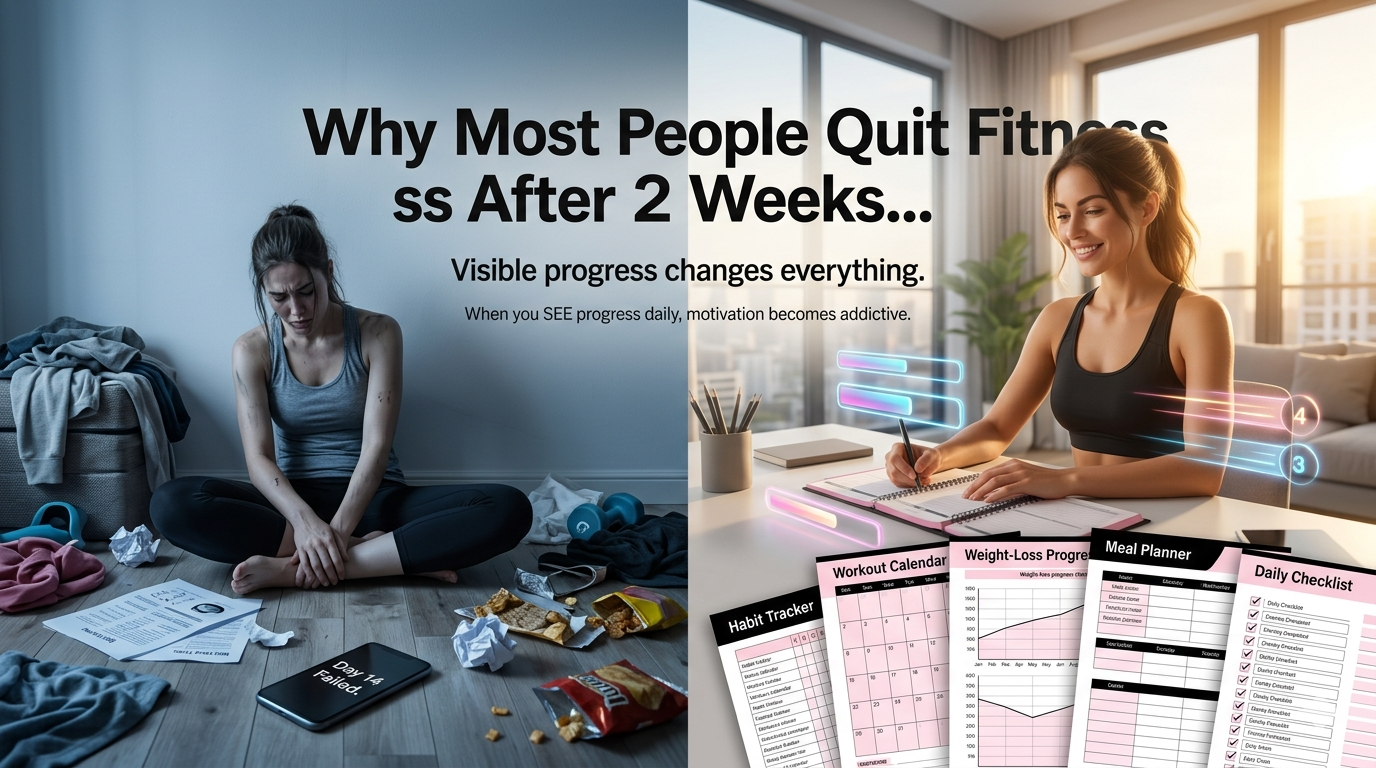
Quit fitness after 2 weeks? You’re not alone. Here’s why it happens, how to break the cycle, and why tracking visible progress is the #1 motivation hack that actually works.
Let me tell you about the graveyard of fitness attempts in my living room.
There’s the yoga mat—still in its plastic wrap from three years ago. The resistance bands—used twice. The perfect pair of training shoes—worn exactly once. And let’s not talk about the “30-day shred” calendar on my fridge with exactly two checkmarks.
If you have a corner in your home that looks like this, you are not alone. You are not lazy. You are not weak.
You are human.
After studying this pattern in myself and watching countless friends go through the same cycle, I’ve realized something important: quitting after 2 weeks isn’t a character flaw. It’s a design flaw. The way most people start fitness is practically engineered to fail.
Let me walk you through what’s actually happening, why visible progress is the secret key to consistency, and how to break the cycle for good.
The 2-Week Wall: Why It Happens
Let me paint you a picture of the classic “New Year, New Me” scenario.
Week 1 (The Honeymoon Phase):
You’re fired up. You’ve made a vision board. You bought new workout clothes. You go from zero to sixty overnight—hour-long workouts, chicken and broccoli for every meal, no sugar, no carbs, no fun.
You feel sore but proud. This time is different.
Week 2 (The Crash):
The soreness hasn’t gone away. You’re exhausted. Your muscles ache. The scale hasn’t moved—or worse, it went up because of water retention from your new workouts. You missed one day because you were tired, and now that voice in your head is screaming, “You’ve ruined it. Might as well give up.”
By day 14, the workout clothes are back in the drawer. The vision board feels like a joke. You’re eating takeout, telling yourself you’ll start again Monday.
Sound familiar?
Here’s what’s actually happening biologically and psychologically.
The 3 Hidden Reasons People Quit After 2 Weeks
Reason 1: The “All-or-Nothing” Mindset
This is the biggest killer of fitness progress.
We’ve been conditioned to believe that a “real workout” is an hour of suffering. If we can’t do the full hour, we do nothing. Because doing nothing feels less disappointing than doing something “incomplete.”
The truth: Five minutes is better than zero. A single stretch is better than no movement at all. Walking around the block counts. It all counts.
The fix: Lower the bar until it’s embarrassingly low. Your goal isn’t a workout—it’s to put on your workout clothes. That’s it. Once you’re in the clothes, you’ll probably do something. But if you don’t? You still succeeded at your goal.
Reason 2: No Visible Progress (The Silent Motivation Killer)
Here’s the brutal truth that no fitness influencer tells you.
In the first 2 weeks of a new workout routine, you will not see visible changes in the mirror. You might even look worse—muscles holding onto water, soreness making you feel puffy, the scale fluctuating.
Your brain craves feedback. When it doesn’t see results, it interprets the effort as “wasted.” And when effort feels wasted, motivation dies.
The truth: Real body changes take 4-8 weeks to become visible. But there are OTHER kinds of progress you can see immediately—if you know where to look.
The fix: Stop measuring progress by the mirror alone. Track your workouts. Write down how many push-ups you could do on Day 1 vs Day 7. Notice that you’re less winded climbing stairs. Feel your jeans fitting slightly differently. These are visible progress markers—just not the ones you’re used to.
Reason 3: The Motivation Trap
We wait for motivation to strike like lightning before we work out.
Here’s a hard truth: motivation is a liar.
Motivation shows up when you’re already feeling good. It’s easy to work out when you’re well-rested and stress-free. But those aren’t the days when you need help. You need help on the days when you’re exhausted, overwhelmed, and absolutely zero percent motivated.
The truth: Discipline is what you do when motivation is absent. And discipline isn’t about willpower—it’s about making decisions in advance.
The fix: Stop waiting for motivation. Make a decision right now: “I will do something—anything—every day. Even if it’s tiny. Even if it’s ridiculous. I will move my body.” Write it down. Tell someone. Make it real.
The Science of Visible Progress (And Why It Changes Everything)
Let me tell you about the moment everything changed for me.
I was 21 days into a new routine. The scale hadn’t moved. My jeans felt the same. I was ready to quit. But I had been tracking my workouts in a cheap spiral notebook.
I flipped back to Day 1. On Day 1, I could hold a plank for 15 seconds before collapsing. On Day 21, I held it for 45 seconds.
That was the moment I understood: progress wasn’t missing. I was just looking in the wrong place.
The science backs this up. A 2018 study published in the Journal of Behavioral Medicine found that people who tracked their progress were 33% more likely to stick with their fitness routine than those who didn’t. Why? Because tracking creates visible evidence of improvement—even when the mirror hasn’t caught up yet.
What Real Progress Looks Like (Before the Mirror Shows It)
| Week | What’s Happening Inside | How to Track It |
|---|---|---|
| Week 1 | Nervous system adaptation. Your body is learning the movements. | Reps, time, form quality |
| Week 2 | Muscle repair and mild hypertrophy begins | Soreness reduction, strength increase |
| Week 3 | Neural efficiency improves. Your brain gets better at activating muscles. | Better form, less wobbling, smoother movements |
| Week 4 | First visible changes in muscle definition (if you look closely) | Photos, how clothes fit, measurements |
| Week 6-8 | Significant visible changes for most people | Side-by-side photos, energy levels, endurance |
The takeaway: Your body is making progress from Day 1. You just need a system to see it.
How to Create Visible Progress (Even When the Mirror Lies)
Here’s your 4-step system to never quit after 2 weeks again.
Step 1: Track the Right Things
Don’t just track the scale (the slowest-moving metric). Track:
- Daily check-in: Did I move my body today? (Yes/No)
- Workout metrics: How many reps? How many seconds in plank? How many minutes of activity?
- How you feel: Energy level, mood, sleep quality
- Weekly photo: Same pose, same lighting, same clothes
Step 2: Lower Your Daily Bar
Your goal isn’t an hour-long workout. Your goal is to show up.
- Week 1 goal: Put on workout clothes and do 1 exercise
- Week 2 goal: Do 5 minutes of movement
- Week 3 goal: Do 10 minutes of movement
- Week 4 goal: Complete a full 20-minute workout
Step 3: Celebrate Every Win (No Matter How Small)
Finished your workout? Celebrate. Did a longer plank than last week? Celebrate. Simply showed up when you didn’t want to? Celebrate.
Celebration reinforces behavior. Guilt erodes it.
Step 4: Use a Tool That Shows You the Progress
This is where most people fail. They try to remember their progress, but memory is unreliable. You need a system that visually shows your growth.
Related Articles to Keep You Going
- How to Actually Stick With Home Workouts When Life Keeps Getting in the Way – Practical strategies for busy people.
- 5 Beginner Mistakes to Avoid When Starting a Home Workout – Don’t let these kill your progress.
- Beginner Fitness Routine at Home (No Equipment Needed) – Start here if you’re brand new.
- What to Eat for Breakfast to Feel Your Best All Day Long – Fuel your progress properly.
Digital Tools to Support Your Journey
💪 Smart Fitness Tracker for Men – Workout, Sleep & Calorie Planner
Track your workouts, calories, sleep, and daily fitness goals in one powerful digital planner made for men.
👉 Get the Smart Fitness Tracker
🧘 3-in-1 Yoga & Wellness Bundle – Stress Relief & Daily Self-Care
Reduce stress, improve recovery, and build healthy habits with this beautifully designed wellness planner.
👉 Get the Yoga & Wellness Bundle
📋 Metabolism Reset Checklist – Fix Stubborn Belly Fat & Slow Metabolism
Identify and fix the root causes of slow metabolism. Printable PDF.
👉 Get the Metabolism Reset Checklist
Frequently Asked Questions
1. Is it normal to want to quit after 2 weeks?
Yes. Completely normal. It’s not a sign of weakness—it’s a sign that your expectations are misaligned with reality. Most people expect visible results in 2 weeks. Real body changes take 4-8 weeks. The gap between expectation and reality creates the urge to quit.
2. Why do I feel worse before I feel better?
When you start exercising, your muscles hold onto water to repair themselves. You may feel puffy, sore, and heavier. Your body is also adapting to new movement patterns, which can be tiring. This is temporary. It usually passes after 2-3 weeks.
3. What if I miss a day?
Nothing. One missed day doesn’t ruin anything. The guilt spiral after missing a day is what ruins progress. If you miss a day, just start again tomorrow. No punishment. No extra workout to “earn it back.” Just start again.
4. How do I stay motivated when I don’t see results?
Stop relying on the mirror. Track your workouts instead. When you can see that you did 5 more push-ups than last week or held a plank 10 seconds longer, that’s progress. That’s visible. That’s motivating.
5. What’s the single best tip for someone who always quits?
Lower the bar until you can’t fail. Your goal isn’t a workout—it’s to put on your workout clothes. Once you’re in the clothes, momentum often carries you. But if it doesn’t, you still succeeded at your goal. You showed up.
A Final Thought
If you’ve quit fitness after 2 weeks before, please hear this: you didn’t fail. The system failed you.
You were set up with unrealistic expectations. You were told to go from zero to hero overnight. You weren’t given the tools to see your invisible progress.
But now you know.
You know that motivation is a liar. You know that visible progress exists from Day 1—you just need to track it. You know that 5 minutes counts. You know that showing up is the only victory that matters.
Start today. Not tomorrow. Not Monday. Today.
Do one squat. That’s it. Then do another tomorrow.
Your future self—the one who didn’t quit this time—is waiting to thank you.
This article contains links to other pages on our site and free tracking tools. We also offer digital products to support your fitness journey.