
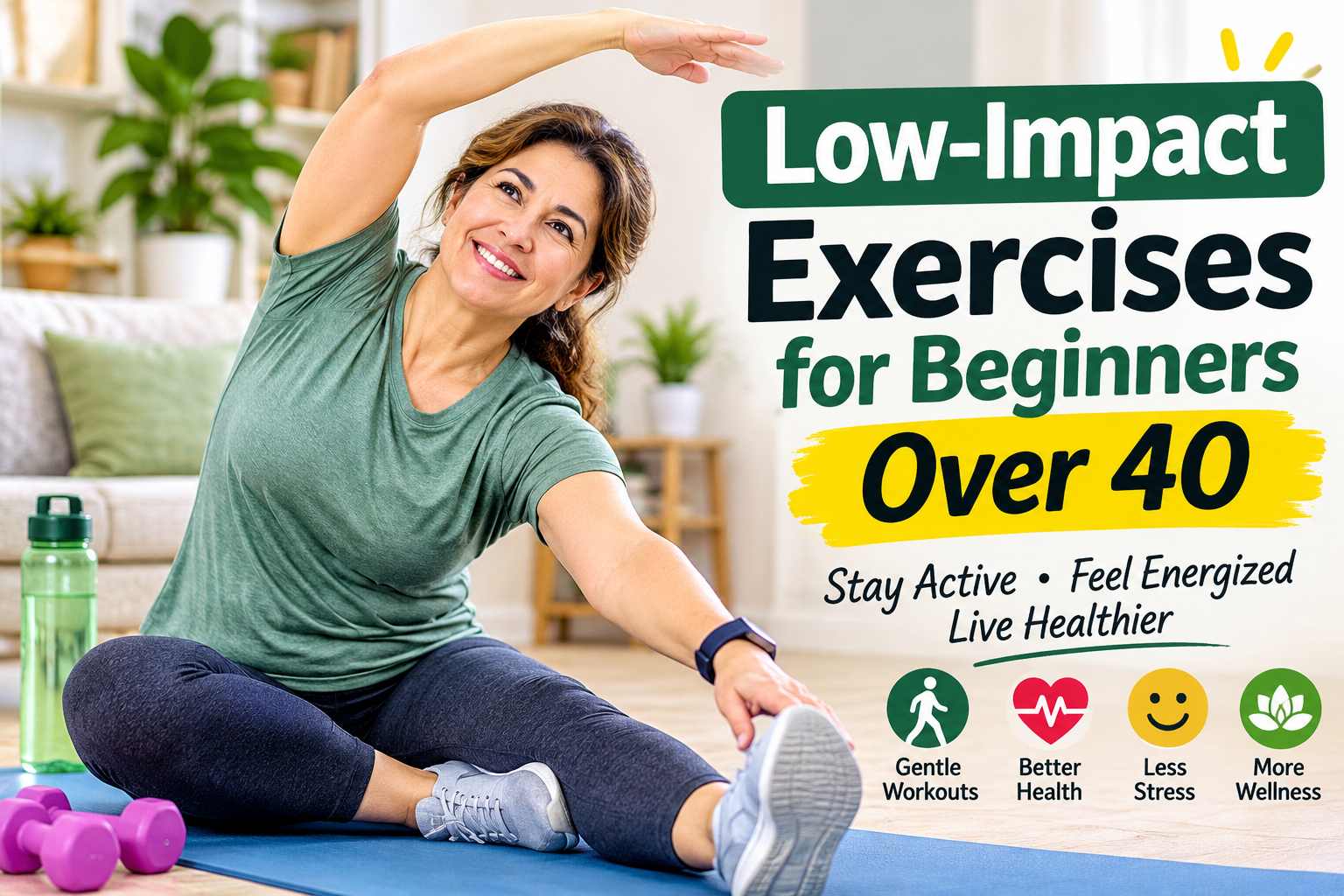
The 10 best low impact exercises for beginners over 40 are brisk walking, wall push-ups, chair squats, glute bridges, bird dogs, standing side steps, band or towel rows, marching or stationary cycling, gentle pool or floor cardio, and a short stretch-and-mobility flow. All 10 are easy on the joints, need little or no equipment, and can be done at home in 15 to 20 minutes a day.
Written by Kalsoom Khan, Founder & Wellness Content Creator, FitHealthyMind,
If you are over 40 and just starting, you probably recognise at least one of these thoughts:
- “My knees click and my back is stiff. I am scared I will hurt myself.”
- “I used to train hard in my 20s. Now one bad workout leaves me sore for a week.”
- “I don’t have an hour a day, and I can’t afford a gym or a trainer.”
- “Every beginner plan online looks like it was made for a 25-year-old.”
These are real problems, and they are not signs that you are “too old”. After 40 your body recovers a little slower, muscle and bone need more deliberate attention, and joints like gentler loading. That is exactly why low impact training works so well at this age: you get stronger and fitter without punishing your joints.
This guide is built to be different from the usual list. For every exercise you get step-by-step form, an easier version, a harder version, the mistakes beginners make, and who it suits best (bad knees, sore back, extra weight, very low fitness). You also get a pain-versus-soreness traffic light, a 4-week plan you can follow without thinking, and a simple way to track your progress.
The 10 exercises at a glance
| # | Exercise | Main benefit | Best for |
|---|---|---|---|
| 1 | Brisk walking | Heart, mood, stamina | Everyone |
| 2 | Wall push-ups | Chest, arms, shoulders | Sore wrists, low strength |
| 3 | Chair squats (sit-to-stand) | Legs, everyday movement | Bad knees, balance |
| 4 | Glute bridges | Hips, lower back support | Desk workers, back stiffness |
| 5 | Bird dog | Core, balance, spine | Lower back care |
| 6 | Standing side steps | Hips, balance, fall prevention | Wobbly balance |
| 7 | Band or towel rows | Upper back, posture | Rounded shoulders |
| 8 | Marching or stationary cycling | Low impact cardio | Heavier bodies, knee issues |
| 9 | Gentle floor or pool cardio | Full-body conditioning | Joint pain, hot weather |
| 10 | Stretch and mobility flow | Flexibility, recovery | Everyone, daily |
What “low impact” really means (and why it works after 40)
Low impact exercise means at least one foot stays on the ground, or your body is supported, so there is no hard landing through your knees, hips and spine. Walking, cycling, swimming and most bodyweight strength moves count. Jumping, sprinting and heavy plyometrics do not.
Low impact does not mean low effort or low results. You can still raise your heart rate, build muscle and burn calories. You just do it with smoother, more controlled movement.
Why beginners over 40 benefit most
- Joints stay happier. Gentle, controlled loading is generally easier to tolerate than repeated jolts, especially if you have stiff knees or a history of niggles.
- Muscle needs attention. Adults gradually lose muscle mass with age unless they strength-train. Simple resistance moves like squats, rows and bridges help you keep it.
- Bones respond to load. Weight-bearing movement such as walking and standing exercises is widely recommended to support bone health, which matters more as we age, particularly for women approaching menopause.
- Energy and mood improve. Regular moderate activity is linked with better sleep, mood and stress control.
- Consistency beats intensity. A routine you can repeat three or four times a week for a year beats a brutal program you quit in ten days.
General public-health guidance for adults is about 150 minutes of moderate activity per week plus two days of muscle-strengthening work. You do not need to hit that on day one. Think of it as the destination, and this guide as the on-ramp.
Low-impact exercise isn’t just good for your body; it can also support your mental well-being. Gentle movement may help reduce stress, improve mood, and make it easier to build a consistent self-care routine. If you want to improve your mental well-being beyond exercise, try our 30-Day Mental Wellness Challenge for simple daily habits.
Low impact vs. high impact: a quick comparison
| Low impact | High impact | |
|---|---|---|
| Examples | Walking, cycling, bridges, chair squats | Running, jump rope, box jumps |
| Joint stress | Lower | Higher |
| Beginner friendly | Yes | Often not |
| Can build strength and fitness | Yes | Yes |
| Injury risk for a returning beginner | Lower | Higher |
Before you start: safety check for beginners over 40
Speak with a doctor or physiotherapist before starting if any of these apply to you:
- You have heart disease, high blood pressure that is not controlled, diabetes, or a chronic lung condition
- You have chest pain, dizziness or unexplained breathlessness during activity
- You are pregnant or recently gave birth
- You have had joint replacement, recent surgery, or an injury that is still healing
- You have osteoporosis or a history of fractures
- You have been told to avoid exercise for any reason
This guide is general education, not medical advice. If you are unsure, a short check-up costs far less than an injury.
The pain vs. soreness traffic light
Beginners often cannot tell “good effort” from “warning sign”. Use this simple rule during and after each session.
| Signal | What it feels like | What to do |
|---|---|---|
| Green | Mild muscle burn or tiredness, gentle soreness the next day, breathing faster but you can still talk | Carry on. This is normal adaptation |
| Yellow | Mild joint ache, pinching, or soreness that lasts more than 2 days | Make the move easier, shorten the range, or rest a day |
| Red | Sharp or stabbing pain, joint locking, numbness, tingling, chest pain, dizziness | Stop right away. Seek medical advice if it does not settle |
A 5-minute warm-up you can use every time
A warm body moves better and feels safer. Do each step for 30 to 40 seconds:
- March gently in place, swinging your arms
- Shoulder rolls, forward then backward
- Hip circles with hands on your waist
- Gentle knee lifts, holding a wall or chair if needed
- Ankle circles, five each way on each foot
- Cat-cow on hands and knees, or seated side bends if the floor is uncomfortable
The 10 low impact exercises, step by step (1 to 4)
Each exercise below has the same layout: how to do it, an easier version, a harder version, mistakes to avoid, and who it suits. Start with 1 set and add more as you feel ready.
1. Brisk walking
Why it works: Walking is the simplest low impact cardio there is. It lifts your heart rate, supports bones and mood, and almost anyone can start today.
How to do it:
- Stand tall with your eyes ahead and shoulders relaxed
- Walk at a pace where you can talk but not sing
- Let your arms swing naturally and land softly heel to toe
- Start with 10 minutes and build toward 30
- Easier: Walk at a slow, steady pace indoors or around the block for 5 minutes
- Harder: Add short faster bursts (1 minute quick, 2 minutes easy) or a gentle hill
- Common mistakes: Hunching forward, overstriding, wearing worn-out shoes
- Best for: Everyone, especially if you are very out of shape
2. Wall push-ups
Why it works: You train your chest, shoulders and arms without loading your wrists or lower back the way floor push-ups can.
How to do it:
- Stand an arm’s length from a wall with feet hip-width apart
- Place your palms on the wall at shoulder height
- Bend your elbows and bring your chest toward the wall, body in a straight line
- Press back to the start. Do 8 to 10 reps
- Easier: Stand closer to the wall and lower only halfway
- Harder: Move your feet further back, or progress to a kitchen counter, then a sturdy bench
- Common mistakes: Sagging hips, flaring elbows wide, holding your breath
- Best for: Sore wrists, low upper body strength, beginners who cannot get down on the floor
3. Chair squats (sit-to-stand)
Why it works: Standing up from a chair is one of the most important movements in daily life. Practising it builds leg and hip strength you use every day.
How to do it:
- Sit near the front of a sturdy chair, feet hip-width apart and flat on the floor
- Lean slightly forward and press through your heels to stand
- Pause, then slowly lower back down over about 3 seconds
- Do 8 to 10 reps
- Easier: Use a higher seat (add a cushion) or push gently with your hands
- Harder: Hover just above the seat without sitting, or hold a water bottle at your chest
- Common mistakes: Knees collapsing inward, dropping into the chair, leaning too far forward
- Best for: Knee care, balance, anyone who wants easier daily movement
4. Glute bridges
Why it works: Strong glutes support your hips and take pressure off your lower back, which is helpful if you sit most of the day.
How to do it:
- Lie on your back with knees bent and feet flat, hip-width apart
- Tighten your abdominal muscles and squeeze your glutes
- Lift your hips until your body makes a straight line from shoulders to knees
- Hold for 2 seconds, then lower slowly. Do 8 to 12 reps
- Easier: Lift only a few centimetres, or rest your feet on a low step
- Harder: Hold the top for 5 seconds, or lift one foot slightly off the floor
- Common mistakes: Over-arching the lower back, pushing through the toes, rushing the lowering phase
- Best for: Desk workers, stiff lower backs, weak hips
Low impact exercises 5 to 7: core, balance and posture
5. Bird dog
Why it works: The bird dog trains your core and spine stabilisers while keeping your back neutral. It is a staple in many back-care programs.
How to do it:
- Start on hands and knees, wrists under shoulders, knees under hips
- Keep your back flat like a tabletop and your neck long
- Slowly extend your right arm forward and your left leg back
- Hold 3 seconds, return, then switch sides. Do 6 to 8 reps per side
- Easier: Lift only the arm, or only the leg, or just slide the foot back along the floor
- Harder: Hold for 5 seconds, or draw your elbow and knee together under your body before extending again
- Common mistakes: Twisting the hips, arching the lower back, lifting the leg too high
- Best for: Lower back care and core strength. Use a folded towel under your knees if the floor is hard
6. Standing side steps
Why it works: Side-to-side movement trains the outer hips and balance, which supports steadiness and helps lower the risk of trips and falls as we age.
How to do it:
- Stand beside a counter or chair for support, feet hip-width apart
- Soften your knees slightly and keep your chest tall
- Step to the right 4 steps, then back to the left 4 steps
- Repeat for 3 to 4 rounds
- Easier: Hold the counter with both hands and take smaller steps
- Harder: Loop a light resistance band around your thighs, or hold the steps lower in a mini squat
- Common mistakes: Leaning sideways, dragging the back foot, locking the knees
- Best for: Wobbly balance, weak hips, anyone worried about falls
7. Band or towel rows
Why it works: Many of us spend hours hunched over phones and screens. Rowing movements strengthen the upper back muscles that help you stand taller.
How to do it (with a band):
- Sit or stand with a resistance band anchored at chest height, or loop it around your feet while seated
- Hold the ends with arms straight
- Pull your elbows back, squeezing your shoulder blades together
- Return slowly. Do 8 to 12 reps
No band? Towel version: Loop a towel around a sturdy door handle (door closed), hold both ends and lean back slightly. Pull your elbows back and return slowly.
- Easier: Use a lighter band, or take smaller pulls
- Harder: Use a stronger band, or pause for 2 seconds at the squeeze
- Common mistakes: Shrugging shoulders to the ears, using momentum, arching the back
- Best for: Rounded shoulders, neck tension, desk workers
Low impact exercises 8 to 10: cardio and mobility
8. Marching in place or stationary cycling
Why it works: You raise your heart rate and burn calories without any jumping. Marching needs no equipment. A stationary bike or an under-desk pedaler is a joint-friendly upgrade.
How to do it (marching):
- Stand tall near a wall or counter for support
- Lift your knees to a comfortable height, swinging your opposite arm
- Keep a steady rhythm for 2 minutes, rest for 30 seconds
- Repeat 3 to 5 rounds
How to do it (stationary bike): Set the seat so your knee is slightly bent at the bottom of the pedal stroke. Pedal at an easy resistance for 10 to 20 minutes.
- Easier: Seated marching, lifting one knee at a time
- Harder: Faster pace, higher knees, or add light resistance on the bike
- Common mistakes: Seat too low, bouncing, gripping the handlebars too tightly
- Best for: Heavier bodies, knee or hip discomfort, hot or rainy days
9. Gentle floor or water cardio
Why it works: If joints are sore, water is a friendly place to move because buoyancy supports your body weight. No pool? Floor-based, no-jump cardio gives you a similar feel.
Pool option: Walk across the shallow end, 10 to 20 minutes. Add arm sweeps or side steps once comfortable.
Floor option (no jumping):
- Step-touch side to side for 1 minute, swinging your arms
- Do slow heel digs forward, alternating legs, for 1 minute
- Do gentle knee lifts with arm pushes for 1 minute
- Repeat the circuit 2 to 3 times
- Easier: Smaller steps, slower tempo, hold a chair
- Harder: Bigger arm movements, quicker pace, add light hand weights
- Common mistakes: Rushing, holding your breath, skipping the warm-up
- Best for: Joint pain, low fitness, people who dislike treadmill-style workouts
10. Stretch and mobility flow
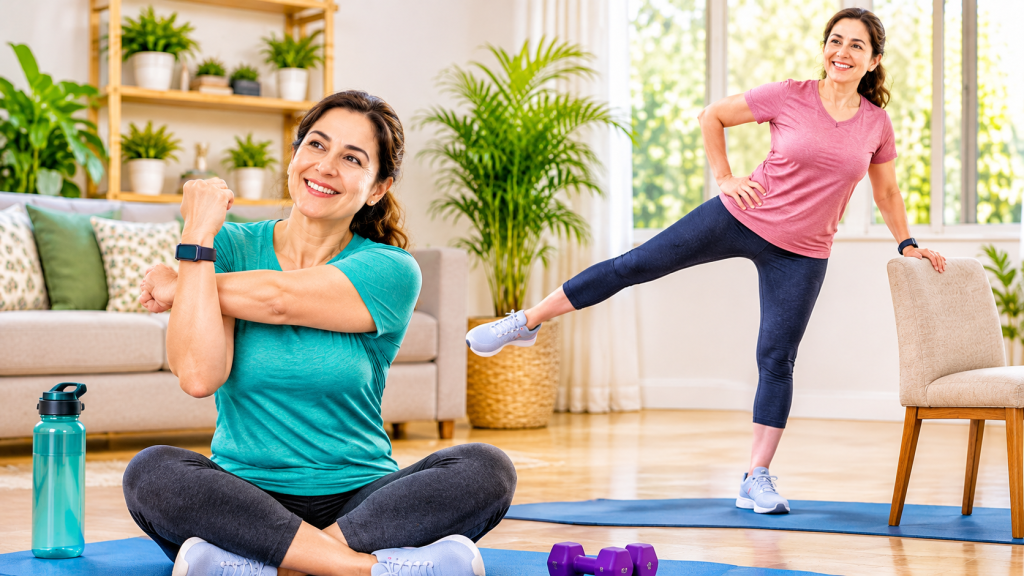
Why it works: Gentle mobility keeps joints moving, eases stiffness and helps you recover between sessions. It is also a calm way to end the day.
A simple 6-minute flow (hold each 30 to 45 seconds):
- Cat-cow: On hands and knees, round and arch your back slowly
- Child’s pose: Sit back toward your heels, arms forward
- Seated hamstring stretch: Straighten one leg on a chair, lean forward gently
- Chest opener: Clasp your hands behind your back and lift slightly
- Figure-4 stretch: Lying on your back, cross an ankle over the opposite knee
- Slow deep breathing: Inhale for 4 seconds, exhale for 6
- Easier: Skip the floor and do the flow seated
- Harder: Hold each stretch longer, or add a gentle yoga sequence
- Common mistakes: Bouncing, forcing the stretch, holding your breath
- Best for: Everyone, every day. It is the best add-on to any workout
Low impact exercises for beginners over 40 by situation
The same 10 moves can be adjusted for your body and your goal. Find your situation below.
Low impact exercises for beginners over 40 with bad knees
- Favor chair squats with a higher seat, glute bridges, bird dogs, side steps and stationary cycling
- Keep your knees tracking over your toes and avoid deep bends
- Skip lunges and step-ups at first, and avoid any move that causes sharp knee pain
- Walk on flat, even surfaces in cushioned shoes
Low impact exercises for beginners over 40 with lower back pain
- Start with bird dogs, glute bridges and walking, with gentle cat-cow stretches
- Keep your spine neutral. Move slowly and avoid twisting under load
- Skip full sit-ups and heavy forward bends for now
- If pain travels down a leg or you feel numbness, see a medical professional
Low impact workout for overweight beginners over 40
- Start with walking, marching, seated and wall-supported moves
- Use a sturdy, higher chair for squats and take longer rests
- Aim for consistent short sessions of 10 to 15 minutes, 4 days a week
- Focus on how you feel (energy, sleep, mood) instead of the scale alone
Low impact workout for women over 40 at home
- Prioritize strength moves (bridges, chair squats, rows) to support muscle and bone as hormone levels change
- Pair strength with brisk walking most days
- Listen to your energy through your cycle or perimenopause. Easier weeks are part of a plan, not a failure
- If you have symptoms such as heavy bleeding, pelvic pain or severe fatigue, speak with your doctor
Low impact exercises for men over 40 who are out of shape
- Begin with walking, wall push-ups, chair squats and band rows
- Resist the urge to “go hard” on day one. Leave each session feeling like you could do a little more
- Build to three strength sessions per week before adding intensity
Eating balanced meals and staying hydrated can help support your activity routine. A nutritious breakfast or post-workout snack containing protein can help you meet your nutritional needs. Try our guide on what happens when you drink a high-protein smoothie every morning for a simple nutrition idea to add to your routine.
Low impact cardio at home for beginners over 40, no equipment
You can get a good cardio session using only your living room: march in place for 2 minutes, step-touch for 2 minutes, then slow knee lifts for 2 minutes. Repeat 3 times with 30 seconds rest between rounds.
Your 4-week low impact workout plan for beginners over 40
This plan takes 15 to 25 minutes a day and has built-in rest days. Warm up first (5 minutes) and finish with the stretch flow (exercise 10). If a week feels too hard, repeat it before moving on.
| Week | Focus | Strength days (3x) | Cardio days (2-3x) | Rest |
|---|---|---|---|---|
| 1 | Learn the moves | Chair squats, wall push-ups, glute bridges: 1 set of 8 | Walk 10-15 min | 2 days |
| 2 | Build the habit | Add bird dog and band rows: 2 sets of 8 | Walk 15-20 min or march 2 min x 4 | 2 days |
| 3 | Add volume | All strength moves: 2 sets of 10, plus side steps | Walk 20-25 min with 3 short faster bursts | 2 days |
| 4 | Challenge yourself | Strength moves: 2-3 sets of 10-12, slower tempo | Walk 25-30 min or bike 15-20 min | 2 days |
A sample week (Week 2)
| Day | Workout | Time |
|---|---|---|
| Mon | Strength: chair squats, wall push-ups, bridges, bird dog | 20 min |
| Tue | Brisk walk + stretch flow | 20 min |
| Wed | Rest or gentle stretching | 10 min |
| Thu | Strength: band rows, side steps, bridges, wall push-ups | 20 min |
| Fri | Marching or cycling cardio | 15 min |
| Sat | Strength day, full body | 20 min |
| Sun | Rest | – |
How to know you are ready to progress
- You can finish the session with good form and no joint pain
- You feel pleasantly tired, not wiped out for days
- You finish a set and feel you could do 2 or 3 more reps
When that happens, add 2 reps, then an extra set, then a harder version of the move.
9 common mistakes beginners over 40 make (and fixes)
- Doing too much, too soon. Start with 2 sets, not 5. Soreness that lasts more than 2 days means you overdid it.
- Skipping the warm-up. Five minutes of easy movement makes the rest feel smoother.
- Comparing yourself to younger people. Compare yourself to last week’s you.
- Only doing cardio. Strength moves protect muscle and bone. Include them 2 to 3 days a week.
- Ignoring sleep and protein. Recovery needs both. Eat a protein source with each main meal unless your doctor advises otherwise.
- Pushing through sharp pain. Use the traffic light. Red means stop.
- Training only on motivation. Motivation fades. Schedule workouts at a fixed time, like an appointment.
- Wearing the wrong shoes. Worn or unsupportive shoes make walking harder on your joints.
- Quitting after a missed day. Never miss twice in a row. One skip is normal. Just restart tomorrow.
How to stay consistent with exercise after 40
- Make it small. Even 10 minutes counts. A short workout you do beats a long one you skip.
- Attach it to a habit. Do your bridges right after brushing your teeth, or walk after dinner.
- Prepare the night before. Lay out shoes, a mat and a resistance band.
- Track it. Seeing a row of ticked boxes is surprisingly motivating (more below).
- Celebrate non-scale wins. Climbing stairs easier, sleeping better, standing up without using your hands. These matter more than a number.
Track your progress: free weekly log + the 90-Day Fitness & Wellness Habit Tracker
What gets tracked gets repeated. Use this simple weekly log to see your own progress. Copy it into a notebook or your notes app.
| Day | Exercise done (Y/N) | Minutes | Energy (1-5) | Joint comfort (1-5) | Note |
|---|---|---|---|---|---|
| Mon | |||||
| Tue | |||||
| Wed | |||||
| Thu | |||||
| Fri | |||||
| Sat | |||||
| Sun |
Want it all in one place?
The FitHealthyMind 90-Day Fitness & Wellness Habit Tracker Dashboard is a digital planner that keeps your workouts, daily habits, energy, sleep and progress together, so you can see your 4-week start turn into a 90-day habit. It works in your browser, so you can use it on your phone or computer.
What you can do inside it:
- Check off daily movement and habits and watch your streak grow
- Log energy, mood and sleep next to your workouts
- Review your week and plan your next one in minutes
- Stay motivated with a clear 90-day view of how far you have come
ADD YOUR PLANNER LINK HERE: Get the 90-Day Fitness & Wellness Habit Tracker Dashboard
Start with this guide’s 4-week plan, then let the tracker carry you to day 90.
FAQ: low impact exercise for beginners over 40
What is the best low impact exercise for beginners over 40?
Brisk walking is the best starting point because it is free, gentle and builds stamina. Add two or three short strength sessions a week (chair squats, glute bridges, wall push-ups) for muscle and bone support.
How often should a beginner over 40 exercise?
Start with 3 to 4 days a week for 15 to 20 minutes, with rest days between strength sessions. Build gradually toward the general adult guideline of about 150 minutes of moderate activity a week.
Can I lose weight with low impact exercise?
Yes, it can support weight loss when combined with sensible eating, good sleep and consistency. Low impact workouts burn fewer calories per minute than hard running, but you can do them more often and with fewer injuries, which matters more over months.
Is walking enough exercise after 40?
Walking is a great base, but it is best paired with strength training two days a week. Strength work helps preserve muscle and supports bone health, which walking alone does not fully cover.
What low impact exercises are best for bad knees?
Chair squats with a higher seat, glute bridges, bird dogs, side steps and stationary cycling are usually well tolerated. Avoid deep bends and any move that causes sharp pain, and check with a doctor or physiotherapist for personal advice.
How long until I see results?
Many beginners notice better energy and mood within 2 to 3 weeks. Strength and stamina changes often show up around 4 to 8 weeks. Results vary from person to person.
Do I need equipment for a low impact workout at home?
No. A chair, a wall and a towel cover almost every move here. A resistance band and a yoga mat are inexpensive upgrades.
Is it too late to start exercising at 40, 50 or older?
No. Research on older adults consistently shows people can build strength and fitness at almost any age. The best time to begin is today, slowly.
Final thoughts: start small, stay steady
You do not need a gym, a trainer or a perfect plan to get fitter after 40. You need a few gentle, well-chosen movements, a schedule you can keep, and a way to see your progress. Pick three exercises from this guide, do them tomorrow for 15 minutes, and build from there.
If you want everything in one place, the 90-Day Fitness & Wellness Habit Tracker Dashboard keeps your workouts, habits and progress together. Visit FitHealthyMind.com for more beginner-friendly guides and planners.
Sources
- CDC: Adult Activity, An Overview (150 minutes of moderate activity per week and muscle-strengthening on at least 2 days per week)
Other statements in this guide (benefits for joints, bones, mood and balance, and the exercise form tips) are general fitness knowledge and are not individually cited. Review them with a qualified professional if you have specific health concerns.
Medical disclaimer
This article is for general education only and is not medical advice. It does not replace guidance from a doctor, physiotherapist or other qualified professional. Stop exercising and seek medical help if you feel chest pain, severe dizziness, sharp pain or any symptom that worries you.