
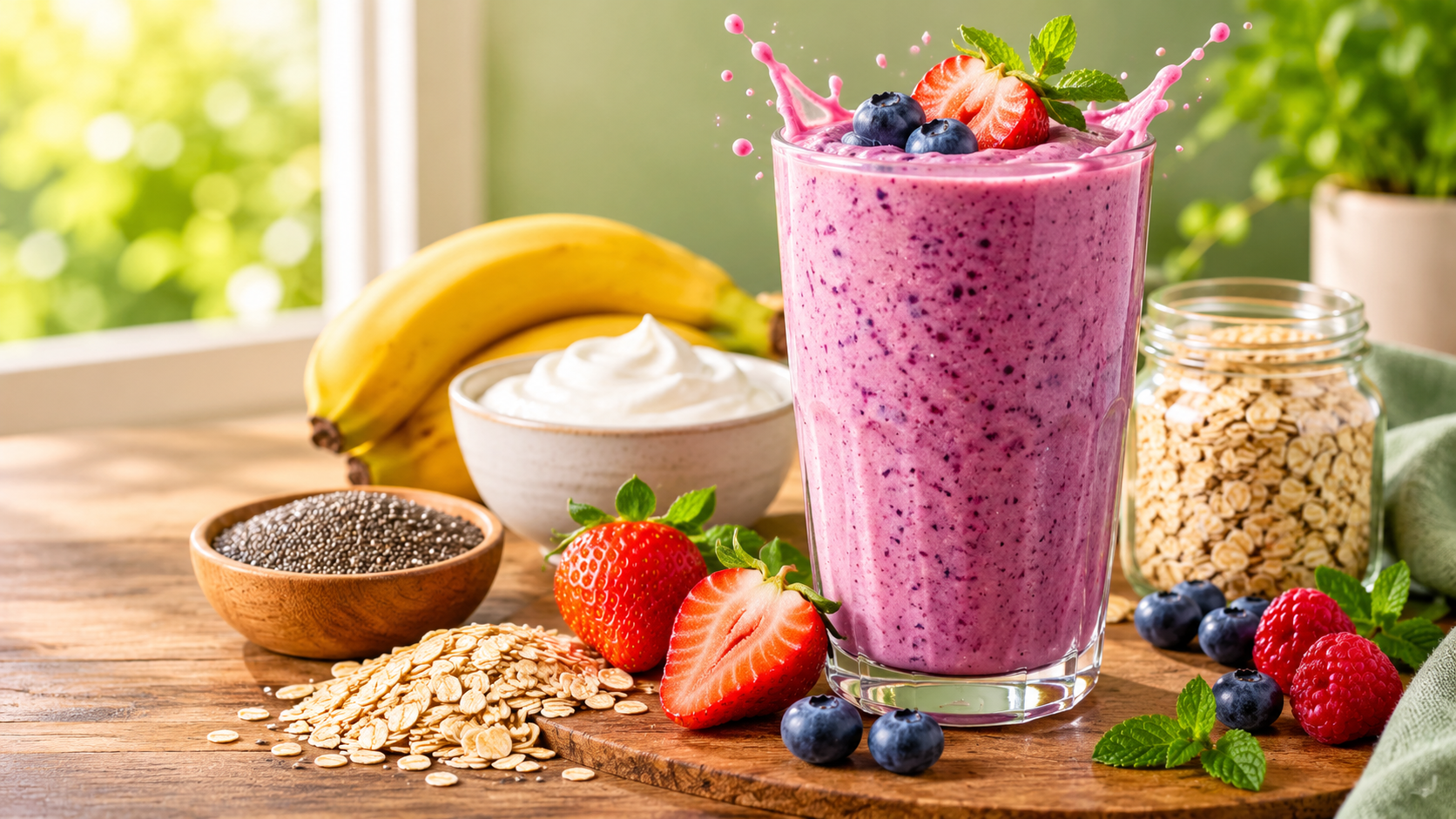
Drink a high-protein smoothie every morning for 30 days? See a week-by-week timeline, real expectations, 12 recipes, who should be careful and a free tracker.
Written by Kalsoom Khan, Founder & Wellness Content Creator, FitHealthyMind
If you drink a high-protein smoothie every morning for 30 days, most healthy adults notice the same few things: they feel fuller after breakfast, they snack less before lunch, and their daily protein total moves closer to a useful target. Whether that turns into weight loss, more muscle or better energy depends on what else is in the cup, how much you eat the rest of the day, and whether you move your body.
That is the honest short answer. Most articles on this topic either promise miracle results or copy each other’s generic lists. This guide is different in four ways:
- It is written as a 30-day timeline. You will see what usually happens in week 1, week 2, week 3 and week 4, including the awkward parts such as bloating, boredom and the “my smoothie is secretly 600 calories” problem.
- It tells you who should be careful. People with kidney disease, certain allergies and some medical conditions need to talk to a professional first.
- It gives you a formula, not just recipes. Once you understand the five parts of a balanced smoothie, you can build your own without a recipe.
- It comes with a tracking system. A 30-day habit only works if you can see your progress, so there are ready-made trackers and a digital planner built for exactly this.
You will also find 12 recipes, a protein-needs table, a comparison of protein sources, a shopping list, a day-by-day challenge plan, myth-busting, a 20-question FAQ and a sources list.
Important: This article is for general education only. It is not medical or dietetic advice. If you have kidney disease, diabetes, an eating disorder, food allergies, are pregnant or breastfeeding, or take regular medication, speak with your doctor or a registered dietitian before changing your diet.
Let us start with the big picture.
The 30-Day Timeline at a Glance
Here is what a typical month can look like. Individual results differ, and nothing below is a guarantee. Think of it as a realistic map, not a promise.
| Time | What many people notice | What to watch |
|---|---|---|
| Days 1 to 3 | Breakfast feels easier. Fullness lasts a little longer. Some people feel mild bloating. | Too much powder at once, or lactose in milk-based powders, can upset the stomach. |
| Days 4 to 7 | Less mid-morning snacking. A routine begins. | Blender cleanup and boredom. Pick two or three recipes and repeat them. |
| Week 2 | Hunger feels steadier. Protein intake is more consistent. Digestion usually settles. | Do not add extra sweeteners, juice and nut butter without checking calories. |
| Week 3 | Habit feels automatic. People who also exercise may notice better recovery. | Flavor fatigue. Rotate fruits and protein sources. |
| Week 4 | Clearer picture of what works: fullness, energy, grocery cost. Any scale change is usually small and gradual. | Plateau thinking. Judge by habits, measurements and how you feel, not only the scale. |
| Day 30 | A tested morning habit you can keep, adjust or drop. | Decide: keep as is, rotate, or move to a whole-food breakfast on some days. |
What the smoothie can and cannot do
It can:
- Add a convenient 20 to 30 grams of protein to your day
- Help you feel full for longer than a low-protein breakfast such as a pastry or sugary cereal
- Replace a rushed, skipped or sugary breakfast
- Give you an easy way to eat fruit, greens, seeds and yogurt
- Build a simple morning routine
It cannot:
- Burn fat on its own
- Build muscle without enough total protein, enough food and some resistance exercise
- Fix poor sleep, stress or an unbalanced diet
- Replace medical treatment
- Make a very high-calorie smoothie “healthy” just because it contains protein powder
Keep this table in mind as you read. The next sections explain the reasons behind each stage.
Why Protein at Breakfast Matters: The Science in Plain Words
Protein is one of the three main nutrients, along with carbohydrates and fat. Your body uses it to build and repair muscle, skin, hormones and enzymes. It is also the most filling of the three nutrients for many people, which is why protein-rich meals tend to keep hunger away for longer.
Looking for more nutritious options between meals? Explore our healthy snack ideas for simple, delicious and balanced snacks that fit into your daily routine.
How much protein do adults need?
According to Harvard Health, the Recommended Dietary Allowance is 0.8 grams of protein per kilogram of body weight (about 0.36 grams per pound) for adults. Harvard describes this as the minimum needed to avoid deficiency, not an ideal target. The same article notes that higher intakes may have potential benefits for preserving muscle mass and strength, but that the best amount is still being studied and that benefits for weight loss or heart health remain debated.
In plain words:
- The RDA is a floor, not a goal. Many active people, older adults and people who are trying to lose fat while keeping muscle choose to eat more than the minimum.
- There is no single perfect number. Needs depend on age, body size, activity and health.
- Quality and variety matter. Harvard also points out that protein does not have to come from meat, and that beans, nuts, whole grains and dairy can all contribute.
Why spread protein across the day?
Many people eat very little protein at breakfast and a large amount at dinner. A typical breakfast of toast, cereal or a pastry may contain only 5 to 10 grams. Evening meals, on the other hand, can contain 40 grams or more.
Moving some protein to the morning has two practical benefits:
- You are not starting the day with a quick blood-sugar spike and crash. Protein, fiber and fat slow digestion, so energy tends to feel steadier than after a sugary breakfast.
- You are more likely to reach your daily total. It is hard to catch up on protein at the end of the day. A smoothie is an easy way to add 20 to 30 grams early.
Some small studies suggest that higher-protein breakfasts can increase fullness, especially when people are eating fewer calories. Results are mixed across studies, and they depend on the participants and the design, so treat this as a helpful tendency, not a rule.
Why a smoothie?
A smoothie is not magic. It is a convenient container. Its advantages are speed (about five minutes), flexibility (any flavor, any protein source), portability and the ability to include fruit, vegetables and fiber in one drink.
Its disadvantages are also real: liquid calories can add up quickly, drinking is less filling than chewing for some people, and powders can be expensive or low quality. Later sections show how to get the benefits without the traps.
Protein quality in one minute
Proteins are made of amino acids. Animal proteins such as whey, casein, eggs and dairy contain all the essential amino acids in good amounts. Many plant proteins, such as soy, are also complete, while others, such as rice or pea alone, are lower in certain amino acids. Combining sources, such as pea and rice protein, or adding seeds and oats, helps. We cover this in detail in the protein sources comparison.
Week 1 (Days 1-7): The Adjustment Week
The first week is mostly about logistics and your body getting used to something new. It is rarely dramatic, and that is normal.
What you may notice
Fullness. Many people say breakfast feels more “solid” than a piece of toast or a bowl of cereal, even though they are drinking it. If you feel hungry again within an hour, your smoothie probably needs more protein, more fiber or some healthy fat. See the formula section.
Mild digestive changes. Protein powders, extra fiber from oats, chia and flax, and more fruit can all change how your stomach feels. Mild gas or bloating in the first few days is common. Whey concentrate and milk-based powders contain lactose, which bothers some people. Plant proteins can cause gas in others.
Time and effort. Making a smoothie takes about five minutes, but washing the blender takes another two. Many people give up in week 1 because of the cleanup. A quick rinse straight after blending makes a big difference.
Taste. Some powders taste chalky or artificial. Fruit, cocoa, cinnamon or vanilla can help. Frozen banana adds creaminess without extra sugar powders.
How to make week 1 easier
- Start with half a scoop of protein powder for the first two days if you have never used one.
- Choose two recipes only. Do not experiment with ten combinations.
- Prepare smoothie packs. Put fruit, oats and seeds in bags in the freezer. In the morning, add liquid and protein, then blend.
- Drink slowly, over 10 to 15 minutes, instead of gulping. Slower drinking may help fullness.
- Record how you feel at 10 a.m. and at lunch in your planner: hunger (1 to 5), energy (1 to 5), digestion (good, okay, upset).
Week 1 mistakes
- Making a smoothie that is mostly fruit juice and banana with a small scoop of protein
- Adding too many extras at once: honey, nut butter, dates, juice and sweetened yogurt
- Skipping lunch because “the smoothie was enough”
- Expecting to see the scale move in 7 days
Week 1 checklist
- Pick your two starter recipes
- Buy a protein source you tolerate
- Make freezer packs for 5 days
- Record hunger, energy and digestion each day
- Drink water through the morning
Week 2 (Days 8-14): The Routine Week
By the second week, the smoothie stops feeling like a project and starts feeling like part of your morning.
What you may notice
Steadier hunger. Many people find they snack less between breakfast and lunch. This is the most commonly reported change, and it makes sense given that protein, fiber and fat slow digestion. If you still feel hungry, that is useful data. Adjust the recipe instead of blaming yourself.
Better digestion. Mild bloating usually settles as your gut adapts. If it does not, try a different protein source (for example, switch from whey concentrate to a lactose-free option, or from pea to soy), reduce the amount of powder, or increase fiber more gradually.
More consistent protein. If your daily protein used to be 50 grams and your smoothie adds 25 grams, that is a meaningful improvement. Harvard Health notes that the RDA is a minimum, and that many people may benefit from more.
A new problem: boredom. Taste fatigue begins around day 10 for many people. This is the moment to rotate flavors.
How to keep week 2 interesting
- Use a flavor rotation: chocolate-banana, berry-vanilla, mango-turmeric, peanut-butter-oat, green apple-spinach.
- Switch liquid bases: milk, unsweetened soy milk, kefir, water, coconut water (use sparingly for sugar).
- Add one new ingredient per week: cinnamon, cocoa nibs, frozen cauliflower, ginger, chia.
- Change the glass or bottle. It sounds silly, but novelty helps habits.
Check your calories
This is the week to read your own smoothie honestly. A smoothie with a banana, mango, peanut butter, oats, honey, milk and a scoop of protein can reach 600 to 800 calories. That may be fine if it is a full meal for an active person. It is not fine if you want a light breakfast and then eat a normal lunch.
| Add-in | Typical amount | Approximate calories |
|---|---|---|
| Banana | 1 medium | 100 |
| Peanut butter | 1 tablespoon | 95 |
| Rolled oats | 1/4 cup | 75 |
| Honey | 1 tablespoon | 60 |
| Whole milk | 1 cup | 150 |
| Unsweetened soy milk | 1 cup | 80 |
| Protein powder | 1 scoop | 100 to 130 |
| Chia seeds | 1 tablespoon | 60 |
| Frozen berries | 1 cup | 70 |
These numbers are approximate and vary by brand. Always check your own labels.
Week 2 check-in questions
- Am I full until lunch?
- Is my energy steadier?
- Is my digestion comfortable?
- Am I enjoying the flavors, or am I forcing it?
- Is the smoothie replacing something unhealthy, or is it just an addition on top of a normal breakfast?
Week 3 (Days 15-21): The Habit Week
By week 3, the routine feels automatic. You no longer think about whether to make a smoothie. That is the point where the habit is working, and the point where many people start paying attention to results.
What you may notice
Habit strength. Research on habit formation suggests it often takes several weeks, and sometimes months, for a new behavior to feel automatic. Week 3 is where many people feel the first real “I do this without thinking” moment.
Exercise and recovery. If you do resistance exercise, such as weights, bands or bodyweight workouts, your protein intake may support recovery and muscle maintenance. Without exercise, extra protein alone does not build muscle. Harvard Health describes potential benefits of higher protein intake for preserving muscle mass and strength, which is most relevant for people who are active or older.
Appetite patterns. Some people notice they crave sweets less at midday. Others notice no difference. Both are normal.
Clothes and measurements. If your overall calorie intake dropped because the smoothie replaced a high-calorie breakfast, you might see small changes in how clothes fit. The scale may move slowly or not at all.
Common week 3 problems
Flavor fatigue. Rotate your recipes and add a new fruit or spice.
“I stopped seeing changes.” Early changes such as fullness are noticeable quickly. Body composition changes are slow. Take photos, measure your waist, record strength changes and track your energy.
Social or travel disruption. On days when you cannot blend, use a fallback: Greek yogurt with fruit and nuts, eggs with whole-grain toast, or a ready-to-drink protein shake with a short ingredient list.
Add movement to multiply the benefit
Protein works best alongside activity. A simple plan:
- Walk 20 to 30 minutes on most days
- Strength train 2 to 3 times a week for 20 to 30 minutes (squats, push-ups, rows, glute bridges)
- Sleep 7 to 9 hours if you can, since poor sleep affects hunger and recovery
If you have a medical condition or injury, check with your doctor before starting a new exercise plan.
Week 3 mini-review
In your planner, answer:
- How many mornings did I complete the smoothie this week?
- What was my average energy at 10 a.m. (1 to 5)?
- How full was I before lunch (1 to 5)?
- What was my favorite recipe? Which one will I stop making?
- Did I move my body at least three times?
Week 4 (Days 22-30): The Review Week
The last week is where you turn a month of experience into a decision. Do not judge the whole month by the scale alone. Look at several signals together.
Five signals to review
| Signal | How to measure | What a good sign might look like |
|---|---|---|
| Hunger and fullness | Daily 1 to 5 rating before lunch | Fewer mornings of strong hunger |
| Energy | 10 a.m. and 3 p.m. rating | Fewer crashes |
| Digestion | Daily note | Comfortable most days |
| Habit consistency | Count the days completed | 24 or more out of 30 |
| Body measures | Waist, photos, strength numbers, weight once a week | Stable or slowly improving, depending on your goal |
What the scale may and may not show
Daily weight can move by a kilogram or more because of water, salt and digestion. Do not judge a 30-day habit by a single weigh-in. If you weigh yourself, do it once a week at the same time, and look at the trend.
If you were previously eating a high-calorie breakfast and the smoothie is lighter, you may lose a little. If your smoothie is higher in calories than your old breakfast, you may gain a little. Calories still matter, even when the drink is high in protein.
Possible 30-day outcomes
Good outcome: you feel fuller, snack less, have steadier energy, and have a repeatable morning routine. This is common and realistic.
Neutral outcome: not much changed except convenience. This is fine. Not every habit changes your body in a month.
Poor outcome: bloating, constant hunger, rising weight or dislike of the drink. Adjust the recipe, change the protein source, or stop. A habit that makes you miserable is not a good habit.
The Day 30 decision
Ask yourself:
- Do I enjoy this enough to continue?
- Is it affordable?
- Did it replace a worse breakfast?
- Do I want to do it every day, or on busy days only?
- Do I need more or less protein?
- Should I speak with a dietitian or doctor about my results?
Many people settle on a middle path: a smoothie on busy mornings and a whole-food breakfast, such as eggs, Greek yogurt or oats with nuts, on slower days.
Week 4 checklist
- Complete the Day 1 versus Day 30 comparison
- Take final photos and measurements if you chose to track them
- Write which recipes you will keep
- Decide your plan for next month
- Reward yourself with something non-food, such as a walk, a book or a new water bottle
What Results Can You Expect for Your Goal?
The same smoothie does different things for different people, because the goal and the rest of the day change the outcome. Here is a realistic look at the five most common goals.
Goal 1: Weight loss
What can help: A protein-rich breakfast can make you feel fuller, which may make it easier to eat less later without feeling deprived. If the smoothie replaces a sugary pastry or skipped breakfast followed by heavy snacking, total calories may fall.
What does not happen automatically: Protein powder does not burn fat. Harvard Health notes that the value of high-protein diets for weight loss remains debated. Weight loss still depends on your overall calorie balance over weeks and months.
Realistic 30-day expectation: Small or modest changes at most, if any, and mainly if the smoothie replaces higher-calorie choices. A healthy pace for many adults is generally described as gradual. Do not expect a dramatic change in one month.
Tips: Keep the smoothie between roughly 250 and 400 calories if weight loss is your goal, use whole fruit instead of juice, avoid sweetened syrups, and measure nut butter, since it is easy to over-pour.
Goal 2: Muscle gain or maintenance
What can help: Eating enough total protein, spread across meals, supports muscle repair after resistance training. Harvard Health notes potential benefits of higher protein intake for preserving muscle mass and strength.
What does not happen automatically: Protein without training and enough total energy rarely builds noticeable muscle. A smoothie alone will not change your body.
Realistic 30-day expectation: If you train with weights two to three times a week and eat enough overall, you may notice better recovery and small strength gains. Visible muscle growth takes longer than a month for most people.
Tips: Aim for 25 to 35 grams of protein in the smoothie, add oats or banana for carbohydrates, and train consistently.
Goal 3: More energy
What can help: Replacing a high-sugar breakfast with one that has protein, fiber and fat can lead to steadier energy for many people. Having breakfast at all can help if you usually skip it and feel tired.
What does not happen automatically: Protein is not a stimulant. Tiredness can come from poor sleep, stress, low iron, thyroid problems, depression, and other conditions. If you feel exhausted all the time, speak with a doctor.
Realistic expectation: Fewer mid-morning crashes if your previous breakfast was mostly sugar. No change if your old breakfast was already balanced.
Goal 4: Blood sugar steadiness
What can help: Combining protein, fiber and healthy fat with fruit usually leads to a slower rise in blood sugar than drinking fruit alone. Whole fruit, greens, nuts and seeds are better than juice and sweeteners.
Important: If you have diabetes or prediabetes, or take glucose-lowering medication, talk with your healthcare team before changing your breakfast. A smoothie can still contain a lot of carbohydrate.
Goal 5: Digestion and regularity
What can help: Smoothies with oats, chia, flax, berries, spinach and kefir or yogurt add fiber and, in the case of fermented dairy, live cultures. This can support regularity for people who usually eat little fiber.
What can go wrong: A sudden increase in fiber or sugar alcohols from some protein products can cause gas, bloating or loose stools. Increase fiber gradually and drink enough water.
Summary: who gets what
| Goal | Likely benefit in 30 days | Main condition for results |
|---|---|---|
| Weight loss | Small, if smoothie replaces higher-calorie food | Total calories and consistency |
| Muscle | Better recovery, small strength gains | Resistance training and enough food |
| Energy | Steadier mornings for some | Quality sleep and balanced meals |
| Blood sugar | Slower rise than a sugary breakfast | Low added sugar, medical guidance if diabetic |
| Digestion | More fiber and regularity | Gradual increases and water |
Who Benefits Most, and Who Should Be Careful
A high-protein smoothie suits many healthy adults. But “healthy food” is never one-size-fits-all.
People who often benefit
- Busy people who skip breakfast or grab something sugary
- People who struggle to reach their protein intake, such as those on mostly plant-based diets who are new to planning protein
- Active people and gym-goers who want a convenient post-workout or morning option
- Older adults who eat small meals, when guided by their doctor or dietitian, since maintaining muscle becomes more important with age
- People who feel hungry mid-morning after a low-protein breakfast
People who should talk to a professional first
People with kidney disease or risk factors. Cleveland Clinic explains that healthy kidneys can usually handle a modest increase in protein, but that people with kidney disease may need to stay at the lower end of the guidelines or even below. It also notes that many people with kidney disease do not know they have it, and recommends that anyone with conditions such as high blood pressure or a family history of kidney disease speak with a healthcare professional before significantly changing protein intake.
People with diabetes or prediabetes. Smoothies can be high in carbohydrate. A dietitian can help you adjust portions and timing.
People with food allergies or intolerances. Dairy, soy, egg, peanut and tree nut ingredients are common triggers. Always read labels, because protein powders may contain several allergens or be made in shared facilities.
People who are pregnant or breastfeeding. Protein needs often rise, but not every powder or supplement is suitable. Speak with your doctor or midwife about products.
People with a history of an eating disorder. Strict tracking and rules around food can be harmful. If tracking numbers makes you anxious, do not track calories or grams, and speak with a professional.
Children and teenagers. Growing bodies generally need balanced meals rather than protein supplements. Ask a pediatrician before using powders.
People who take regular medication. Some medicines interact with certain foods or supplements. Ask your pharmacist.
Warning signs to take seriously
Stop the habit and contact a healthcare professional if you notice:
- Swelling in your legs or face
- Foamy urine or changes in urination
- Persistent nausea, vomiting or severe stomach pain
- Hives, itching, swelling of the lips or difficulty breathing (seek emergency care for breathing problems)
- Unusual fatigue that does not improve
These signs are not specific to smoothies, but they deserve proper medical attention.
Side Effects and Mistakes That Ruin Your 30-Day Results
Most problems come from how the smoothie is made, not from protein itself. Here are the common ones and how to fix them.
Common side effects
| Problem | Likely cause | Fix |
|---|---|---|
| Bloating or gas | Lactose in whey concentrate, large fiber jump, sugar alcohols, rapid drinking | Try a lactose-free or isolate powder, lower the dose, increase fiber slowly, drink more slowly |
| Loose stools | Too much powder, sugar alcohols (erythritol, xylitol, sorbitol), too much fruit | Choose unsweetened powder, reduce portion |
| Constipation | Low fluids and low fiber | Add chia, oats, berries and water |
| Hunger one hour later | Not enough protein, fiber or fat | Add Greek yogurt, oats, seeds or nut butter |
| Weight gain | A smoothie that is 600 to 800 calories on top of a normal breakfast | Replace breakfast, do not add it, and measure extras |
| Skin breakouts in some people | Possibly dairy-based powders, though evidence is limited and individual | Try a plant-based protein for a few weeks and observe |
| Headaches | Skipping meals later, dehydration, too much caffeine | Drink water and eat regular lunch |
The 10 biggest mistakes
1. Treating it as an extra, not a replacement. If you drink a 500-calorie smoothie and still eat your usual breakfast, you added calories, not value.
2. Using fruit juice as the base. Juice adds sugar without the fiber of whole fruit. Use milk, soy milk, kefir or water instead.
3. Overloading with healthy extras. Nut butter, honey, dates, granola and coconut are healthy in small amounts, but they add up fast.
4. Choosing a powder only for taste. Look at the label: protein per scoop, added sugar, sweeteners, number of ingredients, and third-party testing.
5. Ignoring the rest of the day. One smoothie cannot offset ultra-processed lunches and late-night snacking.
6. Skipping real food entirely. Whole foods supply nutrients and chewing satisfaction that drinks cannot fully replicate. Include meals with vegetables, whole grains, legumes, fish or eggs.
7. Making it too thick or too thin. Too thick, and you will not finish it. Too watery, and it will not satisfy you.
8. Not adjusting for your size and goals. A 50-kilogram person and a 100-kilogram athlete do not need the same protein amount.
9. Judging by the scale only. Photos, measurements, strength and energy matter too.
10. Forgetting hydration. More protein and fiber work better with enough water.
About protein powder quality
Supplements are not regulated as strictly as medicines in many countries. If you use powders:
- Choose brands that publish third-party testing results
- Prefer products with a short ingredient list
- Check added sugar and sweeteners
- Avoid products that make dramatic claims about fat loss or muscle gain
- Do not use several powders and supplements at once
- Ask a pharmacist or dietitian if you are unsure
If you prefer whole foods, you can build a high-protein smoothie without any powder at all, using Greek yogurt, skyr, silken tofu, kefir, cottage cheese or soy milk.
How Much Protein Do You Actually Need? (Table by Body Weight)
Start with the number from Harvard Health: the adult RDA is 0.8 grams per kilogram per day, which is the minimum to avoid deficiency. Many active people and some older adults aim higher, with their doctor or dietitian’s guidance. The table below shows the RDA and an example of a higher range often used for active adults. These are approximate planning numbers, not prescriptions.
| Body weight | Minimum (RDA, 0.8 g/kg) | Higher range example (1.2 to 1.6 g/kg) |
|---|---|---|
| 50 kg (110 lb) | 40 g | 60 to 80 g |
| 60 kg (132 lb) | 48 g | 72 to 96 g |
| 70 kg (154 lb) | 56 g | 84 to 112 g |
| 80 kg (176 lb) | 64 g | 96 to 128 g |
| 90 kg (198 lb) | 72 g | 108 to 144 g |
| 100 kg (220 lb) | 80 g | 120 to 160 g |
How to use this table
- Find your weight in kilograms (pounds divided by 2.2).
- Look at the minimum. This is the least most healthy adults need.
- Decide if a higher range applies to you. If you exercise regularly, are older, or are trying to lose fat while keeping muscle, you might aim above the minimum. Check with a professional first if you have any health condition.
- Split it across meals. A smoothie with 20 to 30 grams of protein covers about a quarter to half of the daily minimum for many people.
What 25 grams of protein looks like in food
Harvard Health’s examples include about 17 grams of protein in 6 ounces of plain Greek yogurt, about 6 grams in an egg, and about 8 grams in half a cup of cooked beans. A smoothie can combine several of these.
| Food (approximate) | Protein |
|---|---|
| 1 scoop whey or plant protein powder | 20 to 25 g |
| 3/4 cup plain Greek yogurt (about 170 g) | 15 to 17 g |
| 1/2 cup cottage cheese | 12 to 14 g |
| 1/2 block silken tofu (about 150 g) | 8 to 10 g |
| 1 cup soy milk | 6 to 8 g |
| 1 cup dairy milk | 8 g |
| 2 tablespoons peanut butter | 7 to 8 g |
| 1 tablespoon chia seeds | 2 g |
| 1/4 cup rolled oats | 3 to 4 g |
| 1 tablespoon hemp seeds | 3 g |
Values vary by brand, so check your labels.
Is there a maximum?
There is no single universal ceiling. Very high intakes can be a problem for people with kidney disease and other conditions, and extreme intakes are not necessary for most people. If you want to eat much more than the ranges above, discuss it with a doctor or dietitian.
The 5-Part Formula for a Balanced High-Protein Smoothie
Recipes are useful, but a formula lets you improvise with whatever is in your kitchen. Every smoothie that keeps you full has the same five parts.
The formula
Protein + Fiber + Healthy fat + Fruit or vegetable + Liquid
| Part | Job | Choices | Typical amount |
|---|---|---|---|
| 1. Protein | Fullness, muscle support | Protein powder, Greek yogurt, skyr, kefir, cottage cheese, silken tofu, soy milk | 20 to 30 g of protein |
| 2. Fiber | Slows digestion, supports gut | Rolled oats, chia, ground flax, berries, spinach, pears | 1 to 2 tablespoons or 1/4 cup |
| 3. Healthy fat | Satisfaction, nutrient absorption | Nut butter, avocado, almonds, walnuts, hemp seeds | 1 teaspoon to 1 tablespoon |
| 4. Fruit or vegetable | Flavor, vitamins, fiber | Berries, banana, mango, spinach, kale, frozen cauliflower | 1/2 to 1 cup |
| 5. Liquid | Texture | Water, milk, unsweetened soy milk, kefir, unsweetened almond milk | 1 cup |
Build it in 60 seconds
- Pour the liquid into the blender first.
- Add soft items such as yogurt, tofu or protein powder.
- Add fruit and greens.
- Add fiber and fat.
- Add ice or frozen fruit last.
- Blend for 45 to 60 seconds, then taste and adjust.
Quick adjustments
- Too thick: add a splash of liquid.
- Too thin: add frozen banana, ice, oats or chia.
- Too sweet: use less fruit or add spinach, lemon juice or cinnamon.
- Too bland: add vanilla, cocoa, cinnamon, ginger or a pinch of salt.
- Not filling: add 1/4 cup oats, 1 tablespoon nut butter or more yogurt.
- Too many calories: remove honey and nut butter first.
Calorie ranges by goal
| Goal | Smoothie size (approximate) |
|---|---|
| Lighter breakfast, weight management | 250 to 350 calories |
| Standard breakfast replacement | 350 to 450 calories |
| Active or muscle-building | 450 to 600 calories |
These ranges are only starting points. Adjust to your appetite, activity and medical advice.
The simplest rule
If your smoothie keeps you full for three to four hours and does not leave you feeling sick, bloated or sleepy, the balance is probably right.
12 High-Protein Smoothie Recipes for Your 30 Days
Each recipe makes one serving. Protein and calorie values are rough estimates that depend on your exact brands. Always check labels and adjust. Where a recipe uses protein powder, assume one scoop providing about 20 to 25 grams of protein.
1. Chocolate Peanut Butter Oat Smoothie
Ingredients: 1 cup milk or soy milk, 1 scoop chocolate protein powder, 1 small frozen banana, 1 tablespoon peanut butter, 1/4 cup rolled oats, ice.
Estimated protein: 30 to 35 g. Estimated calories: 450 to 500.
Best for: muscle gain, active mornings.
2. Berry Vanilla Greek Yogurt Smoothie
Ingredients: 3/4 cup plain Greek yogurt, 1/2 cup water or milk, 1 cup frozen mixed berries, 1 tablespoon chia seeds, 1/2 teaspoon vanilla.
Estimated protein: 18 to 22 g. Estimated calories: 220 to 280.
Best for: a light, powder-free option.
3. Green Apple Spinach Protein Smoothie
Ingredients: 1 cup unsweetened soy milk, 1 scoop vanilla protein powder, 1 green apple, a large handful of spinach, 1 tablespoon ground flax, ice.
Estimated protein: 30 to 33 g. Estimated calories: 300 to 350.
Best for: fiber and a light feel.
4. Mango Turmeric Tofu Smoothie
Ingredients: 1/2 block silken tofu (about 150 g), 1 cup frozen mango, 1/2 teaspoon turmeric, a pinch of black pepper, 1 cup coconut milk beverage or soy milk, a squeeze of lemon.
Estimated protein: 14 to 20 g. Estimated calories: 250 to 330.
Best for: a dairy-free, powder-free option. Add 1/2 scoop of protein powder for more.
5. Banana Cinnamon Cottage Cheese Smoothie
Ingredients: 1/2 cup cottage cheese, 1 cup milk, 1 banana, 1/4 cup oats, 1/2 teaspoon cinnamon.
Estimated protein: 22 to 26 g. Estimated calories: 330 to 400.
Best for: a creamy, filling breakfast.
6. Strawberry Banana Kefir Smoothie
Ingredients: 1 cup plain kefir, 1 scoop vanilla protein powder, 1 cup frozen strawberries, 1/2 banana.
Estimated protein: 30 to 35 g. Estimated calories: 330 to 380.
Best for: gut-friendly fermented dairy. Check tolerance if you are lactose-sensitive.
7. Coffee Mocha Protein Smoothie
Ingredients: 1/2 cup cooled strong coffee, 1/2 cup milk, 1 scoop chocolate protein powder, 1/2 frozen banana, 1 tablespoon cocoa powder, ice.
Estimated protein: 25 to 28 g. Estimated calories: 200 to 260.
Best for: coffee lovers. Note that caffeine suits some people and not others.
8. Tropical Green Smoothie
Ingredients: 1 cup unsweetened soy milk, 1 scoop plant protein, 1/2 cup frozen pineapple, 1/2 cup frozen mango, a handful of spinach, 1 tablespoon hemp seeds.
Estimated protein: 30 to 34 g. Estimated calories: 300 to 370.
Best for: a bright, refreshing summer feel.
9. Blueberry Almond Oat Smoothie
Ingredients: 3/4 cup Greek yogurt, 1/2 cup almond milk, 1 cup frozen blueberries, 1/4 cup oats, 1 tablespoon almond butter.
Estimated protein: 22 to 26 g. Estimated calories: 380 to 430.
Best for: a satisfying, antioxidant-rich breakfast.
10. Pumpkin Spice Protein Smoothie
Ingredients: 1/2 cup canned plain pumpkin puree, 1 cup milk or soy milk, 1 scoop vanilla protein powder, 1/2 frozen banana, 1/2 teaspoon pumpkin pie spice.
Estimated protein: 28 to 32 g. Estimated calories: 250 to 310.
Best for: autumn and winter mornings.
11. Peanut Butter Banana Skyr Smoothie
Ingredients: 3/4 cup skyr or thick plain yogurt, 1/2 cup milk, 1 small banana, 1 tablespoon peanut butter, ice.
Estimated protein: 25 to 30 g. Estimated calories: 350 to 420.
Best for: a powder-free, high-satisfaction smoothie.
12. Cauliflower Berry Smoothie (Low Sugar)
Ingredients: 1 cup unsweetened soy milk, 1 scoop vanilla protein powder, 1/2 cup frozen cauliflower, 1/2 cup frozen raspberries, 1 tablespoon chia seeds.
Estimated protein: 30 to 33 g. Estimated calories: 250 to 300.
Best for: lower sugar. The cauliflower adds creaminess without a noticeable flavor.
Recipe rotation for 30 days
| Week | Monday | Tuesday | Wednesday | Thursday | Friday | Weekend |
|---|---|---|---|---|---|---|
| 1 | Recipe 2 | Recipe 1 | Recipe 2 | Recipe 1 | Recipe 2 | Your choice |
| 2 | Recipe 3 | Recipe 5 | Recipe 6 | Recipe 9 | Recipe 3 | Your choice |
| 3 | Recipe 4 | Recipe 7 | Recipe 8 | Recipe 11 | Recipe 12 | Your choice |
| 4 | Favorite 1 | Favorite 2 | Favorite 3 | Favorite 1 | Favorite 2 | Your choice |
Protein Sources Compared: Powder, Yogurt, Tofu, Kefir and More
There is no single “best” protein source. The best one is the one you tolerate, enjoy, can afford and will use consistently.
| Source | Approximate protein | Pros | Cons | Good for |
|---|---|---|---|---|
| Whey protein powder | 20 to 25 g per scoop | Convenient, mixes well, complete protein | Contains lactose in concentrate, can upset some stomachs, quality varies | Active people, convenience |
| Whey isolate | 22 to 27 g per scoop | Lower lactose | Often more expensive | Mild lactose sensitivity |
| Casein powder | 20 to 25 g per scoop | Thick, creamy | Thick texture, dairy | Thick smoothies, evening use |
| Pea protein | 20 to 24 g per scoop | Dairy-free, plant-based | Earthy taste, can cause gas in some | Vegans, dairy-free |
| Soy protein | 20 to 25 g per scoop | Plant-based and generally a complete protein | Soy allergy, taste | Plant-based diets |
| Rice-pea blends | 20 to 24 g per scoop | Better amino acid balance | Gritty texture in some brands | Vegans |
| Greek yogurt | 15 to 17 g per 3/4 cup | Whole food, probiotics, tangy | Dairy, varies by brand | Powder-free smoothies |
| Skyr | 15 to 20 g per 3/4 cup | Very thick and high in protein | Dairy | Creamy smoothies |
| Cottage cheese | 12 to 14 g per 1/2 cup | Cheap, high protein | Texture, sodium | Thick, filling smoothies |
| Kefir | 8 to 10 g per cup | Fermented, drinkable | Tart, dairy | Gut-friendly smoothies |
| Silken tofu | 8 to 10 g per 150 g | Creamy, neutral, plant-based | Soy | Dairy-free, powder-free |
| Soy milk (unsweetened) | 6 to 8 g per cup | Plant-based liquid with real protein | Soy allergy | Base liquid |
| Nut butter | 7 to 8 g per 2 tbsp | Healthy fats, flavor | Calorie-dense | Small boost |
| Hemp, chia, flax | 2 to 3 g per tbsp | Fiber and omega-3 | Small protein amount | Add-ons |
Values are approximate and vary by brand.
How to choose in 30 seconds
- Lactose-sensitive? Try whey isolate, lactose-free milk, soy or pea.
- Vegan? Use soy, a pea-rice blend, tofu and soy milk.
- Budget? Greek yogurt, cottage cheese, tofu and soy milk are often cheaper per gram of protein than premium powders.
- Sensitive stomach? Start with whole foods, add powder gradually, and avoid sugar alcohols.
- Allergies? Read every label. Powders can contain several allergens.
A note on “complete” proteins
A complete protein contains all nine essential amino acids in good proportions. Animal proteins and soy are generally considered complete. If you use pea or rice alone, combining them, or adding seeds, oats and nuts over the day, improves the overall amino acid profile. You do not need to match amino acids in every smoothie.
High-Protein Smoothie vs a Whole-Food Breakfast: Which Is Better?
This is the question that most articles skip, and it is the most useful one. The honest answer is that neither wins every time.
If your mornings are busy, meal preparation can make healthy eating easier. Check out our meal prep for busy moms guide for practical ways to organize meals and save time.
| Factor | Smoothie | Whole-food breakfast (for example eggs, oats, yogurt and fruit) |
|---|---|---|
| Speed | About 5 minutes | 5 to 20 minutes |
| Convenience | Portable | Needs a plate or a stop |
| Fullness | Often good if balanced, but some people feel less full from liquids | Chewing may add to satisfaction |
| Fiber | Can be high with oats, chia, fruit | Can be high with whole grains and fruit |
| Protein | Easy to reach 20 to 30 g | Easy with eggs, yogurt, tofu scramble |
| Added sugar risk | High if made with juice, honey, sweetened yogurt | Moderate (sweetened cereal, pastries) |
| Cost | Powder can be pricey | Often cheaper with eggs, oats, beans |
| Cleanup | Blender | Pan and plate |
| Variety of nutrients | Depends on ingredients | Often broader |
A practical middle path
- Busy weekdays: smoothie
- Slower mornings: eggs, Greek yogurt with fruit and nuts, oats with seeds, tofu scramble, whole-grain toast with nut butter
- After workouts: a smoothie or a balanced meal within a couple of hours
When a whole-food breakfast may be the better choice
- You feel hungry soon after drinking smoothies
- You enjoy chewing and a sit-down breakfast
- You prefer to avoid supplements
- You are on a tight budget
- You are trying to build slow eating habits
When a smoothie may be the better choice
- You normally skip breakfast
- You have a short morning and a long commute
- You struggle to reach your protein target
- You are recovering from training and want something easy to digest
- Your appetite is low in the morning
The goal of this 30-day experiment is not to prove that smoothies are superior. It is to find out whether a protein-rich morning habit works for you.
Shopping List, Budget and Meal Prep for 30 Days
A smoothie habit lasts when it is cheap, easy and ready to go. This section removes the friction.
The shopping list (for one person, about 2 weeks)
Protein:
- Protein powder (one tub), or
- Plain Greek yogurt or skyr (large tub)
- Cottage cheese
- Silken tofu
- Unsweetened soy milk or milk
Fruit and vegetables:
- Frozen mixed berries
- Bananas (peel and freeze extras)
- Frozen mango or pineapple
- Spinach (fresh or frozen)
- Frozen cauliflower
- Apples
Fiber and fats:
- Rolled oats
- Chia seeds
- Ground flaxseed
- Peanut or almond butter
- Hemp seeds (optional)
Flavor:
- Cinnamon
- Cocoa powder (unsweetened)
- Vanilla extract
- Turmeric and ginger (optional)
Budget tips
- Buy frozen fruit. It is often cheaper, lasts longer and is picked ripe.
- Use whole-food protein on some days. Yogurt, cottage cheese and tofu are often cheaper per gram of protein than premium powders.
- Buy oats and seeds in bulk.
- Compare price per gram of protein, not price per tub. Divide the price by total grams of protein in the container.
- Do not buy ten flavors. Start with one tub.
- Use ripe bananas. Freeze them before they spoil.
Price-per-gram example
If a tub costs 30 dollars and contains 30 servings of 24 grams of protein, that is 720 grams, or about 4 cents per gram of protein. Compare this with a tub of Greek yogurt or a block of tofu using the same method. Prices vary by country and store, so do your own calculation with your local prices.
Sunday prep routine (15 minutes)
- Line up 5 freezer bags.
- In each, add fruit, greens, oats and seeds.
- Label them with the day or recipe.
- Freeze.
- In the morning, dump the bag into the blender, add liquid and protein, and blend.
Smoothie fallback plan
On days when you cannot blend, have a fallback so the habit is not broken:
- Greek yogurt with fruit and nuts
- Two eggs with whole-grain toast
- A ready-to-drink protein shake with a short ingredient list and low sugar
- Overnight oats with milk and chia
Blender cleanup in 30 seconds
Right after pouring, add warm water and a drop of dish soap, blend for 15 seconds, rinse. This prevents the stuck-on residue that makes cleaning feel like a chore.
The 30-Day High-Protein Smoothie Challenge Plan
Use this plan if you want a clear structure. Each day has a small focus, so the month feels like progress instead of repetition. You do not need to follow it exactly.
Before Day 1: set your baseline
Write these in your planner or notebook:
- Typical breakfast now and how full you feel by 11 a.m. (1 to 5)
- Energy at 10 a.m. and 3 p.m. (1 to 5)
- Your weight and waist if you choose to track them (optional)
- Approximate daily protein now (optional)
- Your goal for the month in one sentence
- Any digestive issues you already have
If tracking numbers makes you anxious or stressed, skip the weight and calories and track only how you feel.
Week 1: Start and learn (Days 1 to 7)
| Day | Focus |
|---|---|
| 1 | Make Recipe 2 (Berry Vanilla). Rate fullness at 11 a.m. |
| 2 | Repeat Recipe 2. Notice digestion. |
| 3 | Try Recipe 1 (Chocolate Peanut Butter). Measure the nut butter. |
| 4 | Prepare 5 freezer bags for the next week. |
| 5 | Drink slowly over 15 minutes and note whether fullness changes. |
| 6 | Weekend smoothie: sit down and enjoy it without a screen. |
| 7 | Review: what did you notice about hunger, energy and digestion? |
Week 2: Build the routine (Days 8 to 14)
| Day | Focus |
|---|---|
| 8 | Try Recipe 3 (Green Apple Spinach). |
| 9 | Record your protein sources in the smoothie. |
| 10 | Add one new spice or flavor. |
| 11 | Try Recipe 5 (Banana Cinnamon Cottage Cheese). |
| 12 | Check calories honestly: is the smoothie replacing or adding? |
| 13 | Try Recipe 6 (Strawberry Banana Kefir). |
| 14 | Review: which recipes will you keep? |
Week 3: Add movement (Days 15 to 21)
| Day | Focus |
|---|---|
| 15 | 20-minute walk plus Recipe 4 (Mango Turmeric Tofu). |
| 16 | First or second strength session of the week (20 to 30 minutes). |
| 17 | Try Recipe 7 (Coffee Mocha) or a caffeine-free alternative. |
| 18 | Rest or gentle stretching. Smoothie as usual. |
| 19 | Try Recipe 8 (Tropical Green). |
| 20 | Strength session or longer walk. |
| 21 | Review: how is your recovery, energy and consistency? |
Week 4: Review and decide (Days 22 to 30)
| Day | Focus |
|---|---|
| 22 | Make your favorite recipe so far. |
| 23 | Try Recipe 12 (Cauliflower Berry). |
| 24 | Test a whole-food breakfast and compare fullness. |
| 25 | Smoothie again. Compare to day 24. |
| 26 | Check your budget: what did the month cost? |
| 27 | Take optional photos and measurements. |
| 28 | Write what you liked and disliked. |
| 29 | Choose your long-term plan (daily, weekdays only, or a mix). |
| 30 | Final review and a non-food reward. |
Daily checklist
Every morning:
- Smoothie made (or fallback breakfast)
- Water glass finished with it
- Hunger rating at 11 a.m. (1 to 5)
- Energy rating at 3 p.m. (1 to 5)
- One note about digestion or mood
Rules for staying on track
- Never miss twice. One skipped day does not ruin the challenge.
- Always have a fallback breakfast. Greek yogurt with fruit, eggs, or overnight oats.
- Do not punish yourself. Habits grow from kindness, not from guilt.
- Review weekly. Small adjustments beat big restarts.
Track Your 30 Days With a Digital Planner
If you want this month to turn into a lasting habit, you need more than a recipe list. You need a way to see your progress. That is where a planner makes the difference.
Why tracking makes a 30-day habit work
- You see patterns. Perhaps your energy is better on days when you drink the smoothie slowly, or you feel hungry again on days you skip oats.
- You stay consistent. Tick marks and streaks make daily habits easier to keep.
- You notice problems early. If bloating or hunger keeps returning, your notes show it, and you can change the recipe.
- You judge progress fairly. Weight can mislead, but notes on energy, fullness, workouts and consistency give a fuller picture.
- You can bring facts to a professional. If you ask a dietitian or doctor for advice, a month of notes is useful.
Meet the 90-Day Fitness & Wellness Habit Tracker Dashboard
The 90-Day Fitness & Wellness Habit Tracker Dashboard from FitHealthyMind helps you turn this smoothie experiment into a long-term routine. It is designed so that your daily habits, energy, workouts and progress live in one place, instead of in scattered notes.
[Editor note: check this feature list against the actual product before publishing, and replace the link below.]
Want to stay consistent with your healthy breakfast routine? Our 90-Day Fitness & Wellness Habit Tracker Dashboard can help you track daily habits, water intake, sleep, workouts and wellness progress.
Use it to:
- Tick off your daily smoothie or breakfast habit and watch your streak grow
- Record energy, hunger and mood in under a minute
- Log workouts and walking alongside your nutrition habits
- Review your week and decide what to keep, change or drop
- Keep going well beyond day 30 with a 90-day view
[Get the 90-Day Fitness & Wellness Habit Tracker Dashboard here
How to use the planner with this challenge
Each morning (2 minutes):
- Tick “Smoothie done.”
- Write which recipe you used.
- Note your starting energy.
Each evening (3 minutes):
- Rate fullness at 11 a.m. and energy at 3 p.m., if you did not do it earlier.
- Write one note about digestion or cravings.
- Tick your movement for the day.
Each Sunday (10 minutes):
- Count how many mornings you completed.
- Look at your hunger and energy scores.
- Choose one change for next week: new recipe, more protein, less sugar, or more water.
Copy this 30-day smoothie tracker
| Day | Recipe | Protein source | Fullness at 11 a.m. (1-5) | Energy at 3 p.m. (1-5) | Digestion | Notes |
|---|---|---|---|---|---|---|
| 1 | ||||||
| 2 | ||||||
| 3 | ||||||
| 4 | ||||||
| 5 |
Continue the table through Day 30.
Day 1 versus Day 30 comparison
| Measure | Day 1 | Day 30 |
|---|---|---|
| Typical fullness at 11 a.m. (1-5) | ||
| Typical energy at 3 p.m. (1-5) | ||
| Mid-morning snacking (days per week) | ||
| Estimated daily protein | ||
| Strength or workouts per week | ||
| How I feel overall |
Planner tips
- Track three to five things, not twenty.
- Treat data as information, not a report card.
- If tracking makes you anxious or obsessive about food, stop tracking numbers and speak with a professional.
- Return after a missed day without guilt.
High-Protein Smoothie Myths vs Facts
| Myth | Fact |
|---|---|
| “Protein shakes burn belly fat.” | No food or powder burns fat on its own. Weight changes depend on overall calories, activity and many other factors. |
| “More protein is always better.” | Needs vary. Very high intakes are not necessary for most people and can be a concern for those with kidney disease. |
| “You need protein powder to get enough protein.” | You can reach your needs with food alone. Powder is convenient, not essential. |
| “A smoothie is automatically healthy.” | A smoothie can contain as many calories and as much sugar as dessert if it is loaded with juice, honey and syrups. |
| “Protein makes you bulky.” | Building significant muscle takes resistance training, enough food and time. A smoothie will not do it alone. |
| “Plant protein is not as good.” | Soy is generally considered a complete protein, and a varied plant diet can meet protein needs. Combining sources helps. |
| “Healthy kidneys are damaged by protein.” | Healthy kidneys can usually handle a modest increase, according to Cleveland Clinic, but people with kidney disease or risk factors should seek medical advice. Extreme intakes are still not wise. |
| “Liquid protein is less effective.” | It depends on the person. Some find drinks less filling than chewing, others find them just as satisfying. |
| “I must drink it within 30 minutes of a workout.” | Total daily protein and consistency matter more than a strict window for most people. |
| “Smoothies replace all meals.” | They are useful for breakfast, but whole foods supply a wider range of nutrients. |
| “If it has protein on the label, it is good for me.” | Check the ingredients, added sugar, sweeteners and testing. |
| “A 30-day habit will transform my body.” | It can build a useful routine. Visible body changes usually take longer and need other habits as well. |
The idea behind most myths
Marketing often turns one useful nutrient into a miracle. Protein is useful. It is not a miracle. Combine it with fiber, sleep, movement and a reasonable overall diet, and it works better.
Real-Life Scenarios: How Different People Might Experience 30 Days
The stories below are illustrative examples, not real case studies and not medical results. They show how the same habit can lead to different outcomes depending on the person.
Scenario 1: The breakfast skipper
Hira, 31, works in an office and usually skips breakfast, then eats biscuits at 11 a.m. and a large lunch. She starts a berry yogurt smoothie each morning. In week 1 she feels fuller but misses the crunch of food. By week 3 she snacks less and her lunch portions feel more natural. She does not lose much weight, but she values the steadier morning and the routine. Her main lesson: replacing a gap with a balanced breakfast improved her day more than any number on the scale.
Scenario 2: The gym beginner
Usman, 26, started lifting weights twice a week. He adds a chocolate peanut butter smoothie after workouts and on other mornings. By week 4 he notices better recovery and small strength improvements, which he credits mainly to training and consistency. His smoothie did not build muscle by itself, but it made it easier to reach his daily protein.
Scenario 3: The calorie trap
Sana, 35, wanted to lose weight. Her smoothies contained banana, mango, honey, peanut butter, oats and whole milk, roughly 650 calories, and she still ate her usual breakfast sandwich on workdays. After three weeks she felt heavier. When she reviewed her planner, she saw that the smoothie had become an addition, not a replacement. She switched to a 300-calorie version and cut the sandwich. The lesson: protein does not cancel calories.
Scenario 4: The sensitive stomach
Bilal, 29, started with a full scoop of whey concentrate and felt bloated for a week. He switched to a lactose-free option and began with half a scoop. By week 2 he was comfortable. His lesson: the product and the dose matter. If the first choice does not suit you, change it before giving up.
Scenario 5: The plant-based eater
Maryam, 40, is vegan and was unsure about her daily protein. She used soy milk, silken tofu, pea-rice protein and chia seeds in her smoothies. She also tracked beans, lentils and tofu in her meals. After a month she felt confident that she could plan protein without animal products. Her lesson: variety and planning matter more than any single powder.
Scenario 6: The cautious one
Ahmed, 58, has high blood pressure and a family history of kidney disease. Before starting, he spoke with his doctor, who suggested keeping protein moderate and monitoring kidney function. He adjusted his plan with a dietitian instead of copying a gym influencer. His lesson: personal medical context comes first.
What these stories show
- The smoothie helps most when it replaces a worse breakfast.
- Results depend on the whole day.
- Tracking reveals problems that guessing misses.
- Product choice and dose matter.
- Medical context can change the plan.
Frequently Asked Questions About High-Protein Smoothies
1. What happens if I drink a protein smoothie every day for a month?
Most healthy adults who replace a low-protein breakfast notice more fullness and less snacking, and they reach their protein goals more easily. Results for weight, muscle and energy depend on total calories, exercise, sleep and the rest of the diet. Any change after 30 days is usually modest.
2. Is it okay to drink a protein smoothie every morning?
For most healthy adults, a balanced smoothie every morning can be fine. People with kidney disease or risk factors, diabetes, allergies, eating disorders, or pregnancy should speak with a professional first.
3. How much protein should a breakfast smoothie have?
Many people aim for roughly 20 to 30 grams, depending on body size, goals and total daily needs. Harvard Health lists the adult RDA as 0.8 grams per kilogram per day, which is a minimum, not an ideal target.
4. Will a protein smoothie help me lose weight?
It can help if it replaces a higher-calorie or sugary breakfast and keeps you fuller. It will not burn fat by itself. Total calorie balance still matters, and the value of high-protein diets for weight loss is debated.
5. Can a protein smoothie replace breakfast?
Yes, if it is balanced with protein, fiber, healthy fat and fruit or vegetables. On slower days, a whole-food breakfast is also a great option.
6. Will I gain muscle from protein smoothies?
Not by themselves. Muscle gain needs enough total food, enough protein, resistance training and time. Smoothies can make it easier to meet your protein needs.
7. Are protein smoothies bad for your kidneys?
Cleveland Clinic explains that healthy kidneys can usually handle a modest increase in protein, but people with kidney disease or risk factors should talk to a healthcare professional and may need to stay at lower intakes. Extreme protein intakes are not recommended for anyone.
8. Do I need protein powder?
No. You can build high-protein smoothies with Greek yogurt, skyr, cottage cheese, silken tofu, kefir and soy milk. Powder is convenient but optional.
9. What is the best protein powder for smoothies?
There is no single best. Choose one that you tolerate, with a short ingredient list, low added sugar, and ideally third-party testing. Lactose-sensitive people might prefer isolate, soy or pea blends.
10. Why do I feel bloated after my protein smoothie?
Common causes include lactose in whey concentrate, sugar alcohols, a big jump in fiber, or drinking too fast. Try a different protein, reduce the dose, increase fiber slowly and drink more slowly.
11. Why am I hungry an hour after my smoothie?
It may not have enough protein, fiber or fat, or it may be mostly fruit and liquid. Add Greek yogurt, oats, chia seeds or nut butter, and drink it more slowly.
12. How many calories should a protein smoothie have?
A common range is about 250 to 450 calories for a breakfast replacement, depending on your goals. Active or muscle-building people may need more.
13. Is it better to drink a protein smoothie before or after a workout?
For most people, total daily protein and consistency matter more than a strict timing window. Choose what feels comfortable for your digestion and routine.
14. Can I drink a protein smoothie if I have diabetes?
Speak with your healthcare team. Smoothies can be high in carbohydrate, and portions and ingredients need to fit your plan.
15. Can I use water instead of milk?
Yes. Water makes a lighter smoothie. Using yogurt, tofu or powder will still provide protein, and milk or soy milk adds both protein and creaminess.
16. Should I add banana to every smoothie?
Not necessarily. Banana adds creaminess and sweetness but also sugar. Alternatives include frozen cauliflower, frozen zucchini, avocado, oats or Greek yogurt.
17. Can I make the smoothie the night before?
Yes, but it may separate. Store it in a sealed container in the fridge for up to 24 hours and shake or re-blend before drinking. Freezer packs are often a better option.
18. How long until I see results?
Fullness and routine changes can appear in the first one to two weeks. Body composition changes take longer and depend on training, diet and individual factors.
19. Is it safe for teenagers?
Teenagers generally need balanced meals, and protein supplements are often unnecessary. Speak with a pediatrician or dietitian before using powders.
20. When should I stop and see a doctor?
Stop and seek medical advice if you develop swelling, foamy urine, severe stomach pain, persistent vomiting, hives or breathing difficulty (seek emergency care for breathing problems), or if you have a medical condition and are unsure whether the plan is safe.
Healthy routines are not just about nutrition. Taking care of your mental wellbeing matters too. Try our 30-day mental wellness challenge to build simple daily habits for mindfulness, stress management and self-care.
Conclusion: What Will Your 30 Days Teach You?
A high-protein smoothie every morning for 30 days is not a miracle, but it is a useful experiment. For many people, it brings a steadier morning, fewer snacks, an easier path to their protein goals, and a routine that makes healthy eating less random. For others, it teaches them that they prefer a whole-food breakfast, or that a smoothie suits busy days only. Both results are valuable.
Remember the key points:
- Replace, do not just add. The smoothie should substitute a worse breakfast, not sit on top of one.
- Use the five-part formula: protein, fiber, healthy fat, fruit or vegetable, and liquid.
- Watch calories and added sugar, even in healthy ingredients.
- Match the plan to your medical context. Kidney disease, diabetes, allergies, pregnancy and eating disorders need professional guidance.
- Pair it with movement, sleep and real meals.
- Track your progress with fullness, energy, digestion and consistency, not only the scale.
Your first step today
- Choose one recipe from this guide.
- Buy or prepare the ingredients.
- Write your Day 1 baseline in your planner.
Turn it into a lasting habit with the planner
If you want a simple place to tick your daily habit, record how you feel and review your week, the 90-Day Fitness & Wellness Habit Tracker Dashboard can help you keep this smoothie habit going well past day 30, along with workouts, energy and wellness routines.
Get the 90-Day Fitness & Wellness Habit Tracker Dashboard:
Disclaimer: This article is for general education and information only. It is not medical, nutritional or dietetic advice, and it does not diagnose or treat any condition. The people described are illustrative examples. Speak with a doctor or registered dietitian before changing your diet, especially if you have a medical condition, allergies, are pregnant or breastfeeding, or take medication.
Sources
These are the pages I opened and used for the health statements that are cited in this article. Recipe protein and calorie values are rough estimates and are not taken from a single source, so check the labels of your own ingredients.
- Harvard Health: How much protein do you need every day? (adult RDA of 0.8 g per kg, higher intakes, protein sources)
- Cleveland Clinic: Planning to start a high-protein diet? Check with your kidneys first (who should be careful, kidney considerations)
Not cited, and why: statements about fullness at breakfast, habit formation and food-label values are general summaries. I could not open the research papers while writing, so please add a trusted citation, such as a recent review from PubMed or a national nutrition authority, before publishing if you want a stronger EEAT signal.
Medical Disclaimer
This article is for educational purposes only and is not a substitute for individualized medical or dietary advice. Consult a qualified healthcare professional or registered dietitian if you have a medical condition, food allergy, or specific dietary requirements.
Free 30-Day High-Protein Smoothie Tracker (PDF)
Track fullness, energy and digestion every day. Print it and fill it in. One click, no sign-up.