
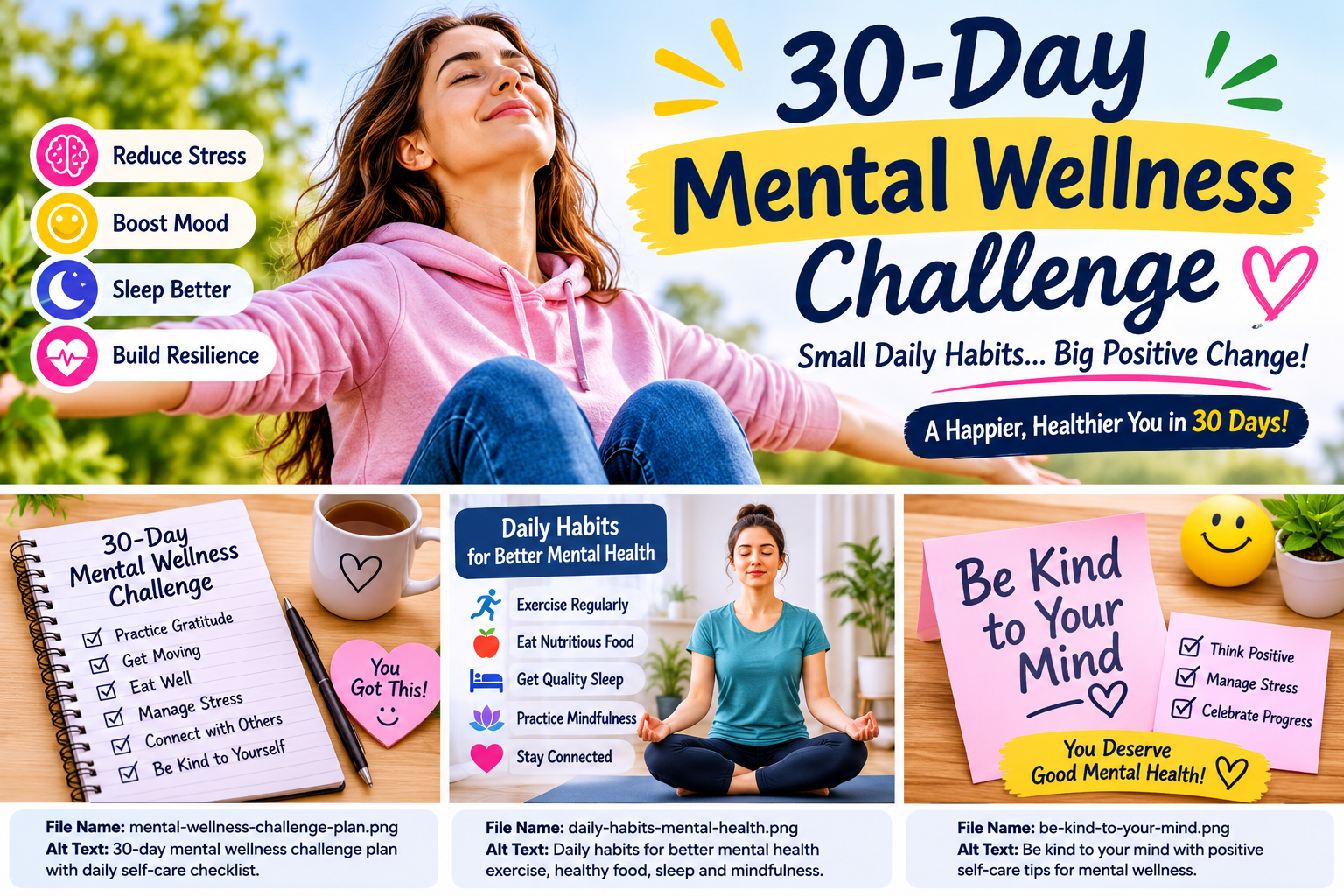
Feel calmer in 30 days with this easy day-by-day mental wellness challenge. Simple daily tasks, a hard-day plan and a free tracker to stay consistent.
Written by @kalsoomkhan, Founder & Wellness Content Creator, FitHealthyMind,
Nov 21, 2026 ·
Do you feel tired, stressed or mentally stuck? Do your thoughts run fast at night? Do you feel low and do not know where to begin? You are not alone, and you do not need a big life change to feel better.
A 30-day mental wellness challenge is a simple plan with one small task each day. You breathe for a few minutes. You go for a short walk. You write three good things from your day. Each task is easy on its own. But when you do them for 30 days in a row, they become real habits that support your mind.
This guide gives you everything in one place:
- A clear day-by-day plan with easy steps for all 30 days
- A short explanation of why each task helps
- A plan for hard days when you have no energy
- Simple ways to track your mood and progress
- Answers to common questions
- A way to keep everything in one place with a digital planner
The language is simple on purpose. Most days take only 10 to 15 minutes. You do not need any special tools, a gym or money.
Important: This challenge is for general wellness and self-care. It is not medical treatment and it does not replace a doctor or therapist. If you feel hopeless, unsafe, or have thoughts of harming yourself, please contact a healthcare professional or your local emergency or crisis service right now.
Ready? Let us begin with the basics.
What Is a 30-Day Mental Wellness Challenge?
A 30-day mental wellness challenge is a month-long plan to care for your mind. You do one small, specific action every day. After 30 days you have a calmer routine and a better understanding of what helps your mood.
Think of it like physical fitness. You would not run a marathon on your first day at the gym. You would start with short, easy workouts and build up. Mental wellness works in the same way. Small, regular practice works better than one big effort.
The four parts of the challenge
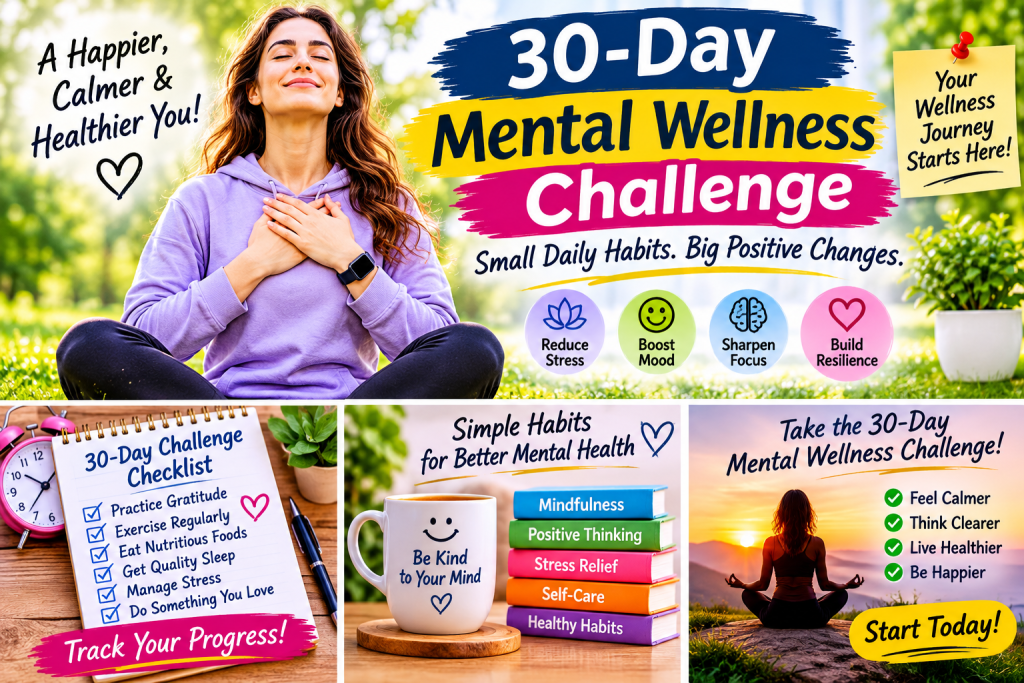
The plan is split into four weeks. Each week has one theme:
| Week | Days | Theme | Main goal |
|---|---|---|---|
| 1 | 1 to 7 | Build the foundation | Sleep, water, daylight, slow breathing |
| 2 | 8 to 14 | Calm the mind | Mindfulness, grounding, journaling |
| 3 | 15 to 21 | Move and connect | Exercise, friends, kindness |
| 4 | 22 to 30 | Strengthen and sustain | Self-kindness, boundaries, a plan to keep going |
What the challenge is not
- It is not a cure for anxiety, depression or any medical condition.
- It is not a test. There is no pass or fail.
- It is not about being positive all the time. Hard feelings are normal. The challenge helps you handle them better.
- It is not a replacement for therapy. It can work well alongside professional care.
How long does each day take?
Most days take 10 to 20 minutes. Some days are only 3 to 5 minutes. On very busy or very low days, you can do the 2-minute version of any task. A short version still counts.
Why a 30-Day Challenge Works (and What You Can Expect)
Many people try to change everything at once. They promise to meditate daily, exercise every morning, eat perfectly and sleep eight hours. After a week, they feel tired and quit. A 30-day challenge avoids this trap.
Explore Mental Health Exercises →
Five reasons it works
1. It is small. One task a day does not feel scary. Your brain accepts small changes more easily than big ones.
2. It has an end date. Thirty days is long enough to build a routine and short enough to stay motivated. You can see the finish line.
3. It builds one habit at a time. Each day adds something new on top of what you already practised.
4. It gives you proof. When you rate your mood every day, you see real patterns. For example: “I feel better on days when I walk.” Proof is more powerful than guessing.
5. It builds self-trust. Every time you keep a small promise to yourself, you feel a little more capable.
Benefits many people notice
- Feeling less overwhelmed
- Falling asleep a little easier
- Pausing before reacting to stress
- Noticing worries earlier and handling them better
- Feeling more connected to friends and family
- More energy and focus during the day
- A stronger sense of control
What to expect, honestly
Results are different for everyone. Some people feel better in the first week. Others need the full month or longer. You may also have good days and hard days. That is normal and does not mean you are failing.
The habits in this plan, such as regular sleep, movement, breathing, journaling and social contact, are widely recommended in mental health education. They are healthy for most adults. But they do not replace professional care. If your symptoms are strong or last for more than two weeks, please talk to a doctor or mental health professional.
Who Is This Challenge For?
This plan is made for ordinary people with busy lives. You do not need any experience. You can use it if you are:
- A busy professional who feels stressed, tired or burned out
- A student with exam pressure and poor sleep
- A parent or caregiver who gives everything to others and forgets themselves
- A business owner or freelancer who works alone and never fully switches off
- Someone who feels lonely or disconnected
- Someone who overthinks and cannot calm their mind
- Anyone who just wants better daily habits and a calmer routine
Real-life examples
Sara, 29, marketing executive. She lies awake at night thinking about work. She drinks too much coffee and feels anxious by noon. Week 1 and Week 2 give her a better sleep routine and calming tools.
Bilal, 24, student. He scrolls his phone for hours and feels behind in life. The digital reset on Day 23 and the movement days in Week 3 help him break the habit.
Ayesha, 38, online shop owner. She answers messages at midnight and feels exhausted. The boundary day and the weekly planning days help her protect her time.
These people are examples only. They show how different readers can use the same plan.
Who should be careful
This challenge is gentle, but please talk to a doctor or therapist before you start, or alongside it, if:
- You have a diagnosed mental health condition and are in treatment
- You have strong panic attacks, trauma memories or flashbacks
- You feel hopeless most days or have thoughts of self-harm
- You have a medical condition that limits exercise
- You are pregnant or recovering from illness and unsure about exercise
You can still use the plan, but with professional guidance. If any task makes you feel worse, stop that task and ask a professional for advice.
Before You Start: Simple Setup in 10 Minutes
Spend ten minutes on setup. It makes the next 30 days much easier.
Step 1: Choose your start date
Pick a day when you can begin without stress. A Monday is popular, but any day works. Write the start date and the end date in your planner or notebook. Tell one friend if you want extra support.
Step 2: Choose your tracker
You need one place to record your progress. You can use:
- A digital planner (easiest to carry and to review)
- A notebook
- A notes app on your phone
Whatever you choose, keep it simple and always in the same place.
Step 3: Learn the mood scale
Each evening, give your mood a score from 1 to 10.
| Score | What it means |
|---|---|
| 1 to 2 | Very low, hard to cope |
| 3 to 4 | Low, stressed or flat |
| 5 to 6 | Okay, up and down |
| 7 to 8 | Good, fairly calm and positive |
| 9 to 10 | Very good, relaxed and energetic |
There is no right or wrong score. It is only information. If you often score 1 to 3 for two weeks or more, please speak to a healthcare professional.
Step 4: Write your starting numbers
Before Day 1, write down:
- Your average mood this past week (1 to 10)
- How many hours you usually sleep
- How many days you moved your body this week
- Your biggest stress right now
- One thing you hope to feel after 30 days
You will compare these with your numbers on Day 30.
Step 5: Set up your space
- Put a glass or bottle of water where you can see it
- Place your planner or notebook near your bed or desk
- Set a daily reminder on your phone
- Decide on a quiet corner for breathing and journaling
The 4 golden rules
- Keep it small. If a task feels too big, do the 2-minute version.
- Never miss twice. One missed day is normal. Just continue the next day.
- Be honest, not perfect. Write real scores, not good-looking ones.
- Be kind to yourself. The goal is progress, not perfection.
A quick safety check
Please stop and seek help if you feel dizzy, short of breath, or in pain during any exercise. Also stop and seek help if a task brings up strong distress or painful memories. Your safety comes first.
How to Use Each Daily Lesson
Every day in this challenge follows the same simple pattern, so it is easy to follow:
- Today’s task: what to do in one sentence
- How to do it: easy steps
- Why it helps: a short, plain explanation
- If it feels hard: a smaller version of the task
- Planner tip: what to write down
Best time of day
You can do the tasks at any time, but a steady time works best. Many people like to do the main task in the morning and the mood rating in the evening. Choose what fits your life.
How to handle missed days
If you miss a day, do not go back and do two days at once. Just do today’s task. Remember the rule: never miss twice in a row.
Daily checklist
Every day, aim for these three things:
- Do the day’s task (or its 2-minute version)
- Rate your mood from 1 to 10
- Write one small win
Week 1 (Days 1-7): Build Your Foundation
This week is about the basics. Before you learn advanced tools, your body needs steady sleep, enough water, daylight and a way to calm down fast. These simple habits make everything else in the challenge easier.
Week 1 goal: a steady daily rhythm and one quick calming skill.
Day 1: Set a Fixed Wake-Up Time
Today’s task: Choose one wake-up time and write your starting numbers in your planner.
How to do it:
- Pick a wake-up time you can keep every day, even on weekends. Choose a time you can realistically follow, not an ideal one.
- Set an alarm for that time. Put your phone across the room if you tend to snooze.
- Write down last night’s sleep: bedtime, wake time and how rested you feel (1 to 5).
- Rate your mood in the morning and again in the evening (1 to 10).
- Write one thing you hope to feel after 30 days.
Why it helps: Your body has an internal clock. When you wake up at the same time every day, this clock becomes steady. Sleep, energy and mood all work better when the clock is regular. Many people notice that a fixed wake-up time helps them feel sleepy at the right time at night.
If it feels hard: Try waking up within one hour of your chosen time. Perfect timing is not required. Regular is the goal.
Planner tip: Start your sleep log today. In two weeks you will see how your sleep affects your mood.
Discover a Healthy Sleep Routine →
Day 2: Drink Water and Get Morning Daylight
Today’s task: Drink water regularly and spend 10 minutes in daylight in the morning.
How to do it:
- Drink a glass of water soon after you wake up.
- Keep a bottle or glass near you and sip through the day.
- Within an hour of waking, go outside or stand by an open window for 10 minutes. A balcony, doorstep or short walk is fine.
- Look at the sky, trees or buildings. Take a few slow breaths.
- Tick off your water and daylight in your planner.
Why it helps: Even mild dehydration can cause tiredness, headaches and poor focus, which can make you feel more stressed. Morning light helps tell your body clock that the day has started, which supports better sleep at night. It can also lift your mood a little.
If it feels hard: If you cannot go outside, sit next to the brightest window you have. If you have a medical condition that limits fluids, follow your doctor’s advice about how much to drink.
Planner tip: Make a small water tracker with boxes to tick. Seeing the ticks builds a feeling of success.
Day 3: Learn Slow Belly Breathing
Today’s task: Practise slow belly breathing for 3 minutes, twice today.
How to do it:
- Sit or lie down comfortably. Put one hand on your belly.
- Breathe in slowly through your nose for about 4 seconds. Let your belly rise.
- Breathe out slowly through your mouth for about 6 seconds. Let your belly fall.
- Repeat for 3 minutes. Make your out-breath longer than your in-breath.
- Do it once in the morning and once in the evening.
Why it helps: Slow breathing with a long out-breath tells your nervous system that you are safe. Your heart rate slows and your muscles relax. It is one of the quickest tools for stress, and you can use it anywhere.
If it feels hard: If you feel dizzy, breathe more gently and return to normal breathing. If your mind wanders, that is normal. Simply return to counting your breath.
Planner tip: Write how you feel before and after (0 to 10 stress). Over time, you will see that it works.
Try Simple Breathing Exercises →
Day 4: Take a 15-Minute Walk
Today’s task: Walk for 15 minutes at an easy pace and notice your mood before and after.
How to do it:
- Rate your mood from 1 to 10 before you leave.
- Walk outside if you can. If not, walk around your home or on the spot.
- Keep a comfortable pace. You should be able to talk.
- Look around. Notice colors, sounds and the air on your skin.
- Rate your mood again when you finish.
Why it helps: Walking is one of the easiest ways to move your body. It helps release tension, improves sleep and gives your mind a break from worry. Even short walks are linked with better mood.
If it feels hard: Walk for 5 minutes. Short walks count. If you have pain or a health condition, move in a way your doctor approves.
Planner tip: Note the mood change. A rise of even one point is proof that movement helps you.
Day 5: Start a Screen-Free Wind-Down
Today’s task: Switch off screens 30 minutes before bed and do something calm.
How to do it:
- Choose your bedtime and set a reminder for 30 minutes before.
- Put your phone on charge away from your bed, if possible.
- Dim the lights in your home.
- Do something quiet: take a warm shower, stretch, read a few pages, or listen to soft music.
- Go to bed at your planned time.
Why it helps: Bright screens and exciting content keep your brain alert. Scrolling can also bring worry, comparison and bad news right before sleep. A calm routine tells your body that it is time to rest.
If it feels hard: Start with 10 minutes screen-free and build up. Use night mode if you must use your phone.
Planner tip: Rate your sleep tomorrow morning and compare it with earlier days.
Day 6: Do a 5-Minute Brain Dump
Today’s task: Write down everything on your mind for 5 minutes, then pick your top 3 for tomorrow.
How to do it:
- Set a timer for 5 minutes.
- Write everything in your head: worries, tasks, ideas, things you must remember. Do not edit.
- Circle anything that needs action.
- Choose the three most important tasks for tomorrow.
- Close your notebook and tell yourself, “This is safely written down.”
Why it helps: When thoughts stay in your head, they repeat again and again. Writing them down gives your brain permission to let go. Many people sleep better after a brain dump because they no longer need to remember everything at night.
If it feels hard: If you do not know what to write, begin with “Right now I am thinking about…” and keep going.
Planner tip: Keep a “top 3” section in your planner. Three tasks feel manageable. Ten do not.
Day 7: Week 1 Review
Today’s task: Look back at the week and notice what helped.
How to do it:
- Read your mood scores for Days 1 to 6. Is there a pattern?
- Write your answers to these questions:
- Which task was easiest? Which was hardest?
- On which day did I feel best?
- Which habit do I want to keep?
- Count how many days you completed the task, even partly.
- Celebrate. Do something kind for yourself: a warm drink, a favorite song or a rest.
Why it helps: Reviewing turns experience into learning. You will see that small actions create small changes, and this builds motivation for Week 2.
If it feels hard: If the week was difficult, that is fine. Write one thing you learned. Nothing is wasted.
Planner tip: Write your Week 1 review in a special “weekly review” page. You will repeat this on Days 14, 21 and 30.
Week 2 (Days 8-14): Calm Your Mind
Your foundation is in place. Now you learn simple tools for racing thoughts, worry and tension. These skills help you notice what is happening in your mind without being pulled into it.
Week 2 goal: to calm your thoughts and feel more in control.
Day 8: Try a 5-Minute Breath Meditation
Today’s task: Sit quietly for 5 minutes and focus only on your breath.
How to do it:
- Sit comfortably. Set a timer for 5 minutes.
- Close your eyes or look softly at the floor.
- Feel your breath where it is easiest: nose, chest or belly.
- When your mind wanders, say silently “thinking” and gently return to your breath.
- Repeat each time you drift. Each return is one repetition, like exercise for your attention.
Why it helps: Mindfulness means noticing the present moment without judging it. You are not trying to have an empty mind. You are learning to notice thoughts and let them pass. With practice, this makes it easier to step back from worry.
If it feels hard: Your mind will wander many times. That is normal and not a failure. Start with 2 minutes if 5 feels long.
Planner tip: Write one sentence about what you noticed, such as “My mind was busy but I came back 10 times.”
Start Meditation for Beginners →
Day 9: Use the 5-4-3-2-1 Grounding Trick
Today’s task: Practise the 5-4-3-2-1 technique once when you feel calm, and use it again if you feel stressed.
How to do it:
- Name 5 things you can see.
- Name 4 things you can feel (your feet on the floor, your clothes, the chair).
- Name 3 things you can hear.
- Name 2 things you can smell. If you cannot smell anything, name two smells you like.
- Name 1 thing you can taste, or take a slow sip of water.
Go slowly. Say the items quietly or in your head.
Why it helps: When you feel anxious, your attention gets pulled into “what if” thoughts. Grounding brings your attention back to the present moment and your senses. It is a quick tool for worry, stress and feeling overwhelmed.
If it feels hard: Choose only one sense, such as sight, and name 10 things you can see.
Planner tip: Note when you used it and your stress level before and after (0 to 10).
Day 10: Write Three Good Things
Today’s task: Before bed, write three things that went well today, and why.
How to do it:
- Sit with your planner or notebook.
- Write three good things from today. They can be tiny: a warm drink, a kind message, a finished task.
- Beside each, write why it happened or what it says about you.
- Read them once before you sleep.
Why it helps: The brain naturally notices problems more than good things. This habit trains your attention to notice what is working, without pretending that hard things do not exist. Many people feel more grateful and calm when they do this regularly.
If it feels hard: On a heavy day, list basics: “I had food. I have a bed. Someone replied to my message.”
Planner tip: Keep a “good things” page. Read it on bad days.
Day 11: Check One Stressful Thought
Today’s task: Pick one stressful thought and separate what is true from what is only a fear.
How to do it:
- Write the thought, for example “I will fail my presentation.”
- Draw two columns: Facts and Fears.
- Under Facts, write what you really know (“I have practised twice”).
- Under Fears, write what you are only guessing (“Everyone will laugh at me”).
- Write a more balanced thought, such as “I am prepared and I can handle small mistakes.”
Why it helps: This is a simple idea from cognitive behavioral therapy. Thoughts feel like facts, but they are not always true. Checking them can reduce their power and help you respond more calmly.
If it feels hard: Choose a small worry first. Ask yourself, “What would I tell a friend who had this thought?”
Planner tip: Rate how strong the feeling is before (0 to 100) and after. Often it drops.
Day 12: Do a 10-Minute Body Scan
Today’s task: Lie down and slowly relax your body from toes to head.
How to do it:
- Lie on your back in a quiet place.
- Bring your attention to your toes. Notice any feeling: warmth, tightness, nothing.
- Move slowly upward: feet, legs, hips, belly, chest, hands, arms, shoulders, neck, face.
- When you find tension, breathe toward that area and let it soften if it can.
- End by feeling your whole body resting.
Why it helps: Stress often hides in your body as tight shoulders, a clenched jaw or shallow breathing. A body scan helps you notice and release it. It is also a very good way to prepare for sleep.
If it feels hard: If lying down makes you restless or if strong feelings come up, sit up, open your eyes and ground yourself with 5-4-3-2-1. If you have trauma memories, a therapist can guide you safely.
Planner tip: Write where you felt the most tension. It shows where stress lives in your body.
Day 13: Set a 15-Minute “Worry Time”
Today’s task: Choose a 15-minute time slot to write down your worries and possible next steps.
How to do it:
- Choose a daily time, such as 5 p.m. Avoid bedtime.
- During the day, when a worry appears, write two or three words on a list and tell yourself, “I will think about this at worry time.”
- At your chosen time, read the list.
- For each worry, ask: “Can I do something about this?” If yes, write one small step. If no, write “Let it go for now.”
- When 15 minutes end, close the notebook.
Why it helps: Worries tend to spread across the whole day. A fixed worry time gives them a place to go. Many people find that worries feel smaller or disappear before worry time arrives.
If it feels hard: If worries feel too big or constant, speak with a doctor or counselor. Anxiety is common and treatable.
Planner tip: Make two columns: “I can act” and “I cannot control.” Focus on the first.
Day 14: Week 2 Review
Today’s task: Decide which calming tool works best for you.
How to do it:
- Read your notes for Days 8 to 13.
- Write which tool helped most: breathing, meditation, grounding, journaling, body scan or worry time.
- Compare your average mood this week with last week.
- Choose one calming tool to use daily from now on.
- Reward yourself with a rest, a favorite meal or time with someone you like.
Why it helps: Everyone is different. Some people calm down with breathing. Others prefer writing or body awareness. Knowing your best tool gives you something to reach for when stress comes.
If it feels hard: If you missed days, simply note it and continue. You are still building a skill.
Planner tip: Create a “my calm toolkit” list with your top three tools. Keep it where you can see it quickly.
Week 3 (Days 15-21): Move and Connect
You have a steady routine and calming tools. Now you add two of the strongest natural mood supports: movement and people. Both are simple, free and powerful.
Week 3 goal: more energy, more connection and a lighter mood.
Day 15: Move Your Body for 20 Minutes
Today’s task: Walk, dance, cycle or exercise gently for 20 minutes.
How to do it:
- Choose movement you enjoy: a brisk walk, dancing in your room, a bicycle ride, a home workout video.
- Rate your mood before you start.
- Move at a pace where you can still speak in short sentences.
- If you like, add music or a podcast.
- Cool down with a minute of slow breathing, then rate your mood again.
Why it helps: Regular physical activity is linked with lower stress, better sleep and improved mood. It uses up stress energy in the body and gives your mind a break from worry. It also builds confidence, because you do something good for yourself.
If it feels hard: Start with 5 or 10 minutes. If you have a health condition, injury or are pregnant, choose gentle movement approved by your doctor.
Planner tip: Keep a simple movement log with the type, minutes and mood change.
Day 16: Message a Friend or Family Member
Today’s task: Send a message to someone you have not spoken to lately.
How to do it:
- Think of one person you like or miss.
- Send a short, friendly message, such as “I was thinking of you. How are you doing?”
- If you want, add a small detail: a memory, a photo or a question.
- Do not worry about a perfect message. Warm and simple is best.
- Put your phone down and carry on with your day.
Why it helps: Humans need connection. Feeling close to others protects mental health and helps us cope with stress. Most people are happy to hear from you, even if it feels awkward to start.
If it feels hard: Choose someone safe and easy, such as a cousin or an old classmate. If you are shy, send a voice note or a simple emoji and a greeting.
Planner tip: Write a list of 5 people you want to stay in touch with. Contact one each week.
Day 17: Do 10 Minutes of Gentle Stretching or Yoga
Today’s task: Stretch your body slowly for 10 minutes.
How to do it:
- Find a quiet space and a soft surface.
- Roll your shoulders back and forth 10 times.
- Gently tilt your head from side to side and hold for 20 seconds each side.
- Stand and reach your arms overhead, then fold forward slowly with soft knees.
- Sit and twist gently to each side.
- Lie on your back and hug your knees to your chest for 30 seconds.
- Finish with 5 slow breaths.
Why it helps: Stress makes muscles tight, especially in the neck, shoulders and back. Gentle stretching releases tension and helps your body relax. Combined with slow breathing, it is a great evening habit.
If it feels hard: Move only within comfort. Stretching should never cause sharp pain. If you have back or joint problems, ask a professional for safe stretches.
Planner tip: Note which stretch felt best so you can repeat it.
Day 18: Have a 15-Minute Real Conversation
Today’s task: Talk with someone you trust for 15 minutes, by phone, video or in person.
How to do it:
- Choose someone who makes you feel comfortable.
- Ask a real question: “What was the best part of your week?” or “What is on your mind lately?”
- Listen without checking your phone.
- Share one honest sentence about yourself, such as “I have been feeling a bit stressed lately.”
- Thank the person at the end.
Why it helps: Small talk keeps us polite. Real talk builds closeness. Feeling heard and supported lowers stress and loneliness. You do not need to solve problems. Simply being together matters.
If it feels hard: Start with a walk and talk or a shared activity such as cooking, so you do not have to rely on words alone. If you have no one close, consider a local group, class or online community with regular meetings.
Planner tip: After the call, write how you feel. Many people notice they feel lighter.
Day 19: Do One Small Act of Kindness
Today’s task: Do one kind thing for another person, without expecting anything back.
How to do it:
- Choose a simple act: send a thank-you message, help a neighbor, make tea for a family member, give a sincere compliment, share useful information.
- Do it today.
- Notice how you feel afterward.
- Write what you did and how the other person reacted.
Why it helps: Kindness shifts your attention from your own worries to someone else. It builds a sense of purpose and connection. Studies on prosocial behavior suggest that helping others can improve well-being for both giver and receiver.
If it feels hard: Keep it very small, such as holding a door or leaving a kind comment. Remember that you also need kindness. Be gentle with yourself.
Planner tip: Keep a “kindness list”. Looking back at it on hard days reminds you that you matter.
Day 20: Try Something New or Fun
Today’s task: Do one small thing you have never done, or something you enjoyed long ago.
How to do it:
- Choose something simple and safe: try a new recipe, visit a new park, draw, listen to a new genre of music, learn a few words in a new language, dance, take photographs.
- Spend at least 20 minutes on it.
- Do not worry about doing it well. Be a beginner and enjoy it.
- Write how you felt: curious, silly, relaxed, proud.
Why it helps: When we are stressed, life can feel repetitive and heavy. Fun and curiosity give the mind fresh energy. New experiences can also break a cycle of overthinking and improve mood.
If it feels hard: If you cannot think of anything, look at your childhood interests. What did you love before life got busy?
Planner tip: Make a “fun list” of 10 small activities. Choose one each week.
Day 21: Week 3 Review
Today’s task: Notice who and what lifts your mood.
How to do it:
- Read your notes from Days 15 to 20.
- Write answers to these questions:
- Which activity gave me the most energy?
- Which person made me feel supported?
- How did my mood change after moving my body?
- Compare your average mood with Week 1.
- Choose one movement habit and one connection habit to keep.
- Celebrate your progress with something kind.
Why it helps: Many people discover that mood is not random. It follows patterns, such as movement, people, sleep and rest. Seeing your own patterns makes you more confident about what works for you.
If it feels hard: If your mood has not improved, that is useful information too. Share your notes with a doctor or therapist, who can help you find extra support.
Planner tip: Draw a simple mood line for 21 days. Notice the direction, not each tiny dip.
Week 4 (Days 22-30): Strengthen and Sustain
The last stretch is about making your new habits last. You will be kinder to yourself, protect your time and energy, and build a plan to continue after Day 30.
Week 4 goal: to keep what works and make it part of your life.
Day 22: Speak to Yourself Like a Good Friend
Today’s task: Notice your inner voice and replace one harsh thought with a kind one.
How to do it:
- Notice a moment today when you criticize yourself, such as “I am so stupid” or “I always fail.”
- Ask: “Would I say this to a friend?”
- Rewrite the thought as you would speak to a friend: “I made a mistake, and I can learn from it.”
- Place a hand on your chest and say, “This is hard. Many people feel this way. I can be kind to myself.”
- Write one kind sentence to yourself in your planner.
Why it helps: Harsh self-talk adds stress and lowers confidence. Self-compassion does not mean making excuses. It means treating yourself with the same respect you give others. Research suggests it is linked with better coping and resilience.
If it feels hard: Start by simply noticing your inner voice without changing it. Awareness is the first step.
Planner tip: Keep a “proof list” of three small things you did well today.
Day 23: Do a Digital Reset
Today’s task: Reduce phone stress by turning off extra notifications and setting phone-free times.
How to do it:
- Open your phone settings and turn off notifications from apps that are not important.
- Choose one phone-free time, for example the first 30 minutes after waking, or meals.
- Charge your phone outside your bedroom if you can.
- Mute or unfollow one account that makes you feel worse.
- Replace one scrolling session with a walk, a call or a book.
Why it helps: Constant alerts keep your brain in “alert mode”, and endless scrolling can bring comparison and worry. Small limits help you use your phone on purpose, instead of letting it use you.
If it feels hard: Begin with one change only. If you need your phone for work, set boundaries around non-work apps.
Planner tip: Note how you feel after your phone-free time.
Day 24: Practise One Boundary
Today’s task: Say no to one small thing that drains you, or set one clear limit.
How to do it:
- Choose a small, safe example, such as a request that you do not have time for or a late-night work message.
- Use a calm, short sentence: “I cannot do that today, but thank you for asking.”
- You do not have to give a long explanation.
- Notice how you feel afterward. Guilt is common at first. It usually fades.
- Write what you learned.
Why it helps: Without boundaries, you can give away all your energy and feel resentful and exhausted. Healthy boundaries protect your time, health and relationships.
If it feels hard: Practise the sentence out loud first. If a relationship feels unsafe, controlling or abusive, please seek help from a trusted person or a professional service.
Planner tip: Write your own list of “I can say no to…” examples.
Day 25: Connect With What Matters Most
Today’s task: Write what matters to you and one small action for each.
How to do it:
- List three things you value, such as family, health, faith, learning, creativity, service or honesty.
- Next to each, write one small action you can do this week.
- Add one of those actions to tomorrow’s plan.
- Look at your list and ask: “Does my week reflect what I care about?”
Why it helps: Living in line with your values gives life meaning and direction, even in hard times. It helps you choose where to spend your limited energy.
If it feels hard: If you are unsure what matters, think about what you would like to be remembered for, or what you missed during stressful times.
Planner tip: Add a “values action” to your weekly plan.
Day 26: Spend 30 Minutes in Nature
Today’s task: Spend half an hour in a park, garden, near water or anywhere with trees and open sky.
How to do it:
- Choose a green or open place near you.
- Walk slowly or sit quietly.
- Leave your phone in your pocket, or use it only for photos.
- Notice five natural things: leaves, birds, clouds, sunlight, wind.
- Take five slow breaths before you leave.
Why it helps: Time in green spaces is linked with lower stress and better mood. Nature gently draws attention outward and slows your mind. Even a small garden or a few trees helps.
If it feels hard: If you cannot go outside, sit near a window with plants, or look at nature photographs for a few minutes. Make sure you choose a safe place and time.
Planner tip: Add a weekly “nature time” to your planner.
Day 27: Plan Your Ideal Week
Today’s task: Build a simple weekly plan that includes your best habits.
How to do it:
- Choose your top five habits from the challenge: for example, walking, breathing, three good things, calling a friend, weekly review.
- Put them into your week on specific days and times.
- Add one rest block and one fun activity.
- Keep the plan realistic. Leave empty space.
- Share your plan with a friend if you would like support.
Why it helps: Habits last when they have a time and place. A written plan reduces decision stress and makes it easier to stay on track after the challenge ends.
If it feels hard: Start with three habits only. You can add more later.
Planner tip: Use a weekly layout with morning, afternoon and evening blocks.
Day 28: Write a Letter to Yourself
Today’s task: Write a short, kind letter to yourself about what you have learned.
How to do it:
- Start with “Dear me,”.
- Write what you did well in the last 28 days.
- Write what you learned about your mind and body.
- Write one encouragement for hard days ahead.
- Keep the letter somewhere you can find it later.
Why it helps: Writing helps you notice your growth and reminds you of your strengths. Reading your own words on a tough day can be very comforting.
If it feels hard: Write only three sentences. Imagine you are writing to a friend.
Planner tip: Save the letter in your planner. Read it again in three months.
Day 29: Choose Your Top 3 Habits
Today’s task: Pick the three habits that helped you most, and decide how to keep them.
How to do it:
- Look through your planner and notes.
- Circle the habits that gave you the biggest mood boost.
- Choose your top three. Keep them small and clear, such as “10-minute walk after lunch”.
- Link each habit to something you already do every day.
- Write your plan for the next 30 days.
Why it helps: Trying to keep everything often leads to burnout. Choosing three keeps your routine simple and realistic.
If it feels hard: If you cannot choose, pick the one habit that was easiest and begin there.
Planner tip: Use a habit tracker with checkboxes and watch your streaks grow.
Explore the 90-Day Habit Tracker Dashboard →
Day 30: Final Review and Celebration
Today’s task: Review your journey, compare your numbers and celebrate.
How to do it:
- Open the starting numbers you wrote before Day 1.
- Compare them with today: average mood, sleep, movement days and stress.
- Answer: What changed? What surprised me? What was hardest? What helped most?
- Write three things you are proud of.
- Reward yourself with something kind: a favorite meal, a day out, a rest, or time with a loved one.
- Decide: continue with your top three habits, repeat the challenge, or seek extra support if needed.
Why it helps: Finishing is powerful. It shows that you can keep promises to yourself. Your tracker gives you real evidence of progress, and this builds confidence for the future.
If it feels hard: If you did not complete every day, that is okay. Every day you practised counted. You can continue or repeat the challenge at any time.
Planner tip: Write your Day 30 review in a special page, and set a date for your next review in one month.
What to Do on Hard Days: The Minimum Day Plan
Some days will be hard. You may wake up exhausted, anxious or very low. You may have a family problem, a busy work day or simply no energy. On those days, a full task may feel impossible. That is okay. This is what the “minimum day” is for.
The minimum day checklist
On a very hard day, aim only for these five things:
- Drink a glass of water
- Eat something
- Open a window or step outside for 5 minutes
- Contact one person (a short message is enough)
- Go to bed at a reasonable time
If you do these five things, you have had a successful day. Anything extra is a bonus.
The 2-minute version of every task
You can shrink almost any task in this challenge:
| Full task | 2-minute version |
|---|---|
| 15-minute walk | Walk to the door and back, or stand outside for 2 minutes |
| 5-minute meditation | Take 10 slow breaths |
| Write three good things | Write one good thing |
| Call a friend | Send a heart or a short message |
| 10-minute stretching | Stretch your neck and shoulders |
| Brain dump | Write three words about what is on your mind |
Rules for hard days
- Lower the bar, not the habit. Do less, but still do something.
- Do not judge your score. A mood of 3 is information, not a failure.
- Be gentle. Talk to yourself as you would to a tired friend.
- Rest is allowed. Sometimes the best action is to rest and start again tomorrow.
- Ask for support. You do not have to carry hard days alone.
When a hard day becomes a hard week
Occasional bad days are normal. But if you have felt very low, anxious or hopeless for two weeks or more, or if it is hard to do daily tasks, please speak with a doctor or mental health professional. If you ever think about harming yourself, contact your local emergency number or a crisis service immediately. You deserve support, and help is available.
Building your own hard-day kit
Prepare a small kit while you feel okay. It can include:
- A short list of your top three calming tools
- The name and number of one person you can contact
- A favorite song or playlist
- Your “good things” page and your letter to yourself
- A simple meal or snack you can make easily
- Crisis and support numbers for your country
When a hard day arrives, you will not need to think. You will just open your kit.
Common Mistakes in a 30-Day Challenge (and How to Fix Them)
Most people who stop a challenge are not lazy. They make small mistakes that anyone can make. Here are the most common ones, with easy fixes.
Mistake 1: Starting too big
You decide to meditate for 30 minutes, run every day and journal for an hour. By Day 4, you are tired and quit.
Fix: Follow the small tasks in this plan. Increase time only after the habit feels easy.
Mistake 2: Waiting to feel motivated
Motivation often arrives after you start. If you wait to feel like it, you may never begin.
Fix: Commit to two minutes. Start, then see how you feel.
Mistake 3: Skipping the mood rating
The rating takes ten seconds, but many people skip it. Without it, you cannot see your progress.
Fix: Link it to a daily habit, such as brushing your teeth at night.
Mistake 4: Treating one missed day as total failure
You miss Day 9 and think, “I have ruined it.” This all-or-nothing thinking is the biggest challenge killer.
Fix: Remember the rule: never miss twice. Return the next day.
Mistake 5: Comparing your progress to others
Someone online completes everything perfectly. You feel behind.
Fix: Compare yourself only with your own Day 1.
Mistake 6: Ignoring your body’s signals
Pushing through pain, dizziness or severe fatigue is not wellness.
Fix: Rest when you need to and speak with a healthcare provider about symptoms.
Mistake 7: Doing the challenge alone in silence
Support makes habits easier to keep.
Fix: Tell one friend about your challenge. Share a weekly update.
Mistake 8: Expecting instant results
Some habits help quickly. Others take weeks. Mood can also go up and down.
Fix: Look at the trend over weeks, not one day.
Mistake 9: Using the challenge instead of professional help
Self-help is useful, but it cannot replace care when you need it.
Fix: Use the challenge alongside medical or therapy support if needed.
Mistake 10: Stopping on Day 30
Many people finish and slowly return to old habits.
Fix: Use Day 29 and Day 30 to choose your top three habits and plan the next month. Follow the “After Day 30” section below.
Quick self-check
Tick the mistakes that sound familiar and choose one fix for this week:
- Starting too big
- Waiting for motivation
- Skipping mood ratings
- All-or-nothing thinking
- Comparing with others
- Ignoring body signals
- Going alone
- Expecting fast results
- Replacing professional help
- Stopping after Day 30
How to Adapt the Challenge to Your Life
The plan works for many people, but real life is different for everyone. Here is how to adjust it.
If you are a busy professional
- Do your main task in the morning or at lunch.
- Use the 2-minute version on very busy days.
- Add a 5-minute shutdown ritual at the end of work: write tomorrow’s top three tasks, close your laptop and say “work is done for today.”
- Use short walking breaks between meetings.
If you are a student
- Keep a fixed sleep time, especially during exams.
- Take a 5-minute breathing break after every study session.
- Use the worry time (Day 13) to handle exam fears.
- Meet a friend for a walk instead of studying all day.
If you are a parent or caregiver
- Choose micro-habits: five slow breaths while the kettle boils, a glass of water, a walk with the stroller.
- Invite your children to join your stretching or walking.
- Accept help. Ask a family member to take over one task.
- Remember that caring for yourself helps you care for others.
If you work for yourself
- Set clear start and finish times.
- Take one real day off each week.
- Use your planner to protect rest time just like client meetings.
- Join a small community, because working alone can feel lonely.
If you feel very anxious
- Spend extra days on breathing and grounding.
- Limit caffeine, especially in the afternoon.
- Keep tasks short and calm.
- Talk to a professional if anxiety is strong or constant.
If you feel low or flat
- Use the 2-minute versions often.
- Focus on small actions: daylight, a short walk, one message.
- Do not wait to feel better before acting.
- Speak to a doctor or therapist if low mood lasts for two weeks or more.
If you have a health condition or limited mobility
- Choose movement that suits your body, such as seated stretches or gentle arm movements.
- Follow your doctor’s advice about exercise and fluids.
- Focus on the breathing, journaling and connection days.
If you are going through grief or a big life change
- Keep your plan very small.
- Allow tears and rest. They are part of healing.
- Add support from friends, family, a support group or a counselor.
Faith and culture
Many people find strength in prayer, spiritual practice, community gatherings and family traditions. You can include these in your daily routine. For example, quiet reflection or prayer can be your “mindfulness” time, and community time can be your “connection” time. Choose what feels meaningful and respectful for you.
Real-life story: a month of small steps
Here is an example of how the challenge might look for someone. This is an illustrative story, not a medical case.
Nadia, 33, works full time and has two young children. She felt tired and short-tempered most evenings. On Day 1 she rated her mood 4. She slept about five and a half hours and scrolled her phone in bed.
In Week 1, she fixed her wake-up time and stopped scrolling in bed. By Day 7 she was sleeping an extra half hour and her mood averaged 5. In Week 2, she used breathing while the kids watched cartoons and wrote three good things on her phone. In Week 3 she walked with her sister twice and sent messages to old friends. In Week 4, she muted work notifications after 7 p.m. and said no to one extra task.
On Day 30, her average mood was 6 to 7. Life was still busy, but she felt less frazzled and more in control. She chose three habits to keep: a morning daylight walk, evening three good things and a weekly call with her sister.
The lesson: small steps, repeated, can change how a day feels.
Track Your 30-Day Challenge With a Digital Planner
If there is one thing that helps people finish a challenge, it is tracking. When you can see your days, your mood scores and your streaks, you feel progress. And on days when you feel stuck, your own notes show that you have moved forward.
A digital planner puts everything in one place: your daily task, mood rating, sleep, habits, journal notes and weekly reviews. You can open it on your phone, tablet or computer, so you can use it anywhere.
Why track your mental wellness?
- You see patterns. For example: “My mood is higher on days I walk and sleep before midnight.”
- You stay consistent. Tick marks and streaks make habits feel rewarding.
- You reduce mental clutter. Writing things down frees your mind.
- You catch problems early. If your mood stays low for weeks, you notice sooner and can seek help.
- You talk better to professionals. Notes about sleep, mood and triggers help a doctor or therapist understand you.
- You celebrate progress. Looking back at 30 days shows how much you did.
Meet the 106-Day Mind System Digital Planner
The 106-Day Mind System Digital Planner is made to help you build calm, steady habits day by day. It turns the ideas in this challenge into a simple daily system, so you spend less time planning and more time doing.
With the planner you can:
- Plan your daily top 3 tasks without feeling overloaded
- Record your mood, energy and sleep in under a minute
- Tick off daily habits and watch your streak grow
- Write short journal and gratitude notes
- Use weekly reviews to see what works for you
- Keep going after Day 30 with a longer routine
[Get the 106-Day Mind System Digital Planner here: ADD YOUR PLANNER LINK]
How to use the planner with this challenge
Every morning (3 minutes):
- Write your sleep and starting mood.
- Read today’s task from this guide.
- Write your top 3 priorities.
Every evening (5 minutes):
- Tick your daily task.
- Rate your mood from 1 to 10.
- Write one win and three good things.
- Plan tomorrow’s first step.
Every Sunday (15 minutes):
- Look at your mood scores for the week.
- Note what helped and what drained you.
- Choose one change for next week.
Copy this 30-day tracker
Use this table in your planner or on paper. Add rows up to Day 30.
| Day | Date | Mood (1-10) | Sleep (hours) | Task done? | One win |
|---|---|---|---|---|---|
| 1 | |||||
| 2 | |||||
| 3 | |||||
| 4 | |||||
| 5 |
Your Day 1 versus Day 30 comparison
| Measure | Day 1 | Day 30 |
|---|---|---|
| Average mood (1-10) | ||
| Sleep hours per night | ||
| Days I moved my body | ||
| Stress level (1-10) | ||
| Biggest worry | ||
| How I feel overall |
Tips for using a planner without stress
- Keep it simple. Track three to five things only.
- Do not use it to judge yourself. Treat the data like a weather report, not a school report.
- Leave empty space. A packed schedule raises stress.
- Plan rest. Add rest blocks as seriously as tasks.
- Return after a missed day. Skip the guilt, and begin again with the next page.
Paper or digital?
Both can work. Paper feels slow and calming. Digital planners are always with you, easy to copy, searchable and good for tracking patterns over time. Some people use a hybrid: digital for daily tracking and a notebook for deeper journaling.
After Day 30: What to Do Next
Completing 30 days is a real achievement. But the goal is not just to finish. The goal is to keep what helps you. Here is a simple plan for your next steps.
Option 1: Keep your top three habits
Use the three habits you chose on Day 29. Link each to a daily cue and track them in your planner. Aim for 80 percent of days, not perfection.
Option 2: Repeat the challenge with changes
Many people benefit from a second round. This time:
- Skip tasks you did not enjoy and replace them with similar ones.
- Spend extra days on your weakest area, such as sleep or connection.
- Add a longer version of your favorite task.
Option 3: Move to a longer routine
A longer plan, such as a 90 or 100-day habit system, helps you turn new actions into lifelong habits. This is where a planner can be very useful, because you can see your streaks and review your progress every week.
A simple 30-day follow-up plan
| Week | Focus |
|---|---|
| 5 | Keep your top 3 habits. Do a weekly review each Sunday. |
| 6 | Add one new healthy habit, such as a hobby or a social activity. |
| 7 | Review your sleep and stress levels. Adjust your routine. |
| 8 | Celebrate your 60-day mark. Decide what to keep and what to change. |
Protect your progress
- Expect setbacks. Stress, illness and busy periods are normal. Use the minimum day plan.
- Review monthly. Spend 30 minutes once a month looking at your mood, sleep and habits.
- Update your calm toolkit. Replace tools that do not help.
- Keep your support network. Stay in touch with people who lift you.
- Stay curious. Try one new self-care idea each month.
Signs that you may need extra support
If, after 30 days, you notice that you still feel very low, anxious or hopeless most days, or that your daily life is affected, please speak with a doctor or therapist. Share your planner notes. They can make the conversation much easier, and professional care can be a powerful next step.
Mental Wellness Myths vs Facts
Myths can stop people from starting. Here are common ones, with simple facts.
| Myth | Fact |
|---|---|
| “Mental wellness is only for people with problems.” | Everyone has a mind that needs care, just like the body. |
| “I need an hour a day for it to work.” | Short, regular practice, even 5 to 15 minutes, can be helpful. |
| “If I miss a day, I have failed.” | Missing a day is normal. Return the next day. |
| “Positive thinking fixes everything.” | Positive habits help, but real problems also need action and sometimes professional support. |
| “Meditation means emptying my mind.” | It means noticing your thoughts and gently returning to the present. |
| “Exercise only counts if it is hard.” | Gentle walks, stretching and dancing all count. |
| “Asking for help is weak.” | Asking for help is a sign of strength and self-respect. |
| “Self-care is selfish.” | Caring for yourself helps you care for others too. |
| “A 30-day challenge cures anxiety or depression.” | It can support well-being, but it is not a cure or a treatment. |
| “Only adults need to worry about mental health.” | Children and teenagers also need support, and early help matters. |
The key idea
Your mind is part of your health. You do not have to wait until you are in crisis to look after it. Small, regular care now can protect you later.
When to Get Professional Help
This challenge is a self-care tool. It is not a substitute for medical or psychological care. Please speak with a doctor, psychologist, counselor or therapist if:
- You feel sad, anxious or hopeless most days for two weeks or more
- Your mood or worry affects work, study, sleep or relationships
- You have panic attacks, strong fears or frightening memories
- You use alcohol, drugs or other behaviors to cope
- You feel numb, empty or have lost interest in nearly everything
- You simply feel you need more support
You do not have to wait until it gets “bad enough.”
If you are in danger right now
If you or someone else may be in immediate danger, or you are thinking about ending your life, contact your local emergency number now or go to the nearest emergency department. If you can, tell someone near you and do not stay alone.
To find a crisis line in your country, you can use:
- Find a Helpline, which lists services by country
- International Association for Suicide Prevention crisis centres directory
In the United States you can call or text 988. In the UK and Ireland, Samaritans is available on 116 123. In other countries, your local emergency number or health service can direct you to support.
Taking your planner to an appointment
Bring your mood scores, sleep notes and a short list of your main worries. This helps your doctor or therapist see patterns and plan the best support. You can also share which challenge tasks helped you.
Frequently Asked Questions About the 30-Day Mental Wellness Challenge
1. What is a 30-day mental wellness challenge?
It is a month-long plan with one small daily action to support your mind, such as breathing, walking, journaling or connecting with someone. The goal is to build calm, steady habits and notice what helps your mood.
2. Does a 30-day challenge really work?
Many people find that small, daily habits improve sleep, stress and mood over time. Results differ from person to person. The challenge is a helpful self-care tool, but it is not a cure or a replacement for medical care.
3. How much time does it take each day?
Usually 10 to 20 minutes. Some tasks take only 3 to 5 minutes. On hard days, you can do a 2-minute version.
4. Can I start the challenge on any day?
Yes. Any day works. Choose a day when you can begin without too much pressure, and write your start and end dates.
5. What if I miss a day?
Just continue with the next day. Do not try to double up. The rule is to never miss two days in a row.
6. Can I do the challenge if I have anxiety or depression?
The tasks are gentle and suit many people, but they do not replace treatment. If you are in treatment, tell your doctor or therapist about the challenge. If your symptoms are strong or last for two weeks or more, please seek professional help.
7. What are the best daily habits for mental wellness?
Widely recommended habits include regular sleep, daily movement, spending time outdoors, slow breathing or mindfulness, journaling, healthy meals, limiting screen time and staying connected with people.
8. Do I need a digital planner?
No, but tracking helps you stay consistent and see progress. A planner keeps your tasks, mood scores, sleep and habits in one place. You can also use a notebook or a notes app.
9. How do I track my mood?
Each evening, give your mood a score from 1 to 10 and add one sentence about your day. After a week or two you can look for patterns, such as better moods on walking days.
10. What is the best time of day to do the tasks?
The best time is the one you can keep. Many people like to do the main task in the morning and the mood rating in the evening.
Conclusion: Your Calmer Month Starts Today
You now have a complete, easy plan for a 30-day mental wellness challenge. In four weeks you will build a steady foundation, learn calming tools, add movement and connection, and then create a plan to keep going. Each day asks for only a few minutes, but together they can change how your days feel.
Remember the key ideas:
- Small is powerful. Do the 2-minute version when you need to.
- Never miss twice. One missed day does not end the challenge.
- Track your progress. What you can see, you can improve.
- Be kind to yourself. You are learning, not being tested.
- Ask for help when needed. Professional support is a strength.
Your first step right now
You do not need to wait for Monday or for a perfect moment. Today, do three simple things:
- Write your start date.
- Choose your wake-up time.
- Rate your mood from 1 to 10.
That is Day 1 begun.
Make it easy with the 106-Day Mind System Digital Planner
If you want one simple place to plan, track and review your habits, the 106-Day Mind System Digital Planner can help you turn this challenge into a daily routine. Track your mood, sleep and habits, write your notes and enjoy watching your streaks grow, during these 30 days and beyond.
[Start now with the 106-Day Mind System Digital Planner:
Disclaimer: This article is for general education and information only. It is not medical advice and does not replace diagnosis or treatment by a qualified professional. The people mentioned are illustrative examples. If you are struggling, please contact a healthcare provider. If you are in immediate danger or thinking about harming yourself, contact your local emergency number or a crisis service right away.
Free 30-Day Mental Wellness Planner
Track your mood, sleep and daily wins. One click, opens in any browser. No sign-up.
2 thoughts on “30-Day Mental Wellness Challenge: A Simple Daily Plan to Feel Calmer”