
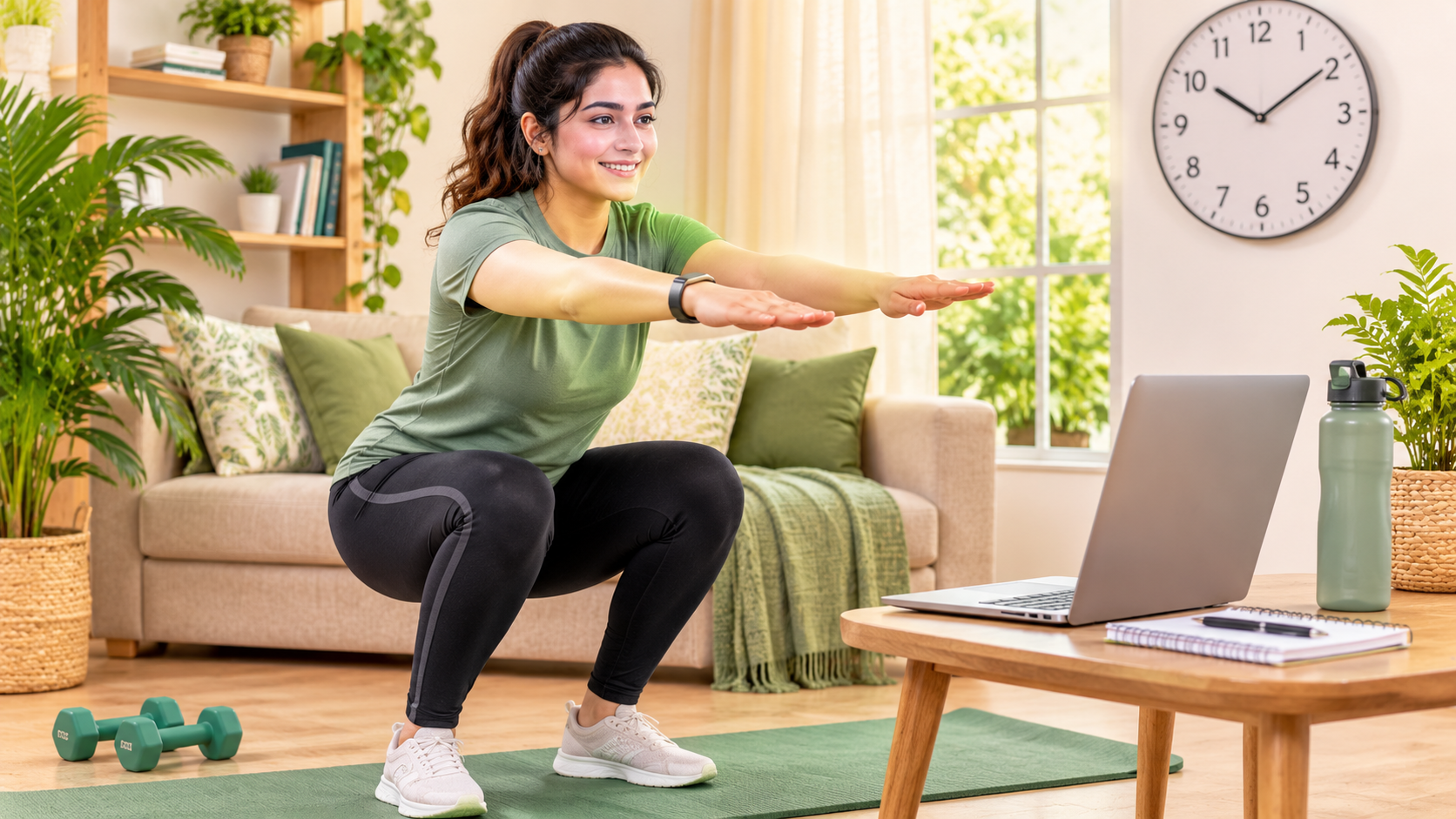
Try a 7-minute morning workout for energy : no equipment , low -impact options ,a 30-day plan & a free tracker . Beginner-friendly & easy to stick to
Written by Kalsoom Khan, Founder & Wellness Content Creator, FitHealthyMind, on November 15, 2026
Last updated: November 2026 | Reading time: about 100 minutes (use the table of contents to jump to the section you need)
Editorial note: this guide is educational and is not medical advice. If you have a heart, lung, joint or other health condition, are pregnant, or have been inactive for a long time, speak to a doctor before starting a new exercise routine.
It is 6:45 a.m. The alarm is ringing. You know that a workout would help you feel more awake, but a 45-minute session feels impossible, and by the time you finish scrolling, the morning has already gone.
Sound familiar?
Here is a different idea. What if your morning workout took only seven minutes? No gym, no equipment, no commute, no special clothes. Just a small, repeatable routine you can do beside your bed, in the kitchen or in the living room before the day begins.
Seven minutes will not turn you into an athlete. But it can do something almost as valuable: it can become a habit. And a habit you actually keep beats a perfect plan you abandon by Thursday.
If you are searching for a 7-minute morning workout for energy, you probably want:
- A routine you can start tomorrow, with clear instructions
- Honest answers about whether such a short workout is worth it
- Low-impact and beginner options that suit your body
- A way to stay consistent even on tired, busy and unmotivated mornings
- Practical tips on sleep, water, breakfast and caffeine that affect morning energy
- A simple system to track your streaks and progress
In this guide you will learn:
- What the research says about short workouts (and what it does not say)
- Why mornings feel low-energy and what a few minutes of movement can and cannot fix
- A complete 7-minute home workout with step-by-step form tips
- Easier, harder, low-impact, quiet and back-friendly versions
- Six more 7-minute routines so you never get bored
- A 30-day plan, a weekly progression and a “minimum workout” for the worst days
- The psychology of consistency: cues, habit stacking, if-then plans and “never miss twice”
- Safety guidance and who should check with a doctor first
- How to build from 7 minutes toward general health guidelines
- How to use a digital planner to track your mornings and see your progress
- Answers to 50 common questions
We wrote it the way a friendly coach with a science background would explain it: practical, encouraging and honest about what is known and unknown.
Quick promise: we will not claim that seven minutes melts fat, replaces a gym or fixes fatigue that has a medical cause. We will show you how to use seven minutes well, and how to keep showing up.
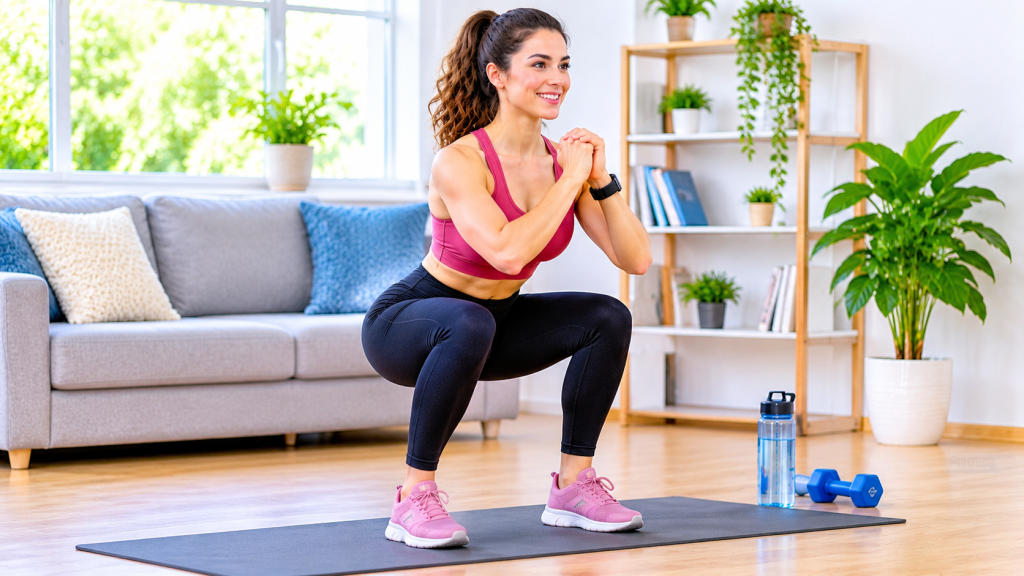
Quick Start: Your First 7-Minute Morning Workout (Do It Today)
Do not wait until you have read everything. Try this tomorrow morning, or right now.
The Basic 7-Minute Routine
Format: 7 exercises, 40 seconds of work and 20 seconds of rest each. Total time: exactly 7 minutes.
| # | Exercise | Work / Rest |
|---|---|---|
| 1 | March in place or jumping jacks | 40 s / 20 s |
| 2 | Bodyweight squats | 40 s / 20 s |
| 3 | Push-ups (wall, incline or floor) | 40 s / 20 s |
| 4 | Alternating reverse lunges | 40 s / 20 s |
| 5 | Plank (or knee plank) | 40 s / 20 s |
| 6 | High knees or fast marching | 40 s / 20 s |
| 7 | Glute bridge | 40 s / 20 s |
How hard should it feel? Aim for about a 6 or 7 out of 10. You should be breathing harder but still able to say a short sentence.
Before you start: drink a few sips of water, stand tall, roll your shoulders and take three deep breaths.
After you finish: walk slowly for 30 seconds, take a few deep breaths and notice how you feel.
What Just Happened?
You moved your whole body for seven minutes. Your heart rate rose, your muscles woke up and you probably feel a little more alert. That is a good start, and every step in this guide builds on it.
Key Takeaways (Read This If You Read Nothing Else)
- Short workouts can count. The World Health Organization says some physical activity is better than none and recommends starting small. A well-known “7-minute workout” circuit was published in 2013 in ACSM’s Health & Fitness Journal.
- Seven minutes alone will not meet general activity guidelines. Adults are advised to aim for 150 to 300 minutes of moderate activity (or 75 to 150 minutes of vigorous activity) per week, plus muscle-strengthening on two or more days. Seven minutes a day is a great foundation, not the whole picture.
- Exercise can help with fatigue. In one small University of Georgia study of sedentary adults with persistent fatigue, even low-intensity exercise (20 minutes, three times a week for six weeks) was linked with reduced fatigue and about 20 percent higher energy than no exercise. No study has tested this exact seven-minute routine for morning energy.
- Consistency beats intensity. Habit research suggests new behaviours take weeks to become automatic, on average around 66 days in one study, with huge variation between people.
- Missing one day matters little. The same research found that a single missed day had little effect on long-term habit building. The “never miss twice” rule keeps you moving.
- Morning is a convenience, not magic. The best time is the time you will actually do it. Mornings work well for many people because there are fewer interruptions.
- Sleep, water and light matter too. A workout cannot fully cancel the effects of too little sleep.
- Start easy. If you are new to exercise, begin with the low-impact version and increase gradually.
- Safety first. Check with a doctor if you have a heart condition, chest pain, dizziness, joint problems or you are pregnant, and stop if something hurts.
- Track it. A planner or simple tracker makes your streak visible, which keeps you motivated.
How We Researched This Guide (Our Method and Its Limits)
What we did
- Reviewed the published 7-minute workout circuit (Klika and Jordan, 2013) and the World Health Organization’s 2020 physical activity guidelines.
- Looked at research on very short bursts of vigorous activity in daily life, on exercise and fatigue and on how habits form.
- Built practical, equipment-free routines using basic training principles: full-body movements, alternating muscle groups and adjustable intensity.
- Separated what the evidence supports from what is common sense and what is marketing.
What we did not do
- We did not invent testimonials or “before and after” stories.
- We did not claim that any seven-minute routine guarantees weight loss, muscle gain or a cure for tiredness.
- We did not test our routines on a clinical population. They are general fitness suggestions.
Limits you should know about
- No trial we know of has tested a seven-minute morning routine specifically for energy. We explain what related research suggests, and we label it as such.
- Studies on short activity bursts are often observational, meaning they show associations, not proof of cause.
- Individual responses vary widely, depending on sleep, health, fitness and lifestyle.
Who Is This Guide For?
This guide is for you if you:
- Feel sluggish in the morning and want an easy way to wake up your body
- Have very little time or a packed schedule
- Are new to exercise or returning after a long break
- Have tried long workouts and quit
- Prefer to work out at home with no equipment
- Want a simple routine to anchor a healthy morning
- Are a parent, student, shift worker or professional looking for a realistic habit
- Like tracking habits and want a planner to stay motivated
It is not a replacement for personalised medical or training advice. If you have a medical condition or injury, use this guide to prepare questions for your clinician or a qualified trainer.
What Is a 7-Minute Workout? (Plain-English Explanation)
A 7-minute workout is a short, structured routine that you can do in about seven minutes, typically as a circuit of bodyweight exercises with brief rests.
The Original “7-Minute Workout” (2013)
The best-known version comes from an article by Brett Klika and Chris Jordan titled “High-intensity circuit training using body weight: Maximum results with minimum investment,” published in 2013 in ACSM’s Health & Fitness Journal. It describes a circuit of 12 bodyweight exercises, each done for about 30 seconds with 10 seconds of rest, using only a chair and a wall:
- Jumping jacks
- Wall sit
- Push-ups
- Crunches
- Step-ups onto a chair
- Squats
- Chair triceps dips
- Plank
- High knees running in place
- Lunges
- Push-ups with rotation
- Side plank
The circuit takes just under eight minutes, and the authors suggest it can be repeated for a longer session. Exercises alternate between upper body, lower body and core so that one area rests while another works.
Our Version
Our routine follows the same principles but is tuned for morning energy and consistency:
- Seven exercises instead of twelve, to keep instructions simple
- 40 seconds of work and 20 seconds of rest, for exactly seven minutes
- Low-impact options for every move
- A built-in “wake-up” feel, starting with gentle movement and building up
What a 7-Minute Workout Is Not
- It is not a replacement for all the exercise you need over a week.
- It is not a fat-burning miracle.
- It is not meant to be painful. Hard, but comfortable, is the goal.
- It is not one-size-fits-all. Adjust to your body.
Does a 7-Minute Workout Really Work? What the Research Says
Let us look at the evidence honestly, because short workouts attract both hype and cynicism.
Evidence Point 1: The WHO Says Some Activity Is Better Than None
The World Health Organization’s 2020 guidelines on physical activity and sedentary behaviour (Bull and colleagues, British Journal of Sports Medicine) recommend that adults aged 18 to 64:
- Do at least 150 to 300 minutes of moderate-intensity aerobic activity per week, or 75 to 150 minutes of vigorous-intensity activity, or an equivalent combination
- Do muscle-strengthening activities involving all major muscle groups on two or more days per week
- Limit sedentary time, and replace it with physical activity of any intensity
The guidelines also state that for all populations, some physical activity is better than none, and that people should start small and gradually increase frequency, intensity and duration.
What this means for you: seven minutes a day adds up to 49 minutes a week. That is a meaningful start, but it is below the 150-minute minimum. Think of seven minutes as the first step, not the finish line. Later in this guide we show how to build up.
Evidence Point 2: Very Short Bursts of Vigorous Activity Are Linked With Better Outcomes
A 2022 study in Nature Medicine (Stamatakis and colleagues) analysed wrist-worn activity tracker data from the UK Biobank. The researchers focused on more than 25,000 “non-exercisers,” people who reported no sport or exercise in their leisure time, and followed their health records for roughly seven years.
They looked at VILPA, or vigorous intermittent lifestyle physical activity: very brief bursts of intense effort lasting up to one or two minutes within ordinary life, such as hurrying up stairs or power-walking.
Key findings reported:
- Around three to four one-minute bouts per day were associated with up to a 40 percent lower risk of death from any cause.
- The associations were larger with more bouts.
- Participants averaged around eight bouts a day.
Important caveats
- The study is observational. It shows an association, not proof that bursts caused better outcomes.
- The “non-exerciser” group was identified by self-report.
- The sample comes from a UK volunteer database, so it may not represent everyone.
What this means for you: the study does not test a seven-minute workout. But it supports a simple idea: brief, hard-ish efforts add up, and short bursts of movement are not meaningless.
Evidence Point 3: The Published “7-Minute Workout” Circuit
The 2013 article by Klika and Jordan proposed a high-intensity circuit of 12 bodyweight exercises, each performed for 30 seconds with 10-second rests. Its authors argued that this format could address lack of time, a common barrier to exercise, and that repeating the circuit could build up to longer sessions.
What this means for you: the circuit is a well-designed template, not a clinical trial proving specific results. It is a reasonable, practical format, especially for people who are already fairly fit, because the pace is demanding. Our version is gentler and has more rest, which suits beginners and morning bodies.
Evidence Point 4: Exercise and Fatigue
A 2008 study from the University of Georgia (Puetz, O’Connor and Flowers, in Psychotherapy and Psychosomatics) assigned 36 sedentary adults who reported persistent fatigue to moderate-intensity exercise, low-intensity exercise or no exercise. The exercise groups did 20-minute sessions three times a week for six weeks.
According to the university’s summary:
- Both exercise groups reported roughly 20 percent higher energy than the control group.
- The low-intensity group had a larger drop in fatigue (about 65 percent) than the moderate-intensity group (about 49 percent).
- The improvements did not appear to track with gains in aerobic fitness, which led the authors to speculate that exercise might affect the central nervous system.
Important caveats
- It was a small study of 36 people.
- Participants did not have a medical condition such as chronic fatigue syndrome, so results may not apply to people with such conditions.
- Fatigue was self-reported.
- Sessions were 20 minutes on exercise bikes, not seven-minute bodyweight circuits.
- Our source is a university press release, not the full paper.
What this means for you: this is encouraging evidence that regular, even gentle, exercise can help with everyday tiredness for some people. It is not proof that seven minutes will do the same. The take-home message: you do not need to exhaust yourself to feel more energetic.
Evidence Point 5: Habits Take Time, and Missing a Day Is Not a Disaster
Researchers at University College London (Lally and colleagues, European Journal of Social Psychology) asked 96 volunteers to adopt a new daily behaviour, tied to a cue, for 84 days. Examples included eating fruit with lunch or doing 50 sit-ups after morning coffee.
According to a British Psychological Society summary:
- On average it took about 66 days for a behaviour to reach its maximum automaticity, but individual times ranged from 18 days to an estimated 254 days.
- A single missed day did not significantly affect later habit building.
- Exercise-related habits took longer to become automatic than eating or drinking habits.
- The study relied on self-reported automaticity.
What this means for you: give yourself at least two to three months and expect variation. Do not quit if one morning goes wrong.
Summary: What the Evidence Supports
| Claim | Support | Plain-English verdict |
|---|---|---|
| Some exercise is better than none | Strong (WHO guidelines) | Seven minutes is worth doing |
| Short bursts of vigorous activity are linked with better outcomes | Moderate (observational, large sample) | Encouraging, not proof |
| A 7-minute circuit can be a practical fitness template | Reasonable (published design) | Good format for time-poor people |
| Exercise can reduce fatigue | Moderate (small trials) | Likely helpful for many sedentary people |
| This exact 7-minute routine boosts energy | Not directly tested | Plausible, but unproven |
| Seven minutes replaces the recommended weekly activity | Not supported | Use it as a foundation |
| Morning is better than other times | Not established | Choose what you will do consistently |
Why Do Mornings Feel Low-Energy? (And What Seven Minutes Can Realistically Do)
Understanding why you feel sluggish helps you set realistic expectations.
Common Causes of Morning Tiredness
| Cause | What is happening | Can a workout help? |
|---|---|---|
| Not enough sleep | Your body did not get enough rest | A little, but sleep is the real fix |
| Poor sleep quality | Noise, light, stress, late caffeine or alcohol, snoring | Indirectly, if you build a better routine |
| Sleep grogginess | The transition from sleep to wakefulness can feel heavy for a while | Movement and light may help you feel more alert |
| Low light in the morning | Your body clock responds to light | Opening curtains and going outside helps |
| Dehydration | You may be a little dry after hours without fluids | A glass of water helps |
| Skipped or low-quality breakfast | Low fuel after a long overnight gap | Eating regularly helps for many people |
| Stress and rumination | A busy mind drains energy | Movement can ease tension |
| Sedentary lifestyle | Too little activity can leave you feeling flat | Regular exercise helps over time |
| Medical causes | Anaemia, thyroid problems, depression, sleep apnoea, medicines and more | A workout is not a treatment; see a clinician |
What Seven Minutes Can Do
- Raise your heart rate and body temperature a little, which many people find helps them feel more awake.
- Get blood moving to muscles and joints that feel stiff.
- Give you a quick sense of accomplishment to start the day.
- Create a ritual that signals “the day has begun.”
- Build the exercise habit, making longer workouts easier later.
What Seven Minutes Cannot Do
- Fix chronic sleep loss.
- Treat medical causes of fatigue.
- Replace caffeine, food or water if those are the issue.
- Deliver instant, dramatic energy every single day.
When to See a Doctor About Tiredness
Speak to a healthcare professional if you have:
- Persistent, unexplained fatigue lasting weeks
- Fatigue with weight changes, shortness of breath, chest pain, palpitations or dizziness
- Loud snoring, gasping or daytime sleepiness despite enough sleep
- Low mood, loss of interest or hopelessness
- Heavy periods, pale skin or other signs of low iron
- New fatigue after starting a medicine
Exercise is a helpful habit, but tiredness can be a signal worth investigating.
Before You Start: Setup, Safety and a 60-Second Readiness Check
A good routine starts before the timer does. Spend one minute on these basics and you will make the workout safer and more pleasant.
What You Need
| Item | Why | Optional alternatives |
|---|---|---|
| A clear floor space about the size of a yoga mat | Room to step back, lunge and lie down | A hallway, a bedroom corner or the living room |
| Supportive shoes or bare feet on a non-slip surface | Grip and joint comfort | A mat on a smooth floor |
| A timer | Keeps the 40/20 rhythm | A phone, a kitchen timer, a smartwatch or a video |
| A wall or sturdy counter | For wall or incline push-ups | A sturdy table or sofa arm |
| A towel and water | Comfort and hydration | None needed |
| A mat (optional) | Comfort for plank and bridges | A folded blanket or carpet |
No dumbbells, bands or benches are required.
The 60-Second Readiness Check
Ask yourself:
- Do I feel unwell today? If you have a fever, chest symptoms or feel faint, rest.
- Is my area safe? Clear toys, cords, pets and slippery rugs.
- Have I had a few sips of water?
- Do I have any new pain? If a joint feels sore today, choose the low-impact options.
- Is my footwear or floor slippery?
The 45-Second Warm-Up
Warm-ups are not a luxury. They help your body shift gently from sleep to movement, especially in the morning when joints feel stiff.
| Move | Time |
|---|---|
| Neck rolls (slow half circles) | 8 seconds |
| Shoulder rolls backward | 8 seconds |
| Arm circles | 8 seconds |
| Hip circles | 8 seconds |
| Gentle knee bends | 8 seconds |
| Three slow deep breaths | 5 seconds or more |
If you are short on time, skip the warm-up on some days and let the first exercise (march in place) act as the warm-up. Do not skip it if you feel stiff or are over 50.
The Talk Test: How to Judge Effort Without Gadgets
You do not need a heart-rate monitor. Use the talk test:
| Effort level | What it feels like | Rating (out of 10) |
|---|---|---|
| Easy | You can sing or chat easily | 3 to 4 |
| Moderate | You can talk, but in short sentences | 5 to 6 |
| Hard | You can say only a few words at a time | 7 to 8 |
| Maximal | You cannot speak | 9 to 10 |
Aim for 6 to 7 during work intervals. Your first weeks should feel closer to a 5 to 6. It should feel challenging, never painful.
Stop Signs: When to End the Workout Immediately
Stop and seek medical help if you notice:
- Chest pain, pressure or tightness
- Unusual shortness of breath or inability to catch your breath
- Dizziness, light-headedness or fainting
- Irregular or racing heartbeat
- Sharp or sudden joint, back or muscle pain
- Nausea or cold sweats
Mild muscle burn and normal heavy breathing are expected. Sharp pain, chest symptoms and dizziness are not.
The 7 Exercises Explained: Step-by-Step Form Guide
Good form matters more than speed. Read this section once, then use the quick table later.
Exercise 1: March in Place or Jumping Jacks (40 seconds)
What it does: raises your heart rate gently and warms up your whole body.
How to do the march
- Stand tall, feet hip-width apart.
- Lift one knee to a comfortable height, then the other.
- Swing your arms naturally, opposite arm to opposite leg.
- Keep your chest up and your shoulders relaxed.
- Pick up the pace gradually through the 40 seconds.
How to do jumping jacks
- Start with feet together and arms at your sides.
- Jump your feet out wide as your arms sweep overhead.
- Jump back to the start.
- Land softly on the balls of your feet with slightly bent knees.
Common mistakes
- Slouching forward
- Landing stiff-legged
- Going too fast too soon
Easier: step-touch side to side with arm swings.
Harder: jumping jacks at a fast pace, or add a squat jack.
Exercise 2: Bodyweight Squats (40 seconds)
What it does: strengthens thighs, glutes and the muscles you use every time you stand up from a chair.
How to do it
- Stand with feet slightly wider than hip-width, toes slightly turned out.
- Push your hips back as if sitting into a chair.
- Bend your knees, keeping your chest lifted and your heels on the floor.
- Lower until your thighs are about parallel to the floor, or as far as comfortable.
- Press through your heels to stand tall, squeezing your glutes.
Common mistakes
- Knees collapsing inward (push them gently out over your toes)
- Heels lifting
- Rounding the back
Easier: squat to a chair, tapping the seat lightly and standing back up. Or do a shallow squat.
Harder: add a jump at the top (squat jump), or slow the lowering phase to three seconds.
Exercise 3: Push-Ups, Wall, Incline or Floor (40 seconds)
What it does: works your chest, shoulders, triceps and core.
How to do a wall push-up (easiest)
- Stand an arm’s length from a wall.
- Place your hands on the wall at shoulder height, slightly wider than your shoulders.
- Bend your elbows to bring your chest toward the wall, keeping your body in a straight line.
- Push back to start.
How to do an incline push-up (medium)
- Place your hands on a sturdy counter, table or sofa arm.
- Walk your feet back until your body forms a straight line.
- Lower your chest toward the surface and press back up.
How to do a floor push-up (harder)
- Start in a high plank with hands slightly wider than your shoulders.
- Lower your chest toward the floor with elbows at about a 45-degree angle to your body.
- Press back up, keeping your hips from sagging.
Common mistakes
- Sagging hips or piking the hips high
- Flaring elbows straight out
- Holding your breath
Easier: wall push-ups, or knee push-ups.
Harder: floor push-ups with a slow lowering phase, or feet elevated.
Exercise 4: Alternating Reverse Lunges (40 seconds)
What it does: works thighs, glutes and balance, one leg at a time.
How to do it
- Stand tall with your feet together and hands on hips.
- Step one foot back and lower until both knees are bent at about 90 degrees.
- Keep your front knee over your ankle and your torso upright.
- Push through your front heel to return to standing.
- Alternate legs.
Why reverse lunges? Many people find stepping backward easier on the knees than stepping forward.
Common mistakes
- Leaning forward
- Letting the front knee cave inward
- Taking too short a step
Easier: hold a wall or chair for balance, and make the lunge shallow.
Harder: add a knee drive on each return, or hold the bottom for two seconds.
Exercise 5: Plank or Knee Plank (40 seconds)
What it does: trains your core, shoulders and back to stay stable.
How to do a forearm plank
- Place your forearms on the floor, elbows under shoulders.
- Extend your legs behind you, toes on the floor.
- Squeeze your glutes and brace your abdomen lightly.
- Keep a straight line from head to heels.
- Breathe steadily.
Knee plank: the same, but with knees on the floor and a straight line from head to knees.
Common mistakes
- Hips sagging or rising too high
- Neck craning up
- Holding your breath
Easier: knee plank, or hands on a counter in a high plank.
Harder: lift one foot or hand alternately, or do plank shoulder taps.
Note: it is fine to break the plank into two 20-second holds if you start to shake. Quality counts.
Exercise 6: High Knees or Fast Marching (40 seconds)
What it does: gives a second cardio burst and lifts your heart rate.
How to do high knees
- Stand tall.
- Run in place, driving your knees up toward hip height.
- Pump your arms.
- Stay light on your feet.
How to do fast marching (low impact)
- March in place with a brisk pace.
- Lift knees to a comfortable height.
- Swing your arms.
Common mistakes
- Leaning back
- Stomping hard
- Tensing shoulders
Easier: fast marching with smaller steps.
Harder: high knees at top speed.
Exercise 7: Glute Bridge (40 seconds)
What it does: strengthens your glutes, hamstrings and lower back, and offsets a lot of sitting. It is also a calmer move to finish.
How to do it
- Lie on your back with knees bent and feet flat, hip-width apart.
- Press through your heels to lift your hips until your body forms a line from shoulders to knees.
- Squeeze your glutes at the top for a second.
- Lower slowly.
Common mistakes
- Arching the lower back
- Pushing through the toes
- Letting the knees fall in or out
Easier: smaller range, no pause at the top.
Harder: single-leg bridge, or hold at the top for three seconds.
The Quick-Reference Card
| # | Exercise | Main muscles | Easier | Harder |
|---|---|---|---|---|
| 1 | March or jumping jacks | Legs, heart | Step-touch | Fast jacks |
| 2 | Squats | Thighs, glutes | Chair squat | Jump squat |
| 3 | Push-ups | Chest, shoulders, arms | Wall push-up | Floor push-up |
| 4 | Reverse lunges | Thighs, glutes | Hold a wall | Knee drive |
| 5 | Plank | Core | Knee plank | Shoulder taps |
| 6 | High knees | Legs, heart | Fast march | Fast high knees |
| 7 | Glute bridge | Glutes, hamstrings | Small range | Single-leg |
How to Do the Workout: The 7-Minute Timeline
Here is the exact minute-by-minute flow.
| Time | Exercise | Cue |
|---|---|---|
| 0:00 to 0:40 | March or jumping jacks | Start easy and speed up |
| 0:40 to 1:00 | Rest | Breathe, shake out arms |
| 1:00 to 1:40 | Squats | Hips back, chest up |
| 1:40 to 2:00 | Rest | Walk in a small circle |
| 2:00 to 2:40 | Push-ups | Body in a straight line |
| 2:40 to 3:00 | Rest | Shake out wrists |
| 3:00 to 3:40 | Reverse lunges | Alternate legs |
| 3:40 to 4:00 | Rest | Slow breaths |
| 4:00 to 4:40 | Plank | Squeeze and breathe |
| 4:40 to 5:00 | Rest | Stand and shake |
| 5:00 to 5:40 | High knees | Quick and light |
| 5:40 to 6:00 | Rest | Catch your breath |
| 6:00 to 6:40 | Glute bridge | Squeeze at the top |
| 6:40 to 7:00 | Rest and cool down | Slow breaths, sip water |
Tips for Timing
- Use a free interval timer app or a free interval timer in your phone’s clock.
- Voice or beep cues help you keep your eyes off the screen.
- A playlist with songs that last around 40 seconds of work followed by a calm 20 seconds can work, though a timer is easier.
- Count rounds, not minutes, when you build up to two rounds.
The Cool-Down (Optional, 60 to 90 Seconds)
| Stretch | Time |
|---|---|
| Standing quad stretch | 15 seconds per leg |
| Standing hamstring reach | 15 seconds |
| Chest opener (hands behind back) | 15 seconds |
| Cat-cow or gentle spine twist | 15 seconds |
| Three slow breaths | Enough |
Stretching is optional, but many people enjoy it as a mini “reset” before the day begins.
Easier, Harder and Adapted Versions: Make the 7 Minutes Fit Your Body
One routine will not suit everyone. Use these versions as starting points and pick the one that matches how you feel today.
Version 1: The Gentle Beginner Version (Weeks 1 to 2)
Best for: people new to exercise, returning after a long break or feeling very stiff in the morning.
Format: 7 exercises, 30 seconds of work and 30 seconds of rest, about 7 minutes.
| # | Exercise | Notes |
|---|---|---|
| 1 | Marching in place | Small steps, relaxed arms |
| 2 | Chair squats | Tap the chair and stand |
| 3 | Wall push-ups | Slow and controlled |
| 4 | Supported reverse lunges (hand on wall) | Shallow |
| 5 | Knee plank or counter plank | Short holds are fine |
| 6 | Fast marching | Brisk, not hurried |
| 7 | Glute bridge | Slow, squeeze at top |
Effort target: 4 to 5 out of 10. You should finish feeling you could have done more.
Goal: show up and learn the movements. Do not worry about intensity.
Version 2: The Standard Version (Weeks 3 to 6)
This is the 40/20 routine from the Quick Start. Effort target: 6 to 7 out of 10.
Version 3: The Stronger Version (Weeks 7 and Beyond)
Best for: people who find the standard version comfortable and want more challenge.
Option A: Increase work time. Move to 45 seconds of work and 15 seconds of rest.
Option B: Add harder variations. Use jumping jacks, jump squats, floor push-ups, knee-drive lunges, shoulder-tap planks, fast high knees and single-leg bridges.
Option C: Do two rounds with only 20 seconds of rest between rounds (see the next section on longer sessions).
Version 4: The Low-Impact Version (No Jumping)
Best for: people with sensitive joints, those who live in apartments, people who are heavier and want less impact, or anyone who simply prefers a gentler style.
| # | Exercise |
|---|---|
| 1 | Marching in place with arm swings |
| 2 | Bodyweight squats |
| 3 | Incline push-ups |
| 4 | Reverse lunges (slow) |
| 5 | Forearm or knee plank |
| 6 | Fast marching or step-jacks (step out to the side, no jump) |
| 7 | Glute bridge |
All moves are performed without jumping. You can still raise your heart rate with a brisk pace and big arm movements.
Version 5: The Quiet Apartment Version (No Noise)
Best for: early risers who do not want to wake family members or disturb neighbours.
| # | Exercise | Quiet tip |
|---|---|---|
| 1 | Slow marching on the spot | Place feet softly |
| 2 | Slow squats | Control the descent |
| 3 | Incline push-ups | Hands on counter |
| 4 | Slow reverse lunges | Step softly |
| 5 | Plank | Silent by nature |
| 6 | Seated or standing bicycle punches in the air | Quiet and active |
| 7 | Glute bridge on a mat | Silent |
Tip: use a thick mat or carpeted area, and wear socks or soft shoes.
Version 6: The Back-Friendly Version
Best for: people who feel stiff or sensitive in the lower back in the morning. If you have a diagnosed back problem or ongoing pain, check with a clinician or physiotherapist first.
| # | Exercise | Why it is gentle |
|---|---|---|
| 1 | Marching in place | Low load on the spine |
| 2 | Chair squats | Support and control |
| 3 | Wall push-ups | Upright posture |
| 4 | Supported reverse lunges | Stable and shallow |
| 5 | Bird-dog (opposite arm and leg, kneeling) instead of plank | Core work with less strain |
| 6 | Fast marching | Low impact |
| 7 | Glute bridge | Often comfortable for backs, but stop if it hurts |
General rules: move slowly, avoid twisting or jerky movements, and stop if pain increases.
Version 7: The Knee-Friendly Version
Best for: people who feel knee discomfort during lunges or squats. Persistent knee pain needs a clinician’s advice.
| # | Exercise | Adjustment |
|---|---|---|
| 1 | Marching | Lift knees only as high as comfortable |
| 2 | Chair squats | Shallow depth |
| 3 | Push-ups (incline) | No knee loading |
| 4 | Standing hip hinge or glute kickbacks instead of lunges | Less knee bend |
| 5 | Plank (forearm, on a mat) | Use padding if kneeling |
| 6 | Seated knee lifts | Gentle |
| 7 | Glute bridge | Knee-friendly for many |
Version 8: The Desk-Worker Version (Posture Reset)
Best for: people who sit most of the day and feel tight in the shoulders, hips and upper back.
| # | Exercise | Benefit |
|---|---|---|
| 1 | Marching with big arm circles | Opens shoulders |
| 2 | Squats | Wakes up glutes |
| 3 | Wall push-ups with a chest squeeze | Upper back and chest |
| 4 | Reverse lunges with an overhead reach | Hip flexor stretch |
| 5 | Plank | Core stability |
| 6 | Wall angels or shoulder blade squeezes | Upper back posture |
| 7 | Glute bridge | Counteracts sitting |
Version 9: The Travel and Hotel Room Version
| Move | Use |
|---|---|
| March in place | Fits any room |
| Squats | No equipment |
| Incline push-ups on the desk | Use a sturdy surface |
| Lunges | Limited space is fine |
| Plank | Use a towel as a mat |
| High knees | Quick and quiet |
| Glute bridge on the carpet | Simple |
Pack nothing. Use the hotel room as your gym and keep the streak going.
Version 10: The “Older Adult” Friendly Version
Best for: adults who want a safe, stable routine. Please consult your doctor first, particularly if you have heart disease, osteoporosis, balance problems or take medicine that may cause dizziness.
| # | Exercise | Notes |
|---|---|---|
| 1 | Marching with a chair nearby | Hold the chair if needed |
| 2 | Sit-to-stand from a chair | A functional move for everyday life |
| 3 | Wall push-ups | Easy on joints |
| 4 | Standing hip abduction (leg lift to the side) with support | Balance and hips |
| 5 | Standing core brace or counter plank | Gentle |
| 6 | Heel raises with support | Calves and balance |
| 7 | Glute bridge or seated marching | Choose comfortable |
Safety rules: keep a stable chair or wall within reach, wear supportive shoes, rise slowly and stop with any dizziness.
Exercising During Pregnancy or After Birth
This guide is general and not tailored to pregnancy. If you are pregnant or recently gave birth, please ask your doctor or midwife which exercises suit you before using any routine here. Guidelines differ depending on your stage and health.
Choosing Your Version: A Quick Decision Table
| Your situation today | Choose |
|---|---|
| Brand-new to exercise | Gentle Beginner |
| Comfortable with the basics | Standard |
| Strong and bored | Stronger version |
| Sore joints or heavier body | Low-impact |
| Sleeping family or neighbours | Quiet apartment |
| Lower back stiff | Back-friendly |
| Knee discomfort | Knee-friendly |
| Desk job | Desk-worker |
| On a trip | Travel |
| Low energy or sick day | Minimum workout (see the Consistency section) |
Six More 7-Minute Routines So You Never Get Bored
Variety helps you stay interested. Rotate these through the week, or use one per day.
Routine A: The “Wake-Up” Flow (Gentle Mobility and Cardio)
Format: 40 seconds on, 20 seconds off.
| # | Move | Cue |
|---|---|---|
| 1 | Arm swings and marching | Loosen up |
| 2 | Hip circles and knee bends | Gentle |
| 3 | Standing side bends | Reach overhead |
| 4 | Step-touch with arm sweeps | Rhythm |
| 5 | Cat-cow on hands and knees | Spine mobility |
| 6 | World’s greatest stretch (lunge with a rotation) | Slow |
| 7 | Deep breathing with arm raises | Calm |
Best for: days when you feel stiff or very low in energy.
Routine B: The Cardio Boost
Format: 40 seconds on, 20 seconds off.
| # | Move |
|---|---|
| 1 | Jumping jacks (or step-jacks) |
| 2 | High knees (or fast march) |
| 3 | Skater steps side to side |
| 4 | Butt kicks |
| 5 | Shadow boxing |
| 6 | Fast feet or quick steps |
| 7 | Jog in place, slowing to a walk |
Best for: days when you want to feel more awake and warm.
Routine C: The Strength Builder
Format: 40 seconds on, 20 seconds off.
| # | Move |
|---|---|
| 1 | Squats |
| 2 | Push-ups |
| 3 | Reverse lunges |
| 4 | Plank |
| 5 | Glute bridges |
| 6 | Tricep dips (chair) |
| 7 | Superman (back extension) |
Best for: days when you want to build muscle endurance.
Routine D: The Core Focus
| # | Move |
|---|---|
| 1 | Forearm plank |
| 2 | Dead bug |
| 3 | Bird-dog |
| 4 | Side plank (left) |
| 5 | Side plank (right) |
| 6 | Glute bridge |
| 7 | Slow mountain climbers or standing knee-to-elbow crunches |
Best for: building a steady midsection and improving posture. Note that core work strengthens muscles but does not target belly fat.
Routine E: The Mobility and Stretch Routine
| # | Move |
|---|---|
| 1 | Neck and shoulder rolls |
| 2 | Cat-cow |
| 3 | Child’s pose |
| 4 | Low lunge hip stretch (left) |
| 5 | Low lunge hip stretch (right) |
| 6 | Seated forward fold |
| 7 | Supine spinal twist |
Best for: recovery days or mornings when you want to move without effort.
Routine F: The Walk-and-Wake Combo (If You Prefer to Leave the House)
| Time | Activity |
|---|---|
| Minutes 1 to 2 | Easy walk outdoors |
| Minutes 3 to 4 | Brisk walk, arms swinging |
| Minutes 5 to 6 | Fast walk or stairs |
| Minute 7 | Slow walk and deep breaths |
Best for: getting morning daylight as well as movement. Morning light is a helpful cue for your body clock.
A Sample Weekly Rotation
| Day | Routine |
|---|---|
| Monday | Standard 7-minute routine |
| Tuesday | Routine B (cardio boost) |
| Wednesday | Routine A (wake-up flow) |
| Thursday | Routine C (strength builder) |
| Friday | Standard routine |
| Saturday | Routine F (walk and wake) or Routine D |
| Sunday | Routine E (mobility) |
Remember, the best plan is the one you will repeat. If a rotation feels like too much to remember, repeat the standard routine every day.
The Morning Energy Stack: Sleep, Light, Water, Food and Caffeine
A 7-minute workout is one lever. Morning energy depends on several others. Think of them as a stack: each layer helps, and the layers work together.
Layer 1: Sleep (The Foundation)
No workout fully replaces sleep. Most adults are advised to aim for around seven or more hours of sleep a night, though needs vary by person.
Simple sleep habits that support morning energy
| Habit | How to do it |
|---|---|
| Keep a regular schedule | Go to bed and wake at similar times, including weekends if you can |
| Create a wind-down | Dim lights and put screens away 30 to 60 minutes before bed |
| Keep the bedroom cool, dark and quiet | Use curtains, an eye mask or earplugs if useful |
| Limit caffeine later in the day | Many people do well with a cut-off at lunchtime or early afternoon |
| Limit heavy meals and alcohol close to bedtime | Alcohol may make you drowsy but can disrupt sleep |
| Get daylight and movement during the day | Supports your body clock |
The honest link between sleep and workouts: if you are very short of sleep, choose the gentle version of the workout rather than pushing hard. A light session may still help you feel more awake, but forcing intense exercise when exhausted can feel miserable and may make you quit.
Layer 2: Morning Light
Your body clock responds strongly to light. Getting outdoor light soon after waking is a widely recommended habit for feeling alert and keeping a stable sleep schedule.
Easy ways to add light
- Open the curtains before you start your workout.
- Do the workout by a window or on a balcony if weather and privacy allow.
- Step outside for two minutes after the workout with your drink.
- Take a short walk if you have the time.
Outdoor light, even on a cloudy day, is generally much brighter than indoor lighting.
Layer 3: Hydration
You lose some water overnight through breathing and sweat. Many people feel better after a glass of water, though the evidence that mild dehydration causes morning tiredness is mixed, and needs vary.
Practical tips
- Keep a glass of water by the bed and drink a few sips before the workout.
- Drink more after the workout, especially if you sweated.
- Check your urine colour: pale yellow usually suggests you are drinking enough.
- Do not force huge amounts. Drinking far more than you need is not helpful, and sipping steadily is more comfortable.
Layer 4: Breakfast (Before or After?)
Should you eat before a 7-minute workout?
For most people, a seven-minute session is short enough that you do not need to eat first. Some feel fine fasted. Others feel lightheaded or low.
| If you… | Try |
|---|---|
| Feel fine on an empty stomach | Work out first, then eat |
| Feel shaky or weak when fasted | Have a small snack first: a banana, a few dates, a slice of toast or a yoghurt |
| Have diabetes or take glucose-lowering medicine | Ask your care team how to time exercise and food |
| Have a sensitive stomach | Work out first and eat after, or wait 20 to 30 minutes after a small snack |
Simple post-workout breakfasts
| Breakfast | Why it works |
|---|---|
| Eggs with whole-grain toast and fruit | Protein, fibre and carbohydrate |
| Greek yoghurt with berries and nuts | Protein and fibre |
| Oatmeal with fruit and seeds | Slow-release carbohydrate and fibre |
| Lentil chilla or vegetable omelette | Protein-rich and filling |
| Smoothie with milk or yoghurt, fruit and oats | Quick and portable |
| Peanut butter on whole-grain toast with a banana | Easy and energising for many |
Eating regularly and including protein and fibre may help keep energy steadier through the morning for some people. Individual responses vary, so notice what works for you.
Layer 5: Caffeine (Friend, Not Crutch)
Caffeine can make you feel more alert, and many people enjoy a morning coffee or tea. A few practical points:
- Moderation matters. Health authorities generally suggest that up to about 400 mg a day (around four cups of brewed coffee) is acceptable for most healthy adults, though sensitivity varies and pregnancy has lower limits.
- Timing matters. Caffeine late in the day can disrupt sleep for some people, which can worsen the next morning’s tiredness.
- Pair, do not replace. Use your workout as your first “wake-up,” then enjoy coffee afterward if you like.
- Watch the extras. Sweet coffee drinks can add a lot of sugar and calories.
If you feel jittery, have palpitations or get headaches when you skip caffeine, consider reducing slowly and speak with a clinician if symptoms are bothersome.
Layer 6: Stress and Mindset
A rushed, stressed start can leave you feeling drained. Pairing your workout with a tiny mindset ritual can help:
- Take three slow breaths before you begin.
- Set one intention for the day.
- Notice how your body feels afterward. Say, “I did something good for myself.”
If you enjoy mindfulness, see our guide on meditation for beginners and consider adding a one-minute breathing pause after your workout.
The Morning Energy Checklist
| Layer | Quick action |
|---|---|
| Sleep | Protect your bedtime |
| Light | Open curtains, step outside |
| Water | A few sips before, more after |
| Movement | Your 7-minute routine |
| Food | A balanced breakfast with protein |
| Caffeine | Moderate and timed early |
| Mindset | Three breaths and one intention |
A Sample 20-Minute Energising Morning Routine (Built Around Your 7 Minutes)
You do not need a long morning, but it can help to see how the pieces fit together.
| Time | Activity | Purpose |
|---|---|---|
| 0:00 to 0:02 | Wake, drink water, open curtains | Hydrate and get light |
| 0:02 to 0:04 | Bathroom, put on workout clothes | Cue the habit |
| 0:04 to 0:05 | Warm-up (neck, shoulders, hips) | Prepare |
| 0:05 to 0:12 | 7-minute workout | Move |
| 0:12 to 0:14 | Cool-down and deep breaths | Calm |
| 0:14 to 0:17 | Shower or wash up | Refresh |
| 0:17 to 0:20 | Mark your tracker and plan the day | Reinforce the habit |
The 10-minute version for rushed mornings: water, 7-minute workout, tick the tracker. Done.
What to Do on the Mornings When You Have Almost No Time
Consider the “Minimum Workout” (covered in the Consistency section): two or three exercises for two minutes. It keeps the habit alive without demanding much.
When Is the Best Time to Work Out? (Morning vs Afternoon vs Evening)
Many people assume morning is best. Here is what we can honestly say.
| Time of day | Possible advantages | Possible drawbacks |
|---|---|---|
| Morning | Fewer interruptions; done before the day gets busy; may help alertness for some; fits habit stacking after waking | Stiffness; low motivation for some; may need a longer warm-up |
| Midday | Breaks up sitting; may relieve afternoon slump | Harder to fit in around work |
| Afternoon or early evening | Body is typically warmer and more flexible; many people feel strongest | Plans can get in the way |
| Late evening | May relieve stress | Vigorous exercise close to bedtime can make sleep harder for some people |
The honest conclusion: research on “best time to exercise” is mixed and often depends on the person and the goal. The best time is the time you will do it consistently. If mornings work for you, great. If they do not, a different time is still much better than no workout.
How to Know If Morning Workouts Suit You
Try this two-week experiment:
- Do your workout in the morning for seven days and note your energy at 10 a.m. and 3 p.m., and your sleep that night.
- Do it in the afternoon for seven days and make the same notes.
- Compare how you felt and which time you were more likely to complete.
Use whichever gives you better energy and consistency.
What to Expect: A Realistic Timeline of Results
Honest expectations help you stay motivated. This is a general guide based on typical experience with beginner exercise, not a promise.
| Timeframe | What you might notice |
|---|---|
| Day 1 to 3 | A little warmer, maybe more alert after the session; mild muscle tiredness |
| Week 1 | The routine feels less awkward; you may feel proud for sticking with it |
| Weeks 2 to 3 | Movements feel easier; you may feel you recover faster; some people notice a better mood |
| Weeks 4 to 6 | You may feel stronger in everyday tasks (stairs, carrying bags); the routine starts to feel more automatic |
| Weeks 8 to 12 | The habit may feel more natural; you may be ready to add more minutes |
| Beyond | Longer-term gains depend on your total activity, sleep, food and health |
What Seven Minutes Will Probably Not Do on Its Own
- Produce major weight loss without changes in eating and overall activity
- Build large amounts of muscle
- Fix a medical cause of fatigue
- Prepare you for a marathon
What Might Reasonably Improve
- Feeling of alertness after the session
- Everyday strength and stamina, especially if you were inactive
- Mood and sense of control, from keeping a promise to yourself
- Consistency, which supports bigger goals later
The Consistency System: How to Actually Do This Every Morning
Knowing what to do is the easy part. Doing it on a dark, cold, sleepy Tuesday is the real challenge. This section gives you a system, not just motivation.
Why Motivation Fails (and What to Use Instead)
Motivation rises and falls with mood, sleep, stress and weather. If your plan needs you to feel inspired, it will fail on exactly the mornings you need it most.
A better approach is to rely on design: make the habit small, obvious, easy and rewarding, so it works even when motivation is low.
| Weak approach | Stronger approach |
|---|---|
| “I will work out when I feel like it” | “After I brush my teeth, I do my 7 minutes” |
| “I will exercise for an hour every day” | “I will do seven minutes, every day” |
| “I will start Monday” | “I will start with the minimum version today” |
| “I need to be perfect” | “I will never miss twice” |
| “I will remember” | “My shoes and mat are by the bed, and my tracker is on the table” |
Principle 1: Make It Tiny
Behaviour researchers often advise starting with a habit so small it feels almost silly, then letting it grow. That is why seven minutes is a strong starting point. And if seven minutes feels like too much, shrink it to two minutes (the Minimum Workout) until it becomes routine.
The goal in the first month is not fitness. It is showing up.
Principle 2: Attach It to an Existing Habit (Habit Stacking)
A cue is a trigger that tells your brain “now.” The easiest cue is something you already do every day.
The formula: After I [current habit], I will [7-minute workout].
| Existing habit | Your habit stack |
|---|---|
| Waking up and turning off the alarm | “After I turn off my alarm, I drink water and put on my workout clothes.” |
| Brushing teeth | “After I brush my teeth, I do my 7 minutes.” |
| Using the bathroom | “After I wash my hands, I roll out my mat.” |
| Putting the kettle on | “While the kettle boils, I do warm-up moves, and after my tea I do the routine.” |
| Dropping children at school | “After I get home, I do 7 minutes before opening my laptop.” |
| Switching on a morning podcast | “When the podcast starts, I start my workout.” |
Tip: choose a cue that happens every day and is in the same place.
Principle 3: Make the Environment Do the Work
| Friction to remove | How |
|---|---|
| “Where is my mat?” | Leave it unrolled or standing by the bed |
| “What do I wear?” | Lay out workout clothes the night before, or sleep in them |
| “Which routine?” | Write the routine on a sticky note or print it |
| “Where is the timer?” | Set up an interval timer or alarm in advance |
| “My phone is distracting me” | Put it on do-not-disturb, with the timer running |
| “The room is cold” | Warm the room slightly or do the first minute under a blanket-free warm-up |
Also add friction to bad habits: charge your phone across the room so you must get up to turn off the alarm.
Principle 4: Use If-Then Plans (Implementation Intentions)
Psychologists describe implementation intentions, which are specific “if-then” plans that decide in advance what you will do when a predictable obstacle appears. Many studies of goal pursuit suggest that such plans can help people follow through, although results vary by person and situation.
Write your plans before you need them:
| If this happens… | Then I will… |
|---|---|
| If I wake up exhausted | Do the Gentle Beginner version or the 2-minute Minimum Workout |
| If I wake up late | Do the 3-exercise Minimum Workout before I shower |
| If it rains | Do it indoors; nothing about the routine changes |
| If I am travelling | Do the Travel version in the hotel room |
| If I feel sore | Do Routine A (wake-up flow) or Routine E (mobility) |
| If I feel sick (fever, chest symptoms) | Rest, and restart when well |
| If I miss a morning | Do the routine at lunchtime or evening, or just resume tomorrow, but never skip two days in a row |
| If I think “I do not feel like it” | Put on my shoes and do only the first exercise |
Principle 5: The Two-Minute Rule and the “Just Start” Trick
The hardest part of any workout is the first minute. A well-known trick is to promise yourself only the first exercise. You can stop after that.
In practice, most people continue once they begin. But if you really stop after one exercise, you still showed up, and the habit stays alive.
Principle 6: Never Miss Twice
You will miss a day eventually. That is normal.
In the University College London habit study, missing a single opportunity did not materially affect the habit-forming process. The key idea is: one miss is an accident; two misses start a new habit.
Your rule: If I miss one day, I do the Minimum Workout the next day, no matter what.
Principle 7: Celebrate Immediately
Habits stick better when they feel rewarding. Your brain responds to immediate rewards more than far-off goals.
Easy ways to reward yourself
| Reward | Example |
|---|---|
| A visible tick | Mark the day on your planner or tracker |
| A small pleasure | A warm drink, a favourite playlist, a few quiet minutes |
| A positive phrase | Say “I did it” or “That counts” |
| A streak count | Watch your chain grow |
| A weekly treat | Book a fun activity after seven completed days |
The tick on your tracker is the simplest and most powerful reward, which is why we pair this routine with a tracker later in this guide.
Principle 8: Track Your Streak (But Do Not Be Ruled by It)
Tracking makes your habit visible. A visible chain motivates many people. But beware of perfectionism: if a broken streak makes you quit, switch to a percentage tracker (for example, “I completed 5 of 7 days this week”).
| Tracker style | Best for |
|---|---|
| Streak chain | People who love not breaking the chain |
| Weekly percentage | People who tend to quit after a miss |
| Points system | People who like games |
| Energy and mood journal | People who want to see how they feel |
Principle 9: Get Social Support
| Option | How |
|---|---|
| Workout buddy | A friend or family member who also does seven minutes (in person or by video) |
| Accountability message | Text a friend “done” after each workout |
| Family challenge | A group chat with daily check-ins |
| Online community | A trusted group of people with similar goals |
Principle 10: Identity: “I Am Someone Who Moves Every Morning”
When people see themselves as “a person who exercises,” habits tend to stick. Seven minutes a day is enough to earn that identity. Each completed session is a vote for the person you want to become.
Try saying: “I am someone who starts my day by moving.”
The Minimum Workout: Your Plan for the Worst Mornings
On the worst mornings, a full routine can feel impossible. The Minimum Workout keeps the habit alive.
The Two-Minute Minimum
| Exercise | Time |
|---|---|
| March in place | 30 seconds |
| Bodyweight squats | 30 seconds |
| Wall push-ups | 30 seconds |
| Glute bridge or standing reach | 30 seconds |
That is it. Two minutes, no rest, no guilt. Mark the tracker. You have kept your streak.
The Five-Minute Compromise
If you have some energy but not much time, choose five of the seven exercises, 40 seconds each with 20 seconds of rest.
The “Bed Workout” for Days You Cannot Get Up
| Move | Time |
|---|---|
| Lying knee hugs | 30 seconds |
| Glute bridges | 30 seconds |
| Gentle spinal twist | 30 seconds |
| Deep breathing | 30 seconds |
Rule: a minimum workout counts as a completed day.
Common Obstacles and How to Overcome Them
“I Do Not Have Time”
You are probably right that you do not have 45 minutes. You may have seven. Try putting the routine before anything else, including your phone. If time truly is tight, use the two-minute minimum and build from there.
“I Am Too Tired”
Try the gentle version. Remember that mild exercise has been linked with less fatigue in some studies. Also look at your sleep. If tiredness is constant, see a clinician.
“I Forget”
Use a cue and a visual reminder: a note on your bathroom mirror, a mat beside the bed, a phone alarm labelled “7 minutes.”
“I Get Bored”
Rotate routines (the six alternatives), add music, try a podcast or follow along with a friend.
“I Feel Self-Conscious”
You are at home. No one is watching. Close the door, wear what is comfortable and focus on how you feel.
“I Am Not Seeing Results”
Seven minutes is a foundation. Consider adding more activity, improving sleep and food, and tracking non-scale results such as energy, mood, strength and consistency. If weight loss is your main goal, look at overall eating and activity habits, not only the workout.
“I Get Sore”
Mild soreness is common when you begin. Use lighter versions, do mobility days and drink water. Sharp or lasting pain needs medical attention.
“My Family or Housemates Interrupt Me”
Tell them your seven-minute window, ask them to join you or schedule it before they wake.
“I Missed a Week”
Do not punish yourself. Restart with the Minimum Workout today. Habit research suggests a lapse is not the end of your progress.
“I Hate Mornings”
You do not need to love mornings. If mornings truly do not work for you, shift the workout to another time. Seven minutes at lunch counts too.
The 30-Day 7-Minute Morning Workout Plan
This plan eases you in, builds consistency first and adds challenge gradually. Print it or copy it into your planner.
How the 30 Days Are Organised
| Week | Theme | Format | Effort target |
|---|---|---|---|
| Week 1 | Show up | Gentle Beginner (30 s work / 30 s rest) | 4 to 5 out of 10 |
| Week 2 | Learn the form | Gentle Beginner, shorter rests | 5 out of 10 |
| Week 3 | Standard routine | 40 s work / 20 s rest | 6 out of 10 |
| Week 4 | Variety and confidence | Standard plus rotation | 6 to 7 out of 10 |
| Days 29 to 30 | Review and plan next phase | Your favourite routine | 6 out of 10 |
Rest days? Because the sessions are short and moderate, many people do them daily. If you feel very sore or tired, take a rest day or do the mobility routine. Listen to your body.
Week 1: Show Up (Days 1 to 7)
Goal: complete the routine every day, even if it is clumsy.
| Day | Routine | Focus |
|---|---|---|
| Day 1 | Gentle Beginner | Learn the 7 moves; no pressure |
| Day 2 | Gentle Beginner | Set your cue (for example, after brushing teeth) |
| Day 3 | Gentle Beginner | Lay out clothes the night before |
| Day 4 | Routine A (wake-up flow) | Gentle mobility |
| Day 5 | Gentle Beginner | Notice how you feel afterward |
| Day 6 | Gentle Beginner | Add a glass of water before |
| Day 7 | Routine E (mobility) or minimum workout | Weekly review: how many days did you complete? |
End-of-week check-in
- How many days did I complete?
- What was the easiest part?
- What got in the way?
- How was my energy at 10 a.m.?
Week 2: Learn the Form (Days 8 to 14)
Goal: keep the streak and improve your technique.
| Day | Routine | Focus |
|---|---|---|
| Day 8 | Gentle Beginner, rests of 25 seconds | Squat depth and posture |
| Day 9 | Gentle Beginner | Push-up alignment |
| Day 10 | Routine A | Gentle |
| Day 11 | Gentle Beginner | Breathing steadily |
| Day 12 | Gentle Beginner | Lunge balance |
| Day 13 | Routine B (cardio boost, low-impact style) | Lift your heart rate a little |
| Day 14 | Minimum workout or mobility | Review |
Tip: film yourself once (privately) or check your form in a mirror to catch sagging hips or rounded backs.
Week 3: Standard Routine (Days 15 to 21)
Goal: move to the full 40/20 routine.
| Day | Routine | Focus |
|---|---|---|
| Day 15 | Standard 7-minute routine | First full 40/20 round |
| Day 16 | Standard | Keep pace steady |
| Day 17 | Routine A or E | Easy recovery |
| Day 18 | Standard | Effort about 6 out of 10 |
| Day 19 | Routine C (strength builder) | Muscle endurance |
| Day 20 | Standard | Notice your recovery between exercises |
| Day 21 | Routine F (walk and wake) | Daylight and a walk |
Week 4: Variety and Confidence (Days 22 to 28)
Goal: enjoy variety and push gently.
| Day | Routine | Focus |
|---|---|---|
| Day 22 | Standard | Add one harder variation (for example, floor push-ups) |
| Day 23 | Routine B (cardio boost) | Breathe harder |
| Day 24 | Routine A or E | Recovery |
| Day 25 | Standard | Try 45 s work / 15 s rest |
| Day 26 | Routine D (core focus) | Posture |
| Day 27 | Standard | Smooth and confident |
| Day 28 | Routine F or your favourite | Fun |
Days 29 and 30: Review and Reset
Day 29: Review
- Count your completed days.
- Compare your energy notes from Week 1 and Week 4.
- Note your favourite routines and your hardest mornings.
Day 30: Choose your next step
| If you… | Next step |
|---|---|
| Completed 25 or more days and want more | Move to the next phase (see “Building Up”) |
| Completed 15 to 24 days | Repeat the 30-day plan, aiming to add a few more days |
| Completed fewer than 15 days | Shrink the habit (minimum workout), change your cue or adjust the time of day, and try again |
| Felt great | Add a walk or a second round |
| Felt unwell or had pain | Speak with a clinician before continuing |
The 30-Day Checklist (Printable)
| Day | Done? | Energy (1 to 5) | Notes |
|---|---|---|---|
| 1 | ☐ | ||
| 2 | ☐ | ||
| 3 | ☐ | ||
| 4 | ☐ | ||
| 5 | ☐ | ||
| 6 | ☐ | ||
| 7 | ☐ | ||
| 8 | ☐ | ||
| 9 | ☐ | ||
| 10 | ☐ | ||
| 11 | ☐ | ||
| 12 | ☐ | ||
| 13 | ☐ | ||
| 14 | ☐ | ||
| 15 | ☐ | ||
| 16 | ☐ | ||
| 17 | ☐ | ||
| 18 | ☐ | ||
| 19 | ☐ | ||
| 20 | ☐ | ||
| 21 | ☐ | ||
| 22 | ☐ | ||
| 23 | ☐ | ||
| 24 | ☐ | ||
| 25 | ☐ | ||
| 26 | ☐ | ||
| 27 | ☐ | ||
| 28 | ☐ | ||
| 29 | ☐ | ||
| 30 | ☐ |
Building Up: How to Go Beyond 7 Minutes
Seven minutes is a launchpad. Here is how to grow when you are ready, without wrecking the habit.
Why Build Up?
As noted earlier, the WHO recommends 150 to 300 minutes of moderate-intensity activity a week (or 75 to 150 minutes of vigorous activity), plus muscle-strengthening on two or more days. Seven minutes a day gives you 49 minutes a week. To move toward those guidelines, add more activity gradually.
The “5-Minute Ladder”
| Phase | Weeks | Daily plan | Approximate weekly minutes |
|---|---|---|---|
| Phase 1 | 1 to 4 | 7-minute workout | About 49 |
| Phase 2 | 5 to 8 | 7-minute workout plus a 10-minute walk | About 119 |
| Phase 3 | 9 to 12 | 7-minute workout plus a 15-minute walk, or two rounds (about 14 minutes) on four days | About 150 or more |
| Phase 4 | 13 and beyond | Mix of workouts, walks and one longer session a week | 150 or more, plus muscle-strengthening on two or more days |
These are suggestions, not rules. Increase only when the earlier phase feels comfortable.
Ways to Add Minutes
| Method | How |
|---|---|
| Second round | Repeat the circuit after a one-minute rest (14 minutes in total) |
| Daily walk | Add a 10 to 20 minute brisk walk after dinner or at lunchtime |
| Active commuting | Walk or cycle part of the way |
| Stair breaks | Take the stairs whenever you can |
| Movement snacks | Stand and move for one to two minutes every hour of sitting |
| Weekend activity | A longer hike, swim, dance class or sport |
| Strength day | Add light weights or resistance bands two days a week |
The “10 Percent” Principle
A cautious approach is to increase your total weekly activity by no more than roughly 10 percent at a time, so that your muscles, joints and habits can adapt. This is a common guideline in running and training, not a proven universal rule.
Signs You Are Ready to Progress
- You complete the routine without feeling wrecked.
- You feel recovered by the next morning.
- Your form is solid.
- The habit feels automatic.
Signs to Slow Down
- Persistent soreness or pain
- Poor sleep or unusual tiredness
- Dread or loss of enjoyment
- Illness or injury
Muscle Strengthening: Is the Seven-Minute Routine Enough?
The routine includes squats, push-ups, lunges, planks and bridges, which are muscle-strengthening moves. Doing it on two or more days a week can contribute to the muscle-strengthening recommendation, especially if you progress to harder variations. People wanting greater strength gains may eventually add weights or resistance bands.
What About Weight Loss? An Honest Answer
Many people hope that a short workout will help with weight loss. Here is the plain truth.
| Question | Honest answer |
|---|---|
| Does a 7-minute workout burn many calories? | Not very many. The exact number depends on your body size and effort. It is a modest amount compared with a long workout |
| Can it help with weight loss? | It can contribute as part of a larger plan that includes eating habits, other activity, sleep and stress management |
| Will it spot-reduce belly fat? | No. Exercise does not selectively burn fat from one area |
| Is it still worthwhile? | Yes, for energy, strength, mood, consistency and health, even if the scale does not change |
Our advice: do not choose this workout mainly as a calorie burner. Choose it as a habit builder and energy starter. Then add walking, balanced meals and good sleep if weight management is a goal. For a gentle, realistic approach to eating, read our guide on belly fat and diet on FitHealthyMind.
Track Your Mornings: How to Use a Digital Planner to Stay Consistent
If there is one tool that supports a seven-minute habit, it is a simple tracker. Seeing your streak, your energy and your progress turns an invisible habit into a visible win.
Why Tracking Helps
| Benefit | How it works |
|---|---|
| Visibility | You see exactly how many mornings you showed up |
| Immediate reward | Ticking a box feels satisfying |
| Pattern spotting | You notice which days, routines and sleep patterns match higher energy |
| Accountability | A written record is harder to ignore than a vague intention |
| Motivation on dips | Looking back at a full month reminds you how far you have come |
| Early warning | Two missed days in a row become obvious, so you can recover quickly |
Research on goal pursuit generally finds that monitoring progress can support follow-through, though the effect depends on the person and the goal. Tracking is a tool, not a guarantee.
What a Good Habit Tracker Should Include
| Feature | Why it matters |
|---|---|
| Daily tick box | The core reward |
| Streak counter or weekly percentage | Choose the style that motivates you |
| Energy rating (1 to 5) | Lets you see whether mornings are improving |
| Sleep hours | Connects sleep with morning energy |
| Routine used | Shows what you do on good and bad days |
| Notes | Space for obstacles and wins |
| Weekly review | A short reflection to adjust the plan |
| Monthly summary | A simple big-picture view |
Three Ways to Track (Pick the One You Will Use)
| Option | Cost | Best for |
|---|---|---|
| Paper calendar on the wall | Free | People who love a visible chain next to the bed |
| Notebook or printable template | Free or low | People who like writing by hand |
| Digital planner or spreadsheet dashboard | Free to paid | People who prefer phone or tablet tracking, automatic charts and templates |
There is no wrong choice. The best tracker is the one you open every day.
Free Starter Tracker (Copy This Into Any Notebook)
Draw this table in a notebook, or paste it into a notes app:
| Date | Workout done? (Y/N) | Routine | Energy at 10 a.m. (1 to 5) | Sleep (hours) | Note |
|---|---|---|---|---|---|
Weekly review questions (one minute on Sunday)
- How many mornings did I complete?
- Which routine felt best?
- What was my average energy?
- What got in my way?
- What is one small change for next week?
An Option for a Fuller System: The 90-Day Fitness & Wellness Habit Tracker Dashboard
If you want something more structured, we created the 90-Day Fitness & Wellness Habit Tracker Dashboard, a digital planner designed to help you build habits like this one and see your progress at a glance.
Disclosure: this is our own product, and we earn revenue if you buy it. You do not need it to follow this guide. The free tracker above works well too.
What it is designed to help you do
| Feature | How it supports your 7-minute morning habit |
|---|---|
| 90-day habit grid | Covers the typical stretch of time that habit research suggests it can take to build a routine, with room to log each morning |
| Daily and weekly tracking | Tick your workout and see your weekly consistency |
| Fitness and wellness sections | Space to log movement, water, sleep and mood alongside your workout |
| Progress overview | A dashboard-style view of your streaks and completion rate |
| Reflection prompts | Weekly check-ins to adjust your plan |
Price: $19. [ADD PRODUCT LINK]
Who it may suit: people who like digital tools, enjoy seeing progress visually and want one place to track movement, sleep, water and mood.
Who may not need it: people happy with a paper calendar or free notebook. That is perfectly fine, because consistency matters more than the tool.
How to Use a Planner With Your 7-Minute Habit (Step by Step)
- Set your cue (for example, “after I brush my teeth”) and write it at the top of your planner.
- Choose your starting version (Gentle Beginner, Standard or Low-Impact).
- Tick each morning immediately after finishing, while the feeling is fresh.
- Rate your energy at about 10 a.m. on a scale of 1 to 5.
- Log sleep from the night before.
- Review every Sunday using the five questions above.
- Adjust: if you missed several days, shrink the routine, change the time or tweak the cue.
- At day 30 and day 90, compare your first-week notes with your latest notes.
A Sample Planner Page (One Week)
| Day | Done | Routine | Energy | Sleep | Note |
|---|---|---|---|---|---|
| Mon | ✔ | Gentle Beginner | 3 | 6.5 | Felt stiff at first |
| Tue | ✔ | Gentle Beginner | 3 | 7 | Easier than Monday |
| Wed | ✔ | Routine A | 4 | 7.5 | Gentle day, felt calm |
| Thu | ✘ | None | 2 | 5.5 | Late night |
| Fri | ✔ | Minimum workout | 3 | 7 | Never miss twice |
| Sat | ✔ | Walk and wake | 4 | 8 | Sunny morning |
| Sun | ✔ | Routine E | 4 | 8 | Weekly review done |
Illustration only. This sample week is a made-up example to show how to fill out a tracker, not a real person’s results.
What this sample shows
- One missed day (Thursday) did not end the habit because Friday used the minimum workout.
- Energy tended to be higher after more sleep, a pattern the tracker makes visible.
- Seeing 6 out of 7 mornings completed is a win worth celebrating.
Using Your Tracker to Spot Patterns
After two to four weeks, look for answers to questions like these:
| Question | What to look at |
|---|---|
| Do I feel more energy after better sleep? | Compare sleep hours with energy ratings |
| Which routine do I enjoy most? | Look at which days you completed and rated highly |
| Which days are hardest? | Often Mondays or days after late nights |
| Does the morning workout change my afternoon energy? | Add a second energy rating at 3 p.m. |
| What helps me stay consistent? | Note the cue, environment and mood on successful days |
Digital Planner Tips to Keep the Habit Alive
- Keep the planner where you will see it first, such as your phone’s home screen or next to your mat.
- Turn on a reminder that says “7 minutes, then tick.”
- Do not overcomplicate. Track the workout first. Add sleep, water and mood later if they appeal to you.
- Use colours or emoji to make ticks satisfying if you enjoy that.
- Back up your planner or sync it, so you do not lose your progress.
- Share weekly progress with a friend if accountability helps.
Free Tools to Combine With Any Planner
| Tool | Use |
|---|---|
| Phone alarm or reminder | Cue your morning workout |
| Free interval timer app | Run the 40/20 rhythm |
| Calendar app | Mark workouts as recurring events |
| Notes app | Quick energy and mood logs |
| Fitness band or watch (optional) | Measure heart rate, if you want it; not necessary |
Common Mistakes People Make With Short Morning Workouts (and Easy Fixes)
| Mistake | Why it hurts | Fix |
|---|---|---|
| Going too hard on day one | Soreness and dread lead to quitting | Start at 4 to 5 out of 10 and build up |
| Skipping the warm-up on stiff mornings | Tight joints and a higher chance of strain | Do 45 seconds of mobility first |
| Rushing through bad form | Reduces benefit and raises injury risk | Slow down; quality over speed |
| Holding your breath | Raises blood pressure and makes you tired faster | Breathe out on the effort |
| Waiting for motivation | Mornings rarely feel motivating | Use a cue and a tiny first step |
| Treating it as all or nothing | One bad day becomes “I failed” | Use the Minimum Workout and “never miss twice” |
| Checking your phone first | Scrolling steals the time and the mood | Do the workout before opening apps |
| Changing the routine daily | No sense of progress | Keep a core routine, vary one day a week |
| Expecting dramatic body changes | Disappointment after two weeks | Judge success by consistency, energy and strength |
| Ignoring sleep | Tiredness cancels motivation | Protect your bedtime |
| Exercising through sharp pain | Injury | Stop, rest and seek advice if pain persists |
| Comparing yourself with fitness influencers | Unrealistic standards | Compare with your last month |
| Not tracking | You cannot see progress | Use a calendar or planner |
| Doing it in a messy, cramped space | Friction and a risk of tripping | Clear a small zone the night before |
Myths and Facts About Short Workouts
Myth 1: “If It Is Not an Hour, It Does Not Count”
Fact: the WHO says some physical activity is better than none, and encourages starting small. Short sessions are a legitimate starting point, particularly for people who are currently inactive.
Myth 2: “Seven Minutes Is All You Need”
Fact: seven minutes a day is a good start but, on its own, falls short of the 150-minute weekly minimum for moderate activity. Treat it as a foundation and build gradually if your health allows.
Myth 3: “Morning Workouts Burn More Fat”
Fact: there is no solid evidence that morning exercise is categorically better for fat loss. The best time is whichever you can maintain.
Myth 4: “You Must Feel Exhausted to Get Results”
Fact: harder is not always better. The University of Georgia study mentioned earlier found that even low-intensity exercise was linked with reduced fatigue in sedentary adults with persistent tiredness. Comfortable consistency counts.
Myth 5: “Crunches Will Burn Belly Fat”
Fact: you cannot choose where your body burns fat. Core exercises strengthen muscles, but fat loss depends on overall energy balance.
Myth 6: “No Soreness Means No Progress”
Fact: soreness is not a reliable measure of effectiveness. Many effective workouts leave you feeling fine.
Myth 7: “You Need Equipment or a Gym”
Fact: bodyweight exercises can provide meaningful resistance, especially for beginners.
Myth 8: “A Missed Day Ruins Everything”
Fact: habit research suggests that a single missed day has little effect on long-term habit formation.
Myth 9: “Habits Form in 21 Days”
Fact: the often-quoted 21-day figure is a popular myth. In the University College London study, the average was about 66 days, with a wide range from roughly 18 days to 254 days (an extrapolated estimate). Allow more time.
Myth 10: “Working Out Fasted Is Always Best (or Always Bad)”
Fact: it depends on you. Some people feel fine, others feel faint. A small snack is fine if it helps you exercise comfortably.
Safety Deep Dive: Who Should Talk to a Doctor First?
This routine is gentle compared with many workouts, but it still raises your heart rate and loads your muscles and joints. Check with a doctor, nurse or qualified exercise professional before starting if any of these apply.
| Situation | Why check first |
|---|---|
| Known heart disease, high blood pressure that is uncontrolled, or a history of heart problems | Exercise intensity needs to be personalised |
| Chest pain, pressure, palpitations or fainting spells | Needs evaluation |
| Lung conditions such as asthma or COPD | You may need a plan for symptoms and medicines |
| Diabetes, especially if you use insulin or similar medicines | Exercise can affect blood sugar |
| Pregnancy or recently giving birth | Guidance depends on your stage and health |
| Joint, back, neck or knee conditions or recent injury or surgery | Some moves may need to be modified |
| Osteoporosis or fracture risk | Certain movements may need adapting |
| Balance problems or dizziness | Risk of falls |
| Long inactivity combined with several health risks | A gradual start with advice is wise |
| Taking medicines that affect heart rate, blood pressure or balance | Ask your doctor or pharmacist |
| Unexplained, persistent fatigue | Needs medical evaluation, not just a workout |
This list is not exhaustive. If you are unsure, ask.
The “Safe Start” Rules for Everyone
- Start easy and progress slowly.
- Warm up before you start, especially in the morning.
- Use the talk test. If you cannot speak, ease off.
- Choose stable footing and clear space.
- Keep water nearby.
- Stop if you feel chest pain, dizziness, severe breathlessness or sharp pain.
- Rest if you are ill with a fever or chest symptoms.
- Be gentle after a long break, because muscles and tendons need time to adapt.
- Do not compare yourself with others.
- Seek medical help for symptoms that worry you.
Hot Weather, Cold Mornings and Air Quality
| Condition | Advice |
|---|---|
| Cold mornings | Warm up for longer, dress in layers and move gently before intensity |
| Hot, humid mornings | Use the low-impact version, wear light clothing and drink water |
| Poor air quality or smoke | Exercise indoors with the windows closed and consider the gentle version |
| Fasting periods (for example, religious fasting) | Choose a lighter routine, exercise at a comfortable time and stay hydrated outside fasting hours; speak to a clinician if you have health conditions |
Warning Signs of Overdoing It
- Muscle soreness that lasts more than three or four days
- Trouble sleeping or feeling wired at night
- Persistent fatigue or a rising resting heart rate
- Low mood or loss of enjoyment
- Recurring aches in the same joint
If these occur, scale back for a week and see whether things improve. If symptoms persist, see a clinician.
What Does a Typical Beginner’s Heart Rate Do? (Optional, for Gadget Fans)
You do not need a heart-rate monitor, but some people like numbers. A common rough estimate of maximum heart rate is 220 minus your age, though it is only a rough guide and individuals vary considerably.
| Effort zone | Percentage of estimated maximum | Feels like |
|---|---|---|
| Light | About 50 to 60 percent | Easy |
| Moderate | About 60 to 75 percent | Breathing harder, can talk |
| Vigorous | About 75 to 90 percent | Hard, short sentences only |
Example: for a 40-year-old, 220 minus 40 is 180. A moderate range of 60 to 75 percent would be about 108 to 135 beats per minute. This is a rough guide, not medical advice. Some medicines change heart rate responses, so use the talk test if in doubt.
Equipment Upgrades (Optional, Only If You Want Them)
The routine works with zero equipment. If you enjoy gadgets or want more challenge, these inexpensive items can help. None is required.
| Item | Use | Why it might help |
|---|---|---|
| Exercise mat | Comfort for plank, bridges and floor work | Protects knees and elbows |
| Resistance bands | Add resistance to squats, bridges and rows | A step toward strength training |
| Light dumbbells or water bottles | Add load to squats and lunges | Gradual progression |
| A sturdy chair or step | Step-ups, tricep dips, incline push-ups | Variety |
| Interval timer app | Runs your 40/20 cycle | Keeps your eyes off the clock |
| Supportive shoes | Joint comfort | Especially for jumping moves |
| Fitness tracker (optional) | Streaks and heart rate | Motivation for gadget fans |
Budget tip: do not buy anything until you have completed at least two weeks. Equipment does not create a habit.
The Exercise Swap Library: 35 Moves to Mix and Match
Once you know the basic seven, you can swap moves without losing the structure. The rule is simple: keep one move for each slot (cardio, legs, upper body, single-leg or hip, core, cardio, glutes) and change the exercise inside the slot.
Slot 1: Warm-Up Cardio (Marching or Jumping Jacks)
| Swap | How to do it | Level |
|---|---|---|
| Step-touch with arm sweeps | Step side to side and sweep your arms overhead | Easy |
| Marching with knee lifts | March and lift knees a little higher each round | Easy |
| Heel digs | Alternate pushing a heel forward while swinging your arms | Easy |
| Jumping jacks | Jump feet out and arms overhead | Medium |
| Seal jacks | Sweep arms out wide and clap in front | Medium |
| Skater hops | Hop side to side, landing softly | Harder |
Slot 2: Lower-Body Strength (Squats)
| Swap | How to do it | Level |
|---|---|---|
| Chair squat | Sit back to a chair and stand | Easy |
| Bodyweight squat | Hips back, chest up | Easy to medium |
| Sumo squat | Wide stance, toes turned out | Medium |
| Pulse squat | Small bounces at the bottom | Medium |
| Tempo squat | Three seconds down, one second up | Medium to harder |
| Squat jump | Explode up and land softly | Harder |
Slot 3: Upper-Body Push (Push-Ups)
| Swap | How to do it | Level |
|---|---|---|
| Wall push-up | Hands on a wall | Easy |
| Incline push-up | Hands on a counter or table | Easy to medium |
| Knee push-up | Knees on the floor | Medium |
| Floor push-up | Full plank position | Medium to harder |
| Tempo push-up | Slow lowering phase | Harder |
| Chair dip | Hands on a sturdy chair, lower hips | Medium |
Caution: chair dips can stress shoulders. Keep your hips close to the chair and stop if you feel pinching at the front of the shoulder.
Slot 4: Single-Leg Work (Lunges)
| Swap | How to do it | Level |
|---|---|---|
| Supported split squat | Hold a wall for balance | Easy |
| Reverse lunge | Step back, lower, return | Medium |
| Step-up on a low step | Step onto a sturdy low step | Medium |
| Lateral lunge | Step wide to the side and sit back | Medium |
| Curtsy lunge | Step one foot behind and across | Medium to harder |
| Lunge with knee drive | Add a knee lift as you stand | Harder |
Slot 5: Core (Plank)
| Swap | How to do it | Level |
|---|---|---|
| Standing core brace | Tighten abdomen and breathe, standing | Easy |
| Knee plank | Knees down, straight line | Easy |
| Dead bug | Lying on back, move opposite arm and leg | Medium |
| Bird-dog | On all fours, extend opposite arm and leg | Medium |
| Forearm plank | Straight line from head to heels | Medium |
| Shoulder-tap plank | Tap each shoulder without twisting | Harder |
| Side plank (each side, 20 s) | Stack feet, lift hips | Harder |
Slot 6: Second Cardio Burst (High Knees)
| Swap | How to do it | Level |
|---|---|---|
| Fast march | Brisk marching with big arms | Easy |
| Butt kicks (slow) | Heels toward glutes at a walk | Easy |
| Shadow boxing | Light punches with a bouncy stance | Medium |
| High knees | Run in place, knees high | Medium |
| Mountain climbers (slow) | Hands on a counter, drive knees | Medium |
| Fast feet | Quick, tiny steps | Harder |
Slot 7: Glutes and Back (Glute Bridge)
| Swap | How to do it | Level |
|---|---|---|
| Standing glute kickback | Kick one leg back, holding a wall | Easy |
| Glute bridge | Lift hips from lying position | Easy |
| Marching bridge | Hold the bridge and lift alternate feet | Medium |
| Superman | Lie face down and lift arms and legs slightly | Medium |
| Single-leg bridge | One foot on floor, other extended | Harder |
| Hip thrust (shoulders on sofa) | Shoulders on a stable sofa, drive hips up | Harder |
How to Build a Custom Routine in Two Minutes
- Pick one move from each slot.
- Check your day: low energy? Pick the easy moves. Feeling strong? Choose a harder one in two slots only.
- Alternate upper and lower body so a muscle group can rest while another works.
- Set the timer: 40 seconds of work, 20 seconds of rest.
- Write the routine on a sticky note and keep it near your mat.
Build-Your-Own Routine Template
| Slot | Today’s move | Level |
|---|---|---|
| 1. Warm-up cardio | ||
| 2. Lower body | ||
| 3. Upper-body push | ||
| 4. Single-leg | ||
| 5. Core | ||
| 6. Cardio burst | ||
| 7. Glutes and back |
Why the Order of Exercises Matters
The routine alternates cardio, legs, upper body, legs, core, cardio, glutes. This is deliberate.
| Design choice | Reason |
|---|---|
| Start with easy cardio | Warms up joints and gets blood moving |
| Alternate muscle groups | While your legs work, your arms rest, and the reverse. This keeps the pace up without exhausting one area |
| Place plank in the middle | Core stability work when you are warm but not yet tired |
| Second cardio burst near the end | Raises your heart rate again for variety |
| Finish with a bridge on the floor | A calmer movement that leaves you in a position to breathe and cool down |
This follows the same principle used in the published 7-minute circuit, which alternates upper body, lower body and core exercises so one area can recover while another works.
Which Muscles Are You Working?
| Exercise | Main muscles | Everyday benefit |
|---|---|---|
| Squats | Quadriceps, glutes, hamstrings | Standing up, climbing stairs |
| Push-ups | Chest, shoulders, triceps, core | Pushing doors, getting off the floor |
| Lunges | Quads, glutes, hamstrings, balance muscles | Walking, stepping, balance |
| Plank | Abdominals, shoulders, back stabilisers | Posture, carrying |
| Glute bridge | Glutes, hamstrings, lower back | Hip strength, counteracting sitting |
| March and high knees | Hip flexors, calves, heart and lungs | Walking pace, stamina |
You do not need to memorise any of this. The point is that the routine touches the whole body in a short time.
Posture and Breathing: Two Small Details That Make 7 Minutes Better
Posture Cues for the Whole Routine
- Stack your ribs over your hips. Avoid arching your back.
- Keep your gaze slightly forward, not down at your feet or up at the ceiling.
- Relax your shoulders away from your ears.
- Keep your knees soft, not locked.
- Keep your weight balanced between the ball and heel of each foot.
Breathing Cues
| Moment | Breathing cue |
|---|---|
| Squats | Breathe in on the way down, out on the way up |
| Push-ups | Breathe in as you lower, out as you press |
| Lunges | Breathe out as you push back to standing |
| Plank | Breathe steadily; do not hold your breath |
| Cardio moves | Breathe in a natural rhythm, through the nose or mouth as needed |
| Rest intervals | Slow, deep breaths to bring your heart rate down |
Holding your breath during effort can make you feel dizzy and tired quickly. If you notice you are doing it, slow down and breathe out on the hard part of each move.
The One-Minute Breathing Reset After Your Workout
- Stand or sit comfortably.
- Breathe in through your nose for four counts.
- Breathe out slowly through your mouth for six counts.
- Repeat for about one minute.
This simple pattern can feel calming for many people and signals the end of the workout. Stop if you feel light-headed.
Your 90-Day Roadmap: From First Morning to Automatic Habit
The 30-day plan builds the routine. Because habit research suggests many people need around two to three months for a behaviour to feel automatic, it helps to plan the next 60 days too.
The Three Stages of the 90 Days
| Stage | Days | Goal | What it feels like |
|---|---|---|---|
| Stage 1: Start | 1 to 30 | Show up and learn the moves | New, sometimes awkward, needs effort |
| Stage 2: Stabilise | 31 to 60 | Make the cue automatic and add small challenges | Easier, with occasional dips |
| Stage 3: Strengthen | 61 to 90 | Add volume and variety, protect the habit | More natural; you notice when you skip |
Remember that individual timelines vary a lot. Some people feel the habit is automatic at three weeks; others need much longer. Both are normal.
Stage 2 (Days 31 to 60): Stabilise
Focus: keep the habit steady while gently increasing the challenge.
| Week | Plan |
|---|---|
| Week 5 | Standard routine five days, Routine A or E on two days |
| Week 6 | Standard routine, try 45 seconds on and 15 seconds off on two days |
| Week 7 | Add a 10-minute walk after dinner on three days |
| Week 8 | Choose one harder variation per day (for example, floor push-ups or jump squats) if comfortable |
Stage 2 checkpoint (Day 60)
- How many mornings did I complete in the last 30 days?
- Does the cue feel automatic?
- Is my energy at 10 a.m. higher on workout days?
- Is anything hurting or getting worse?
- What is my next small challenge?
Stage 3 (Days 61 to 90): Strengthen
Focus: increase total movement and keep the habit resilient.
| Week | Plan |
|---|---|
| Week 9 | Standard routine plus a 15-minute walk on three days |
| Week 10 | Two rounds (about 14 minutes) on two days, standard routine on other days |
| Week 11 | Add light resistance (bands or dumbbells) on two days, if you like |
| Week 12 | Do your favourite routines and plan the next 90 days |
| Week 13 (Days 85 to 90) | Review and celebrate |
The Day 90 Review
| Question | Your answer |
|---|---|
| How many mornings did I complete? | |
| What was my longest streak? | |
| What was my average energy rating in week 1 and in week 13? | |
| Which routine did I enjoy most? | |
| What obstacles came up repeatedly? | |
| What will I change for the next 90 days? | |
| How do I feel compared with 90 days ago? |
What to Do After 90 Days
| Option | Description |
|---|---|
| Keep the same routine | Perfectly fine if it fits your life |
| Add a weekly longer session | A 20 to 30 minute walk, class or workout |
| Increase strength training | Resistance bands or weights twice a week |
| Join a class or group | For social support |
| Set a new goal | A 5K walk, a flexibility target or a strength milestone |
| Teach someone else | Share the routine with a friend or family member |
Troubleshooting: Symptoms, Causes and Fixes
| Problem | Possible reasons | What to try |
|---|---|---|
| I feel more tired after the workout | Too intense, too little sleep, not enough food, low iron or another medical reason | Use a gentler version, eat a small snack, sleep more, and see a clinician if it persists |
| I feel lightheaded | Standing up too fast, low blood sugar, dehydration | Slow down, sip water, have a snack beforehand |
| My wrists hurt in push-ups or planks | Wrist angle or load | Use forearm plank, fists or push-up handles, or incline push-ups |
| My knees hurt in squats or lunges | Depth, alignment or underlying issues | Shallower range, check knee tracking, try chair squats; see a clinician if pain persists |
| My lower back aches in planks | Hips sagging, weak core | Knee plank or bird-dog; keep a straight line and brace lightly |
| My neck gets tight | Looking up or craning | Keep your neck long and look at the floor slightly ahead |
| I cannot sleep after morning workouts | Rare, but possible if too intense or stimulating | Reduce intensity and check caffeine and bedtime |
| I get very sweaty | Normal, especially in warm rooms | Open a window, wear light clothing, hydrate |
| I feel hungry afterward | Normal appetite response | Have a protein and fibre-rich breakfast |
| My heart pounds very hard | Pace too fast, deconditioning | Slow down, use the talk test; seek advice if symptoms are unusual |
| I lose motivation by week three | Novelty wears off | Rotate routines, add music, review your reasons and your tracker |
| I keep skipping weekends | Routine changes | Use a weekend cue, such as “after coffee,” or a different style like a walk |
When Life Gets in the Way: Plans for Disruptions
Real life is messy. A plan that survives disruption is a plan that works.
Illness
- Fever, flu-like symptoms or chest symptoms: rest, and do not exercise until you recover.
- A mild cold, above the neck: some people feel fine doing light movement, but others should rest. Use the gentlest option if you try, and stop if you feel worse.
- Restarting: use the Gentle Beginner version for a few days.
Travel and Time Zones
- Use the Travel version, or a short walk.
- Keep your cue: “after I brush my teeth.”
- Accept an imperfect routine. A two-minute minimum counts.
Busy Work Periods
- Shrink to the Minimum Workout for the busiest days.
- Prepare your clothes and mat in advance.
- Remember that dropping to a smaller habit is better than dropping the habit.
Holidays, Festivals and Family Visits
- Invite relatives to join a quick family workout.
- Move the routine to another time if mornings are busy.
- Use the Minimum Workout on very full days.
- Do not use a break as a reason to quit entirely. Restart the next day.
Fasting Periods or Changed Meal Patterns
- Choose a lighter version and a time when you feel most comfortable.
- Prioritise hydration outside fasting hours.
- Speak with a clinician if you have a health condition or take medicine.
Injury
- See a clinician for pain that is sharp, persistent or accompanied by swelling.
- Ask what you can safely do. Often you can keep moving with modified exercises.
Emotional Low Points
- Choose the gentlest option, such as Routine E or a short walk.
- Reach out to someone you trust.
- If you feel persistently low or hopeless, contact a healthcare professional.
The Restart Protocol (After a Break of a Week or More)
| Step | Action |
|---|---|
| 1 | Forgive yourself. Breaks are normal |
| 2 | Choose the Gentle Beginner version |
| 3 | Do three days at an easy effort |
| 4 | Return to your usual routine in the second week |
| 5 | Review what caused the break and adjust your cue or plan |
A Printable Weekly Review
Take two minutes each Sunday to complete this table.
| Question | My answer |
|---|---|
| Mornings completed (out of 7) | |
| Best morning and why | |
| Hardest morning and why | |
| Average energy (1 to 5) | |
| Average sleep (hours) | |
| One thing that helped | |
| One thing to change next week | |
| Next week’s plan |
A Printable Monthly Review
| Question | My answer |
|---|---|
| Total mornings completed | |
| Longest streak | |
| What I feel in my body now vs last month | |
| Energy trend (up, same, down) | |
| Biggest obstacle | |
| How I overcame it | |
| Next month’s focus (consistency, strength, cardio, flexibility) | |
| Reward I will give myself |
The 7-Minute Morning Workout for Different Lifestyles
Your ideal routine depends on your life. Here are practical ways to fit seven minutes into common schedules. The people in these examples are hypothetical and are used only to illustrate how the plan can be adapted. They are not real customers or testimonials.
For Busy Parents
The challenge: early wake-ups, children’s needs and little personal time.
What can work
- Move the workout before the children wake, if that is realistic, or include the children.
- Turn it into a game: let children copy your jumping jacks or count your squats.
- Use the “kettle window”: exercise while the breakfast or kettle is cooking.
- Choose the quiet version if you have babies or toddlers sleeping.
- Accept the Minimum Workout on rough mornings. It still counts.
Hypothetical example: a parent with a toddler who wakes at 6:30 a.m. sets a cue: “As soon as the toddler is in the high chair with breakfast, I do the 5-exercise version in the kitchen.” On some days the toddler joins in by marching around the room.
For Office Workers and Remote Workers
The challenge: long hours sitting, tight hips and shoulders, and a tendency to start emails before anything else.
What can work
- Do the Desk-Worker version (Version 8) to counter sitting.
- Make a rule: “No email until my seven minutes are done.”
- Add movement breaks during the day: stand, stretch, walk for two minutes every hour.
- Put the workout between waking up and logging in, which also marks the start of your workday.
Hypothetical example: a remote worker who used to roll from bed to laptop begins doing the routine right after making tea, then uses the same two-minute minimum on days with early meetings.
For Students
The challenge: irregular schedules, late nights and tight budgets.
What can work
- Anchor the habit to something that happens every day, such as brushing teeth or opening the curtains.
- Use the low-impact or quiet version in shared housing.
- Keep the minimum workout ready for exam weeks.
- Protect sleep as much as you can, because a short workout cannot replace it.
For Shift Workers
The challenge: changing sleep and wake times.
What can work
- Define “morning” as the first part of your day, whenever you wake up.
- Keep the routine at a consistent point in your sleep-wake cycle, for example “within 30 minutes of waking.”
- Avoid hard exercise right before sleeping if you are going to bed.
- Use bright light when you wake and dim light before sleep, if your schedule allows.
For Older Adults
The challenge: balance, joint stiffness and safety.
What can work
- Choose the Older Adult version (Version 10) and keep a chair or wall within reach.
- Include balance practice such as heel raises or standing on one leg while holding a counter.
- Move slowly and breathe steadily.
- Check with a clinician if you have heart disease, osteoporosis, dizziness or take medicines that affect blood pressure.
For People Returning to Exercise After a Break
The challenge: fear of starting over, worry about injury and embarrassment.
What can work
- Start with the Gentle Beginner version, even if you used to be fit.
- Accept that fitness comes back faster than it first built. Be patient.
- Track small wins: an extra squat, steadier balance or one more morning completed.
- Skip comparison with your old self.
For People Who Work Out Already
The challenge: you already train, but want a morning energiser.
What can work
- Use the seven minutes as a “primer” before regular training or as a light activation on rest days.
- Try the Stronger version or Routine B/C.
- Do not count it as a replacement for strength sessions if you are training for performance.
For People With Low Mood or Low Motivation
Movement can be a helpful part of looking after mental health, but it is not a replacement for professional care. If you experience ongoing low mood, loss of interest, hopelessness or thoughts of harming yourself, please reach out to a doctor or a mental health professional, or contact local emergency services or a crisis line. A seven-minute workout can sit alongside professional support as one small, kind step.
Make It Fun: Music, Games and Family Challenges
You are more likely to keep a habit you enjoy.
Music and Audio
| Idea | How to do it |
|---|---|
| Morning playlist | Choose upbeat songs and let the first song cue the start |
| Podcast or audio guide | Listen to a short episode during the routine |
| Silent mode | Some people prefer quiet and a calm mind |
| Guided video | Follow a free 7-minute video if it keeps you moving |
Games and Challenges
| Challenge | How it works |
|---|---|
| The 7-day streak | Complete all seven mornings and treat yourself to something small |
| The family challenge | Everyone logs their workout on a shared fridge chart |
| The friend challenge | Text each other “done” every morning |
| The “level up” game | Each week, add one harder variation |
| The “weather bingo” | Do the workout in different spots in your home, such as the living room, porch or balcony |
Reward Ideas That Support Your Health
| Reward | Example |
|---|---|
| A relaxing drink | Herbal tea or coffee in your favourite mug |
| A morning ritual | Five quiet minutes with a book |
| A fun purchase after 30 days | Workout clothes, a water bottle or a new playlist |
| A weekend activity | A walk in a park or a swim |
Morning Mindset: Small Rituals to Make the Workout Feel Good
The 30-Second Pre-Workout Ritual
- Stand tall and take three deep breaths.
- Set an intention: “Today I will move gently and with energy.”
- Smile (yes, even if it feels odd).
- Start the timer.
The 30-Second Post-Workout Ritual
- Slow your breathing with three deep breaths.
- Notice how you feel: warmer, more awake, calmer?
- Say one positive sentence: “I showed up.”
- Tick your tracker.
Gratitude and Intention in Under a Minute
After your workout, think of one thing you are looking forward to today and one thing you are grateful for. Short moments like this can make your morning feel more intentional.
Self-Talk for Tough Mornings
| Thought | Replace with |
|---|---|
| “I am too tired” | “I will do the first exercise, and then decide” |
| “This is pointless” | “I am building a habit, one morning at a time” |
| “I missed yesterday, so I failed” | “I will restart today” |
| “I am not fit enough” | “This routine meets me where I am” |
| “I do not have time” | “I have seven minutes, or two” |
A Week of Mornings: Sample Schedules You Can Copy
Schedule 1: The 6:30 a.m. Early Bird (30 Minutes Before Work)
| Time | Activity |
|---|---|
| 6:30 | Wake, water, curtains open |
| 6:35 | Warm-up |
| 6:37 | 7-minute workout |
| 6:45 | Cool-down, deep breaths |
| 6:50 | Shower |
| 7:00 | Breakfast with protein |
Schedule 2: The Kids-Out-the-Door Parent (7:45 a.m.)
| Time | Activity |
|---|---|
| 7:45 | Children leave for school |
| 7:50 | Quick water, mat out |
| 7:52 | 7-minute workout |
| 8:00 | Tea and tick the tracker |
| 8:10 | Start the workday |
Schedule 3: The Night-Owl (9:30 a.m. Start)
| Time | Activity |
|---|---|
| 9:30 | Wake, light, water |
| 9:40 | Gentle warm-up |
| 9:45 | Routine at a moderate effort |
| 9:55 | Breakfast |
| 10:15 | Start work or study |
Schedule 4: The Lunch-Break Convert (Morning Does Not Work)
| Time | Activity |
|---|---|
| 12:30 | Step away from the desk, change shoes |
| 12:35 | 7-minute workout |
| 12:45 | Wash up, eat lunch |
| 1:15 | Return to work, with a tick on your tracker |
Remember: the habit matters more than the clock. If mornings keep failing, change the time and keep the habit.
Frequently Asked Questions: 50 Answers About the 7-Minute Morning Workout
Section 1: The Basics
1. Is a 7-minute morning workout really worth doing?
Yes, as a starting point. The World Health Organization says some physical activity is better than none and recommends starting small. A seven-minute routine will not replace a full week of recommended activity, but it can build a habit, raise your heart rate, work your major muscle groups and give your morning a positive start.
2. Will a 7-minute workout give me more energy?
Many people feel more alert after moving, and research on regular exercise and fatigue is encouraging. However, no study has tested this exact seven-minute routine for morning energy, so the effect varies by person. Sleep, food, water and light matter too.
3. What is the best 7-minute workout for beginners?
Start with the Gentle Beginner version: marching, chair squats, wall push-ups, supported lunges, knee plank, fast marching and glute bridges, 30 seconds each with 30 seconds of rest. Keep the effort around 4 to 5 out of 10 and progress gradually.
4. Do I need any equipment?
No. A clear patch of floor, a timer and a wall or sturdy counter are enough. A mat is a nice extra for plank and bridge exercises.
5. How hard should the workout feel?
Aim for about 6 to 7 out of 10 once you are used to it. You should be breathing harder but able to speak a short sentence. Beginners should start lower, around 4 to 5.
6. Can I do the workout every day?
Many people can, because the sessions are short and moderate. If you feel very sore, tired or achy, swap in a mobility day (Routine E) or the wake-up flow (Routine A). Listen to your body, and see a clinician if pain persists.
7. Is it better to work out in the morning?
Not necessarily. Mornings suit many people because there are fewer interruptions, but research on the “best time” is mixed. The best time is the one you will do consistently.
8. Should I eat before a 7-minute workout?
Often it is not necessary, because the session is short. If you feel shaky when fasted, a small snack such as a banana, yoghurt or toast can help. People with diabetes or who take glucose-lowering medicines should ask their care team about timing.
9. How many calories does a 7-minute workout burn?
Not many, and the number depends on your body size and effort. It is best viewed as a habit and energy starter rather than a calorie-burning tool. Weight management depends mostly on overall eating patterns, daily activity and sleep.
10. Can a 7-minute workout help me lose weight?
It can contribute as part of a larger plan, but on its own it is unlikely to cause major weight loss. Pair it with walking, balanced meals and enough sleep.
Section 2: Results and Expectations
11. How long until I notice results?
Many people notice they feel warmer and more alert after the first session. Improvements in everyday strength and stamina often appear over several weeks. Habit formation takes longer: in one study the average was around 66 days, with a very wide range.
12. Can I build muscle with 7 minutes a day?
You can build some strength and muscle endurance, especially if you are new to exercise and progress to harder variations. For significant muscle growth, you will likely need more volume and progressive resistance over time.
13. Does a 7-minute workout meet the WHO guidelines?
Not by itself. Seven minutes a day equals 49 minutes a week, while the WHO recommends 150 to 300 minutes of moderate activity (or 75 to 150 minutes of vigorous activity) plus muscle-strengthening on two or more days. Use it as a foundation and add walking or longer sessions when you are ready.
14. Is 7 minutes better than doing nothing?
Based on the WHO’s statement that some activity is better than none, and on observational research linking short bursts of vigorous activity with better outcomes, yes. It is a sensible step for people who are currently inactive.
15. Can I do two rounds for a 14-minute workout?
Yes, once the single round feels comfortable. Rest for about a minute between rounds, or use the Stronger version. Increase gradually.
Section 3: Form, Safety and Adaptations
16. What if I cannot do a push-up?
Start with wall push-ups, then incline push-ups on a counter or table, and then knee or floor push-ups. Progress as you get stronger. Everyone starts somewhere.
17. What if squats or lunges hurt my knees?
Try shallower squats, chair squats or glute bridges and hip-hinge movements instead of lunges. If knee pain persists, see a clinician or physiotherapist.
18. Is the workout safe for my back?
Many people find these movements comfortable, but back pain varies. Use the Back-Friendly version, move slowly, avoid jerky twisting and stop if pain increases. If you have a diagnosed back condition, check with your clinician.
19. Can I do this workout if I am overweight?
Often yes, with adjustments. Use the low-impact version (no jumping), move at a comfortable pace and choose stable footing. If you have other health concerns, consult a clinician first.
20. Can I do it if I am pregnant?
This guide is not tailored to pregnancy. Please ask your doctor or midwife which exercises suit your stage and health before using any routine.
21. Is it safe for older adults?
Many older adults benefit from gentle strength and balance exercise. Use the Older Adult version, keep a chair or wall within reach and check with your doctor if you have heart disease, osteoporosis, dizziness or take medicines that affect balance or blood pressure.
22. When should I stop immediately?
Stop and seek medical help if you have chest pain or pressure, severe shortness of breath, dizziness or fainting, an irregular heartbeat, sharp joint pain or sudden severe pain.
23. Do I need to warm up for such a short workout?
A short warm-up, about 45 seconds of neck, shoulder, arm and hip movements, is helpful, especially on cold or stiff mornings. If you are pressed for time, the first exercise (marching) can serve as a warm-up on easier days.
24. Is it okay to feel sore afterward?
Mild muscle soreness, especially in the first weeks, is common. Sharp, severe or lingering pain is not normal. Use lighter versions or a mobility day if you are sore.
25. What if I feel dizzy or nauseous?
Stop, sit down and sip water. Dizziness or nausea may be due to not eating, dehydration or doing too much too fast. If it happens repeatedly or you have other symptoms, speak with a clinician.
Section 4: Consistency and Habits
26. How do I make myself do it every morning?
Make it tiny, attach it to an existing habit (for example, after brushing your teeth), lay out your clothes and mat the night before and tick a tracker as an immediate reward. Rely on design, not motivation.
27. What is habit stacking?
Habit stacking means linking a new habit to an existing one using a formula such as: “After I brush my teeth, I will do my seven-minute workout.” The existing habit acts as a reliable cue.
28. What if I miss a day?
Do not panic. In the University College London habit study, a single missed day did not significantly affect habit formation. Follow the “never miss twice” rule and do the Minimum Workout the next day.
29. How long does it take to form a habit?
It varies widely. In that study, the average was about 66 days, ranging from roughly 18 days to an estimated 254 days. The popular “21 days” claim is a myth. Give yourself at least two to three months.
30. What is the Minimum Workout?
It is a two-minute version for your worst mornings: 30 seconds each of marching, squats, wall push-ups and a glute bridge or reach. It keeps your streak and your identity alive.
31. I am too tired in the morning. What should I do?
Choose the gentle version or Routine A, and review your sleep, light, hydration and breakfast habits. If tiredness is persistent and unexplained, talk to a clinician, since fatigue can have medical causes.
32. What if I do not have time?
Use the Minimum Workout. Seven minutes is already short, but two minutes is better than none. Try putting it before your phone, not after.
33. What if I get bored?
Rotate the six alternative routines, add music or a podcast, try a new location in your home or exercise with a friend or family member.
34. Should I track my workouts?
Tracking helps many people because it makes progress visible and gives an immediate reward. Use a wall calendar, a notebook, a phone app or a digital planner, whichever you will open daily.
35. What should I track?
Start with a simple “done” tick. Add energy at 10 a.m. (1 to 5), sleep hours and notes about obstacles. Review once a week.
Section 5: Food, Sleep and Energy
36. What should I eat after a morning workout?
Choose a balanced breakfast with protein, fibre and some carbohydrate, such as eggs and whole-grain toast, Greek yoghurt with fruit and nuts, oatmeal with seeds or a smoothie. There is no single “perfect” breakfast.
37. Should I drink coffee before or after?
Either can work. Some prefer to exercise first and then have coffee, while others like a small coffee beforehand. Keep your total caffeine moderate and avoid late-day caffeine if it affects your sleep.
38. How much sleep do I need to benefit from the workout?
Most adults are advised to aim for around seven or more hours a night, though needs vary. If you are short on sleep, choose a gentler workout. Exercise cannot fully replace sleep.
39. Does morning light really help?
Outdoor daylight in the morning is widely recommended for supporting your body clock and alertness. Opening the curtains or stepping outside for a few minutes after your workout is an easy habit to add.
40. Does drinking water help my energy?
Drinking water when you are mildly dehydrated can make you feel better, though evidence that dehydration is the main cause of morning tiredness is mixed. A few sips before and more water after the workout is sensible.
Section 6: Going Further
41. How do I progress beyond 7 minutes?
Follow the “5-Minute Ladder”: add a 10-minute walk, then do two rounds on some days, and build toward 150 minutes of moderate activity a week plus muscle-strengthening on two or more days. Increase gradually, by roughly 10 percent at a time.
42. Can I add weights?
Yes, when you are ready. Light dumbbells, resistance bands or even water bottles can add load to squats, lunges, bridges and rows. Master bodyweight form first.
43. Is the 7-minute workout good for belly fat?
No exercise burns fat from one specific area. The routine can support your overall activity, but belly fat changes depend mostly on total energy balance, sleep, stress and genetics, among other things.
44. Is this routine enough for strength training?
It provides basic muscle-strengthening, particularly for beginners. For larger strength gains, you will eventually need progressive resistance and more volume.
45. Can I use this routine with other workouts?
Yes. Many people use it as a morning primer, a rest-day activation or a warm-up before longer sessions.
Section 7: Planners, Tools and Other Practical Questions
46. Do I need a planner to succeed?
No. A paper calendar or free notebook works well. A planner is helpful if you enjoy tracking and like having streaks, sleep, water, mood and workouts in one place.
47. What is the 90-Day Fitness & Wellness Habit Tracker Dashboard?
It is a digital planner from FitHealthyMind designed to help you track daily habits over 90 days, including workouts and wellness routines. It is our own product, and you do not need it to follow this guide. [ADD PRODUCT LINK]
48. What is the best free timer for the workout?
Any free interval timer app on your phone, a kitchen timer or a smartwatch will do. Set 40 seconds of work and 20 seconds of rest across seven rounds.
49. Can I do the workout with my kids or partner?
Yes. Many families enjoy it as a shared morning ritual. Keep it playful, adjust the difficulty for each person and make sure everyone has enough space.
50. When should I see a doctor instead of just exercising?
See a clinician if you have unexplained fatigue lasting weeks, chest pain, shortness of breath, dizziness, palpitations, new pain, low mood or any symptom that worries you. Also check before starting if you have heart, lung, joint or metabolic conditions or are pregnant.
Seven Tiny Morning Habits to Pair With Your Workout
Your seven minutes works best when the rest of the morning supports it. You do not need to adopt all of these at once. Pick one, add it after your workout has become routine and keep the rest for later.
| # | Mini-habit | Time | Why it fits |
|---|---|---|---|
| 1 | A glass of water before you start | 30 seconds | Simple, and it gives your body a signal that the day has begun |
| 2 | Two minutes of daylight | 2 minutes | Supports your body clock |
| 3 | A protein-rich breakfast | 5 to 10 minutes | Helps steady hunger and energy for many people |
| 4 | One minute of slow breathing | 1 minute | A calm bookend to a busy workout |
| 5 | A one-line plan for the day | 1 minute | Gives your morning a purpose |
| 6 | Make the bed or tidy your space | 2 minutes | A small win that many people find motivating |
| 7 | Tick your tracker | 10 seconds | The immediate reward that locks in the habit |
How to Add a Second Habit Safely
- Wait until your workout feels automatic, or at least until you have completed three weeks.
- Choose only one new mini-habit.
- Attach it to the workout: “After I finish my seven minutes, I drink a glass of water.”
- Track it in the same planner so that both habits share one view.
- Review after two weeks and keep, change or drop it.
Adding too many habits too quickly is one of the most common reasons people quit all of them. Slow stacking beats a dramatic overhaul.
Printable One-Page Routine Card
Copy this table to your notes app or print it and stick it beside your mat.
| Step | Exercise | Time | Cue |
|---|---|---|---|
| Warm-up | Neck, shoulders, hips | 45 seconds | Loosen up |
| 1 | March or jumping jacks | 40 s / 20 s rest | Build gradually |
| 2 | Squats | 40 s / 20 s rest | Hips back |
| 3 | Push-ups (wall, incline or floor) | 40 s / 20 s rest | Straight body |
| 4 | Reverse lunges | 40 s / 20 s rest | Alternate legs |
| 5 | Plank or knee plank | 40 s / 20 s rest | Breathe |
| 6 | High knees or fast march | 40 s / 20 s rest | Quick and light |
| 7 | Glute bridge | 40 s / 20 s rest | Squeeze at top |
| Cool-down | Slow breaths and a stretch | 1 minute | Settle |
Effort: 6 to 7 out of 10. Minimum Workout: march, squat, wall push-up, bridge, 30 seconds each. Rule: never miss twice.
Glossary: Plain-English Definitions
| Term | Meaning |
|---|---|
| Bodyweight exercise | An exercise that uses your own weight as resistance |
| Circuit | A series of exercises performed one after another with short rests |
| Cue | A trigger, such as brushing your teeth, that reminds you to start a habit |
| Habit stacking | Linking a new habit to an existing one |
| Implementation intention | An “if-then” plan that decides in advance what you will do when an obstacle appears |
| Automaticity | How automatic a behaviour feels, without having to decide or force yourself |
| Talk test | A simple way to judge effort by how easily you can speak while exercising |
| Moderate-intensity activity | Activity that raises your heart rate and breathing but still lets you talk |
| Vigorous-intensity activity | Activity that makes talking difficult beyond a few words |
| VILPA | Vigorous intermittent lifestyle physical activity: very short bursts of hard effort within daily life |
| Muscle-strengthening activity | Exercise that makes muscles work against resistance |
| Low-impact | Movement without jumping or hard landings |
| Sedentary behaviour | Time spent sitting or lying down while awake, apart from sleep |
| Minimum Workout | A two-minute version for the hardest mornings |
| Streak | The number of consecutive days you complete a habit |
| Progressive overload | Gradually increasing the challenge over time |
Questions to Ask Yourself Before You Begin
Spend two minutes with these questions. Writing the answers in your planner or notebook makes your plan more personal and more likely to last.
- Why do I want to do this? (For example: more energy, a calmer morning, feeling stronger, setting an example for my family.)
- What does a successful month look like for me? (Be specific: “20 mornings completed” works better than “get fit.”)
- What time will I do it, and what is my cue?
- What is the biggest obstacle I expect? (Tiredness, time, motivation, space, family.)
- What is my if-then plan for that obstacle?
- Who can support me? (A friend, a family member, an online group.)
- How will I track it?
- What will I do on the worst mornings? (Write down your Minimum Workout.)
- How will I reward myself?
- Do I need to speak to a clinician first?
A Sample Written Commitment
“After I brush my teeth each morning, I will do my seven-minute workout in the living room. If I am tired, I will do the Gentle Beginner version. If I am very short of time, I will do the two-minute Minimum Workout. I will tick my tracker immediately afterward and never miss two days in a row.”
Write your own version and keep it somewhere visible.
Quick Troubleshooting Flowchart in Words
Use this if you feel stuck.
| Question | If yes | If no |
|---|---|---|
| Did I do the workout today? | Tick the tracker and celebrate | Go to the next question |
| Is it still before bedtime, and do I feel well enough? | Do the Minimum Workout now | Go to the next question |
| Am I ill, injured or in pain? | Rest or modify, and see a clinician if needed | Go to the next question |
| Did I miss yesterday too? | Do the Minimum Workout first thing tomorrow, no excuses | One miss is fine; resume tomorrow |
| Have I missed more than a week? | Use the Restart Protocol | Continue with your plan |
| Does the routine feel boring or too hard? | Rotate routines or switch to an easier or harder version | Keep going and review in a week |
A Note for Content Creators, Coaches and Community Leaders
If you teach fitness, health or wellness, the seven-minute format makes a friendly entry point for people who feel intimidated by gyms and long programmes. A few suggestions for sharing it responsibly:
- Be honest about what seven minutes can and cannot do. Over-promising damages trust.
- Invite people to consult a clinician if they have health concerns.
- Offer easy, low-impact and quiet variations so more people feel included.
- Focus on consistency and how people feel, not on appearance.
- Share free tools (a printable tracker, a timer routine) alongside any paid products.
- Celebrate small wins in your community, such as a first week completed.
These principles build the kind of trust that supports a long-lasting community.
How to Read Fitness Claims Without Getting Fooled
Because short-workout marketing is full of bold promises, here is a quick checklist you can use for this article and for anything else you read.
| Red flag | Why it matters | A better sign |
|---|---|---|
| “Burn belly fat in 7 minutes” | Fat loss cannot be targeted to one area | Honest language about overall habits |
| “Guaranteed results” | Bodies differ | “May help,” “is linked with,” “for some people” |
| Only before-and-after photos | Photos can be selected, edited or unrepresentative | Clear methods and realistic timelines |
| No mention of safety | Exercise carries some risk | Clear safety advice and who should check first |
| One study treated as proof | A single study cannot settle a question | Several sources and honest limits |
| “Doctors hate this” | Marketing, not evidence | Named sources you can check |
| Pressure to buy now | Urgency tactics | A free option alongside any paid one |
Observational vs Experimental Studies in One Minute
| Study type | What it can show | What it cannot show |
|---|---|---|
| Observational (for example, the UK Biobank activity tracker study) | Associations between behaviours and outcomes | That the behaviour caused the outcome |
| Randomised trial (for example, small exercise and fatigue trials) | Whether a specific intervention changed an outcome in a specific group | Whether results apply to everyone, especially in small samples |
| Guidelines (for example, WHO) | Expert consensus based on reviews of research | Individual needs |
| Press releases and summaries | A quick overview | Full methods and limitations |
When we cite a study in this guide, we say which kind it is and what it cannot tell you.
Final Verdict: Is a 7-Minute Morning Workout Worth It?
After reviewing the published 7-minute circuit, WHO guidelines, research on short bursts of activity, exercise and fatigue, and habit formation, here is our honest summary.
What the Evidence Supports
- Some activity is better than none, and the WHO encourages starting small.
- Short bursts of vigorous activity are associated with better outcomes in a large observational study, although that study cannot prove cause and effect.
- Regular exercise, even at low intensity, has been linked with reduced fatigue in a small study of sedentary adults.
- Habits take time, on average around 66 days in one study, with huge variation, and a single missed day matters little.
- A circuit of bodyweight exercises is a practical, equipment-free way to work several muscle groups in a short time.
What the Evidence Does Not Show
- No study has tested this exact seven-exercise, 40/20 morning routine for energy.
- Morning exercise is not proven better than exercise at other times.
- Seven minutes a day does not meet the weekly activity minimum on its own.
- It will not spot-reduce belly fat or guarantee weight loss.
- It cannot treat medical causes of fatigue.
Our Rating
| Category | Rating (out of 5) |
|---|---|
| Accessibility (no equipment, any home) | 5 |
| Time efficiency | 5 |
| Usefulness as a habit starter | 5 |
| Direct evidence for this exact routine and morning energy | 2 |
| Sufficiency as a complete fitness plan | 2 |
| Safety for healthy adults when scaled sensibly | 4 |
| Overall as a starting framework | 4 out of 5 |
Ratings reflect our judgment of the approach, not a clinical trial result.
The One-Sentence Recommendation
Start with seven minutes, make it tiny and easy to repeat, attach it to something you already do each morning, track your streak, use the Minimum Workout on bad days, and slowly add walking and strength work toward the weekly guidelines, while seeing a clinician if tiredness is persistent or you have health concerns.
One-Page Summary: The 7-Minute Morning Workout at a Glance
| Topic | Summary |
|---|---|
| The routine | 7 exercises, 40 seconds on, 20 seconds off: march or jacks, squats, push-ups, reverse lunges, plank, high knees, glute bridge |
| Effort | About 6 to 7 out of 10 (talk test); beginners start at 4 to 5 |
| Evidence | Some activity is better than none (WHO); not tested for this exact routine |
| Beginner option | 30 seconds on, 30 seconds off, low-impact moves |
| Minimum Workout | Two minutes: march, squat, wall push-up, bridge |
| Consistency system | Tiny habit, cue, habit stacking, if-then plans, never miss twice, immediate reward |
| Morning energy stack | Sleep, light, water, breakfast, moderate caffeine, mindset |
| Progress | Add a walk, a second round and resistance; aim toward 150 minutes plus strength |
| Tracking | Paper calendar, notebook or digital planner |
| Safety | Warm up, talk test, stop for chest pain or dizziness, check with a doctor if you have health conditions |
| Our rating | 4 out of 5 as a starting framework |
Final Thoughts: Seven Minutes Is Small, and That Is the Point
The most powerful thing about a seven-minute workout is not what it does to your muscles in those seven minutes. It is what it does to your sense of yourself. Every morning that you show up, even for a short, imperfect session, you build trust with the person you are becoming.
There will be mornings when the workout feels great and mornings when it feels like a chore. Both count. What matters is the pattern over weeks and months: showing up, adjusting when you need to and being kind to yourself when life interrupts.
If you only do one thing after reading this guide, do this: tomorrow morning, after you wake up, drink a glass of water, put on comfortable clothes and do the Quick Start routine once. Then tick the box and begin your streak.
Your Next Steps
- Check whether you need medical advice using the safety section.
- Choose your starting version (Gentle Beginner, Standard or Low-Impact).
- Pick your cue and write it down: “After I ______, I do my 7 minutes.”
- Lay out your clothes, mat and timer tonight.
- Start tomorrow and follow the 30-day plan.
- Track every morning with a wall calendar, a notebook or the 90-Day Fitness & Wellness Habit Tracker Dashboard.
- Build your movement with our guide to 7 exercises to do every day for a healthy and active life.
- Review every Sunday and adjust.
- Talk to your clinician if you have health conditions, persistent fatigue or any concerning symptoms.
Medical and Editorial Disclaimer
This article is for general educational purposes only and is not medical advice. It does not diagnose, treat, cure or prevent any condition. Please speak with a qualified healthcare professional before starting a new exercise routine, especially if you have a heart, lung, joint, back, metabolic or other health condition, take regular medicines, are pregnant or recently gave birth, have been inactive for a long time or experience dizziness, chest pain or unexplained fatigue. Stop exercising and seek medical help if you have chest pain or pressure, severe shortness of breath, fainting, an irregular heartbeat or sharp pain.
Exercise results vary from person to person. Nothing here guarantees weight loss, muscle gain or increased energy. Scenarios and sample tracker entries in this article are hypothetical illustrations and are not real customer stories. Research information reflects sources available at the time of writing and may change.
Product disclosure: FitHealthyMind.com sells the 90-Day Fitness & Wellness Habit Tracker Dashboard and earns revenue from its sales. The free tracker and other options described in this article are provided so that you can follow the guide without buying anything. Our assessment is not influenced by compensation.
1 thought on “Home Workout consistency : 7 prove Tips To Build Habits That Stick”