
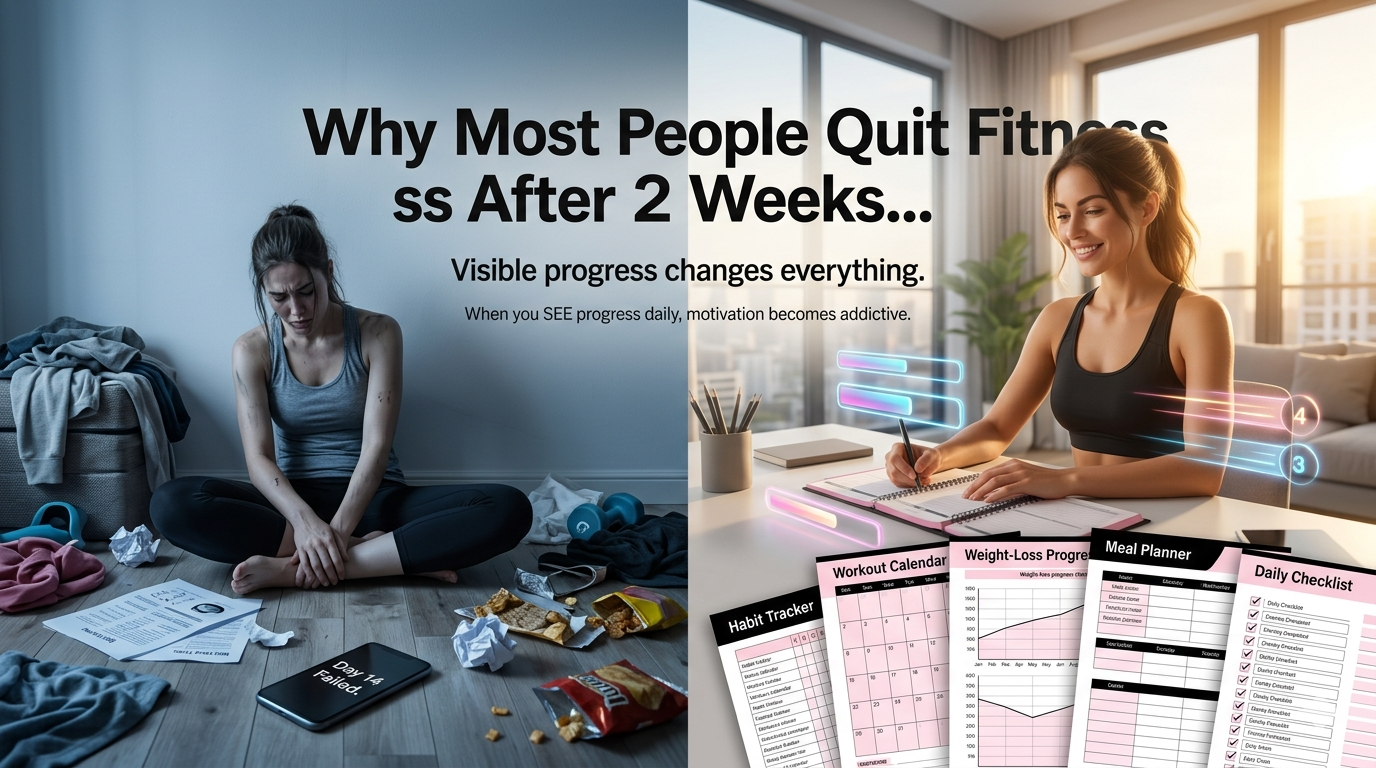
Why do most people quit fitness after 2 weeks? Learn the real reasons, plus a simple visible-progress system to stay consistent and finally stick with it.
By FitHealthyMind.com Editorial Team | Reading time: about 15 minutes
You start strong. You buy the workout clothes, plan the schedule, and complete the first few sessions with real energy. Then somewhere around week two, motivation fades, life gets busy, and the routine quietly disappears.
If that sounds familiar, you are not lazy and you are not alone. This is one of the most common patterns in fitness, and it has clear, fixable causes.
In this guide, you will learn why most people quit fitness after about two weeks, why seeing your progress changes everything, and a simple step-by-step system to stay consistent, even on tired, busy, or unmotivated days.
Quick answer: People quit fitness after two weeks because early motivation fades before results become visible, plans are too ambitious, and there is no system to track progress or recover from a missed day. The fix is to start smaller, track your progress in a visible way, plan for bad days, and focus on showing up rather than on perfection.
Table of Contents
- The Two-Week Wall: What Actually Happens
- 9 Real Reasons People Quit Fitness
- Why Visible Progress Changes Everything
- What to Track (Beyond the Scale)
- How to Build Your Visible Progress System
- The Minimum Viable Workout
- Your 4-Week Consistency Plan
- What to Do When You Miss a Day
- Habit Stacking and Environment Design
- Accountability That Actually Works
- Paper vs. Digital Trackers
- Common Mistakes That Lead to Quitting
- Frequently Asked Questions
- Final Thoughts
The Two-Week Wall: What Actually Happens
The first week of a new routine is usually fueled by excitement. You feel proud and determined, and the novelty keeps you going. By week two, several things happen at once:
- The novelty wears off.
- Soreness and fatigue show up.
- Your schedule gets tested by real life.
- You look in the mirror and see little visible change.
This combination creates what many people call the two-week wall. Effort is high, but rewards are still invisible. Without a way to see that you are improving, your brain starts asking a dangerous question: “Is this even working?”
The good news: the wall is predictable, which means you can plan for it.
9 Real Reasons People Quit Fitness
Track Your Daily Habits With Streakify AI
Stop guessing what works. Track your daily routines, build powerful streaks and stay consistent with a clean, modern habit tracker made for fitness, wellness and self-improvement.
- ✔ Editable HTML planner
- ✔ Printable and mobile friendly
- ✔ Instant digital download
- ✔ No subscription required
One-time purchase • Instant access
Want to see real progress? Track your daily habits and build streaks with Streakify AI, our premium habit tracker.
Download the Free Printable Habit Tracker
Start building healthy habits today. Print it, hang it up and tick off each day. No sign-up needed.
Want streaks, tracking and more? Try Streakify AI Premium.
1. They Start Too Big
Six workouts a week, strict diets, and one-hour sessions look impressive on paper, but they are hard to maintain. A plan that needs perfect conditions will collapse the first time life gets messy.
Fix: Start with a routine so small it feels almost too easy, such as 10 to 15 minutes, three days a week.
2. They Rely on Motivation Instead of Systems
Motivation is a feeling, and feelings change daily. People who stay consistent rarely rely on feeling inspired. They rely on routines, reminders, and habits that run on autopilot.
Fix: Decide when, where, and how you will exercise ahead of time, so you do not have to negotiate with yourself each morning.
3. They Cannot See Progress
True physical changes such as strength, endurance, and body composition take weeks to appear. If the only thing you measure is the scale or the mirror, you may feel like nothing is happening, even when you are improving.
Fix: Track multiple types of progress, including workouts completed, repetitions, energy, sleep, and mood. More on this below.
4. They Expect Fast Results
Social media is full of dramatic transformations that hide how long they took. When your results do not match the highlight reel, it is easy to feel discouraged.
Fix: Judge yourself against your own starting point, not against other people.
5. They Follow an All-or-Nothing Mindset
Missing one workout turns into “I already ruined the week,” and then into quitting completely. This is one of the biggest causes of dropping out.
Fix: Adopt a simple rule: never miss twice. One missed day is a pause, not a failure.
6. They Choose Exercise They Do Not Enjoy
If you dread every session, you will find reasons to skip. You do not have to run just because it is popular.
Fix: Choose movement you can tolerate or even enjoy, such as walking, dancing, cycling, strength training, swimming, or yoga.
7. They Do Not Plan for Obstacles
Travel, bad weather, illness, deadlines, and family events are normal. Without a backup plan, any disruption becomes an excuse.
Fix: Create a “bad day” version of your workout, such as five minutes of movement.
8. They Ignore Sleep, Food, and Stress
If you are exhausted, undernourished, or overwhelmed, exercise feels much harder. Poor recovery makes quitting more likely.
Fix: Treat sleep, balanced meals, hydration, and stress management as part of your fitness plan.
9. They Have No Feedback Loop
Without any record of what you did, you cannot see improvement, spot patterns, or feel proud of your effort. Your memory is unreliable, and it tends to remember what went wrong.
Fix: Keep a simple, visible record every day. This is the biggest lever of all.
Why Visible Progress Changes Everything
Here is the key idea: what you can see, you can keep doing.
Progress Feels Rewarding
Research on motivation and work, including the well-known idea of the “progress principle,” suggests that making visible progress on meaningful goals is one of the strongest drivers of motivation. Seeing small wins creates a sense of momentum, which makes you want to continue.
Streaks Create Momentum
A row of completed days on a calendar or tracker is a powerful visual cue. Many people find they do not want to “break the chain,” which gives them a reason to show up even on days when they do not feel like it.
It Turns Effort Into Evidence
On tough days, your brain may tell you that you never do anything consistently. A record of the last 14 days shows you the truth: you have been showing up. That evidence builds confidence and identity.
It Helps You Spot Patterns
Tracking can reveal helpful patterns, such as which times of day you actually work out, which days you tend to skip, and how sleep affects your energy. You can then adjust your plan intelligently instead of guessing.
It Shifts Your Identity
Every completed session is a vote for the type of person you are becoming: someone who moves regularly. The more votes you can see, the stronger that identity grows.
[CTA: Place the free printable habit tracker PDF box here (Box 3).]
What to Track (Beyond the Scale)
If the scale is your only measure of progress, you are setting yourself up for frustration. Weight can fluctuate daily because of water, food, sleep, and hormones. Track a mix of the following instead.
Behavior Metrics (Most Important at the Start)
- Workouts completed this week
- Total minutes of movement
- Daily steps
- Days in your current streak
Performance Metrics
- Number of squats, push-ups, or lunges you can do
- Plank hold time
- Walking or running distance and time
- Weight lifted, if you lift
How You Feel
- Energy level (1 to 10)
- Mood (1 to 10)
- Sleep quality
- Stiffness or soreness
Body Measurements (Monthly, Not Daily)
- Waist, hips, or other measurements
- Progress photos taken in the same light, position, and clothing
- How your clothes fit
Tip: In the first month, focus on behavior metrics. Showing up is the one thing fully in your control, and it creates every other result.
How to Build Your Visible Progress System
Follow these steps to create a simple system that keeps your progress in front of you.
Step 1: Pick One Clear Starting Goal
Choose a goal for the next 4 weeks that is about behavior, not appearance. For example: “Move for at least 15 minutes, four days a week.”
Step 2: Choose Your Tracking Tool
Pick one place to record everything: a wall calendar, a printable habit tracker, a notebook, or a digital habit tracker. The best tool is the one you will actually look at every day.
Step 3: Define What Counts
Write down exactly what earns a checkmark. A clear definition prevents you from arguing with yourself. For example: “15 minutes of any intentional movement counts.”
Step 4: Record It Right Away
Mark your tracker immediately after your workout. That small reward cements the habit.
Step 5: Review Weekly
Once a week, spend five minutes asking:
- How many sessions did I complete?
- What helped me succeed?
- What got in my way?
- What one small change will I make next week?
Step 6: Celebrate Small Wins
Celebrate completing a week, hitting a 7-day streak, or doing one more repetition. Choose non-food rewards such as a new playlist, a relaxing bath, or a new piece of workout gear.
Step 7: Keep Your Tracker Visible
Place your tracker where you see it daily: on the fridge, next to your bed, or as your phone home screen. Out of sight means out of mind.
The Minimum Viable Workout
One of the most effective strategies for consistency is having a minimum viable workout: a tiny version of your routine that you can do on your worst day.
Examples
- 5 minutes of stretching or mobility
- A 10-minute walk
- 1 round of squats, push-ups, and a plank
- 3 minutes of marching in place while the kettle boils
Why It Works
- It keeps your streak alive.
- It protects your identity as someone who exercises.
- It often turns into a longer session once you start.
- It removes the all-or-nothing trap.
Rule: On low-energy days, do the minimum. On normal days, do your regular session. On great days, do a little extra.
Your 4-Week Consistency Plan
Use this plan to move past the two-week wall.
Week 1: Show Up
- Goal: 3 sessions of 10 to 15 minutes
- Focus: Just start. Do not worry about intensity.
- Tracking: Mark each completed day.
Week 2: Break Through the Wall
- Goal: 3 to 4 sessions of 15 to 20 minutes
- Focus: Expect lower motivation and soreness. Use your minimum workout if needed.
- Tracking: Add a 1 to 10 energy rating after each session.
Week 3: Build Momentum
- Goal: 4 sessions of 20 minutes
- Focus: Add a little challenge, such as an extra round or a few more repetitions.
- Tracking: Record one performance number, such as squats or walking time.
Week 4: Review and Level Up
- Goal: 4 sessions of 20 to 25 minutes
- Focus: Compare Week 4 to Week 1. Notice how your energy, strength, and confidence have changed.
- Tracking: Take progress notes and set your goal for the next month.
Remember: Research on habit formation suggests that the time to build a habit varies a lot from person to person, often taking weeks to months. Be patient and keep going.
What to Do When You Miss a Day
Missing a workout is normal. What matters is what you do next.
The “Never Miss Twice” Rule
If you skip one day, make it a priority to get back on track the very next day, even if only for five minutes. One missed day has very little impact, while two or more start forming a new habit of not exercising.
Skip the Guilt
Guilt drains energy and makes restarting harder. Treat a missed day as information. Ask what happened, adjust your plan, and move on.
Reschedule, Do Not Cancel
If your plan was derailed, move the workout to another slot that day or the following day.
Plan for Common Disruptions
- Travel: Do a 10-minute bodyweight routine in your room.
- Illness: Rest. Return slowly when you feel better, and consult a healthcare professional if needed.
- Busy week: Switch to your minimum workout.
- Low motivation: Commit to just 5 minutes. Starting is the hardest part.
Habit Stacking and Environment Design
Habit Stacking
Link your workout to something you already do every day. For example:
- After I brush my teeth in the morning, I will do 10 minutes of exercise.
- After I get home from work, I will change into workout clothes.
- After I pour my morning tea, I will stretch for 5 minutes.
Make It Easy
- Lay out your clothes the night before.
- Keep your mat or shoes visible.
- Prepare a short playlist.
- Keep workouts short and simple.
Make Skipping Harder
- Put your alarm across the room.
- Schedule your workout in your calendar.
- Tell someone your plan.
Make It Enjoyable
- Listen to music, a podcast, or an audiobook only during workouts.
- Exercise with a friend or family member.
- Try different activities until you find something you like.
Accountability That Actually Works
Share Your Goal
Tell a friend, family member, or online community about your goal. Even a simple weekly check-in can keep you on track.
Find a Workout Partner
A partner makes it harder to skip and easier to have fun. If you cannot meet in person, try a virtual check-in.
Post Your Progress
Share your streaks or weekly summary with a supportive group. Choose kind and encouraging communities, not ones that create pressure or comparison.
Use Your Tracker as a Coach
A daily tracker provides a quiet form of accountability. Seeing an empty box can nudge you to act, while a full row can encourage you to continue.
Paper vs. Digital Trackers
Both can work. Choose the format that fits your lifestyle.
| Feature | Paper or Printable | Digital |
|---|---|---|
| Visibility | Great on a wall or fridge | Always on your phone or computer |
| Setup | Print and start | Open and start |
| Streaks and stats | Count manually | Often automatic |
| Flexibility | Limited by space | Easy to edit |
| Portability | Stays at home | Goes wherever you go |
| Distraction level | Low | Can be higher if notifications are on |
Which Planner Is Best?
The right planner is the one you will use daily. For fitness consistency, look for these features:
- A simple daily check-in that takes less than a minute
- Clear streak tracking
- Space for a few notes or ratings, such as energy and mood
- A weekly or monthly overview so you can see the big picture
- A layout that does not feel overwhelming
[CTA: Place the Streakify AI Premium Habit Tracker box here (Box 1).]
If you prefer to start with a free option, try printing a simple habit tracker and placing it somewhere visible. If you want automatic streak tracking and a cleaner view of your progress, a digital tracker may suit you better.
Common Mistakes That Lead to Quitting
Changing Everything at Once
Trying to overhaul your diet, sleep, exercise, and schedule in the same week is overwhelming. Change one thing at a time.
Only Tracking the Scale
Weight is only one data point. Track behaviors and performance too.
Comparing Yourself With Others
You do not know how long they have been training or what their life looks like. Compare yourself with your own past.
Skipping Rest Days
Overtraining leads to fatigue and injury. Rest days are part of progress.
Punishing Yourself With Exercise
If you see workouts as a punishment for eating or missing a day, you will start to dislike them. Exercise should support your health, not penalize you.
Waiting for Motivation
Motivation often follows action. Start small, and the feeling frequently arrives afterward.
Not Adjusting the Plan
If your routine is not working, change it. The goal is not to follow a plan perfectly but to find one you can keep.
Ignoring Pain
Mild muscle soreness is normal. Sharp pain, dizziness, chest pain, or unusual shortness of breath are not. Stop and seek medical advice if these occur.
Frequently Asked Questions
Why do I quit working out after two weeks?
Most people quit because early excitement fades before visible results appear, their plan is too demanding, and they have no system for tracking progress or handling missed days. Starting smaller and tracking your habits can help you push past this point.
How long does it take to build an exercise habit?
It varies. A well-known study on habit formation found that the time needed ranged widely between people, with an average of around two months, though some took far less and others far longer. Focus on consistency rather than a specific number of days.
How can I stay motivated to exercise every day?
Do not rely on motivation alone. Use small goals, a visible tracker, habit stacking, and a minimum workout for hard days. Motivation often grows after you begin.
How do I stay consistent with working out?
Keep your workouts short, schedule them at the same time each day, track each session, plan for obstacles, and follow the never-miss-twice rule.
What should I track to see fitness progress?
Track workouts completed, minutes of movement, steps, performance numbers like repetitions, and how you feel, including energy and mood. Add monthly measurements or photos if you want to see body changes.
Is it better to work out every day or a few days a week?
For most beginners, three to four days a week is a good start, with rest or light activity in between. Daily gentle movement is fine too if it feels good and you are recovering well.
How long should a beginner workout be?
Ten to thirty minutes is plenty. Even 5 to 10 minutes counts, especially at the start.
What if I have no motivation at all?
Use the 5-minute rule: commit to doing just five minutes. If you still want to stop afterward, you can. Most days you will continue.
Do habit trackers really work?
Many people find that seeing their streaks and progress makes them more likely to continue, because tracking provides feedback and a sense of achievement. Results vary, and a tracker works best when paired with realistic goals.
What is the best time to exercise?
The best time is the one you can stick with. Some people prefer mornings to avoid interruptions, while others prefer evenings. Choose a time that matches your energy and schedule.
How do I restart after a long break?
Begin with a gentle routine, much easier than you did before. Walk, stretch, and do light strength exercises for the first week or two, then build up gradually. Consult a healthcare provider if you have health concerns.
Can I lose weight without tracking?
Some people can, but tracking helps many people stay aware of habits and results. You do not need to track everything. Simple behavior tracking, such as workouts and daily steps, is a good place to start.
Should I take progress photos?
Progress photos can be motivating when taken monthly in consistent lighting and clothing. If photos make you uncomfortable or anxious, skip them and track performance and energy instead.
Why do I feel more tired when I start exercising?
A new routine can temporarily make you feel tired as your body adapts. Make sure you are sleeping enough, eating balanced meals, and staying hydrated. If fatigue is severe or lasts, speak with a healthcare professional.
Final Thoughts
Quitting after two weeks does not mean you lack discipline. It usually means your plan was too big, your progress was invisible, and you had no system to help you through the hard days.
The solution is simple and doable: start small, track your progress where you can see it, keep a minimum workout for tough days, and never miss twice. Over time, those small, visible wins build momentum, confidence, and a lasting habit.
Today, choose one small action. Do a 10-minute walk or a short stretch, mark it on your tracker, and repeat tomorrow. That is how a streak begins.
Ready to make your progress visible? Explore FitHealthyMind.com for simple workouts, habit trackers, and wellness guides that help you stay consistent.
Disclaimer: This article is for general educational purposes only and does not replace advice from a qualified healthcare professional. Consult your doctor before starting any new exercise program, especially if you have a medical condition, an injury, or are pregnant.